In today’s hyper-competitive tech market, AI resume screening isn’t a luxury. It’s a lifeline. When 87% of tech leaders report difficulty finding qualified engineers in areas like AI and cloud, manual CV reviews simply can’t keep pace. You tire after 200 CVs, introduce bias, and risk losing hidden gems, while competitors snap them up.
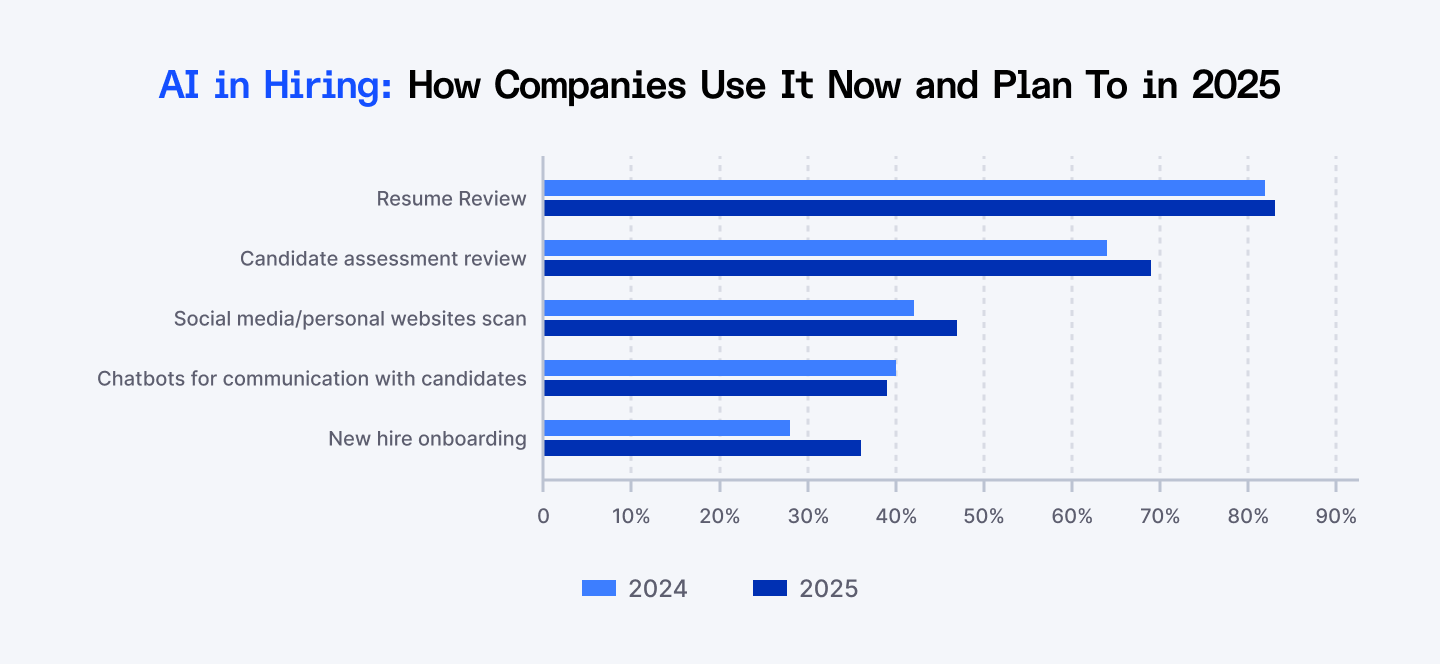
AI resume screening changes the game by cutting screening time from weeks to minutes, boosting match-accuracy to over 90%, and slashing hiring costs by more than 60%.
To help you understand how AI resume screening can transform your hiring process, we have put together this comprehensive guide that explores tools and strategies for scaling recruitment efficiently.
Skip the lengthy resume screening process by using Index.dev's AI-powered talent matching platform now.
Why Manual Screening Holds You Back
Manual resume review may work for small teams, but it breaks down at scale due to:
Scale Breakdown
- Humans fatigue after ~200 resumes.
- Hand-review accuracy hovers around 60%.
Inconsistent Decisions
- Same recruiter rates the same CV differently 41% of the time.
- Variable moods and workloads skew outcomes.
Hidden Bias
- Unconscious preferences for certain universities or backgrounds.
- Legal and diversity risks mount over time.
How AI Resume Screening Works
We’ve moved past the days of keyword matches. The existing AI relies on sophisticated Natural Language Processing (NLP) to interpret meaning and context.
Here’s our four-step engine:
- Data Aggregation
- The engine ingests every relevant signal. It pulls GitHub commits, Kaggle rankings, certifications, open-source contributions, and more.
- The engine ingests every relevant signal. It pulls GitHub commits, Kaggle rankings, certifications, open-source contributions, and more.
- Deep NLP & Skill Mapping
- Our system understands that “K8s” becomes “Kubernetes”, spots transferable skills (React → Vue), and builds a skill-graph to reveal unexpected fits.
- Our system understands that “K8s” becomes “Kubernetes”, spots transferable skills (React → Vue), and builds a skill-graph to reveal unexpected fits.
- Fast, Consistent Filtering
- AI processes up to 5,000+ resumes in under ten minutes, with 92% matching accuracy and under 3% decision variance, whether you screen 100 or 10,000 CVs.
- AI processes up to 5,000+ resumes in under ten minutes, with 92% matching accuracy and under 3% decision variance, whether you screen 100 or 10,000 CVs.
- Human-in-the-Loop
- AI performs first-pass filtering; your team handles cultural-fit and leadership evaluations. This partnership drives speed without sacrificing judgment.
- AI performs first-pass filtering; your team handles cultural-fit and leadership evaluations. This partnership drives speed without sacrificing judgment.
Tit-Bit: Some systems even use Graph Neural Networks to build smart skill maps, connecting abilities, spotting non-obvious talent fits and mapping career progression paths. An example would be a person with a retail management background becoming a good candidate for customer support because of common people skills.
Core Benefits
1. Speed and Accuracy at a Glance
The performance gap between AI and hand screening is staggering. Here's what the figures indicate:
Metric | AI Screening | Manual Review |
| Match Accuracy | 92% | 60% (avg.) |
| Decision Consistency | 97% same result | 59% same result |
| Time-to-screen per CV | 5,000+ CVs in 10 min (~0.06 mins per CV) | ~200 CVs before fatigue (~3 mins per CV) |
| Cost per hire | ~ $2.3K | ~ $6.2K |
| Bad-hire rate | Lower (23%) | High (40%) |
As you can see from the data, firms that employ AI experience remarkably improved hiring results. New hires are employed for longer periods than those recruited through manual filtering. When someone leaves within six months, you lose their salary plus training costs.
This indicates that AI gets people better matched into jobs and cuts down this costly issue to a great extent.
2. Cost and ROI Analysis: AI vs Manual Hiring
The benefits are obvious when you consider the complete picture:
Cost Factor | Manual Screening | AI Screening |
| Setup Investment | $20-30 K | $820 K+ |
| Cost per Hire | $2.3 K | $6.2 K |
| Bad-Hire Rate | 23% lower | 40% higher |
| Scale Impact | Flat-fee growth | Linear increase |
For a firm that employs 100 engineers every year, AI screening saves more than 80% in one year alone. The savings grow larger as hiring volume increases. Index.dev has helped clients reduce their cost per hire by more than 60% using these approaches.
3. Reducing Bias in Hiring
AI removes personal identifiers—age, gender, university—letting skills shine. Independent studies show anonymized AI screening drives a 35% uptick in diverse hires. However, AI learns from history so it’s imperative that companies regularly test systems and adjust to ensure fair outcomes.
To keep it fair, we recommend:
- Anonymize: Strip names, universities, dates.
- Audit Monthly: Test with varied-demo CV sets.
- Review Quarterly: Compare hires by demographic group.
- Document Rejections: Log criteria transparently for every declined candidate.
- Calibrate Annually: Match AI flags against top-performers’ profiles.
By following these five steps, you turn bias-risk into bias-control; ensuring consistent, fair outcomes every screening.
AI Tools You Can Use: Technical Evaluation Matrix
Tool | Core Technology | Best For | Code Assessment | Technical Analysis | Bias Control | Integration | Pricing |
| Eightfold | Deep learning + skill ontology graphs | Large-scale skills inference across diverse technical roles | Limited | Skills inference and career pathing | Demographic redaction | Workday, Oracle HCM | Custom (~$50K+ annually) |
| HireVue | Video NLP + coding simulators | Tech behavioural screening | Java/Python tests | Eye-tracking analysis for video interviews | Behavioural pattern analysis | Greenhouse, SAP SuccessFactors | $35K/year |
| Paradox (Olivia) | Conversational AI + calendar automation | High-volume hiring automation | None | Automated scheduling and initial screening | Anonymised chat interactions | Taleo, ADP | $1K/month |
| Codility | Code runtime analysis + plagiarism detection | Technical coding evaluation | 30+ languages with real-time execution | Blind scoring system | Anti-cheating algorithms | Lever, Ashby, custom APIs | $5K/year |
| Skillate | Multi-format NLP + ATS synchronisation | Resume parsing and data extraction | Basic technical keyword matching | Resume format standardisation | GDPR-compliant data handling | Zoho, Bullhorn | $15/user monthly |
| Greenhouse | GPT-4 + predictive analytics | GenAI job descriptions and candidate matching | Via HackerRank integration | Predictive hiring analytics | Inclusive language scoring | 300+ integrations via API | $7K/year |
| SeekOut | Semantic search + diversity filters | Niche tech sourcing and passive candidates | GitHub activity scanning | Code contribution analysis and academic paper parsing | Veteran/DEI tagging capabilities | MS Teams, Slack, custom integrations | $10K/year |
| Vervoe | Adaptive assessments + "How Model" tracking | Skills-based testing and simulation | Custom technical simulations | Real-world problem solving scenarios | Anonymous grading system | Custom API integrations | $540/month |
| Phenom | Chatbot + internal mobility AI | Talent marketplace and employee experience | Limited technical assessment | Internal skill mapping and career progression | Equity analytics and bias monitoring | SAP SuccessFactors | Custom enterprise pricing |
| Textio | Augmented writing + bias detection | Job description optimisation | None | Language impact analysis | Tone/bias scoring for job posts | Workday, Greenhouse | Custom pricing |
| HackerRank | Auto-grading + cheat detection | Comprehensive coding challenges | 35+ languages with plagiarism detection | Proctoring alerts and environment monitoring | Skill-based blind evaluation | ADP, BambooHR, extensive APIs | $8K/year |
| Juicebox | PeopleGPT + Boolean replacement | Passive candidate search and research | GitHub/academic paper parsing | Repository analysis and publication tracking | None specified | Gmail, Outlook | $79/month per user |
Index.dev usually suggests beginning with solutions that play nicely with the current infrastructure. This minimises implementation complexity as well as user training needs.
Explore 17 AI recruiting tools that make finding software engineers easier.
Implementation Strategy
Deploying AI resume screening needs to be planned carefully. Businesses must begin small and roll out slowly.
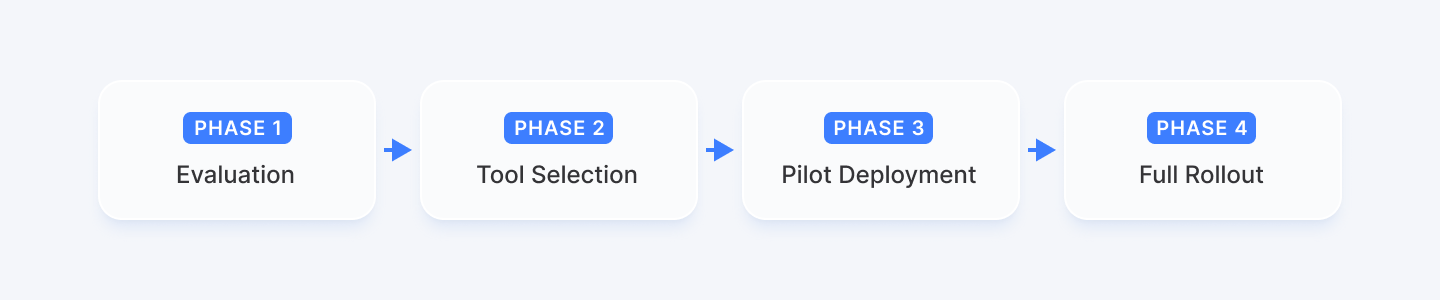
Phase 1: Evaluation
Start by measuring your existing hiring process. Monitor how long it takes to screen for various jobs. Understand which jobs get the most candidates applying. These are the high-volume jobs that are the ideal ones to begin deploying AI on.
Phase 2: Tool Selection
Choose tools based on your specific needs:
- High-volume recruitment: Go for volume and speed
- Technical roles: Emphasise coding assessment features
- Diversity goals: Focus on features aimed at minimising bias
- Budget constraints: Consider the cost of hire and set-up fees
Phase 3: Pilot Deployment
Begin with one or two job categories. Perform parallel AI screening of manual review initially. Compare the results to ensure quality requirements are met. Adjust settings if problems are encountered.
Phase 4: Full Rollout
Roll out to more roles once you are comfortable with the system. Train hiring teams on new procedures. Establish monitoring to catch problems early.
Human-AI Partnership and Governance
AI works best in conjunction with human judgment, rather than replacing it. The technology excels at first-pass filtering and skills matching. People remain best suited for sophisticated decisions of cultural fit and leadership potential.
Smart companies define clear handoffs:
- AI does first-pass filtering and glaring mismatches
- People review tough calls and make final decisions
- Both work on senior roles and cultural fit
This collaborative model gives you speed without sacrificing the human touch that depends on high-stakes hires.
Measuring Success and Common Pitfalls
Monitor these critical metrics and obstacles to measure your AI resume screening success:
What to Measure | Pitfalls & Mitigations |
| Time-to-Hire Reduction | Integration Delays: Plan 2-4 weeks for ATS/API setup. |
| Cost-per-Hire Savings | Cost Rationalization: Include bad-hire fallout in ROI. |
| Quality of Hire (ratings, retention) | Quality Concerns: Pilot on low-risk roles first. |
| Hiring Manager Satisfaction | Team Resistance: Show how AI frees them for strategic work. |
| Candidate Experience Scores | Bias Drift: Run monthly bias audits and quarterly reviews. |
Firms can reach 60-80% less time spent screening during the first month. Financial savings begin to appear after hiring 20-30 candidates through the new process. Quality improvements take 6-12 months to measure properly through performance data.
The Future of AI in Hiring
AI resume screening will continue to improve significantly. As hiring technologies evolve, platforms like CVMaker are also helping job seekers create more optimized and professional resumes that align better with modern AI-driven recruitment systems.
New innovations are:
- Soft-Skill Scoring:
- AI will flag collaboration and leadership traits from language patterns. This will help recruiters to better understand soft skills and personality traits.
- AI will flag collaboration and leadership traits from language patterns. This will help recruiters to better understand soft skills and personality traits.
- Network Pulse:
- Surface passive candidates by analyzing social and developer-community signals.
- Surface passive candidates by analyzing social and developer-community signals.
- Retention Forecasts:
- Predict who’ll stay long term before you make an offer.
- Predict who’ll stay long term before you make an offer.
- Live Market Sync:
- Auto-update salary and skill trends in real time.
Index.dev’s cloud-native pilots already forecast candidate acceptance rates and deliver enterprise-grade screening.
This technology will also become more accessible to smaller companies which will level the playing field between large and small employers.
Conclusion
AI resume screening turns hiring from a time-suck into a strategic edge: screen faster, hire smarter, and cut costs by up to 80%. With clear metrics, bias controls, and a human-AI partnership, you can transform every stage of recruitment.
Success depends on thoughtful implementation, clear goals, the right tools and human oversight. For growing companies, the real question is how soon they can adopt it effectively to stay ahead in the talent race.
Ready to implement AI resume screening with expert guidance? Explore Index.dev's AI-vetted developer network and automated hiring solutions.