Picking a framework today isn’t just about making your server work anymore. It’s about picking the right tool that will carry your app through crazy traffic spikes, real-time data floods, and tomorrow’s surprise feature requests.
So here’s what I’m doing: I’m ranking the top 12 backend frameworks that are dominating 2026.
We've got frameworks that can handle millions of requests per second, others that let you build APIs in minutes, and some that are so developer-friendly they practically code themselves.
Here’s the game plan:
| How I’ll judge them | What it really means for you |
| Performance | Raw speed under load |
| Scalability | How painless it is to add users, servers, and features |
| Ease of Use | How fast you go from idea to launch |
| Security | Built‑in armor against the nasty stuff |
| Community & Ecosystem | Docs, plugins, tutorials, and folks who’ll answer your Stack Overflow cry for help |
Each framework gets a 1‑to‑10 score, then I roll them up into a straight‑shooting overall rating, lowest to highest.
Ready to see who tops the charts?
Let’s jump in.
Ready to build fast with the best? Join Index.dev and work with global companies using top backend frameworks. Remote, high-paying, long-term jobs await.
12. Phoenix (Elixir)
Real-time, fault-tolerant, and scalable web framework built on the Erlang VM
Phoenix is the go-to framework when you need to push data to users fast and often, think chat apps, multiplayer games, or anything with live updates. It’s built on Elixir, which runs on the super-stable Erlang VM (BEAM), the same tech powering telecom systems that can’t afford to go down.
Chris McCord, the guy behind Phoenix, wanted something like Rails but way more scalable. So he ditched the object-oriented approach and built Phoenix with a functional mindset, which gives you cleaner code and better performance, but might feel weird at first if you're used to OOP.
Best Suited For
- Real-time apps such as chat platforms or multiplayer games
- Trading platforms that need live data updates
- IoT systems requiring high concurrency
- Collaborative editors and live dashboards
Ideal for Projects Where
- You need to handle many users or connections at the same time (high concurrency)
- You're building something interactive and live
- Reliability and fault-tolerance can’t be compromised
The Good and The Not-So-Good
The Good
- Excellent real-time capabilities with WebSocket support
- Highly scalable thanks to the Erlang VM’s lightweight processes
- Strong built-in security features (XSS and CSRF protection)
- Fault-tolerant and reliable under heavy load
The Not-So-Good
- Functional programming style can be tough to learn for newcomers
- Smaller community and fewer learning resources compared to older frameworks
- Debugging can be tricky if you’re not familiar with Elixir
Phoenix Rating
| Category | Score (/10) |
| Performance | 9 |
| Scalability | 9 |
| Ease of Use | 6 |
| Security | 9 |
| Community & Ecosystem | 5 |
| Overall Score | 7.6 / 10 |
Phoenix may not be beginner-friendly, but if you’re chasing real-time performance at scale, and you don’t mind learning a new mindset, this one punches way above its weight.
11. Koa (JavaScript / Node.js)
Lightweight, modern, and expressive middleware framework for Node.js
Koa is a minimalist Node.js framework created by the same team behind Express.js but designed to be even more lightweight and modern. It embraces async/await from the ground up, making asynchronous code cleaner and easier to write.
Koa doesn’t come with any middleware by default, giving you full freedom to pick exactly what you need. This makes it perfect for developers who want a flexible, modular foundation without the bloat. It’s great for building APIs and microservices where you want control over every part of the stack.
Best Suited For
- RESTful APIs and microservices
- Projects requiring modern async code with clean middleware
- Developers who want flexibility without the constraints of a full framework
Ideal for Projects Where
- You want a minimal core with full control over middleware
- You prefer writing clean, async/await-based JavaScript
- You’re building scalable, modular backend services
The Good and The Not-So-Good
The Good
- Modern async/await support for clean asynchronous code
- Minimalist core with no middleware included by default
- Better control flow and error handling
- Good performance with low overhead
The Not-So-Good
- Requires more setup and middleware choices than Express
- Smaller community and ecosystem compared to Express
- Not beginner-friendly due to lack of built-in features
KOA Rating
| Category | Score (/10) |
| Performance | 8.5 |
| Scalability | 8 |
| Ease of Use | 7 |
| Security | 7.5 |
| Community & Ecosystem | 6.5 |
| Overall Score | 7.7 / 10 |
Koa is a great fit if you want a modern, lightweight Node.js framework that lets you build exactly what you need without extra baggage. It’s perfect for developers comfortable with async code.
10. Flask (Python)
Minimal, flexible, and lets you build your way
Flask is a lightweight Python microframework that keeps things simple and lets you decide how to build your app. Unlike heavy “batteries-included” frameworks, Flask gives you a barebones core and lets you pick the tools you want from Python’s huge ecosystem.
This makes it super flexible and easy to start with, especially if you like control and want to avoid unnecessary features. It’s great for APIs, small web apps, or even serving machine learning models. But don’t let the simplicity fool you: Flask can scale up for more serious projects when paired with the right tools.
Best Suited For
- APIs for mobile or web apps
- Small to medium web applications or personal projects
- Serving AI/ML models via REST APIs
- Prototypes, MVPs, and small-to-medium web apps
Ideal for Projects Where
- You want a simple, minimal setup to get started fast
- You need full flexibility to choose your own libraries and tools
- You’re building microservices or lightweight APIs
The Good and The Not-So-Good
The Good
- Easy to learn and quick to set up
- Highly flexible and modular, add only what you need
- Large ecosystem of extensions and libraries (Flask-Login, Flask-SQLAlchemy, etc.)
- Strong community support, extensive documentation, and tutorials for beginners
The Not-So-Good
- Missing built-in features (auth, ORM, admin) can slow you down if you're not experienced
- Security is partly your responsibility (Flask gives you the tools, but you do the work)
- Can get messy in large, complex projects without careful architecture
Flask Rating
| Category | Score (/10) |
| Performance | 7.5 |
| Scalability | 6.5 |
| Ease of Use | 8.5 |
| Security | 7.5 |
| Community & Ecosystem | 8.5 |
| Overall Score | 7.7 / 10 |
Do you want to build an API, a web app, or serve a machine learning model? Cool, Flask’s in. Just don’t expect it to hold your hand.
9. FastAPI (Python)
Ridiculously fast, modern, and built for high-performance APIs
FastAPI is one of the fastest Python frameworks out there, designed to build APIs that handle tons of requests simultaneously. It leverages Python’s modern async/await syntax and type hints to deliver speed, automatic data validation, and clean, maintainable code. Plus, it auto-generates interactive API docs (Swagger UI and ReDoc) so you can test and share your APIs effortlessly.
It's built on top of Starlette for performance and Pydantic which means you get enterprise-level features without the enterprise-level complexity and runs at speeds that rival Node.js and Go frameworks.
Best Suited For
- AI and ML APIs that serve models or run inference
- High-performance RESTful APIs
- Fintech, health-tech, or any industry needing fast, validated data handling
- IoT platforms or apps that rely on real-time data processing
Ideal for Projects Where
- Speed and handling many concurrent requests matter
- You want built-in data validation and type safety to avoid bugs
- You’re building data-intensive or AI-powered services that need to scale
The Good and The Not-So-Good
The Good
- Extremely fast, comparable to Node.js and Go thanks to async support
- Automatic API documentation saves tons of time
- Built-in data validation with Pydantic reduces runtime errors
- Asynchronous design handles high concurrency smoothly
- Strong security features with OAuth2, JWT, and password hashing out of the box
The Not-So-Good
- Newer than Flask/Django – smaller community (but growing fast!)
- Debugging async code can be a pain
- Less beginner-friendly if you're not used to type annotations or async concepts
FastAPI Rating
| Category | Score (/10) |
| Performance | 9 |
| Scalability | 8 |
| Ease of Use | 7.5 |
| Security | 7.5 |
| Community & Ecosystem | 7.0 |
| Overall Score | 7.8 / 10 |
FastAPI is your go-to if you want to build lightning-fast, reliable APIs that can handle real-time data and lots of users without slowing down. Its modern Python features and automatic docs make development smooth and efficient. It’s especially killer for AI, fintech, or any project where speed and data validation are non-negotiable.
Also Read: Backend API vs. Frontend API: Understanding the Core Differences
8. Gin (Go)
Lightning-fast, minimalist web framework built for high-performance Go apps
Gin is a web framework built on Go, and it’s all about performance, performance, performance. If your app needs to handle a massive number of requests with minimal latency, Gin is your go-to choice.
It’s incredibly lightweight but doesn’t skimp on essentials. With an optimized HTTP router, Gin handles routing blazingly fast, which makes it a solid pick for high-traffic APIs, real-time systems, and microservices.
Best Suited For
- High-performance APIs where every millisecond counts
- Microservices that need to be lightweight and fast
- Real-time applications (e.g., messaging systems, analytics dashboards)
- Performance-critical backend services
Ideal for Projects Where
- Speed and low latency are top priorities
- You need to handle lots of concurrent connections
- You want something fast, secure, and easy to deploy in production
The Good and The Not-So-Good
The Good
- Among the fastest web frameworks in any language
- Robust middleware support for logging, authentication, etc.
- Built-in JSON validation and error management
- Easy route grouping for better API organization
- Great performance even under load
The Not-So-Good
- Minimalist design means fewer built-in features (more setup required)
- Go’s concurrency model (goroutines, channels) can be tricky for beginners
- Smaller ecosystem than some older frameworks, though growing steadily
Gin Rating
| Category | Score (/10) |
| Performance | 10 |
| Scalability | 9 |
| Ease of Use | 7 |
| Security | 6 |
| Community & Ecosystem | 7 |
| Overall Score | 7.8 / 10 |
Gin is Go’s answer to high-speed web development. Sleek, efficient, and powerful right out of the box. Just be ready to handle some of the setup yourself and dive into Go’s concurrency model to get the most out of it.
7. Laravel (PHP)
Elegant, feature-rich PHP framework that makes web development efficient
Laravel is PHP’s modern comeback story – a full-featured web framework that brings joy to web development with its elegant syntax, robust toolkit, and thriving community.
Designed with developer happiness in mind, Laravel turns building web apps into a smoother, more expressive process. Whether you’re crafting a small blog or an enterprise-grade platform, Laravel gives you the power and polish to move fast.
Best Suited For
- Custom CRMs and internal tools
- E-commerce platforms with carts, accounts, and admin dashboards
- Booking systems for events, hotels, or services
- Content-rich sites like blogs, portfolios, or CMSs
Ideal for Projects Where
- You want to build quickly with clean, easy-to-understand code
- You prefer PHP and want access to tons of community packages
- You want a smooth integration between backend logic and beautiful UI (using Laravel Blade templating)
The Good and The Not-So-Good
The Good
- Simple, expressive syntax that’s easy to pick up
- Artisan CLI and Laravel Mix simplify workflow and frontend build processes
- Built-in tools for routing, caching, sessions, queues, authentication, and more
- Strong security features like CSRF protection and encryption
- Large community with tons of tutorials, packages, and support
The Not-So-Good
- Can hide complexity, making debugging tricky for beginners
- Not the fastest framework compared to more minimal or compiled options
- Overhead might be too much for ultra-light apps or microservices
Laravel Rating
| Category | Score (/10) |
| Performance | 6 |
| Scalability | 7 |
| Ease of Use | 9 |
| Security | 8 |
| Community & Ecosystem | 10 |
| Overall Score | 8.0 / 10 |
Laravel proves that PHP is alive. With its polished DX, extensive features, and supportive ecosystem, Laravel makes modern PHP development efficient and effective.
6. NestJS (JavaScript/TypeScript)
The backend framework that brings structure to the chaos of JavaScript
NestJS brings Angular's organizational principles to the backend world. It works on top of Express and offers powerful tools like decorators and a CLI to speed up development. It's also TypeScript-first, which means you get type safety, better IDE support, and fewer "undefined is not a function" surprises.
While its strict structure might feel heavy if you prefer flexibility, it pays off with easier scaling and better organization.
Best Suited For
- Enterprise SaaS platforms and complex business apps
- Microservice-based architectures
- Real-time collaboration tools (chat, whiteboards, document editors)
- Fintech and secure multi-user platforms
Ideal for Projects Where
- You want Angular-like structure but on the backend
- You prefer TypeScript-first development
- You’re building modular, scalable apps that can grow over time
The Good and The Not-So-Good
The Good
- Strong TypeScript support with type safety and decorators
- Modular design keeps code organized and reusable
- Built-in tools for routing, middleware, guards, interceptors, and WebSockets
- Robust CLI, testing, and documentation tools
- Inspired by Angular (feels familiar to frontend devs transitioning to the backend
The Not-So-Good
- Steeper learning curve due to strict architecture and decorators
- Node.js performance may not match Go or Rust in compute-intensive apps
- Decorators and dependency injection may seem complex at first
Nest.js Rating
| Category | Score (/10) |
| Performance | 8.50 |
| Scalability | 8.50 |
| Ease of Use | 7.5 |
| Security | 8 |
| Community & Ecosystem | 8 |
| Overall Score | 8.1 / 10 |
NestJS is what you get when you combine Angular’s structure with Node’s flexibility. Perfect for teams that value clean architecture, type safety, and scalability.
5. Ruby on Rails (Ruby)
Developer-friendly, full-stack framework focused on fast development
Ruby on Rails, often simply called Rails, is a legendary web development framework built on Ruby. It follows the Model-View-Controller (MVC) pattern, which keeps your code organized and easy to maintain. Its powerful ORM, ActiveRecord, simplifies database work, and built-in generators speed up development.
While it might not be the absolute fastest framework, Rails balances speed with developer experience and scalability. It also embraces modern front-end trends with integrations for React, Vue, and its own Hotwire for dynamic UIs.
Best Suited For
- MVPs and startup launches with fast time-to-market
- Marketplaces like Airbnb or Esty
- Internal tools and collaboration apps like Basecamp
- E-learning platforms, job boards, and SaaS dashboards
Ideal for Projects Where
- You want to build fast and focus on product features
- You prefer opinionated frameworks that handle the heavy lifting
- You value strong testing support and convention-driven development
The Good and The Not-So-Good
The Good
- Embraces convention over configuration, so developers write less boilerplate code
- Built-in tooling for testing, scaffolding, routing, and security
- Mature ecosystem with great libraries and community support
- Built-in testing framework to keep code stable
- Proven scalability for many high-traffic apps
The Not-So-Good
- Not the fastest runtime for high-performance apps
- Scaling requires careful architecture and optimization
- Conventions may feel restrictive to developers who prefer customization
Ruby on Rails Rating
| Category | Score (/10) |
| Performance | 8 |
| Scalability | 8.50 |
| Ease of Use | 10 |
| Security | 8 |
| Community & Ecosystem | 8 |
| Overall Score | 8.5 / 10 |
Rails remains one of the best choices for teams that want to move fast, ship often, and enjoy the process. If your project values speed, simplicity, and community, Ruby on Rails delivers a development experience that’s hard to match.
4. Express.js (Javascript)
Fast, unopinionated, minimalist web framework for Node.js
Express.js is the go-to lightweight framework for Node.js that gives you full control without forcing any structure. It provides just the essentials to build web apps, APIs, or microservices, letting you pick your own libraries and organize your code your way.
This minimalism means less overhead and great performance, making Express a favorite for developers who want speed and flexibility. Its huge community offers tons of middleware and resources, so you’re never stuck.
Best Suited For
- RESTful APIs and microservices architectures
- SPAs (Single Page Applications) with React or Vue
- Real-time chat apps using WebSockets
- E-commerce systems, dashboards, or booking engines
Ideal for Projects Where
- You need maximum control over your app structure
- You’re using JavaScript on both frontend and backend
- Speed, modularity, and performance are key
The Good and The Not-So-Good
The Good
- Minimal and unopinionated, so you control architecture
- Lightweight with minimal overhead for fast responses
- Massive ecosystem with tons of middleware and plugins
- Easy to learn and quick to prototype with
- Strong community support and lots of tutorials
The Not-So-Good
- Lack of enforced structure can cause inconsistent code
- Security and testing need to be handled explicitly by developers
- Can grow in complexity quickly as the project scales
Express.js Rating
| Category | Score (/10) |
| Performance | 8.75 |
| Scalability | 7.5 |
| Ease of Use | 10 |
| Security | 7.5 |
| Community & Ecosystem | 10 |
| Overall Score | 8.75 / 10 |
If you want flexibility and don't mind taking responsibility for your architecture choices, Express is hard to beat.
3. Spring Boot (Java)
Enterprise-grade power with minimal configuration
Spring Boot is a top choice for building robust, scalable Java applications with minimal friction. What sets it apart is its auto-configuration and opinionated defaults designed to eliminate boilerplate and reduce setup time. Developers can get started quickly and focus on business logic while Spring handles the infrastructure setup in the background.
It’s part of the broader Spring ecosystem and is widely used for building enterprise-level software that demands performance, security, and flexibility, including complex scenarios such as Dynamics 365 integration and other line-of-business systems.
Best Suited For
- Banking systems and secure fintech platforms
- Large SaaS and ERP platforms
- Corporate applications that require reliability and uptime
- Microservices architectures with heavy business logic
Ideal for Projects Where
- You prioritize performance, scalability, and security
- You’re working in corporate or enterprise environments
- You're already in a Java ecosystem or Spring stack
- Your team is familiar with object-oriented design and dependency injection
The Good and The Not-So-Good
The Good
- Auto-configuration speeds up development and reduces boilerplate
- Excellent performance and scalability for demanding workloads
- Strong support for microservices and cloud-native deployments
- Seamless integration with Spring ecosystem: Security, Data, Batch, Cloud, etc.
- Large, active community and enterprise backing
The Not-So-Good
- Steeper learning curve, especially if new to Java or Spring
- Complex projects require good understanding of architecture
- Can be heavyweight for small or simple apps
Spring Boot Rating
| Category | Score (/10) |
| Performance | 10 |
| Scalability | 10 |
| Ease of Use | 7.5 |
| Security | 8.50 |
| Community & Ecosystem | 10 |
| Overall Score | 9 / 10 |
Spring Boot is your go-to if you want a battle-tested, enterprise-ready Java framework that handles everything from microservices to cloud deployments with ease. Just be ready to invest time learning the Spring ecosystem to unlock its full power.
2. ASP.NET Core (C#)
High-performance, cross-platform, and enterprise-ready
ASP.NET Core is a powerful, flexible framework designed for building fast, scalable web applications and APIs. It shines with excellent performance, thanks to its optimized design and the robust .NET platform. It runs smoothly on Windows, macOS, and Linux, giving you freedom in deployment.
ASP.NET Core supports modular development, letting you pick only the components you need. It has strong built-in security features and integrates tightly with Microsoft tools like Azure, making it a top choice for enterprise and cloud-based projects. While it might be a bit tougher to learn than some frameworks, its performance and ecosystem make it worth the effort.
Best Suited For
- Government and enterprise portals
- Business intelligence, reporting tools, and dashboards
- Cloud-native applications, especially on Azure
- Internal corporate tools with complex user roles and authentication
Ideal for Projects Where
- You require strong type safety and structured development
- Your environment revolves around Windows or Microsoft stack
- Building large-scale, maintainable enterprise systems is a priority
The Good and The Not-So-Good
The Good
- Exceptional performance and scalability for high-traffic apps
- Cross-platform support (Windows, macOS, Linux)
- Rich ecosystem with excellent tooling (Visual Studio, Azure integration)
- Strong security features to guard against web threats
- Large community and a vast Stack Overflow presence
The Not-So-Good
- Steeper learning curve for beginners or those new to C#/.NET
- Best experience when paired with Microsoft ecosystem tools
- Can be heavyweight for small or simple projects
ASP.NET Core Rating
| Category | Score (/10) |
| Performance | 10 |
| Scalability | 10 |
| Ease of Use | 8.50 |
| Security | 10 |
| Community & Ecosystem | 8 |
| Overall Score | 9.3 / 10 |
If you want a blazing-fast, secure, and scalable backend framework that works across platforms and integrates perfectly with Microsoft tools, ASP.NET Core is a top contender.
1. Django (Python)
Rapid web development with security and scalability built-in
Django is a high-level Python framework famous for its “out-of-the-box” approach. It comes packed with everything you need – ORM, authentication, templating, and more – so you can focus on building your app’s unique features.
Django scales well, prioritizes security, and speeds up development. Its “don’t repeat yourself” philosophy ensures clean, maintainable code. While its comprehensive design can feel rigid and less flexible for microservices or highly custom architectures, Django’s ecosystem and community keep evolving, adding async support, better API tools, and modern front-end integrations.
Best Suited For
- Social networks and community platforms (e.g., Instagram-like apps)
- Content management systems (CMS), news portals, and blogs
- Educational platforms, such as online courses or e-learning sites
- Internal dashboards and admin panels for companies
Ideal for Projects Where
- You want to build fast with security baked in
- You need a scalable, reliable system
- You are working with Python and prefer strong community backing
The Good and The Not-So-Good
The Good
- Full-featured framework with many built-in tools
- Strong security protections against XSS, CSRF, SQL injection
- Excellent scalability for high-traffic apps
- Large, active community and rich ecosystem (Django REST Framework, Channels)
- Rapid development with clean, reusable code
The Not-So-Good
- Can be less flexible for microservices or highly customized architectures
- Some learning curve due to its “all-in-one” nature
- Can feel rigid if your project needs to deviate significantly from Django’s conventions
Django Rating
| Category | Score (/10) |
| Performance | 8.75 |
| Scalability | 10 |
| Ease of Use | 9 |
| Security | 9 |
| Community & Ecosystem | 10 |
| Overall Score | 9.35 / 10 |
Django remains a top choice for developers who want a secure, scalable, and mature framework that lets them build powerful web apps quickly. With ongoing improvements in async capabilities and API support, Django is evolving to meet modern development needs while staying true to its core strengths.
Read More: 10 Software Development Frameworks That Will Dominate
Final Thoughts
Every backend framework here brings something special.
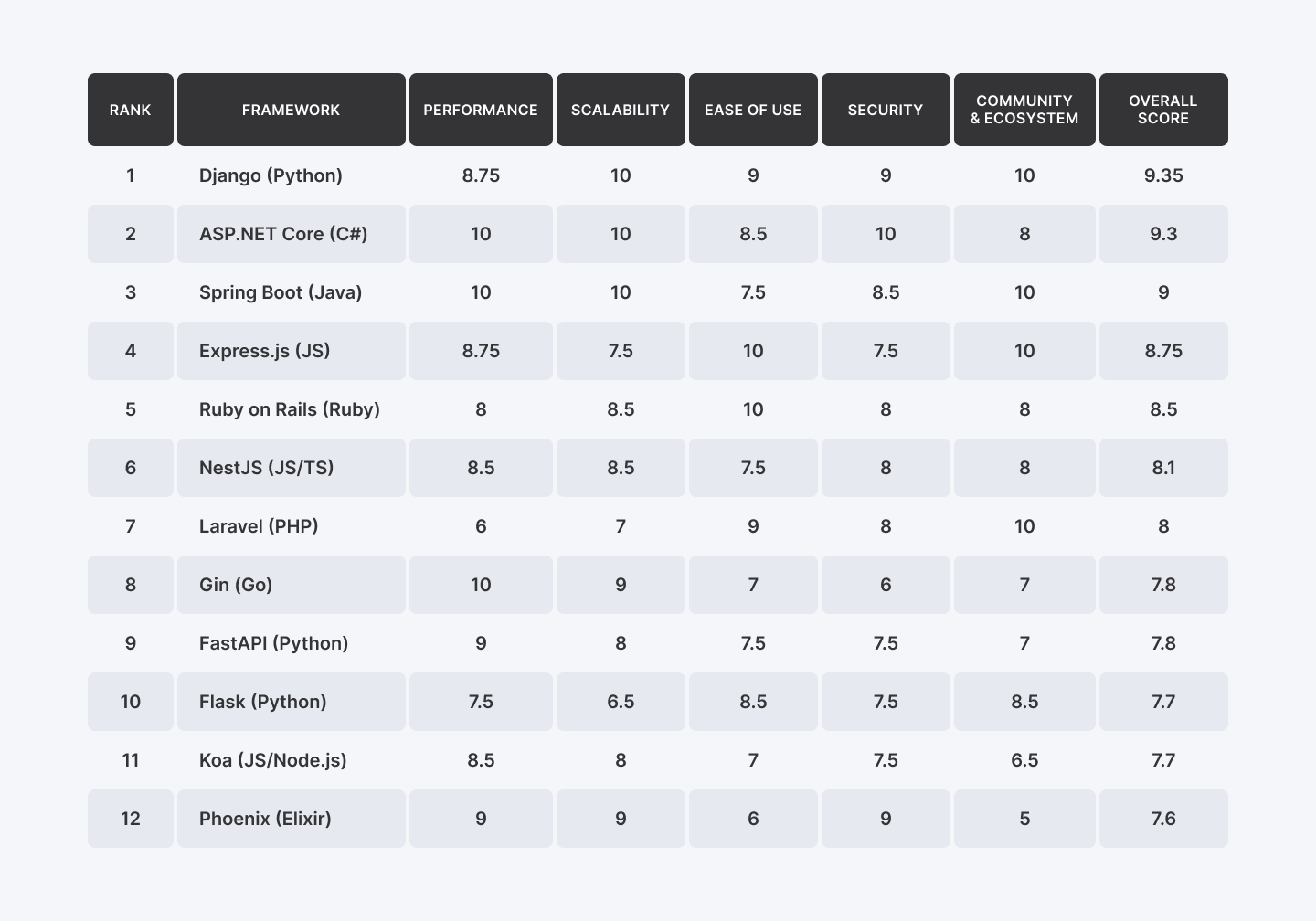
So, how do you pick?
- If you want to move fast and have a small team, go for Django, Laravel, or Flask. They get you up and running quickly.
- For big, serious enterprise apps where scale and stability matter, Spring Boot and ASP.NET Core are solid bets. They’re built for heavy lifting.
- Love JavaScript or TypeScript? Then Express, FastAPI, or NestJS will feel right at home. They’re modern, flexible, and fit perfectly if you want to keep your stack consistent.
- Need real-time features and bulletproof reliability? Phoenix is your go-to, thanks to its fault-tolerant Erlang foundation.
The key is matching your project’s needs with what each framework does best.
Don’t just pick the most popular or the fastest. Pick the one that fits your team and goals.
For Developers:
Ready to put your backend skills to work? Join Index.dev's talent network and get matched with companies building the next big thing with these cutting-edge frameworks.
For Clients:
Need devs who know Django, FastAPI, or Spring? Hire elite backend engineers in 48 hours with Index.dev. Vetted, remote-ready, and risk-free.