
The global remote-work boom has created fierce competition to find the best freelance developers at the best value.
Industry surveys and platform data consistently highlight a few standout talent hubs. India emerges as a perennial powerhouse, boasting millions of coders fluent in English at rock-bottom rates.
In Eastern Europe, Ukraine combines top-tier coding skills (HackerRank scores ~88.7%) with broad English fluency (~80%) and EU-friendly time zones.
Poland and Romania likewise punch above their weight, with world-class education systems and a high share of English-proficient graduates.
Other high-ranked countries include the Philippines (excellent English, extremely cost-effective), Brazil (large tech population, American-friendly time zone), and China (numerous top coders).
Our analysis draws on credible industry reports, developer surveys, and regional studies to guide HR and tech managers in global hiring decisions.
Below, we outline our ranking criteria and then profile each country.
Let’s dive in!
Hire elite freelance developers in 48 hours with Index.dev. Access pre-vetted global talent and start with a 30-day free trial.
Ranking Criteria
We scored each country on multiple dimensions relevant to hiring freelance developers:
Technical Skill & Education
How strong is the dev talent pool? We consulted global coding challenge data (e.g. HackerRank) and education statistics. For example, HackerRank’s Programming Olympics ranks countries by coding test scores where China, Russia and Poland top the list. Other tech-education benchmarks (Coursera’s Skills Index, number of STEM graduates) were also considered.
Cost-Effectiveness
Lower developer rates mean better value. We compared average salaries for software engineers: e.g. CodeSubmit finds Indian devs earn just $7.7K/year vs. ~$110K in the U.S. Similarly, the Philippines, Brazil and several Eastern European countries maintain mid-4-figure salaries, far below Western wages.
English Proficiency
Clear communication is critical. We used English-Proficiency surveys (e.g. EF EPI) and local reports. The Philippines and Romania lead in English skills, with over 90% fluent. Ukraine, Poland and Argentina also rank high in English, whereas China and Taiwan lag behind.
Time Zone & Cultural Fit
Overlap with US/EU work hours and business culture matters. Latin American countries (Brazil, Argentina) and Canada align nicely with US hours, while Eastern Europe (Poland, Romania, Czechia) overlaps well with EU time zones. Asian hubs can collaborate asynchronously or on night shifts.
Ease of Engagement & Legal Climate
We favor countries with stable legal frameworks for contractors. This includes clear IP laws and business regulations (e.g. Germany, Singapore, Canada rank high on “ease of doing business” indexes, though their cost is also high). Emerging markets sometimes pose more bureaucratic hurdles.
Freelance Talent Availability
Finally, we checked global freelancing platform data. Countries like India, Philippines, Ukraine and Bangladesh supply millions of freelancers on Upwork, Payoneer and Fiverr. This depth of talent (in web/mobile dev, cloud, etc.) ensures quick fulfillment of diverse project needs.
Combining these factors produces our ranked list of the ten best countries to hire freelance developers today.
Read More: Top 7 Websites to Hire Web Developers in 2025
1. India
India’s unparalleled developer pool and low costs make it a top choice. Western companies have long tapped India’s vast tech talent: roughly 44 million developers live in India (per SlashData) and its universities graduate millions of IT professionals annually.
India ranks as the second-largest English-speaking nation, and many Indian developers speak fluent English. According to one analysis, India’s average software engineer earns only ~$7.7K/year, which is a fraction of U.S. or European rates, driving huge cost savings. (For example, a mid-level U.S. dev might earn 7 times this in salary.)
India’s time zone (UTC+5:30) has reasonable overlap with EMEA mornings; shifts can cover US afternoons as well. In short, India delivers “million-strong” talent at unbeatable rates. Concerns about quality or multi-tasking have been noted, but skill levels are rising, and platform data show India supplies ~9% of all Upwork freelancers.
2. Ukraine
Ukraine is an Eastern European leader in freelance development. It boasts a highly educated IT workforce (roughly 175,000 tech professionals with ~23,000 new graduates yearly), excellent coding skills, and strong English.
In HackerRank’s global challenge, Ukrainian programmers averaged 88.7% across tests (on par with top nations) and Ukraine even ranked #1 worldwide in some security and graphics contests.
About 89% of Ukrainian IT specialists speak English fluently, with senior engineers nearly universally fluent so communication barriers are virtually non-existent. Ukraine also ranks among Gartner’s Top 30 offshore destinations, thanks to its robust STEM education, over 200,000 certified IT professionals (Toptal Eastern Europe 2024 report).
Salary-wise, a mid-career Ukrainian dev averages ~$22.3K/year, yielding huge savings versus Western markets (roughly one-third of U.S. rates). Time-zone alignment with Europe is excellent, and even U.S. teams can overlap evenings (e.g. New York noon = Kyiv evening).
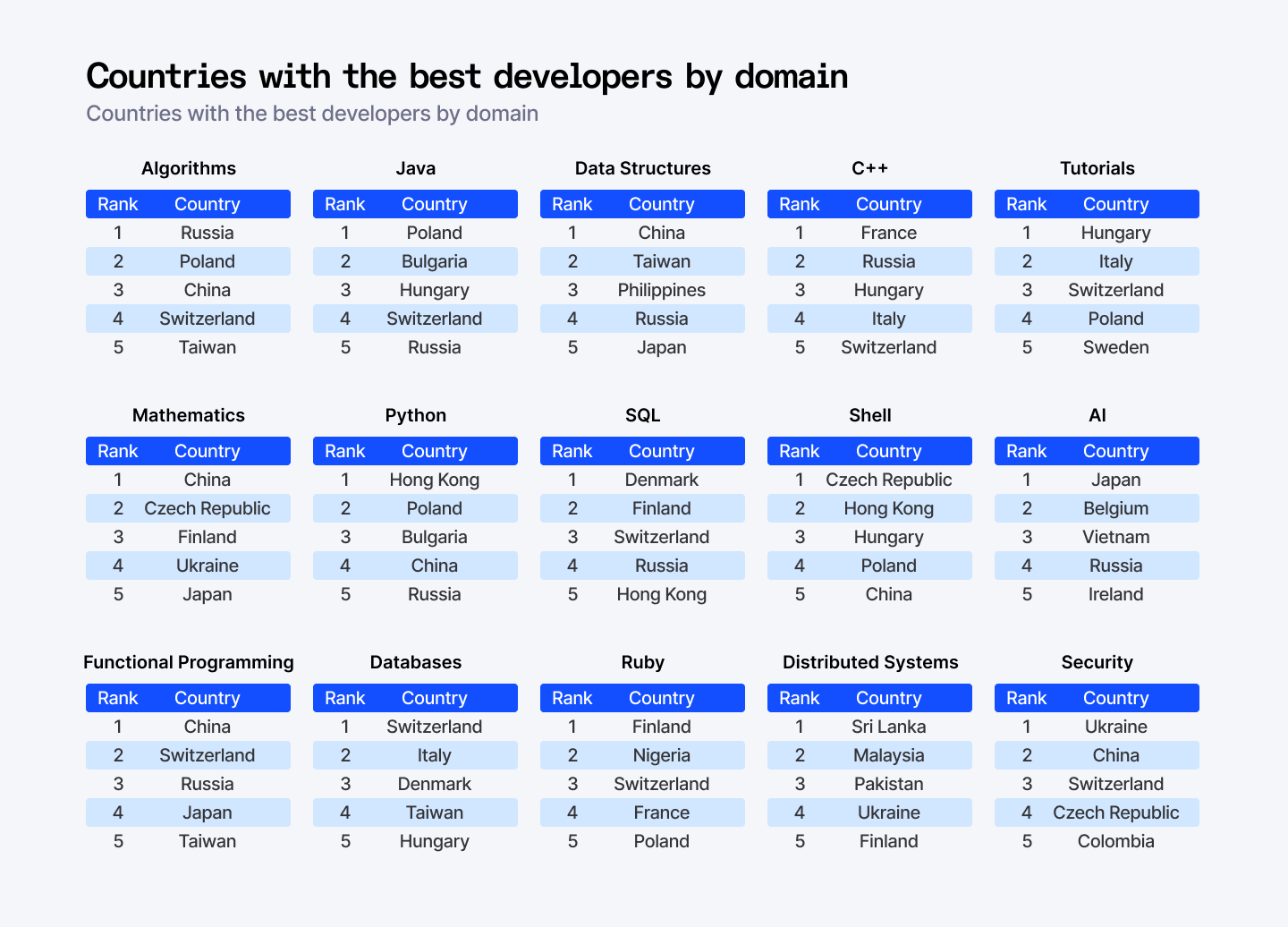
Across different domains, countries show unique strengths. For example, Russia and Poland top algorithm and Java challenges respectively, while China dominates data structures and math tests. (This image from HackerRank’s Programming Olympics highlights country rankings by domain.)
3. Poland
Poland consistently ranks among the world’s elite developer sources. HackerRank placed Poland #3 globally on coding assessments (score 98.0), and Polish engineers regularly win top spots in Java and other language contests.
Poland produces tens of thousands of IT graduates per year, and ~30% of Poles speak at least some English, making collaboration easier. Because Poland is in Central Europe (UTC+1/+2), time-zone overlap with EU companies is perfect, and U.S. teams can work late evenings with Polish mornings.
The average Polish software engineer earns about $22.7K/year, roughly half the equivalent in Western Europe, making it cost-competitive. The country’s stable business climate and EU legal system add contractor-friendliness. In short, Poland offers best-of-both-worlds: premium skill levels at moderate rates.
4. Philippines
The Philippines is a go-to for English-proficient talent. Over 90% of Filipino developers speak English fluently, and the education system emphasizes STEM training.
For U.S. companies, the time difference is a big advantage: Philippine mid-mornings match U.S. late evenings (EST- 2h), allowing near-24/7 coverage on projects. Filipino dev salaries are extremely low, on the order of $7.9K/year, making the Philippines one of the most cost-effective hires.
This country’s workforce doubled as the gig economy grew and Filipinos now rank among the fastest-growing global freelancer markets. The government actively supports tech careers, and companies like Payoneer rank the Philippines high in gig-economy growth. In our scoring, the Philippines stands out for communication fluency and affordability, ideal for flexible projects that need fast turnaround.
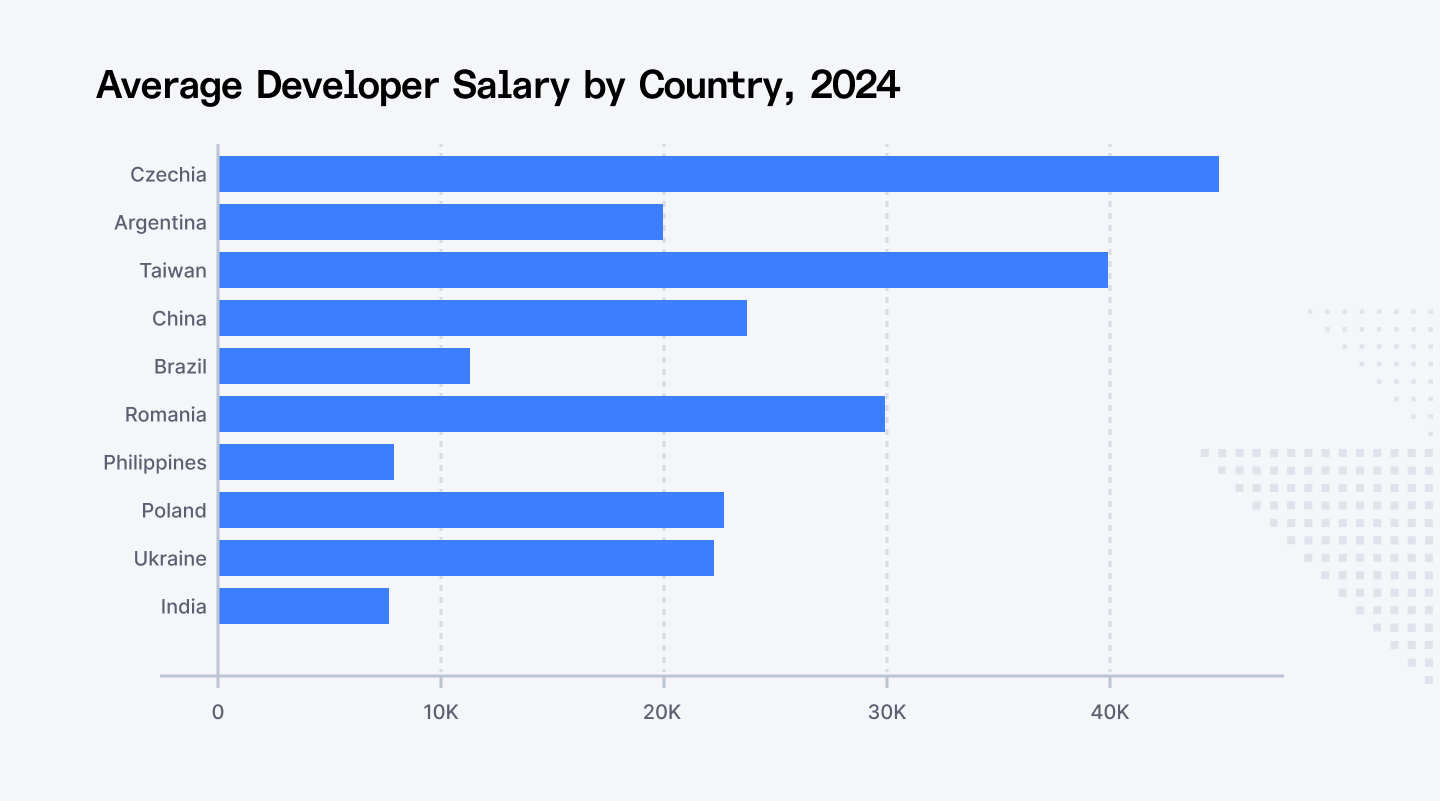
This diagram highlights the cost-effectiveness of each market (lower salaries signal greater budget leverage).
5. Romania
Romania's tech scene has exploded in recent years, becoming Eastern Europe's hidden gem for outsourcing. Not just because they've poured money into their IT backbone, but because almost all their developers speak solid English. All these factors have ensured that Romanian devs are well represented in EU-wide talent pools and hackathons.
While average salaries are higher than in India or the Philippines, they remain modest (~$30-35K/year) by Western standards. Romania’s Central European timezone aligns easily with EU clients and is only 6 hours ahead of New York, aiding U.S.-Romania collaboration.
The World Bank ranks Romania fairly high for business ease, and local laws generally protect IP. In practice, we find Romania offers Tier-1 European quality at Tier-2 pricing, with a highly educated workforce fluent in English.
6. Brazil
Brazil stands out in Latin America due to its sheer developer numbers and growing English skills. It’s home to millions of software engineers (Brazil boasts a young population with tech skills) and graduates 4.7 million STEM students per year.
According to surveys, Brazil has about 6.2 million fluent English speakers in total, and English training is improving. U.S. firms gain a timezone benefit: Brazil’s East Coast time (UTC-3) is only 2 hours ahead of New York in summer, simplifying coordination. Costs are low (typical dev salaries average roughly $11.3K/year) so Brazil combines half-size rates with Western hemisphere convenience.
Challenges like bureaucracy and currency volatility exist, but the large talent pool (especially for web, mobile and data projects) is attractive. All told, Brazil ranks as a value-heavy gig source for North American companies, second only to India/Philippines in cost-effectiveness among big nations.
7. China
China dominates by numbers and skill breadth. It tops global coding-skill rankings: Chinese developers scored 100 on HackerRank’s country index (the maximum), excelling in areas like data structures, math and functional programming. With over 1.3 billion people, China churns out about 4.7 million tech graduates every year.
However, for international freelance contracts China has drawbacks: English proficiency is low (only ~10 million can speak it confidently), and IP-contract enforcement can be tricky. Salaries are higher than in India or Eastern Europe (roughly $23.8K/year on average), reflecting China’s rapid economic growth.
As a result, China is ideal for large-scale, complex projects where technical depth matters most, but it ranks lower for U.S./European firms prioritizing smooth communication. In our ranking, China’s pure coding pedigree keeps it on the list but it sits mid-tier in overall balance due to language and legal factors.
8. Taiwan
Taiwan is an under-the-radar tech center. Its government has invested heavily to make Taiwan “Asia’s Silicon Valley”. Hackers and developers there score very high: Taiwan was #7 in HackerRank’s country rankings (score ~91.2), especially in functional programming and data structures.
The island produces many skilled C/C++ and embedded-systems engineers. The drawbacks: English proficiency is still developing (reports note “hard to find” fluent English engineers), and salaries average about $40K/year (higher than most Asian peers). Time-zone is JST/UTC+8, so late overlap for US workdays.
For clients seeking niche expertise (hardware, IoT, AI) from a disciplined workforce, Taiwan is a top pick. We rank it here as a specialized talent hub since they possess excellent skill, less ideal communication, thereby placing it just inside the top 10.
9. Argentina
Argentina offers a compelling mix of high education and Western alignment. It has grown a deep IT talent pool (over 115,000 software engineers nationwide). Argentina stands out in Latin America for English ability: it ranked #1 regionally in the EF English Proficiency Index and continually scores among the top countries worldwide.
The country’s universities are strong in STEM, and it topped Coursera’s Global Skills Index among developing economies. Argentine professionals often match U.S. cultural/working norms, making collaboration smooth.
Costs are cushioned by the weak peso: Argentina’s dev rates are only a fraction of U.S. wages (and even in dollars, our analysis finds mid-level salaries under $30K). The timezone (UTC-3) is nearly identical to the U.S. East Coast, easing communication. In short, Argentina is a premium Latin outsourcing market: very good English, high skill, NA-friendly hours, and steep cost arbitrage.
10. Czech Republic
The Czech Republic combines solid technical education with EU proximity. About 7,000 tech graduates enter Czech universities each year. Czech developers are known for rigorous training (especially in cybersecurity and enterprise software) and many speak English well (EF ranks Czech among high-proficiency countries).
Average local salaries hover around $45K/year, which is higher than Ukraine/Romania but still far below West Europe or North America. With Central European time (UTC+1/+2), Czech teams work seamlessly with German/UK clients and partially with U.S. afternoons. The business environment is stable and EU-regulated.
We place the Czech Republic in the top 10 for its balanced profile: a reasonable compromise of quality, cost, and convenience, especially for clients seeking EU-standard legal safeguards.
Also Read: Top 6 Websites to Hire European (EU) Developers in 2025
Summary Table
| Country | HackerRank Score (Rank) | Avg. Dev Salary (USD/yr) | English Proficiency | U.S./EU Time Zone Fit | Notes |
| India | ~76.0 (31st) | ~$7,700 | Very High (2nd-largest English population) | +5:30 (partial overlap EU; U.S. night) | Massive talent pool, lowest cost. |
| Ukraine | ~88.7 (11th) | ~$22,300 | High (~80% English speakers) | +2 (EU overlap, U.S. late) | Top coding skill, EU contract-friendly. |
| Poland | ~98.0 (3rd) | ~$22,740 | Moderate (≥30% English) | +1 (EU overlap, U.S. late) | Elite skill in Java/C#, good rates. |
| Philippines | ~63.8 (46th) | ~$7,936 | Very High (>90% English) | -12 (late-night overlap U.S.) | Best for English and cost; US-friendly. |
| Romania | N/A (not ranked) | ~$30,000 (est.) | High (~90% English) | +2 (EU overlap, U.S. late) | EU location, quality grads. |
| Brazil | ~73.5 (38th) | ~$11,337 | Moderate (~6.2M English speakers) | -3 (overlap w/U.S. east) | Large workforce, NA-aligned hours. |
| China | 100 (1st) | ~$23,790 | Low (~10M English speakers) | +8 (Asia, EU-6h, U.S.-12h) | Top coder volume; language/IP barriers. |
| Taiwan | ~91.2 (7th) | ~$40,000 (est.) | Low (English improving) | +8 (Asia, EU-7h, U.S.-12h) | Specialized skills (IoT/embedded). |
| Argentina | ~72.1 (39th) | ~$20,000 (est.) | Very High (EF’s LatAm leader) | -3 (same as Brazil) | Strong English, NA-like culture. |
| Czechia | ~90.7 (9th) | ~$45,000 | High (EF rank ~25th globally | +1 (EU overlap, U.S. late) | Central EU, strong engineering. |
Note: HackerRank scores and ranks from global tests; salaries from industry surveys; English proficiency from EF EPI and local reports. Time zone fit indicates typical work-hour overlap with the U.S./EU.
Conclusion
In conclusion, no single country is perfect, but our analysis shows that India and Ukraine top the list by balancing quality and cost. Poland and the Philippines follow closely, with Romania, Brazil and others filling out a diverse top 10.
Each of these countries has emerged as a leader in at least one hiring factor. By matching the specific needs of your project, be it highly specialized skills, budget constraints, or rapid turnaround, HR and hiring managers can use this guide to target the optimal country for freelance tech talent.
For Clients:
Skip the global talent hunt. Index.dev connects you with pre-vetted freelance developers from these top countries in 48 hours. Start your 30-day free trial today.
For Developers:
Join Index.dev to land top remote jobs, no matter where you live. Work with global companies and grow your freelance career today!

