Building AI agents is no longer limited to writing isolated scripts or plugging models into basic apps. With the rise of the Model Context Protocol (MCP), developers now have a standardized way to connect agents with external tools, databases, and workflows. This shift has opened the door to more reliable, scalable, and collaborative AI agents.
In this roundup, we highlight the seven best frameworks for MCP AI agents, covering their features, strengths, and ideal use cases. Whether you’re a beginner or an advanced developer, this list will help you pick the right foundation.
Build AI agents, land global projects. Join Index.dev today.
What is MCP in AI Agent Development?
The Model Context Protocol (MCP) is an open standard that defines how AI agents connect to external tools, data sources, and applications. Think of it as the USB-C for AI: just like a universal port allows any device to plug into many accessories, MCP allows AI agents to plug into multiple systems in a standardized way.
Instead of building custom integrations for every tool, developers can use MCP to give agents access to:
- Databases for search and retrieval
- APIs and external apps for real-time actions
- Prompts and workflows for dynamic decision-making
- File systems or cloud storage for reading and writing data
This makes agents more powerful, reusable, and easier to scale across different projects. With MCP, an agent doesn’t just work in one environment; it can interact with any MCP-compatible server to fetch context, process tasks, and deliver smarter results.
How we selected the best MCP AI agent frameworks
We selected the best MCP AI agent frameworks by focusing on practical factors that matter most to developers and businesses. Each framework was reviewed for ease of integration, support for MCP standards, and compatibility with popular languages like Python, Java, and C#.
We also considered enterprise adoption, community activity, security features, and scalability. Finally, we compared how well each framework handles tool orchestration, context management, and extensibility, ensuring our list highlights solutions that are both reliable and future-ready.
Best frameworks to build MCP AI agents
1. LangChain
LangChain is the most downloaded and widely used framework for building AI agents and LLM-powered applications. It provides a standard interface that connects any language model with tools, databases, and APIs, making it easy to create apps that adapt as the ecosystem evolves.
Developers can use it with Python or JavaScript, and its open-source design ensures there is no vendor lock-in. LangChain’s ecosystem includes LangGraph for orchestration, LangSmith for debugging and evaluation, and LangGraph Platform for deployment, giving teams everything they need to go from prototype to production.
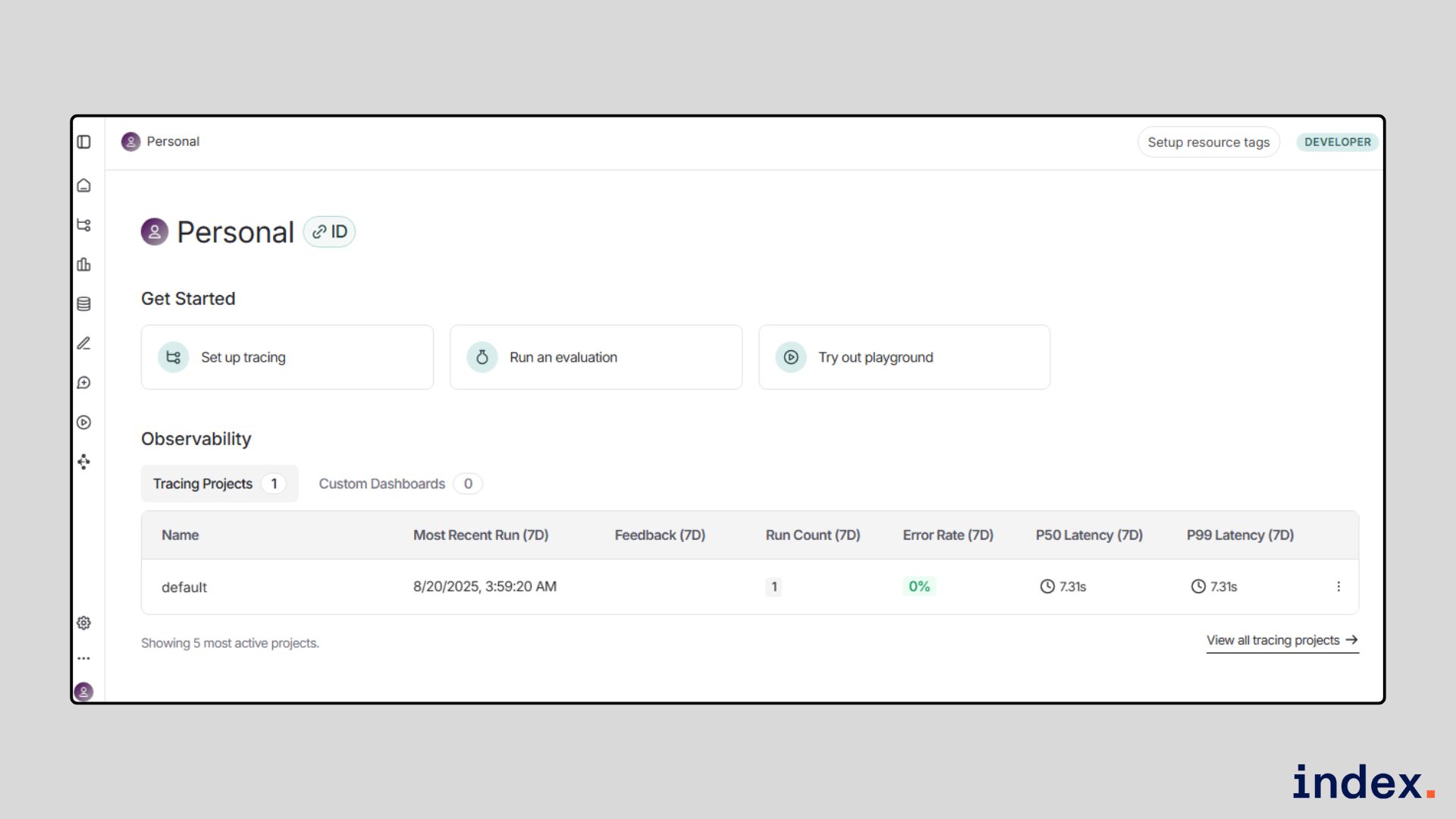
With over 1 million developers, 100,000 GitHub stars, and more than 600 integrations, it has the largest community in the generative AI space.
Features for search/retrieval-based agents
- Offers 600+ integrations with popular vector databases like Pinecone, FAISS, Weaviate, and Chroma, making it one of the strongest frameworks for retrieval-augmented generation (RAG).
- Provides a standard interface across models, tools, and databases, so developers can easily switch providers without rewriting entire applications.
- Supports real-time data augmentation by connecting LLMs to live APIs, external tools, and internal systems.
- Uses LangGraph for advanced orchestration, enabling state management, memory handling, and multi-agent collaboration.
- Includes LangSmith for evaluation, tracing, and debugging, which helps developers quickly identify and fix issues.
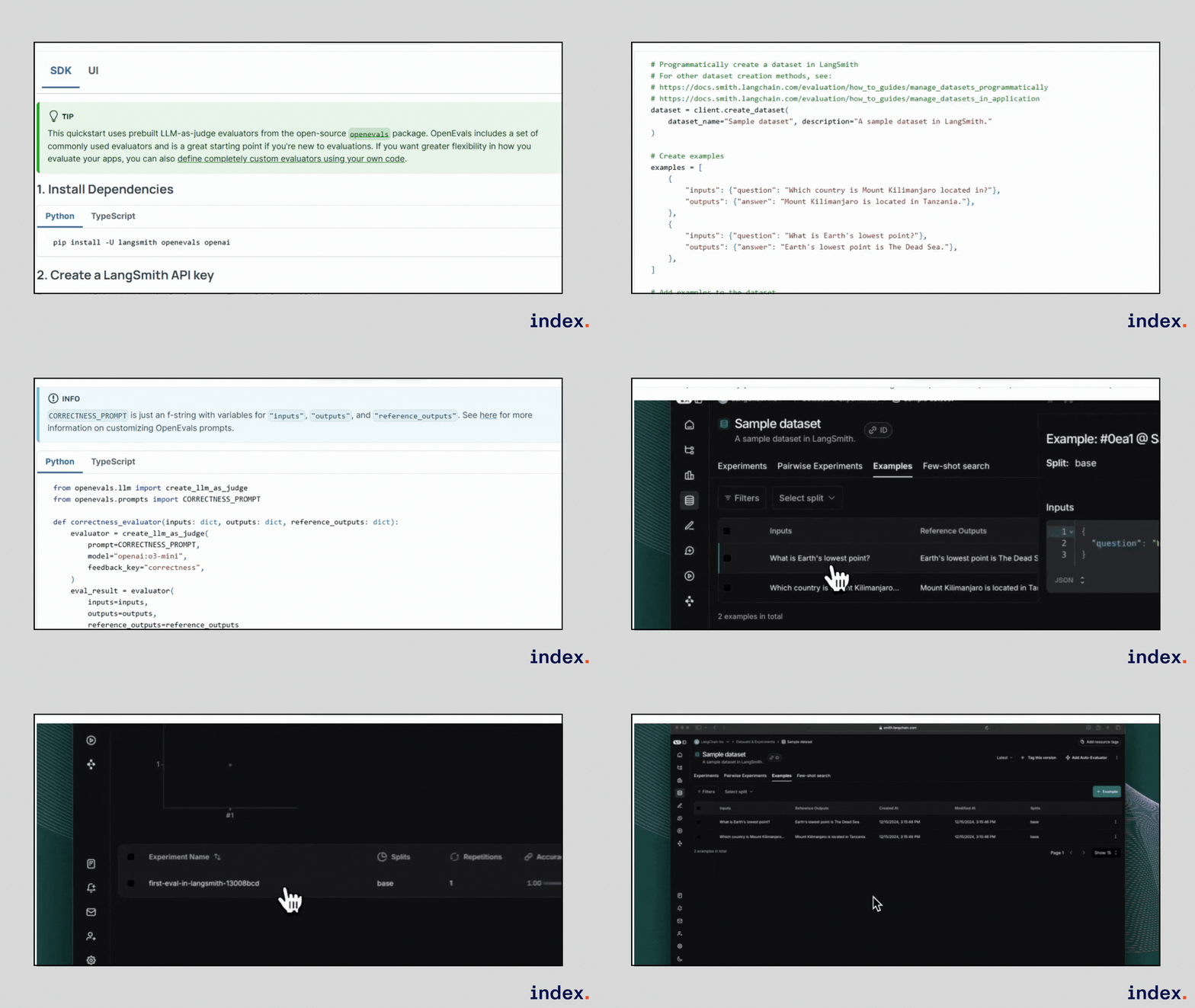
Evaluations in LangSmith let you test and score AI outputs using datasets, target functions, and evaluators. It helps you build more reliable AI apps. Let us see how it works:
- Designed to be open and neutral, which prevents vendor lock-in and allows future-proof integrations.
Pros and cons
Pros
- Speeds up development by providing pre-built abstractions, templates, and integrations.
- Backed by the largest developer community in GenAI, with over 1M users and extensive learning resources.
- Supports both Python and JavaScript, giving flexibility for different development teams.
- Open-source and modular, letting developers experiment and adapt components freely.
- Trusted by top companies such as Google, Klarna, GitLab, Cisco, and many startups for real-world AI agents.
Cons
- The large scope of features creates a steep learning curve for beginners.
- Frequent updates may cause breaking changes, requiring developers to adjust code.
- Debugging complex workflows with multiple chains and tools can be challenging.
- Adds unnecessary overhead when used for simple LLM projects that don’t need orchestration.
Ideal projects
- Knowledge assistants and enterprise RAG systems that search and retrieve information from documents and databases.
- Research copilots that summarise, analyse, and synthesise insights across multiple data sources.
- Customer support agents who connect to CRMs, ticketing platforms, and live databases to provide fast, accurate responses.
Explore how to build your first AI agent using LangGraph.
2. AutoGen (by Microsoft)
AutoGen is an open-source framework from Microsoft for building agentic AI systems and enabling cooperation among multiple agents. It focuses on multi-agent collaboration, asynchronous communication, and flexible workflows, making it ideal for solving complex, real-world problems.
With its redesigned v0.4 release, AutoGen introduces an event-driven architecture that improves scalability, observability, and robustness. It supports both prototyping and enterprise-grade deployments, offering modular tools, reusable components, and cross-language interoperability (Python and .NET).
Features for search/retrieval-based agents
- Supports asynchronous messaging, allowing agents to communicate using event-driven or request/response patterns for efficient retrieval.
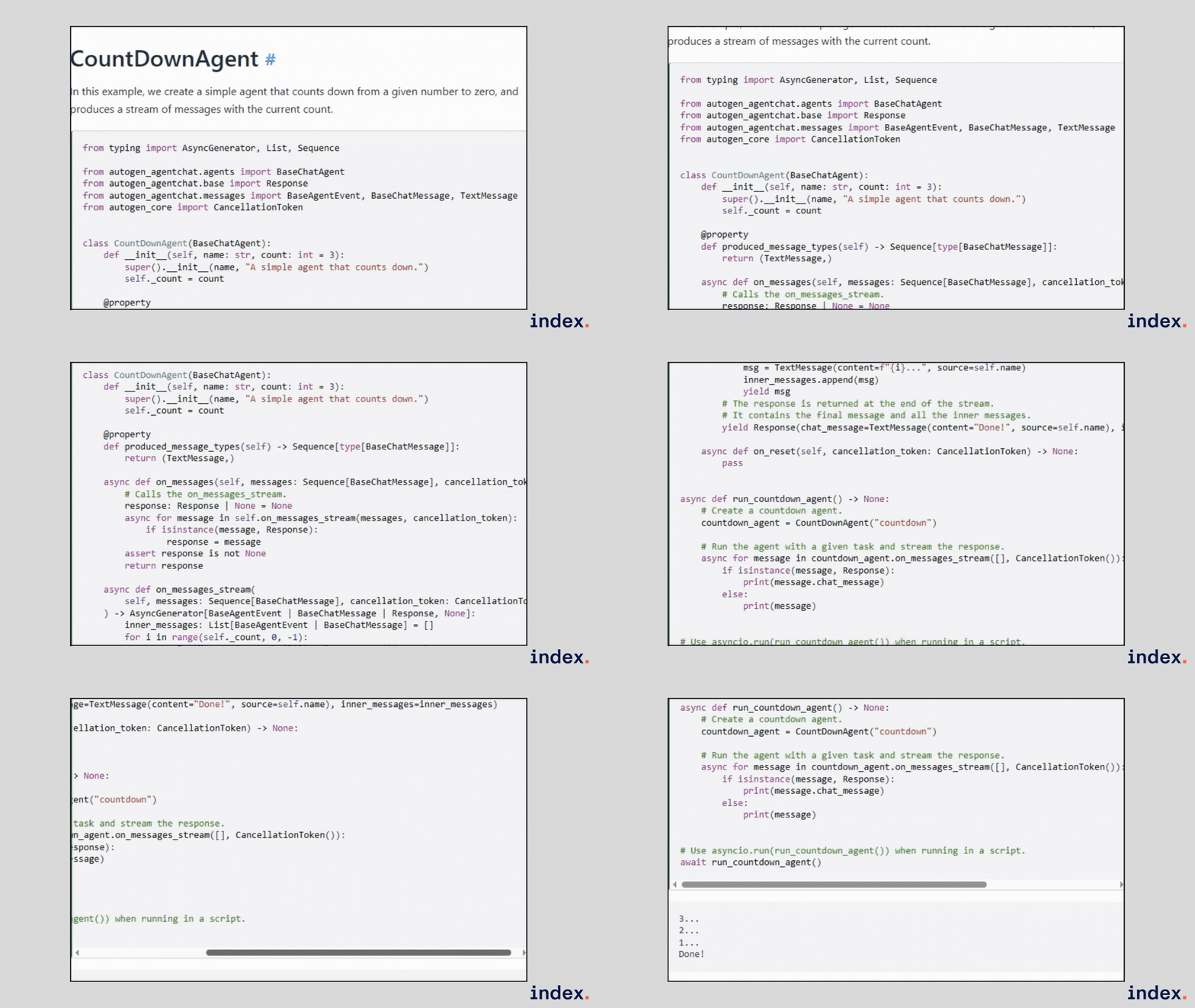
We saw building of a CountDownAgent using this tool by extending BaseChatAgent, where on_messages and on_messages_stream handle the countdown logic, on_reset resets the state, and produced_message_types defines the output message format.
- Provides AgentChat for building conversational agents that can collaborate on search and retrieval tasks.
AgentChat lets you quickly build AI agents that connect to models and tools, like a weather bot.
- Integrates with extensions such as McpWorkbench (for Model Context Protocol), OpenAI Assistant API, and Docker-based code execution.
- Offers observability tools with OpenTelemetry support, making it easier to trace, debug, and monitor agent workflows.
- Enables cross-language interoperability, currently supporting Python and .NET, with more languages planned.
- Includes Studio, a web-based UI for quickly prototyping agents without writing code.
Pros and cons
Pros
- Built for multi-agent collaboration, making it suitable for scenarios where multiple agents must work together.
- Uses a modular and extensible design so that developers can add custom tools, memory systems, and agents.
- Provides enterprise-grade scalability with support for distributed, event-driven systems.
- Includes observability and debugging features, reducing the complexity of managing multi-agent workflows.
- Offers both no-code prototyping (AutoGen Studio) and advanced programming interfaces for developers.
Cons
- Smaller community compared to LangChain and fewer pre-built integrations.
- Has a steeper learning curve, especially for those new to multi-agent orchestration.
- Still maturing, with frequent updates and evolving APIs.
- Requires more setup and system design to use effectively in simple projects.
Ideal projects
- Multi-agent research assistants that collaborate to analyse, summarise, and cross-check information.
- Collaborative problem-solving systems where different agents play roles like researcher, writer, or reviewer.
- Enterprise workflows that require scalable, distributed multi-agent architectures.
- Experimental MCP-first projects, since AutoGen supports MCPWorkbench for Model Context Protocol integration.
3. CrewAI
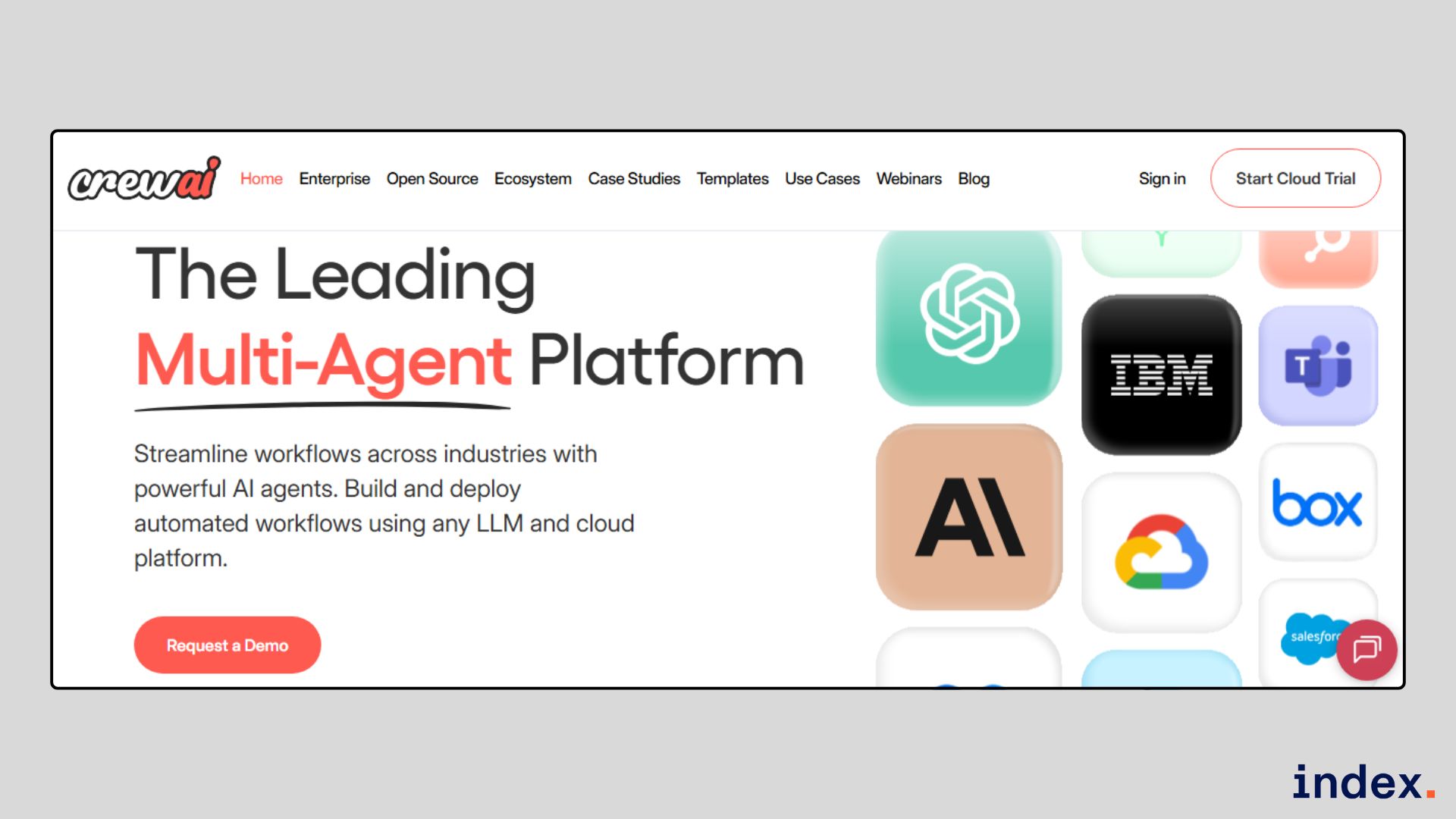
CrewAI is a fast-growing open-source platform designed for building and orchestrating multi-agent workflows. It allows developers and businesses to create “crews” of AI agents that work together, each with specific roles, to complete complex tasks.
With CrewAI, you can build automations quickly through code or no-code tools, deploy them in the cloud or locally, and manage them through a simple UI. It is already trusted by multiple Fortune 500 companies.
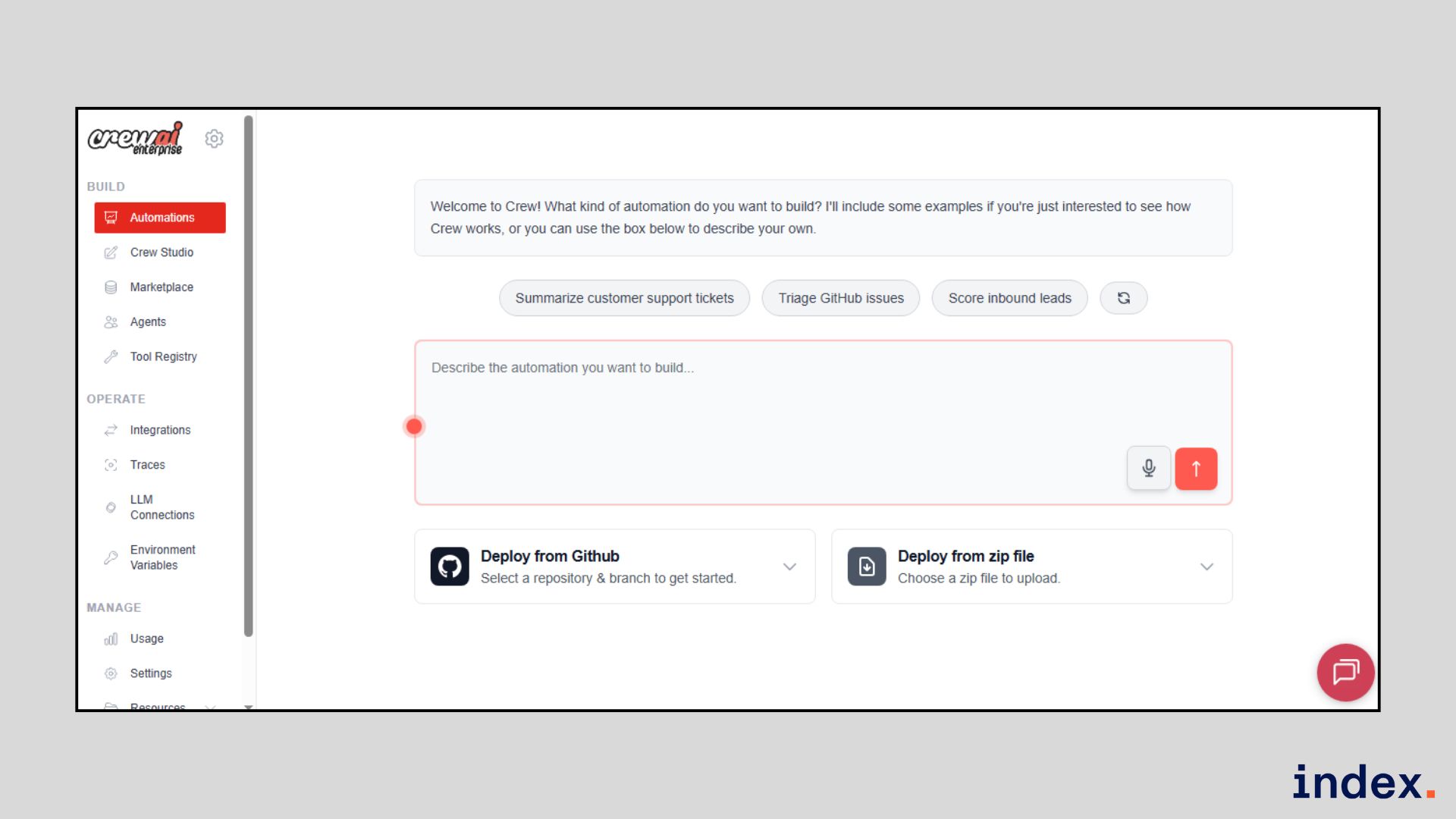
Crew AI is one of the fastest-growing agent platforms, with thousands of use cases across industries like healthcare, finance, marketing, HR, and supply chain.
Features for search/retrieval-based agents
- Provides a Visual Studio and templates that let developers or non-coders design multi-agent workflows quickly.
- Supports tool and API integrations so agents can retrieve, analyse, and act on data from external sources.
- Includes Flows, a feature that lets users design smarter orchestrations with more control over multi-agent communication.
- Works in the cloud, locally, or self-hosted, giving flexibility in how businesses deploy their agents.
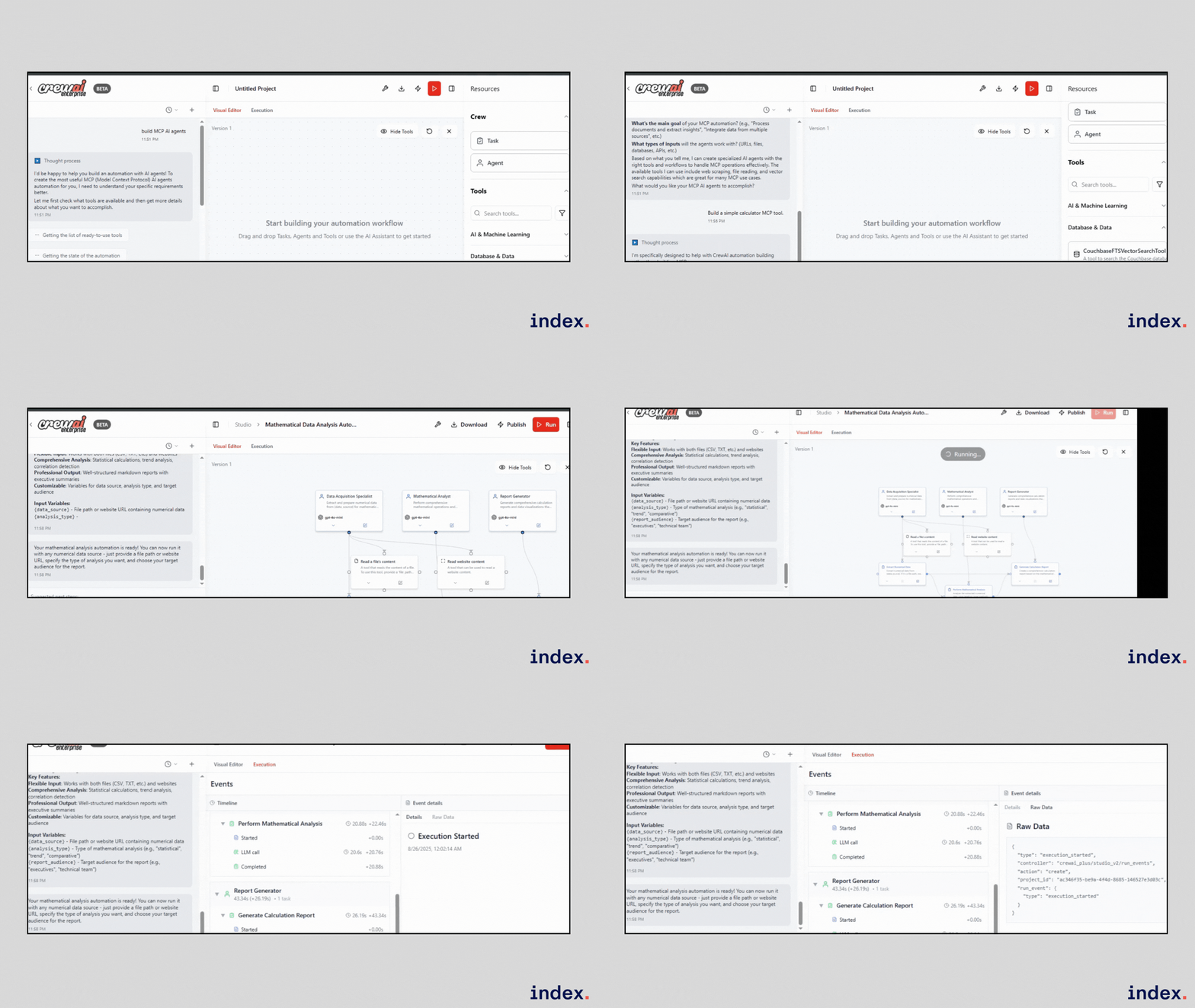
We signed in to the Cloud trial plan and built a simple calculator MCP tool.
- Offers a management dashboard to track, optimise, and measure the ROI of agent workflows.
- Keeps humans in the loop, allowing feedback and oversight for higher accuracy.
Pros and cons
Pros
- Very strong for multi-agent orchestration with role-based agents.
- Offers both code and no-code tools, making it useful for technical and non-technical teams.
- Flexible deployment options (cloud, local, or hybrid).
- Backed by a growing community and trusted by large enterprises.
- Provides visibility and tracking tools to measure agent performance.
Cons
- Still newer compared to frameworks like LangChain, so its ecosystem is smaller.
- Documentation and learning resources are improving, but not as extensive.
- Less suitable for very simple one-agent applications.
- Rapid feature changes may require teams to adjust workflows often.
Ideal projects
- Business automation workflows across HR, finance, marketing, or operations.
- Research and writing pipelines that require collaboration between specialised agents (e.g., researcher + summarizer).
- Enterprise processes that need visibility, tracking, and ROI measurement.
- Industry-specific use cases such as healthcare data enrichment, predictive marketing, or supply chain optimisation.
4. Heystack
Haystack is a production-ready, open-source AI framework developed by Deepset. It is highly customizable and designed to build both simple retrieval-augmented generation (RAG) apps and complex agentic pipelines.
Its modular components and pipeline architecture let developers plug in their own tools, data sources, and workflows. Haystack integrates with major LLM providers (OpenAI, Anthropic, Mistral), vector databases (Weaviate, Pinecone, FAISS, Qdrant), and AI tools, giving teams complete flexibility.
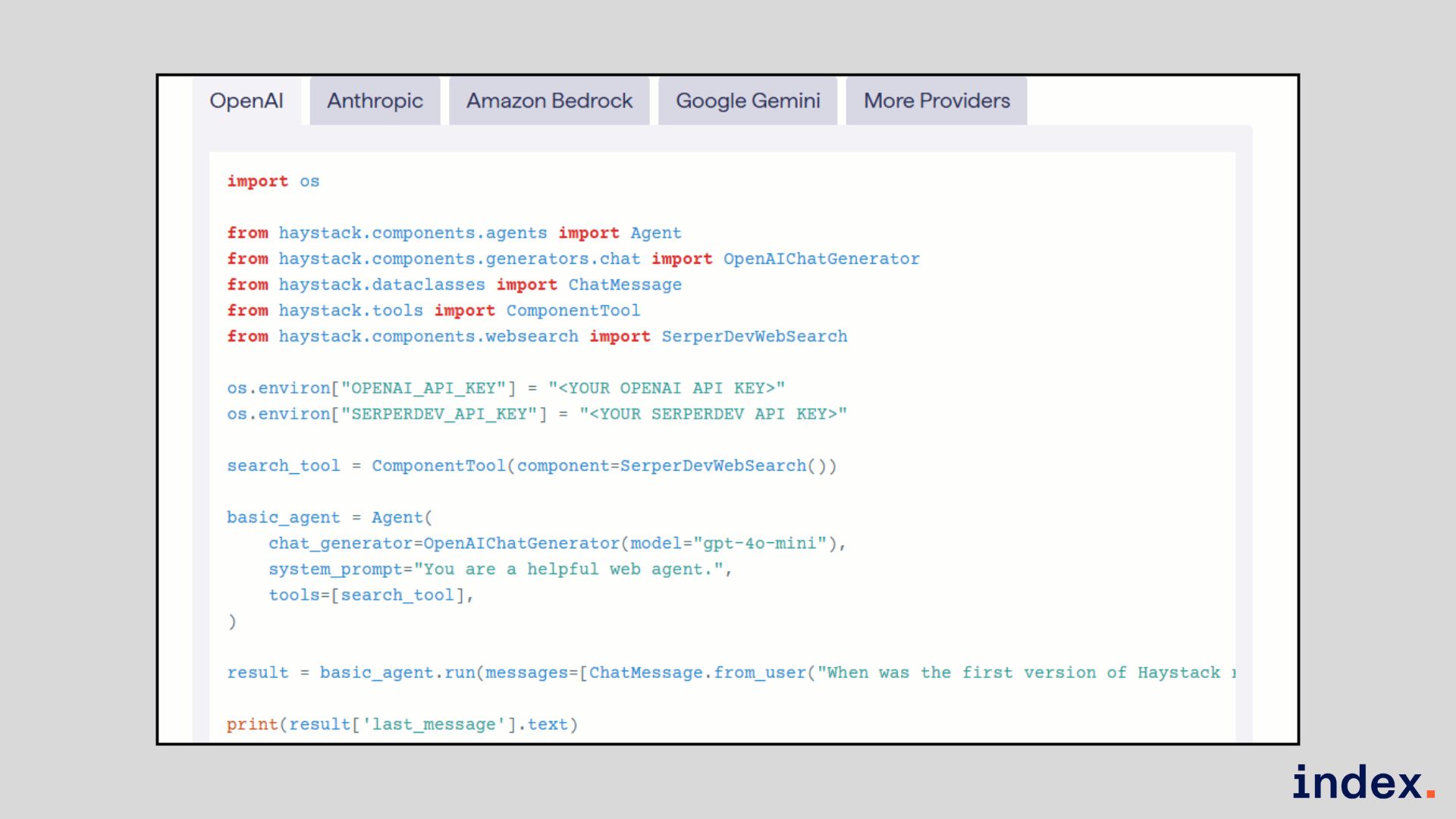
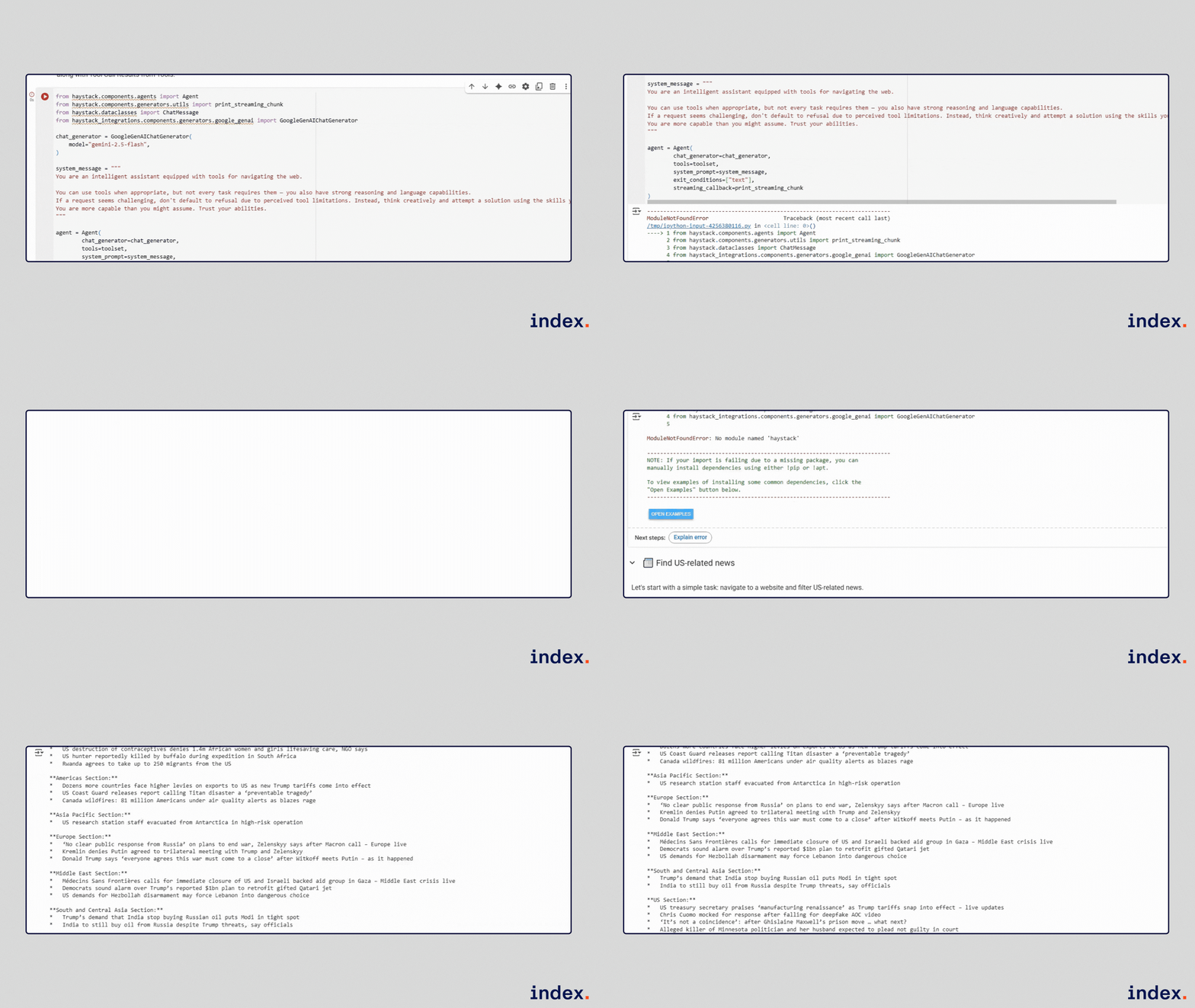
This example shows how Haystack makes it easy to build a basic agent that answers questions and uses tools like web search with just a few lines of code.
Features for search/retrieval-based agents
- Provides a flexible pipeline system for RAG and agent workflows, supporting both simple and multi-step retrieval tasks.
- Integrates with leading vector databases (Weaviate, Pinecone, Milvus, Elasticsearch, etc.) for scalable search.
- Includes MCPTool and MCPToolset, enabling agents to securely connect with external tools, APIs, and file systems using the Model Context Protocol.
This demo shows how Haystack powers Browser Agents by combining Gemini with Playwright MCP, enabling agents to browse websites, extract data, and perform real-world tasks without needing APIs.
- Supports multiple MCP transports (Streamable HTTP, SSE, StdIO) for both local and remote tool integration.
- Production-ready with logging, monitoring, and Kubernetes-native workflows, making deployment and scaling easier.
- Offers deepset Studio, a no-code UI to design, test, and debug pipelines visually.
Pros and cons
Pros
- Very flexible, modular, and customizable for both RAG and agent pipelines.
- Strong ecosystem with integrations to major LLMs, databases, and AI tools.
- Enterprise-ready with monitoring, logging, and deployment guides.
- No-code support via Deepset Studio for faster prototyping.
- Actively maintained with 22k+ GitHub stars and a strong global community.
Cons
- Steeper learning curve for beginners due to modular complexity.
- More setup effort compared to plug-and-play solutions.
- Some advanced features (e.g., multi-agent orchestration) are improving.
Ideal projects
- Building retrieval-augmented generation (RAG) apps for enterprise search or knowledge assistants.
- Developing multi-agent pipelines where MCP tools fetch and process context from multiple data sources.
- Deploying enterprise-grade AI systems that require logging, observability, and Kubernetes workflows.
- Experimenting with advanced NLP/LLM workflows while keeping flexibility to adapt to future models.
5. LlamaIndex
LlamaIndex (formerly GPT Index) is a leading open-source framework for building context-augmented AI agents that work with enterprise documents. It provides the tools needed to parse, structure, and retrieve information from large collections of unstructured and semi-structured data.
With its enterprise offering, LlamaCloud, the platform enables real-time document processing at scale and supports more than 300 formats, from PDFs and spreadsheets to scanned images. LlamaIndex has become a trusted choice for startups and global enterprises alike, powering millions of downloads per month and handling hundreds of millions of pages of enterprise data.
Features for search/retrieval-based agents
- Offers LlamaParse, a state-of-the-art parser that handles complex documents, including nested tables, handwritten notes, images, and low-resolution scans.
- Provides rich connectors and abstractions for databases, APIs, and cloud storage (AWS S3, Google Drive, Azure Blob Storage, SharePoint, etc.).
- Supports retrieval-augmented generation (RAG) pipelines with automated indexing, context injection, and structured querying.
- Includes LlamaCloud, a managed service that automates ingestion, parsing, and retrieval at enterprise scale.
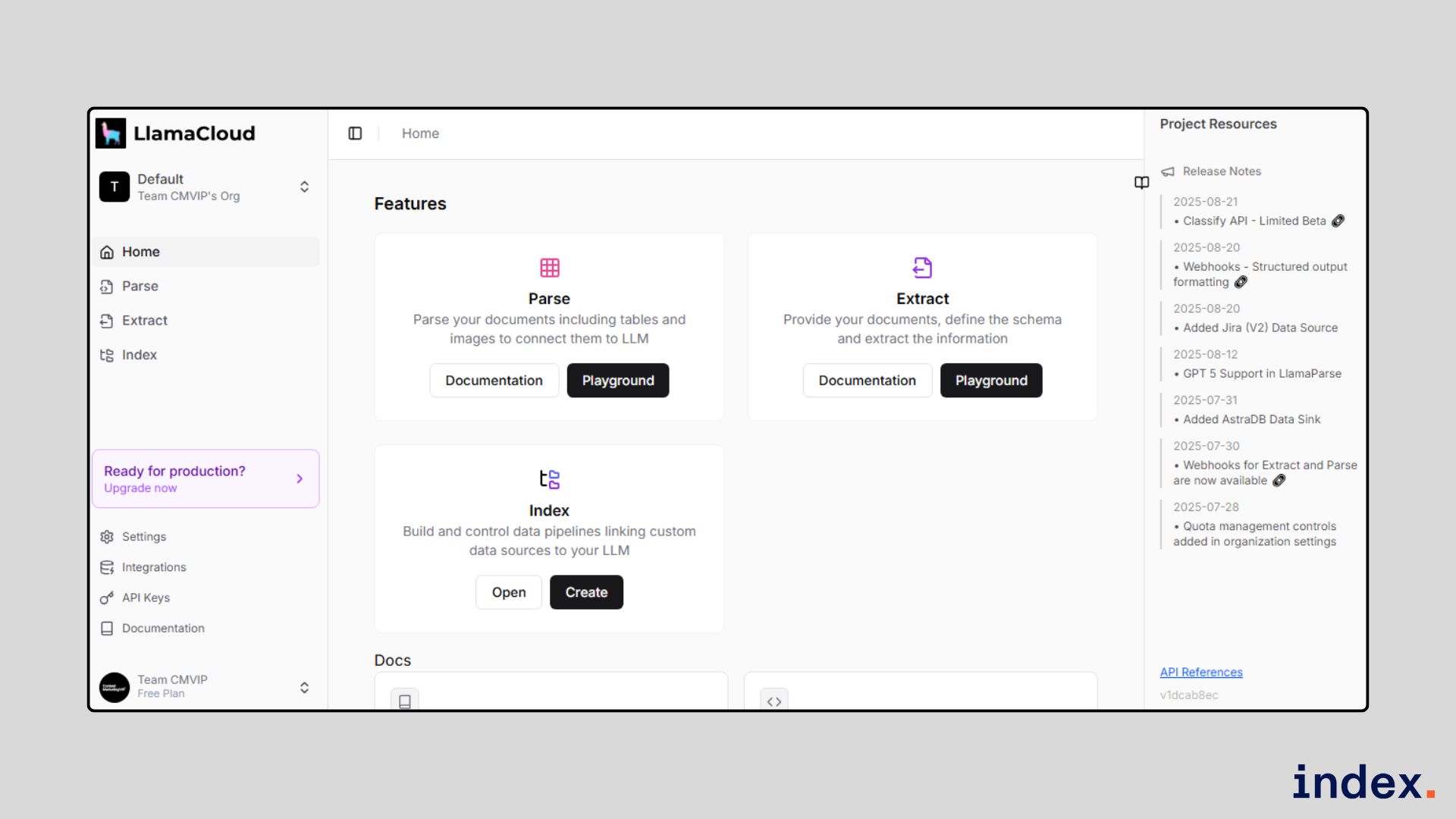
This example shows how LlamaCloud’s Web UI with LlamaParse lets you quickly upload documents, pick a preset, and get parsed results in your browser without any coding.
- Powers agentic document workflows that can extract values, summarise insights, or take actions across financial, legal, healthcare, and technical documents.
- Backed by LlamaHub, a growing repository of community-built connectors, tools, and datasets.
Pros and cons
Pros
- Strong specialization in document parsing and retrieval, making it a perfect choice for knowledge-intensive workflows.
- Easy to set up for developers with Python and TypeScript SDKs.
- Handles enterprise-scale data ingestion with unmatched accuracy and efficiency.
- Supported by an active global developer community and enterprise partners.
- Proven success in real-world use cases with companies like KPMG, Salesforce, Rakuten, and Cemex.
Cons
- Focused mainly on document workflows, so it is less flexible for general-purpose agent orchestration compared to LangChain.
- Complex enterprise features often require a LlamaCloud subscription, which may not suit hobby projects.
- Some advanced features, like multi-modal parsing, are still evolving.
Ideal projects
- Enterprise knowledge assistants that query across large document repositories.
- Financial and legal analysis agents that process 10-Ks, contracts, or compliance documents.
- Customer support assistants who handle FAQs and service requests using internal documentation.
- Research copilots for extracting and synthesizing data from multi-modal sources.
- Automation pipelines in industries like insurance, healthcare, and manufacturing, where documents drive workflows.
6. Semantic Kernel (by Microsoft)
Semantic Kernel is a lightweight, open-source development kit that helps developers build AI agents and connect them with modern AI models. It works as middleware, making it easier to combine LLMs with existing applications written in C#, Python, or Java. The framework is designed to be enterprise-ready, with built-in security, observability, and non-breaking updates.
Several Fortune 500 companies already use it to automate workflows and scale AI solutions, making it one of Microsoft’s most future-proof frameworks for integrating AI into business processes.
Features for search/retrieval-based agents
- Supports C#, Python, and Java with full cross-language reliability and stable versioning.
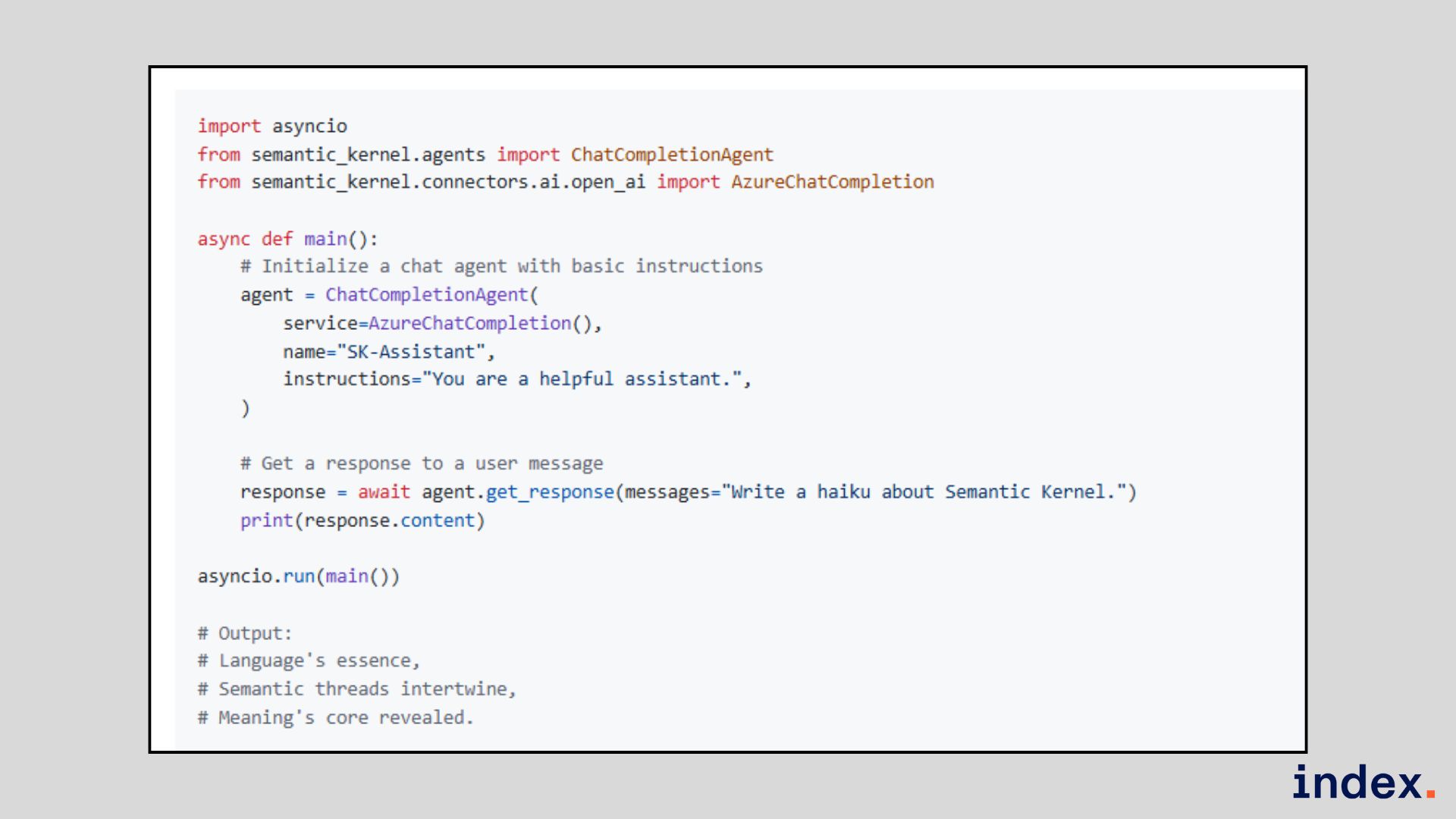
We can create a simple assistant that responds to user prompts using Python like this:
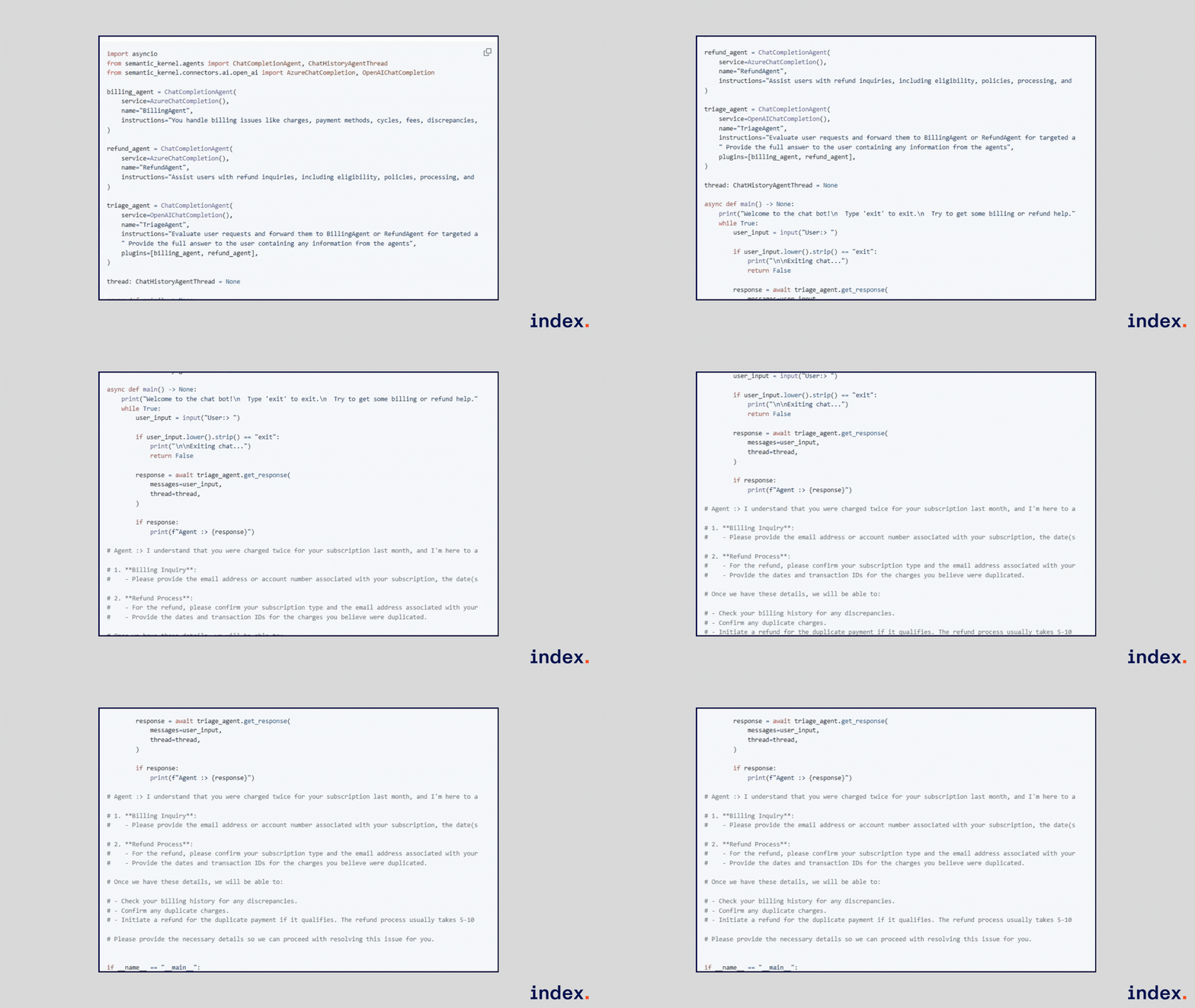
We can also build a system of specialized agents that can collaborate using Python:
- Provides planning and orchestration tools that let AI agents break down complex tasks into smaller steps and use existing APIs for retrieval.
- Acts as middleware that translates model requests into function calls, allowing seamless integration with enterprise systems.
- Includes plugins and connectors built on OpenAPI specifications, which makes it easy to integrate with Microsoft 365, business apps, or custom APIs.
- Provides enterprise-ready observability through telemetry support, filters, and hooks for monitoring and responsible AI practices.
- Designed to be future-proof, letting developers swap new AI models into their systems without rewriting entire applications.
Pros and cons
Pros
- Easy to integrate with existing enterprise systems using modular plugins.
- Backed by Microsoft and already in use at large enterprises.
- Stable and reliable with version 1.0+ support and a focus on non-breaking updates.
- Strong security, observability, and compliance features for enterprise environments.
- Future-proof design makes it easy to adopt new models as they are released.
Cons
- Smaller open-source community compared to frameworks like LangChain.
- More technical to customize, requiring knowledge of C#, Python, or Java.
- Less focus on retrieval-augmented generation compared to LlamaIndex or Haystack.
- Fewer plug-and-play templates for beginners.
Ideal projects
- Enterprise AI workflows where security and compliance are essential.
- Business process automation that integrates AI with existing APIs and services.
- Custom copilots built into productivity tools or enterprise apps.
- Multi-modal AI agents that may later expand into voice, video, or chat workflows.
7. OpenAI Agents SDK
The OpenAI Agents SDK is a developer toolkit that makes it easier to build, run, and manage AI agents powered by LLMs. Its key innovation is Model Context Protocol (MCP), an open standard that works like a “USB-C port for AI,” letting agents plug into any data source or tool consistently.
This gives developers flexibility to connect models with filesystems, APIs, databases, or custom tools without custom glue code. With support for orchestration, guardrails, and tracing, the SDK is built for scalable, production-ready AI applications.
Features for search/retrieval-based agents
- Provides built-in support for MCP servers, letting agents securely connect with data sources, APIs, and file systems.
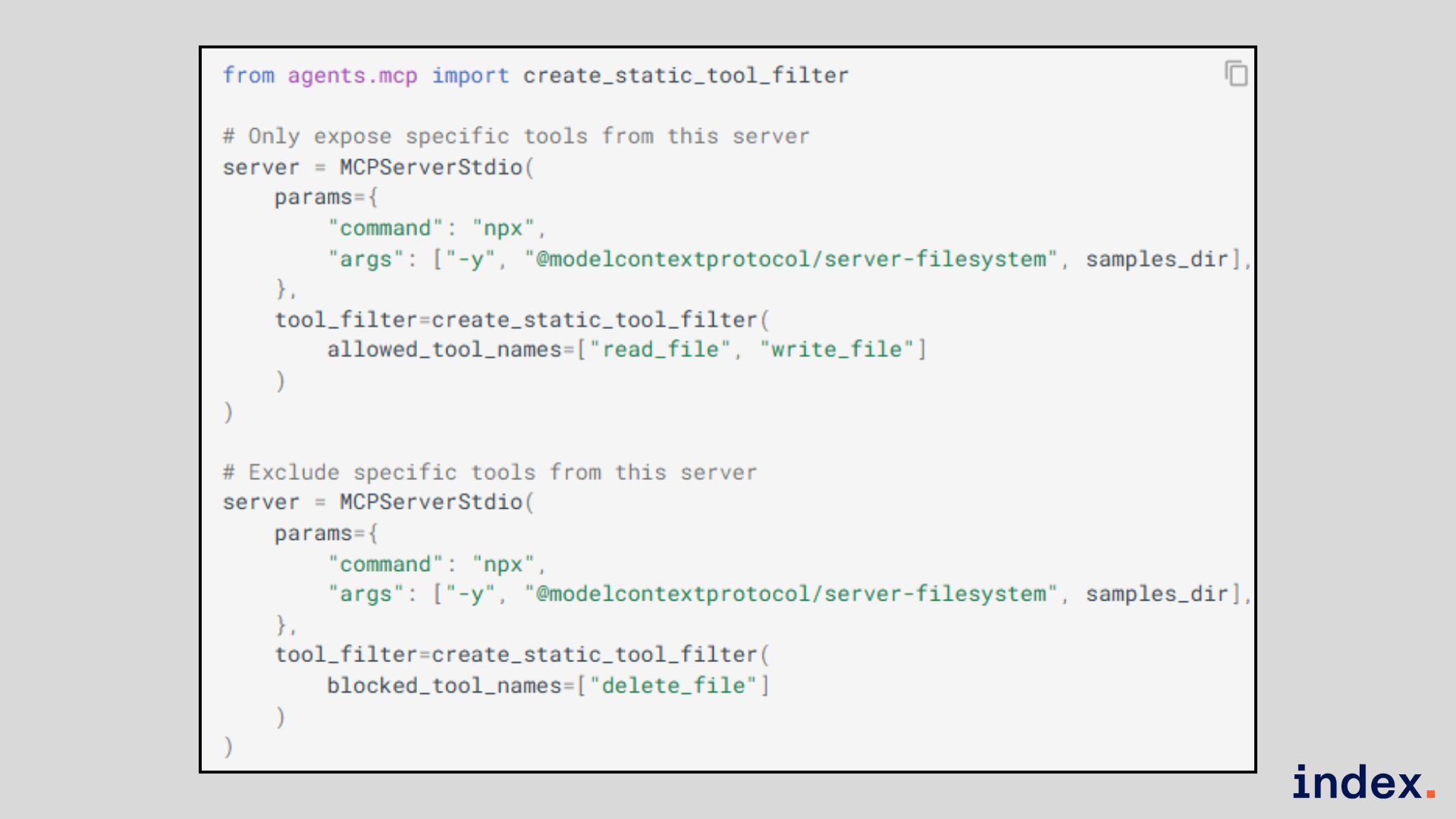
- Supports tool filtering (static and dynamic) so agents only use the right tools for search and retrieval tasks.
For simple allow/block lists, we can use static filtering:
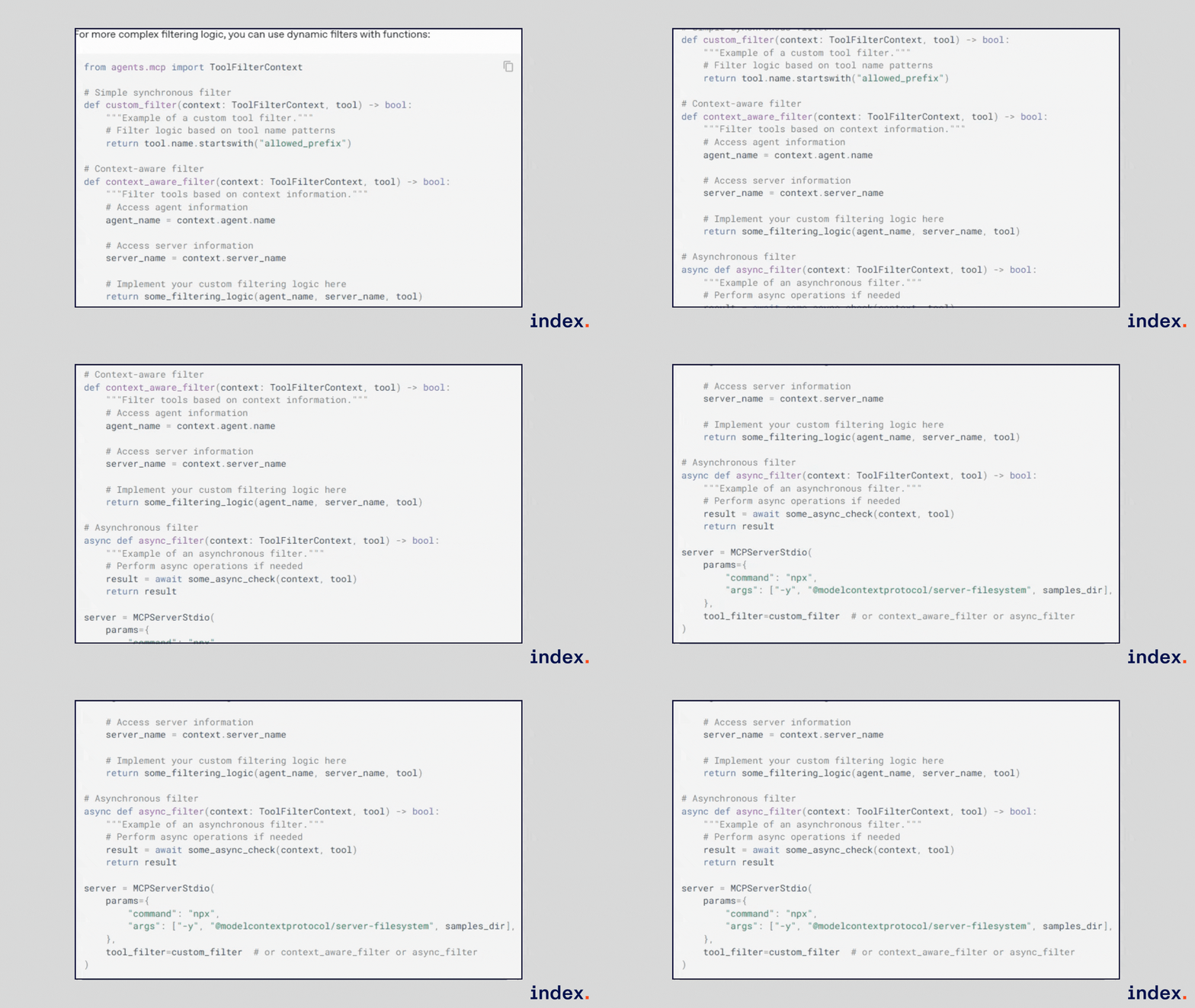
For complex filtering logic, we can use dynamic filters with functions
- Allows prompt management where servers supply reusable instructions to guide retrieval and context handling.
- Offers caching options to reduce latency when agents repeatedly fetch data from MCP servers.
- Includes tracing features that track every search, tool call, and response, making debugging and optimization easier.
Pros and cons
Pros
- Open standardized protocol (MCP) prevents lock-in and promotes interoperability.
- Flexible support for different server types and deployment modes (local, remote, streaming).
- Strong built-in tool filtering, caching, and tracing for enterprise use.
- Works seamlessly with any model via LiteLLM, not limited to OpenAI.
- Designed for both chat-based and real-time voice agents.
Cons
- Still a young ecosystem compared to LangChain or Semantic Kernel.
- Documentation and tutorials are evolving, so beginners may face a learning curve.
- More low-level than frameworks like LangChain, requiring additional setup for orchestration.
- Smaller library of prebuilt connectors compared to alternatives.
Ideal projects
- Cross-tool AI agents where models need to securely fetch data from APIs, databases, or local systems.
- Custom copilots that require reusable prompts, context-aware instructions, and real-time responses.
- Enterprise AI assistants that demand guardrails, logging, and governance features.
- Developers exploring interoperability who want to avoid framework lock-in and build on an open protocol.
Discover the top 5 AI coding agents of 2025: CodeGPT, GitHub Copilot, Postman AI, Replit, and Snyk.
Comparison table of the 7 frameworks for MCP AI Agents
| Framework | Ease of Use | Best At |
| LangChain | Medium – requires coding but is well-documented | Large ecosystem integrations & RAG pipelines |
| AutoGen (Microsoft) | Medium – setup is technical, strong for devs | Multi-agent collaboration & async workflows |
| CrewAI | Easy – offers no-code + code-first options | Orchestrating agents for business automation |
| Heystack | Very Easy – plug-and-play, no coding needed | Retail & customer insights from large data sets |
| LlamaIndex | Medium – developer-focused, some learning curve | Document parsing & enterprise knowledge RAG |
| Semantic Kernel (Microsoft) | Medium-Hard – requires enterprise setup | Secure enterprise copilots with compliance |
| OpenAI MCP SDK | Hard – best for advanced developers | Open standard, governance, real-time agent control |
Final verdict
Each of the seven frameworks brings unique strengths to MCP agent development. LangChain stands out for its ecosystem and tool integrations, making it the go-to for enterprise-scale projects. AutoGen excels in multi-agent collaboration and research use cases, while LlamaIndex is best for retrieval and knowledge-heavy workflows. Lightweight options like CrewAI and Heystack shine for smaller projects and faster prototyping, whereas the OpenAI Agents SDK ensures direct compatibility with MCP standards.
For beginners, CrewAI or Heystack are excellent starting points due to their simplicity and lower learning curve. Advanced teams should explore LangChain, AutoGen, or the OpenAI SDK to unlock deeper customization, multi-agent orchestration, and large-scale deployment capabilities.
FAQs
What is the Model Context Protocol (MCP) in AI agents?
MCP is an open standard that connects AI agents with external data, tools, and APIs. Think of it as a universal connector, like USB-C for AI. It lets frameworks plug into different data sources securely, making agents more useful for real-world tasks like search, retrieval, or automation.
Why should developers use MCP-based AI agent frameworks?
Developers should use MCP frameworks because they simplify integration with external systems, reduce custom coding, and ensure consistent performance across AI models. MCP makes agents modular, extensible, and future-proof, meaning you can swap tools or upgrade models without rewriting your whole codebase.
Which is the best MCP AI agent framework for beginners?
For beginners, OpenAI Agents SDK and LangChain MCP are strong choices. They offer easy setup, clear documentation, and out-of-the-box connectors for search and retrieval. These frameworks let new developers experiment quickly while still being powerful enough for real projects.
Which MCP framework is best for enterprise use?
Enterprises often prefer Semantic Kernel and AutoGen MCP. These frameworks focus on security, observability, and scalability. They integrate well with enterprise systems, provide monitoring tools, and handle compliance needs, making them suitable for production-ready AI agents at scale.
Can MCP frameworks work with any AI model?
Yes. Most MCP frameworks are model-agnostic and can work with multiple LLMs via LiteLLM, OpenAI, or other providers. This flexibility helps developers avoid vendor lock-in and allows agents to switch between models depending on task, performance, or cost.