Microservices have become well-known in software architecture since they allow the division of massive monolithic programs into smaller, independently deployable services. This architectural approach helps companies to quickly implement new products, grow more successfully, and evolve with the times in corporate needs. But with this adaptability, it becomes difficult to guarantee seamless communication between the several moving components—each service in a microservices architecture.
The whole reliability and effectiveness of the system depend on the way microservices interact and coordinate with one another. In this context, two often occurring trends are choreography and orchestration. Although both strategies try to control service encounters, their philosophy and execution vary greatly.
Developers who want strong, scalable systems must first understand the distinctions between choreography and orchestration. With its distributed and event-driven character, choreography lets services communicate independently from a central controller. Conversely, orchestration uses a centralized method whereby one component, the orchestrator, controls the interactions among the several services.
Ready to take on challenging microservices architecture projects? Join Index.dev’s talent network and work remotely on top projects with high pay!
Overview of Microservices Communication Patterns
Designed by nature, microservices are independent elements cooperating to fulfill the objectives of a more extensive program. Since these services are separate, one of the main difficulties is how they coordinate and interact with one another. Especially in complicated processes involving several services, effective communication between services is essential to guarantee the system operates as a coherent unit.
Types of Communication: Synchronous vs. Asynchronous
Service-to-service communication may be generally classified in microservices architecture as either two types:
- Synchronous: Under this synchronous communication one service requests another and waits for a response before moving on. Many times, this is done via HTTP/REST APIs. Although synchronous communication is easy to use, as services rely on one another's reaction times, it might cause tight coupling between them and possible bottlenecks.
- Asynchronous: Often employing messaging systems like Apache Kafka, RabbitMQ, or AWS SNS/SQS, asynchronous communication there are services interacting without waiting for an instantaneous answer. Since services do not wait on one another, this trend encourages loose coupling between them and increases resilience.
Microservices Coordination
Services in a microservices-based system sometimes must coordinate for complicated corporate processes. An e-commerce platform may, for instance, offer different services for order administration, payment processing, inventory updates, and delivery. To finish an order, these services have to cooperate perfectly.
The difficulty is in how effectively to control these interactions. Microservices must manage errors, retries, and guarantee data integrity among scattered services as they interact. Here is where coordination techniques orchestration and choreography finds use.
Choreography lets services react to events and behave autonomously, hence lowering reliance between them.
Orchestration is the core service regulating and directing the flow to guarantee that every service fulfills its intended sequence.
Though they seek to control service interactions, their approaches of achieving coordination are essentially different. Development of a scalable, stable microservices architecture depends on an awareness of these variations.
Read More: How to Implement Microservices Architectures for Better Scalability & Maintainability
What is Orchestration in Microservices?
In microservices, orchestration is a centralized method wherein a specialized component—called the orchestrator—manages and organizes the interactions among many services. Under this arrangement, the orchestrator serves as a "conductor," regulating the flow of activities and guaranteeing that every service executes its assigned choreography in a given sequence.
How Orchestration Works?
Under an orchestrated system, the orchestrator watches the flow by commanding separate services and waiting for their answers. Based on the directions of the orchestrator, every service carries out its component of the process. This central entity controls the whole operation's lifespan and determines which service should start its work and when.
Imagine, for instance, an online business where an orchestrator oversees order placement's process. Once a consumer orders, the orchestrator could:
- Generate the order, order service calls.
- Tell the payment processing payment service.
- Tell the inventory service to verify and change stock levels.
- Set delivery using the shipping service.
The orchestrator guarantees a clear flow by waiting for the result of every step before going to the next.
Advantages of Orchestration
One of the main advantages of centralized control is its clear perspective of the whole process and simpler monitoring of system performance.
The orchestrator may control retries, resolve mistakes, and apply rollback systems should a failure arise. This produces more consistent behavior.
Managing distributed transactions and preserving consistency becomes easier in coordinated systems as the orchestrator regulates the flow and condition of every service.
Disadvantages of Orchestration
The centralized character of orchestration might cause closer connection between services. Changes in one service may also call for modifications in the orchestrator as the conductor oversees all activities.
- Single Point of Failure: The orchestrator turns into a possible single point of failure as she becomes so important for the system. Should it fail, the whole production might stop unless high-availability systems are in place.
- Reduced Scalability: Although orchestration offers control, as the system expands it may become less scalable, resulting in management of big numbers of services bottlenecks.
Examples of Orchestration Tools
Microservices orchestration is supported by several instruments and systems:
- Popular workflow engine Camunda lets complicated corporate procedures be coordinated.
- A serverless orchestrating tool allowing you to manage many AWS services.
- An orchestration engine designed for microservices-based systems is Netflix Conductor.
All things considered, orchestration is appropriate for systems where centralized control, great consistency, and error handling are absolutely important. Its centralized approach, however, could create difficulties with scalability and adaptability.
What is Choreography in Microservices?
Microservices' choreography approaches service interaction from a distributed standpoint. Every service in a choreographed system is in charge of knowing its purpose and behaving depending on the events it encounters rather than depending on a central orchestrator to manage the workflow. Under this paradigm, services "dance" around one another in response to changes without clear guidance from a central authority.
How Choreography Works?
Usually, choreography is accomplished with event-driven architecture. When anything happens, like an order is placed, the services pay attention to these occurrences and respond accordingly. No one service regulates the whole procedure. Every service responds to certain events and activates other services by means of events of its own.
Within the framework of an e-commerce platform, for instance:
- The order service generates a fresh order and documents an event such as `OrderPlaced`.
- Subscribed to OrderPlaced events, the payment service handles payments and generates an `OrderPaid` event.
- Listening for the OrderPaid event, the inventory service changes stock levels and sets off a `Stock Updated` event.
- Arranging delivery, the shipping service gets the `Stock Updated` event.
Under this distributed model, every service understands its roles but is ignorant of the whole process. Their interactions are limited to events, so the system becomes more loosely linked.
Advantages of Choreography
Since every service is exclusively in charge of managing events pertinent to it, choreography encourages loose coupling between them. This lessens dependencies and increases the independence of services.
The distributed character of choreography makes it more readily scalable. Every service may grow on its own demand without affecting others.
Flexibility: New services may be included to the system without upsetting the current design as services interact indirectly through events. Faster innovation and more agile development are therefore made possible.
Disadvantages of Choreography
Managing retries and addressing mistakes might become more difficult as there is no central controller. Every service has to control its own error-handlers.
Without a centralized orchestrator, it might be difficult to track the state of a multi-step process or monitor the general system. Problems spanning several distributed services might be challenging.
The event-driven paradigm can get chaotic as the number of services rises in increasing complexity. Event storms can cause possible performance bottlenecks as well as trouble managing the general system from too many events.
Examples of Choreography in Practice
Systems based on highly scalable designs or real-time data processing make extensive use of choreography. Among other things, include:
- Using an event-driven system, Netflix manages interactions and updates across its many microservices in real-time.
- Under its distributed design, Uber uses choreography to handle real-time requests, payments, and alerts.
For systems where scalability, adaptability, and loose coupling are critical, choreography is essentially perfect. It is more fit for particular use cases, nevertheless, given difficulties with error management and monitoring.
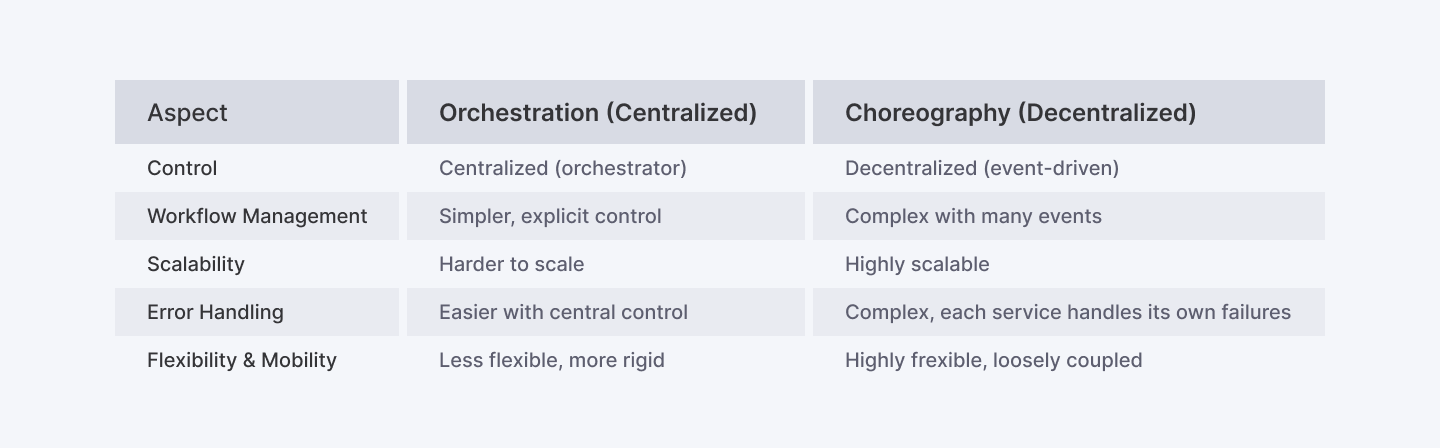
Key Distinctions Between Choreography and Orchestration
While choreography and orchestration serve the same aim of coordinating microservices, their methodologies are fundamentally different. To select the appropriate pattern, it is critical to understand the fundamental distinctions in control, complexity, scalability, error handling, and their influence on system design.
1. Control: Centralized or Decentralized
Orchestration is a centralized strategy in which a single service (the orchestrator) controls the whole process. It determines the sequence in which services complete their jobs and monitors inter-service communication. This makes it simple to track the flow of operations, resulting in a well-structured process.
Choreography, on the other hand, follows a decentralized paradigm. Each service understands its function in the workflow and runs autonomously, responding to events without a central controller. This increases each service's autonomy while decreasing visibility into the overall performance of the system.
Example: In an e-commerce system, an orchestrator may oversee the whole order process, ensuring that payment, inventory, and shipping services are executed in the proper order. In a choreographed system, each service (payment, inventory, and shipping) would react to events separately, with no master controller directing their interactions.
2. Complexity and Workflow Management
Orchestration makes workflow management easier since the orchestrator understands and oversees the whole process. Complex workflows are easier to manage since the orchestrator enforces the order of actions and explicitly controls service dependencies.
Choreography might grow complicated when numerous services interact in response to events. As the number of services increases, so does the number of events produced and consumed. Managing these event chains may be difficult, especially for developers attempting to determine what caused a certain action or why a specific service failed.
Example: A trip booking platform that requires numerous processes, such as booking flights, hotels, and automobiles, may benefit from orchestration since it allows for unambiguous control over the complicated process. With choreography, these exchanges might swiftly devolve into a disorienting web of occurrences.
3. Scalability
Choreography performs well in systems where scalability is a priority. Because services interact independently via events, they may scale without harming the whole system. New services can be readily implemented without requiring modifications to other services or the orchestrator.
Orchestration may have scaling issues. As the number of services and interactions increases, the orchestrator may become a bottleneck, making scaling inefficient. Every interaction must be routed through the orchestrator, which might slow down the system.
Example: Streaming systems like Netflix, which require services to grow fast in response to customer demand, often use choreography because of its ability to manage huge loads without central bottlenecks.
4. Error Handling and Transaction Management
Orchestration provides improved error handling and transaction management. The orchestrator has a comprehensive perspective of the process and can handle retries, rollbacks, and failure recovery in a methodical manner. It can ensure that a missed payment, for example, results in a cancellation in the order system.
Choreography complicates error handling. Each service is responsible for its own failure recovery, and because no one component controls the process, faults might spread without a clear path to handle them across services. Distributed transaction management is especially difficult, necessitating compensatory techniques or elaborate event processing to ensure consistency.
Example: In a financial transaction system, orchestration would make it easier to handle payment failures by including a rollback feature that reverses any completed stages if a mistake occurs. In a coordinated system, each service would have to manage compensations independently, adding complexity.
5. Flexibility and Maintenance
Choreography provides increased flexibility and maintenance. Because services are loosely connected, individual services may be updated or replaced without impacting the others. This design is very customizable, making it easy to add new features over time.
Orchestration improves predictability but at the expense of flexibility. Changes in the workflow frequently need changes in the orchestrator and perhaps several services, making the system more difficult to grow as requirements change.
Example: A ride-sharing platform like Uber may employ choreography for independent services such as ride requests and payments, which must change swiftly and scale independently. In contrast, a typical corporate program that relies on regular procedures may choose orchestration for greater control.
When to Use Choreography
Choreography is very useful for systems that need loose coupling, high scalability, and event-driven architecture. Let's look at the optimal conditions in which choreography outperforms orchestration.
Real-time, event-driven systems
Choreography is an ideal match for systems that rely on real-time, event-driven interactions. In such systems, services publish and consume events without waiting for answers, allowing near-real-time data processing. This asynchronous communication approach lowers latency and improves system responsiveness.
Example: Streaming services like Netflix and YouTube rely significantly on real-time updates to manage dynamic user interactions. In these systems, services such as recommendation engines and content distribution run autonomously by responding to events such as a new user checking in or a video stream commencing.
Systems Requiring High Scalability
Choreography is appropriate for businesses anticipating fast growth or shifting workloads because of its loosely connected nature. Each service may expand independently based on demand, without affecting other services. This increases the entire system's resilience and adaptability to shifting loads.
Example: Uber utilizes choreography to manage real-time trip requests, payment processing, and driver allocation. Each of these services may expand separately to handle heavy user demand while maintaining overall system performance.
Loosely Coupled, Independent Services
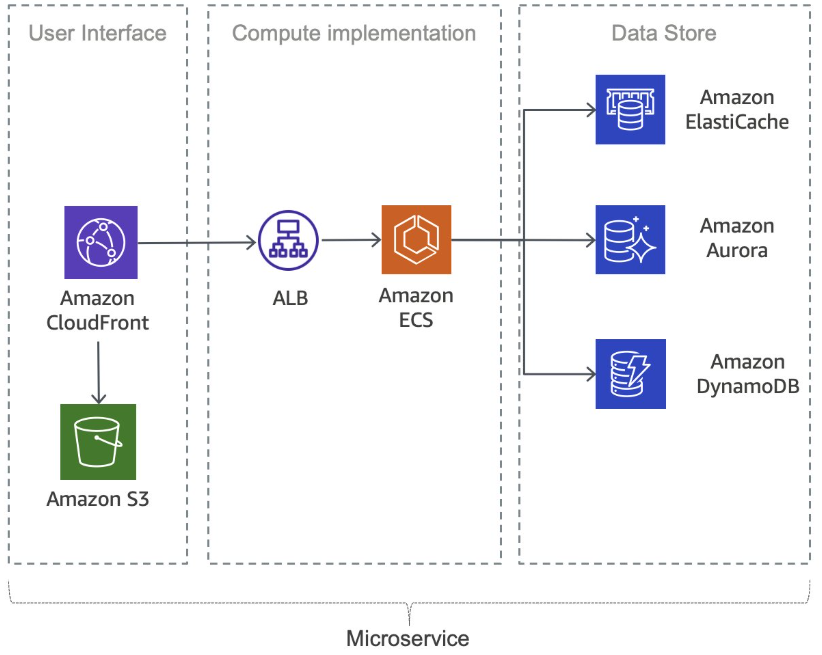
Choreography encourages loose coupling between services, which makes it simpler to evolve individual components without harming the overall system. This flexibility is critical when services must be updated on a regular basis or when new services must be added without completely redoing the architecture.
Example: Amazon's microservices architecture enables autonomous teams to work on various services like order processing, product search, and user recommendations. These services communicate using events, making it easier to deliver new features with little coordination overhead.
Systems with Evolving Business Requirements
When business needs change often, the decoupled nature of choreography enables fast iteration and deployment. Because each service runs separately, the architecture may change over time without needing a total redesign.
Example: In an agile development environment, an e-commerce platform may require speedy integration of additional payment gateways or delivery providers. Choreography enables these new services to communicate with old ones via events without needing major modifications to the current architecture.
Use Cases for IoT and Sensor Networks
Choreography is often utilized in Internet of Things (IoT) applications, which include millions of devices generating events in real time. Services may respond to sensor and device data independently, enabling extremely scalable and decentralized processing.
Example: In smart cities, traffic monitoring systems employ IoT sensors to collect data on vehicle movements. Various microservices, like traffic signals and public transit systems, respond to these events autonomously, changing traffic flows and timetables in real time.
When to Use Orchestration?
While choreography is best suited for loosely linked, highly scalable systems, there are times when orchestration is the preferable option. Orchestration gives you control, visibility, and a clear framework for managing complicated workflows, making it ideal for certain types of business processes and system needs.
Complex business workflows
Orchestration excels when dealing with large, multi-step procedures that need precise sequencing and coordination amongst services. In these cases, a central orchestrator streamlines the flow by ensuring that each service completes its duty at the appropriate moment, with no overlap or misunderstanding.
Example: In an e-commerce platform, placing an order entails a number of services, including payment processing, inventory checks, shipment arrangements, and notification services. Orchestration enables various services to be synchronized sequentially, ensuring that payments are completed before stock is depleted or shipments are sent out.
Transactional Systems Require Strong Consistency
In systems that need data consistency, such as financial transactions or order fulfillment procedures, orchestration guarantees that all services accomplish their jobs in a coordinated way. This ensures that partial failures do not leave the system in an inconsistent state. Orchestration can also manage rollback methods, which let you undo past steps if something goes wrong later on.
Example: In a financial system, when a consumer transfers money from one account to another, the system must verify that the monies are correctly debited and credited across different services. If one service fails, the orchestrator may manage the transaction rollback, guaranteeing the system's consistency.
Systems Require Centralized Control and Visibility
When business operations must be monitored and controlled centrally, orchestration is a logical match. The orchestrator provides complete insight into the system's processes, making it easier to track, troubleshoot, and improve workflows. This centralized control makes error management easier since the orchestrator is aware of all service interactions and may initiate retries or compensations when things go wrong.
Example: Supply chain management systems frequently employ orchestration to organize interactions among manufacturers, suppliers, warehouses, and logistics providers. The orchestrator guarantees that the whole workflow—from raw material purchase to final delivery—is executed in the proper order, while also providing complete records and error control.
Systems requiring predictability and reliability
Orchestration is ideal for systems that require predictability and reliability. Businesses may regulate every part of the process via a central orchestrator, avoiding the unpredictable interactions that might occur in event-driven, choreographed systems. This is especially beneficial when the system behavior must be consistent and visible.
Example: In a healthcare system where patient records are exchanged across several services (labs, hospitals, pharmacies), orchestration guarantees that each service appropriately communicates and retrieves patient data while adhering to tight legal and regulatory guidelines.
Read More: ChatGPT vs Claude for Coding: Which AI Model is Better?
Conclusion
Choreography and orchestration are two independent methods for controlling communication in microservices. Choreography is a decentralized, event-driven approach with high scalability and flexibility, whereas orchestration provides centralized control, making it excellent for complicated operations that require consistency and visibility.
The choice between the two is based on your system's requirements: utilize choreography for real-time, scalable services that need loose coupling, and orchestration where robust consistency, error handling, and a predictable flow are critical.
Developers should consider using a hybrid approach that incorporates both methods when suitable. Experimenting with multiple models depending on individual business objectives and growing system demands is critical to achieving the optimal combination of flexibility and control. As microservice architectures evolve, iterating and improving communication patterns will assist guarantee that the architecture stays scalable, stable, and maintainable over time.
For Developers:
Want to work on innovative microservices projects? Join Index.dev and access high-paying remote jobs in the US, UK, and EU!
For Clients:
Index.dev makes it easy to hire top developers for your microservices projects. Register now to find the best talent and improve your system's architecture!