
Microservices architecture has become one of the most acceptable choices for the modern model of software development since it helps to improve scalability and modularity. Unlike the system where an entire application can be deployed at once, microservices ensure that applications are divided into smaller services, which are independent of each other. Doing so has several benefits such as increased flexibility and robustness, which can result in quicker development cycles thanks to the modularity of this structure.
It is also important to note the capacity, which is the extent of a system’s capacity to work on growing volumes of work or larger data in today’s hyper-growing digital environment. According to the statistics presented it has been revealed that Internet traffic has been gradually increasing in recent years as well as online sales of goods and services and activity in social networks. One of its basic architectural premises is that it enables individual services to be scaled up as per requirement without causing hindrances to other services in the process.
Another critical aspect is maintainability, which means how easily an application can be updated, changed, and appended. Typically in monolithic architectures, modifying a component involves deploying the application again, which means the application will be disrupted. Microservices, in contrast, allow developers to modify these services independently of other services, which is beneficial in terms of development and testing as well as limiting the size of a failure.
This blog will discuss the main concepts and practices for adopting microservices architectures. We will also describe how application-level functionalities can be decomposed into easily understandable services and well-chosen communication models; and how consistency can best be achieved in distributed systems. Also, we will provide information on the issues and potential concerns employing microservices, including, but not limited to, greater system complication and administration burden. By being aware of these factors, you can then make the right choice on whether to implement microservices on your software development projects and how to harness their benefits for scalability and maintainability.
Future-proof your software! Join Index.dev to find experienced developers who can implement efficient microservices architectures for your applications.
Understanding Microservices Principles
Several principles have created the foundation of microservices architecture. So, these principles help to provide the main objectives of microservices – scalability, maintainability, and resilience.
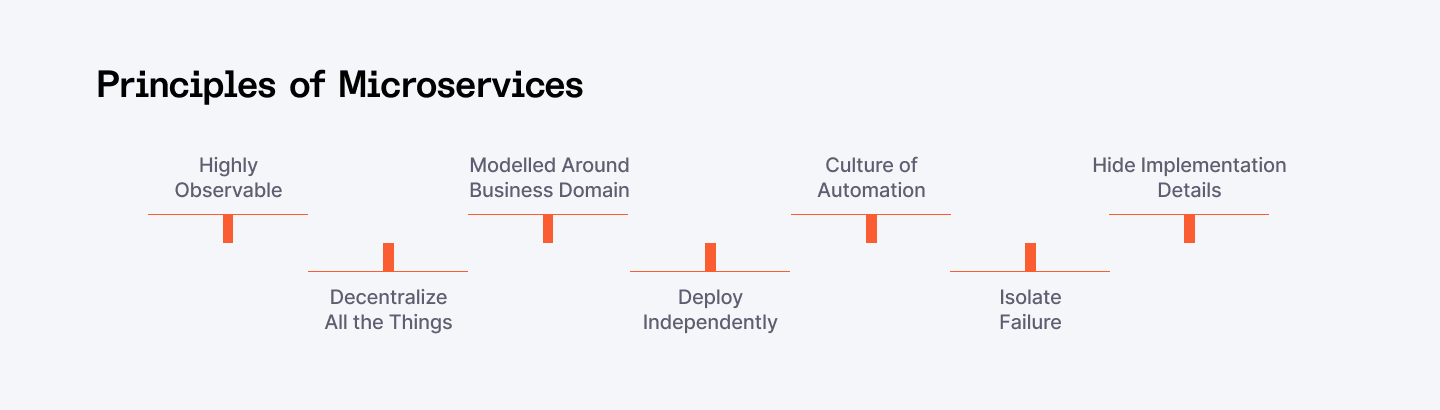
1. Decentralization and Autonomy
Microservices architecture is built in such a way that every microservice is singular and can work independently thus not heavily dependent on other services. All the services are independent of their database and logical system. This level of autonomy can lead to flexibility as services can be developed, deployed and scaled up in a way that is self-contained and not reliant on any other service.
2. Each Service as an Independent Unit
Microservices are small and separate services that are individually responsible for one operation. Relative to other services it can be developed, tested and deployed independently. Due to this modular approach, the management and maintenance of complicated applications is sufficiently facilitated.
3. Benefits of Loose Coupling
Loose coupling is one of the most defining attributes of microservices. Each service should be able to communicate with other services through APIs, with dependencies kept at a minimum. This makes many failures self-contained and isolates services so that when it becomes necessary to redeploy, offer or change functionality, it does not necessarily bring down the entire chain of services.
4. Bounded Contexts
Dealing with bounded contexts allows for the definition of the scope of each microservice. A bounded context refers to the area of control within an application or the narrow area of the application’s concern. This way, it is possible to avoid services getting intertwined and getting increasingly more sophisticated.
5. Defining Clear Boundaries for Each Service
Clear partitioning of functionalities and responsibilities for each microservice are essential to prevent unnecessary blurring of the roles and missions of each microservice within the context of the overall architecture. Every service should have clear objectives and mandates, and the responsibilities of services should not overlap. This creates modularity and helps in comprehending the system and its functional capability and hence allows for easy management of the system.
6. Preventing Tight Coupling and Complexity
Tight coupling, while making processes fast and efficient, can also increase the challenges and decrease their maintainability. Through embracing the principles of loose coupling and the idea of bounded contexts, one is able to mitigate dependencies hardwiring and hence the creation of a complex interdependence.
7. API-First Approach
The API-first approach implies that before the development of microservices, it is necessary to design and describe their APIs. This makes it possible for services to be able to communicate and also enables them to interface with other systems. When choosing the API, you are creating a clear and unified interface for working with microservices.
Designing Services Around Well-Defined APIs
APIs that are clearly defined are pivotal to engagements between microservices as well as with other systems. Therefore, APIs should be made simple to understand, simple to use, and simple to manage. They should give proper documentation and samples for the developer to know the right way to use the service.
Facilitating Communication and Integration
API-first approach also means that microservices can effectively communicate and interoperate with each other. One of the possible benefits includes specification of the defined APIs to enable services to interoperate and exchange information in accordance with established standards. This makes it easy when developing distributed applications and also minimizes the possibility of facing integration problems.
8. Continuous Delivery
Continuous delivery is a practice that refers to the delivery of microservices where the building, testing and deployment are all automated. When you incorporate the continuous delivery pipeline, then it becomes easier to make changes to the services and get them into production. This leads to faster development cycles and lets you adapt to the customers’ feedback or to the changes in the market more efficiently.
Implementing a Pipeline for Frequent and Automated Deployments
Continuous delivery is a process where testing, packaging, and deployment are integrated and run as various processes within a pipeline. This ensures that problems are detected as early as possible in the development process, thus minimizing the number of defects that might make it to the production process. If you are to automate all these tasks, it would be fairly easier and faster to deliver features and bug fixes.
Ensuring Rapid Delivery of Features and Bug Fixes
Continuous delivery lets you deliver new features and bug fixes more often to the customers. By applying automation for the deployment process and the number of manual actions needed, you can decrease the time needed to get the changes to production. That way, it positively boosts customer satisfaction and sustains business competitiveness in today’s highly dynamic environment.
Automation Tools
Consider using tools like:
- Jenkins: A popular open-source continuous integration and continuous delivery server.
- GitLab CI/CD: Integrated CI/CD capabilities within GitLab.
- CircleCI: A cloud-based continuous integration and delivery platform.
By automating the build, test, and deployment process, you can reduce manual effort, improve efficiency, and ensure consistent quality.
Read More: Generative AI Architecture for LLM Applications
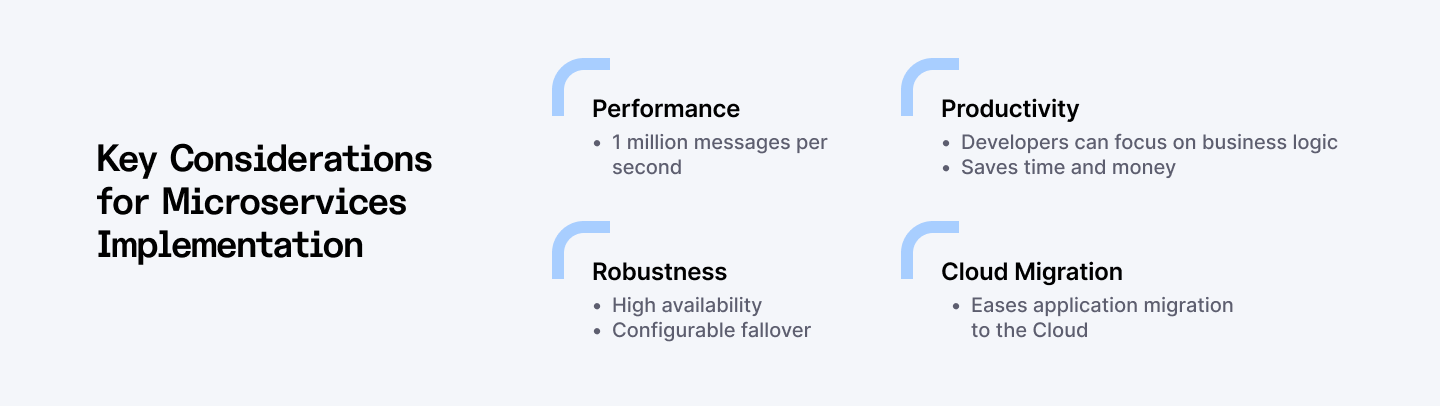
Key Considerations for Microservices Implementation
Service Identification and Decomposition
There is a critical process in moving organizations to the microservices architecture approach, which is the segmentation process that involves dissecting a monolithic application into microservices. This means that to identify natural boundaries, one has to read the business capabilities, functional areas, and domain models properly.
Strategies for Identifying Suitable Boundaries
Domain-Driven Design (DDD):
Bounded Contexts
After understanding the core concepts, relationships, and rules, one has to figure out the bounded contexts in the domain. For instance, where the object of study is the e-commerce application would highlight the bounded contexts such as; Order Management Bounded Context, Product Catalog Bounded Context, and Customer Management Bounded Context.
Event Storming
It is also necessary to perform a maintenance collaborative workshop for the major domain events, commands, and aggregates visualization. This can help in defining natural boundaries with reference to the flow of data and interactions in the system.
Business Capabilities:
Simplify the structure of the application in terms of the roles it plays in the organization’s operations. For instance, in the banking application, one can have sub services such as “Account Management, Loan Processing and Payment Processing”.
Functional Decomposition:
Application functions should be broken down into smaller and more manageable portions that can be offered as separate services. This can be based on some features or even usage scenarios.
Example: Let’s assume there is a monolithic e-commerce application. Using DDD, you may come up with bounded contexts that may include “Order Management,” “Product Catalog,” and “Customer Management.” These can be further broken down into microservices that may include “Order Service,” “Product Service,” and “Customer Service.”
Technology Stack Selection
Selecting the appropriate technology stack for a specific microservice is crucial for its performance, scalability, and maintainability objectives. Consider factors such as:
Team Expertise:
Choose the tools that your team is conversant with to avoid working with unfamiliar tools, which may make your team spend considerable time familiarizing themselves with the various technologies available.
Performance Requirements:
Select technologies which can deliver the service performance requirements for instance low latency or high throughput.
Scalability Needs:
Take into consideration the need of the service in handling large numbers of accesses and choose technologies that can accommodate it.
Example: If you are targeting a high-performance microservice that may deal with real-time data, the most suitable programming language you should use is Go or Java while the most appropriate type of database you should use is Cassandra or Redis. Hence, for a service that mainly performs batch processing, a language like Python or Scala and a database like PostgreSQL or MongoDB is more suitable.
Communication and Coordination
Microservices communicate and coordinate with each other using various mechanisms, such as:
Messaging Systems:
Message Queues
Use message queues like RabbitMQ or Kafka to decouple services and enable asynchronous communication.
Event-Driven Architectures
Publish events to a message bus and have interested services subscribe to relevant events.
Service Discovery:
Registries
Use service registries like Consul or Eureka to discover the addresses of other services.
DNS-Based Services
Use DNS to resolve service names to IP addresses.
API Gateways:
Centralized Entry Points
Use API gateways like Kong or Zuul to provide features like authentication, authorization, rate limiting, and load balancing.
Example: When planning microservices for an e-commerce app, you might use RabbitMQ to broker messages between the “Order Service” and the “Inventory Service.” You can also use Consul for service discovery. API gateway could be used to exist as a single access point for clients to make requests to the microservices.
Data Management
Managing data consistency and eventual consistency across distributed microservices is a significant challenge. Strategies for data management include:
Data Partitioning:
Divide data across multiple databases or storage systems to improve scalability and performance.
Data Replication:
Replicate data across multiple nodes to ensure availability and fault tolerance.
Eventual Consistency:
Allow for temporary inconsistencies between data replicas, ensuring that data will eventually converge to a consistent state.
Example: In an e-commerce application, it may be beneficial to partition the product data by its categories or by regions. You could also copy data to different databases for the purpose of achieving high availability. To deal with the concept of eventual consistency, it is possible to employ such measures as optimistic concurrency, or conflict remediating.
Testing and Monitoring
Effective testing and monitoring are essential for ensuring the quality and reliability of microservices. Strategies include:
- Unit Testing: Test individual components of each microservice in isolation.
- Integration Testing: Test the interactions between multiple microservices.
- End-to-End Testing: Test the entire application flow from the user's perspective.
- Performance Testing: Evaluate the performance of microservices under various load conditions.
- Monitoring and Observability: Use tools like Prometheus, Grafana, and Jaeger to track the health, performance, and behaviour of microservices.
Example: You could use the JMeter tool to conduct load testing on your microservices to establish areas of inefficiency. For detecting and measuring the health and performance levels of your microservices, you may use Prometheus for data harvesting and Grafana for data analysis. It is seen that Jaeger can be utilized for distributed tracing to identify requests across independently existing services.
Read More: Hiring a Developer: The Know-All Guide
Best Practices for Microservices Success
Gradual Migration
A step-by-step migration approach is most often preferred when migrating to the use of microservices. This is the process of unbundling the single application into multiple services gradually thus reducing chances of a major disturbance.
Case Study: Migrating a Monolithic E-commerce Application
Imagine that there is a big e-commerce application with a monolithic architectural structure. As a way to proceed with the transition towards microservices, first, one might perform the extraction of the “Product Catalog” as a separate service. This service could be used to provide updates on products, including information and search capabilities as well as recommendations. In a similar way once you adopt the “Product Catalog” service in the organization and successfully test it, you can then introduce other modules such as “Order Processing” “Payment Processing” and “Customer Management” as other microservices.
Design for Failure
Architectures based on microservices are inherently distributed, which means that they are more vulnerable to failures. There is a strategy known as Design for failure that implies the presence of functions and mechanisms in the design that allows addressing the errors or failure issues.
Techniques for Design for Failure
- Circuit Breakers: Employ circuit breakers to help shut down failing services to avoid more services going down. For instance, if a service fails many times, then the circuit breaker can halt it briefly while other services are working.
- Retry Policies: Use retry policies to trigger a set of actions to retry an HTTP request every time a request fails under certain circumstances. For instance, you might attempt a request which has been rejected one or two times or thrice before you abandon any such attempt.
- Bulkhead Patterns: Make services independent to avert the problem in one service affecting the other ones. This can be attained by hosting unrelated and independent runtimes or instances for the several services.
Security Considerations
Security is a crucial component when it comes to architectures of microservices. To safeguard microservices from susceptibilities and antagonistic access, security should be ensured at the service level.
Security Measures
- Authentication and Authorization: To confirm the identity of users and to permit their access to the microservices, there is the need to incorporate proper authentication approaches such as OAuth or JWT.
- Data Encryption: Secure data transmission and storage using secure socket layers and other secure means of data encryption.
- Input Validation: Check submitted input data to filter out injection attacks and other security threats.
- Vulnerability Scanning: It is important to carry out vulnerability scans frequently to assess the vulnerabilities of the PC and tackle them appropriately.
- Security Audits: Conduct security assessment to determine the overall security situation within your microservices system.
- Privileged Access Management: DevOps and platform teams typically hold elevated access to deployment pipelines, container orchestration, and production infrastructure. Using one of the top privileged access management (PAM) tools helps vault credentials, enforce least-privilege, and audit who touched what across your microservices environment.
Continuous Learning and Adaptation
Microservices architectures are evolving rapidly, and it's essential to stay updated with emerging trends and technologies. Embracing agile development and iterative improvements allows you to adapt to changing requirements and learn from your experiences.
Emerging Trends
- Serverless Computing: Consider using serverless platforms like AWS Lambda or Azure Functions to deploy and scale microservices without managing infrastructure.
- Cloud-Native Technologies: Utilize cloud-native technologies like containers (Docker) and orchestration platforms (Kubernetes) to simplify the deployment and management of microservices.
- Service Mesh: Explore service mesh technologies like Istio or Linkerd to provide advanced features like traffic management, security, and observability for microservices.
By following these best practices and staying updated with emerging trends, you can increase the likelihood of success in your microservices journey and reap the benefits of improved scalability, maintainability, and flexibility.
Read More: The Ultimate Checklist for Releasing Your Full-Stack Web Application
Microservices Patterns
Strangler Pattern
The strangler pattern is a gradual migration strategy that involves slowly wrapping a new microservices-based application around an existing monolithic application. Over time, the new microservices architecture gradually replaces the monolithic application, minimizing the risk of disruption.
Saga Pattern
The saga pattern is a distributed transaction pattern that involves coordinating a series of local transactions across multiple microservices. It uses compensating actions to ensure data consistency in case of failures. The saga pattern can be implemented using either choreography or orchestration.
Choreography Pattern
In the choreography pattern, microservices communicate with each other by publishing and subscribing to events. Each microservice is responsible for making decisions based on the events it receives, leading to a decentralized and loosely coupled architecture.
Example: The below diagram illustrates a choreography-based saga pattern for a booking process. Multiple microservices (Booking Service, Payment Service, Seat Updating Service, Notification Service) interact by publishing and subscribing to events, with a Saga Execution Controller managing the overall process and a Saga Log tracking its execution.
.png)
Containerization and Orchestration
- Docker: A popular tool for packaging applications into containers, providing a consistent and portable environment.
- Kubernetes: An open-source container orchestration platform that automates the deployment, scaling, and management of containerized applications.
By using Docker and Kubernetes, you can simplify the deployment and management of microservices, ensuring that they are running on consistent environments and can be scaled easily.
Service Mesh
A service mesh is a dedicated infrastructure layer for managing communication between microservices. It provides features like traffic management, security, and observability.
- Istio: A popular open-source service mesh platform that offers features like load balancing, fault tolerance, and service discovery.
- Linkerd: Another popular service mesh platform known for its simplicity and performance.
A service mesh can simplify the management of microservices by handling tasks like service discovery, load balancing, and security, allowing developers to focus on building business logic.
Observability
Observability is the ability to understand the internal state of a system based on its outputs. In microservices architectures, observability is crucial for troubleshooting issues and monitoring performance.
- Jaeger: A distributed tracing system that helps visualize the flow of requests through a microservices architecture.
- Zipkin: Another popular distributed tracing system that provides similar capabilities to Jaeger.
- ELK Stack: A popular logging and analytics platform that can be used to collect, analyze, and visualize logs from microservices.
By using observability tools, you can gain insights into the performance and behaviour of your microservices, making it easier to identify and resolve issues.
Microservices Challenges and Solutions
- Distributed Transactions: Coordinating transactions across multiple microservices can be challenging. Solutions include using two-phase commit protocols or sagas.
- Data Consistency: Maintaining data consistency across multiple microservices can be difficult. Strategies like eventual consistency and event sourcing can help address this challenge.
- Network Latency: Network latency can impact the performance of microservices. Techniques like caching, asynchronous communication, and optimizing network topology can help mitigate latency issues.
By understanding these challenges and exploring potential solutions, you can effectively implement microservices architectures and overcome common pitfalls.
Build scalable, maintainable applications with expert developers from Index.dev. Get interview-ready candidates in 48hrs!
The Bottom Line
Microservices architecture offers numerous benefits, including improved scalability, maintainability, and flexibility. By breaking down applications into smaller, independently deployable services, organizations can achieve greater agility, resilience, and faster development cycles.
However, implementing microservices also presents challenges, such as increased complexity, operational overhead, and the need for careful data management and coordination. It's essential to carefully consider these factors and weigh the potential benefits against the costs before adopting a microservices approach.
To fully realize the potential of microservices, it's important to continue exploring and experimenting with different strategies and technologies. By staying informed about emerging trends and best practices, you can optimize your microservices implementation and achieve your desired outcomes.
Ultimately, the success of a microservices architecture depends on a combination of careful planning, effective execution, and a commitment to continuous learning and improvement. By following the principles and best practices outlined in this blog, you can position your organization for success in the era of microservices. To fully leverage the benefits of microservices, continuous learning and adaptation are essential. Index.dev supports this by providing resources and insights into emerging trends and best practices in microservices architecture. By staying informed and experimenting with new strategies, organizations can optimize their microservices implementations, ensuring they remain agile and responsive to market demands.
For Clients:
Stop searching, start building. Post a job on Index.dev to access a pool of qualified developers ready to tackle your most challenging projects. Tell us your needs, and we'll help you build a high-performing team that drives results.
For Developers:
Ready to work on innovative microservices projects? Join Index.dev and take your career to the next level with high-end remote opportunities!


