Cloud and DevOps engineers’ positions have become more critical for organizations that are planning to develop their business processes and software development. Cloud engineering is the branch of engineering dealing with the development and deployment of Cloud computing infrastructure. Cloud engineers are specialized in designing flexible, dependable, and secure solutions for the nature of businesses.
These activities include designing cloud services, deploying using IaC technology, monitoring cloud services, and working with development teams to add cloud technologies to existing applications. From this, they can harness technology with different cloud platforms for the most efficient resource optimization and the improvement of the application performance.

On the other hand, DevOps engineering is a methodology that seeks to bridge the gap between development and operations teams, fostering collaboration and improving software delivery processes. DevOps engineers play a crucial role in facilitating this integration by automating workflows through continuous integration (CI) and continuous deployment (CD) practices.
They engage with developers and operations personnel to arrange the software releases, while the systems are stable in the production situation. Notably, they are in charge of IT facilities, application performance, security, as well as feedback to eliminate early signs of problems during development. This is because DevOps engineers help dismantle the conventional game where different teams work in isolation in the software development process.
This blog aims to explain the critical functions of cloud engineers and DevOps engineers in today’s software development environment. By comprehending these roles, the organizations are well positioned towards the management of many factors that surround the application of technology and efficiency improvements.
Be the top talent companies are looking for! Join Index.dev for high-paying, remote cloud jobs on innovative projects in the US, UK, and Canada.
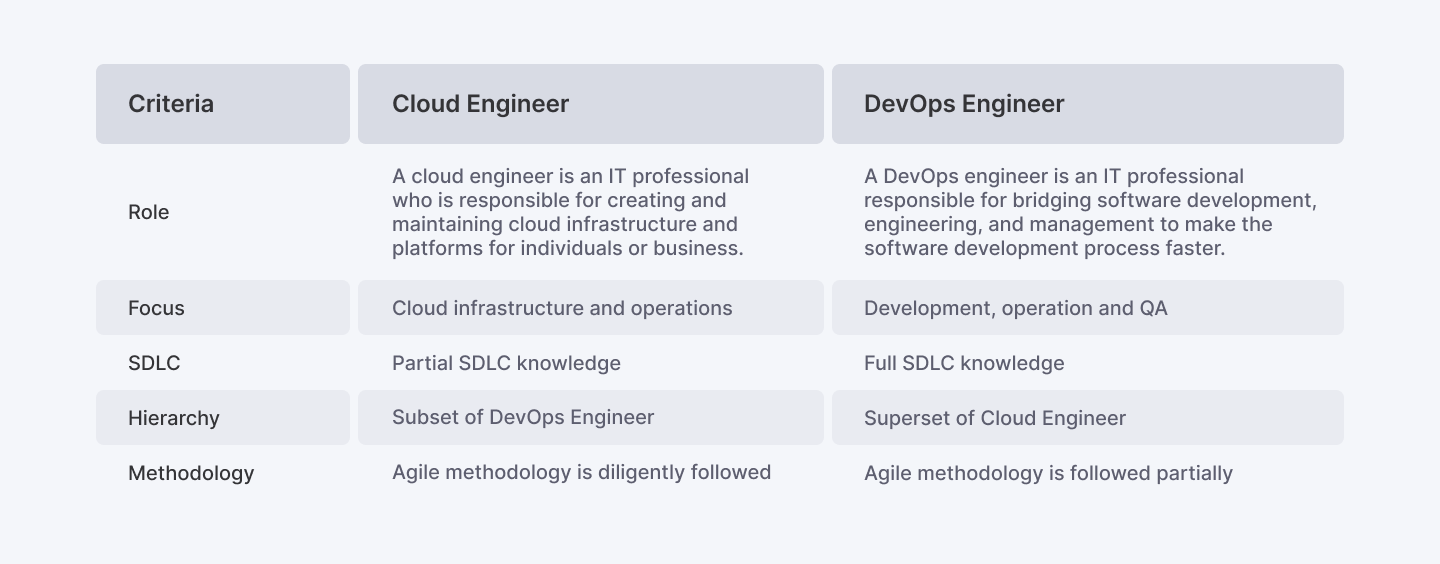
Key Differences: Cloud Engineer vs. DevOps Engineer
Cloud engineers and DevOps engineers are among the most important professions when it comes to the IT environment, especially as cloud solutions become more popular among different companies. Even though in their work both of these specialists deal with technology management and use, they emphasize different aspects of it.
Responsibilities
Cloud Engineer Responsibilities
- Cloud Infrastructure Design: Cloud engineers fully consider organizational requirements and develop safe and reliable architectures; furthermore, they identify appropriate CSPs, such as AWS, Azure or Google Cloud.
- Deployment and Automation: They manage the availability of cloud resources using Infrastructure as Code (IaC) solutions including Terraform or Ansible to avoid human error.
- Performance Optimization: Managing cloud resources to ensure that applications are running as smoothly as possible is often part of the role. This includes questions like resource allocation according to the demand and identification of various measurable parameters of performance.
- Security and Compliance: Security measures such as access controls and encryption should be followed to protect data stored in the cloud.
- Troubleshooting and Maintenance: Cloud engineers are expected to identify problems in the cloud network, perform recurrent troubleshooting, and prevent downtimes.
Cloud Platform Expertise:
- AWS: EC2, S3, VPC, IAM, Lambda, ECS, EKS
- Azure: Virtual Machines, Storage Accounts, Virtual Networks, Azure Active Directory, App Services, Azure Kubernetes Service
- GCP: Compute Engine, Cloud Storage, VPC Network, IAM, Cloud Functions, Kubernetes Engine
Infrastructure as Code (IaC):
- Terraform: Modules, providers, state management, best practices
- Ansible: Playbooks, roles, tasks, inventory management
- CloudFormation: Templates, resources, parameters
Cloud Native Technologies:
- Containers: Docker, container orchestration (Kubernetes, Docker Swarm)
- Serverless Computing: Functions as a Service (FaaS) platforms (AWS Lambda, Azure Functions, Google Cloud Functions)
- Microservices Architecture: Design principles, benefits, challenges
DevOps Engineer Responsibilities
- Continuous Integration/Continuous Deployment (CI/CD): CI/CD is a practice followed by DevOps engineers who seek to automate the process of integrating codes and deploying them frequently and quickly.
- Collaboration Across Teams: They have a good rapport with development and operations where they engineer for efficiency to incorporate development with operations.
- Configuration Management: Typically, the DevOps engineer uses Puppet or Chef to ensure that a consistent configuration of the application is maintained throughout the different environments during deployment.
- Monitoring and Logging: They deploy probes that notify developers of problems that occur in a production environment so that they can troubleshoot the issue.
- Infrastructure Management: Although the automation of infrastructure is not a core focus of DevOps, the engineers may also use tools to automate infrastructure to allocate resources.
CI/CD Pipelines:
- Jenkins: Pipelines, plugins, declarative vs. scripted pipelines
- GitLab CI/CD: Runners, stages, jobs, artifacts
- CircleCI: Orbs, workflows, configuration files
Automation Tools:
- Ansible: Playbooks, roles, and tasks for configuration management
- Chef: Cookbooks, recipes, nodes
- Puppet: Manifests, modules, agents
Monitoring and Logging:
- Prometheus: Metrics collection, alerting, visualization
- Grafana: Dashboards, visualizations, alerts
- ELK Stack: Elasticsearch, Logstash, and Kibana for log analysis
DevOps Practices:
- Continuous Delivery: Feature flags, dark launches, A/B testing
- Infrastructure as Code (IaC): Using tools like Terraform or Ansible
- Configuration Management: Using tools like Ansible, Chef, or Puppet
Skills
Essential Skills for Cloud Engineers
- Cloud Platform Expertise: Experience with the most utilized cloud solutions as a cloud architect (AWS, Azure, GCP) is crucial for cloud solutions design and management.
- Scripting Languages: Augmenting their knowledge about such working scripting languages as Python or Bash is quite important for automating activities and managing resources.
- Infrastructure as Code (IaC): Knowledge of IaC instruments such as Terraform or Cloud Formation is critical for handling such technology individually.
Essential Skills for DevOps Engineers
- Automation Tools: Basic skills in tools like Jenkins in regard to CI/CD processes play a significant role in enhancing rational software delivery.
- Scripting Languages: Like cloud engineers, DevOps engineers are also in need of knowledge of scripting language for automating the repetitive tasks that they get involved in.
- Containerization Technologies: Application developers use containerization tools like Docker and management tools like Kubernetes to ensure that their applications go well across different environments.
Although both roles are considered modern IT practices, cloud engineers are mainly responsible for cloud infrastructure and its reliability. On the other hand, DevOps engineers focus on the automation of the process of delivering software and working on that delivery process as a unified, cooperative team of developers and operators.
Explore More: Key differences between Software vs DevOps engineers
Overlapping Areas: Where Do They Meet?
When it comes to cloud computing and computing software, the positions of a cloud engineer and a DevOps engineer largely overlap. This synergy is particularly evident in three key areas: Infrastructure as Code popularly known as IaC, Continuous integration/continuous delivery usually abbreviated as CI/CD, and DevOps Culture. All of these arenas demonstrate how both parts work together not only to improve the flow of work and increase the automation of processes but also promote the cultural aspect of change.
1. Infrastructure as Code (IaC)
Utilization of IaC by Cloud and DevOps Engineers:
Infrastructure as Code (IaC) is an ideal strategy that is relevant for both cloud engineers and DevOps engineers as both promote the cloud infrastructure through coding. This approach involves the modelling and handling of infrastructure resources like the server and databases at a higher level of code. Due to infrastructure configurations being written in text files, one is able to use version control systems such as GIT to track changes made.
Cloud engineers can use IaC in an ideal spectrum to ensure a similar environment for developing, testing, and using the product. This consistency is imperative in order to eliminate possible mistakes and to improve the time of deployment. At the same time, IaC is leveraged by DevOps engineers to incorporate infrastructure modifications into CI/CD processes that also test and deploy application code with the corresponding infrastructure changes. This integration helps to create an effective work process that subsequently increases working efficiency.
2. Continuous Integration/Continuous Delivery (CI/CD)
Collaboration in CI/CD Pipeline Implementation:
Both cloud engineers and DevOps engineers are involved in setting up integrated CI/CD processes that support the software. Cloud engineers are primarily involved in enabling the CI/CD processes by configuring resources, and making sure they are properly set up to support potential need for demand. They also set up conditions that are similar to the actual production place for the testing activity.
On the other hand, DevOps engineers create the software development life cycle structures that the automation implementing such build, test, and deployment procedures are constructed from. The ones that do use it to implement tools that support the continuous integration of code changes as well as the continuous delivery of these changes into production environments with minimal intervention. This makes sure that while one side is working on the infrastructure the other is coming up with new application code making it possible to release new versions faster and also improving the quality of the software.
3. DevOps Culture
Contributions to a Collaborative Environment:
Though the primary responsibility of implementing DevOps culture lies with cloud and DevOps engineers, other players also contribute to building the culture. This culture fosters transparency and eased interaction between the development and operation teams as there are usually limited interfaces between the two fields.
Cloud engineers assist efforts by ensuring that they supply the rig required for the automation process. They make resources perpetually available for instantiation to support versatile experimentation and their subsequent deployment. On the other hand, the operations of DevOps engineers entail reliable methods that support different iterations that are fundamental in development. Combined, they promote conditions that enable teams to advance ideas more than the current conventional reliability level.
Comparing the set of tasks in cloud engineering with those in DevOps engineering one could mention the collaboration between the two when it comes to managing cloud resources, applying IaC to automate deployment processes, implementing reliable CI/CD pipelines, and fostering the organizational culture of permanent development in large organizations. This integration also increases operational effectiveness while at the same time, fostering advancements in the creation of software applications.
Choosing the Right Career Path
Several factors may affect an individual when choosing between the career of a cloud engineer or a DevOps engineer. Such factors comprise the interests, competencies, and general career aspirations of the personnel. Knowledge of these elements will thus assist prospective professionals in matching their ambitions to the expectations of each post.
Factors to Consider
Personal Interests
People need to decide what they are interested in technology and cloud computing. Genuine interest in problem-solving, system architecture and new technologies may show a perfect match for cloud engineering. On the other hand, those who like shared responsibility, robotics, and integration can rather prefer DevOps engineering.
Technical Skills
While both positions demand technical knowledge as the basis for one’s education, the nature of the work in each position differs. Exact specialists called cloud engineers should have profound knowledge of cloud computing systems (such as AWS, and Azure), networks, and cybersecurity. They call themselves cloud solution architects and specialize in building and overseeing cloud facilities. On the other hand, DevOps engineers need scripting, automation tools like Jenkins and docker, and CI/CD trends to manage the development and deployment process of a software application.
Career Goals
Career objectives can also be used to decide between these two courses. Cloud engineers can look at job titles that contain infrastructure designs and management delegation, for more senior positions that can include Cloud Solutions Architect or Head of Cloud Services. A DevOps engineer may want to level up and become a Site Reliability Engineer (SRE) or DevOps Manager, optimising the deployment and communication among the team.
Potential Career Paths
The cloud engineering profession and the deeds of ops engineering also present a wide array of challenges which can be of interest to students of varied abilities and inclinations.
Cloud Engineer Career Progression
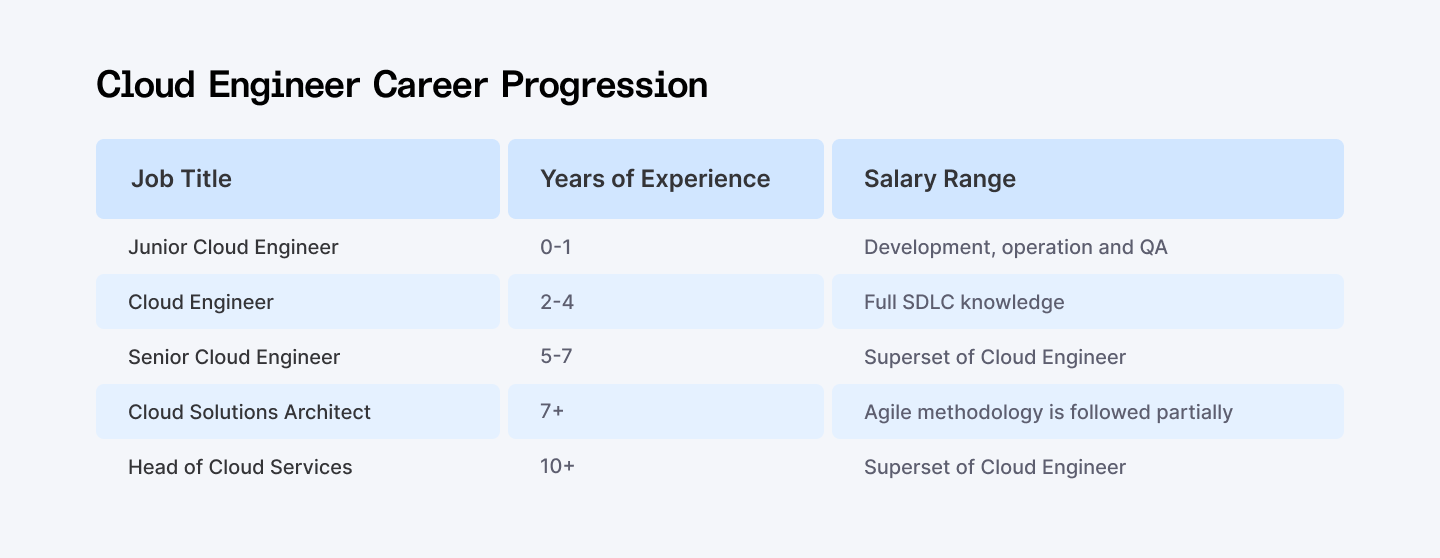
The specializations that cloud engineers may focus on include cloud architecture speciality, security engineering speciality, and data engineering speciality. With time, they may advance up the ladder and become managers who lead on the cloud initiatives and supervise experts.
DevOps Engineer Career Progression
DevOps engineers also have clear pathways for advancement:
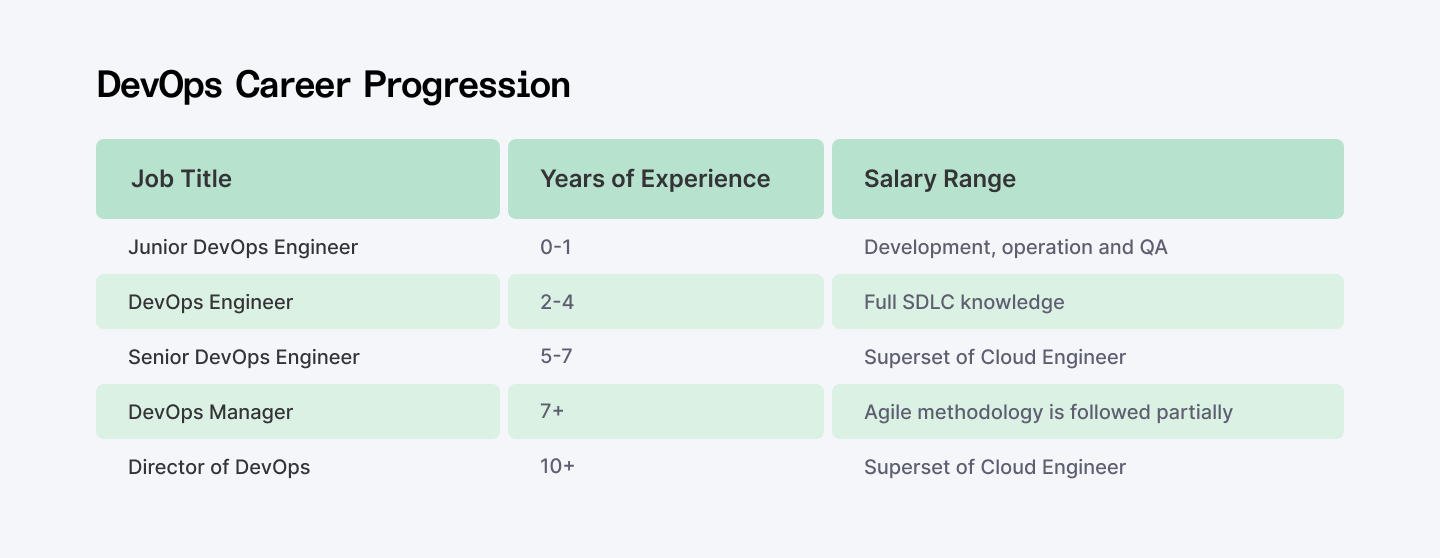
The specialized DevOps engineers can work per CI/CD pipeline or work with specific tools and platforms. They can also progress to management levels where they supervise teams that are crafting software delivery processes and or transform to other IT management capacities.
Finally, the decision whether to become a cloud engineer or a DevOps engineer depends on interests and technology expertise. Each of these tracks has considerable space for development and further differentiation in today’s dynamically developing technological field.
Explore More: How to Set Up and Optimize CI/CD Pipelines for Faster Development and Deployment
The Bottom Line
Cloud computing and software development are two industries growing at a tremendous rate and cloud engineers and DevOps engineers have emerged as very important personnel. Although both disciplines have the same mission to have application delivery and handling in the cloud, desk and skill sets may vary greatly. Cloud engineers are particularly concerned with the actual construction of the cloud services and materials, including their construction, implementation, extension, optimization and management. They focus on breaking down silos between development and operations, on integrating and implementing toolchains and standard processes, and on culture and people.
However, cloud engineers and DevOps engineers are two different roles that require the successful integration of both roles to see successful cloud adoption and software delivery. It allows them to work effectively and efficiently and create successful applications that address the company’s requirements. The cloud engineers that you have in your team should give you an understanding of how well and how inadequately the cloud can perform and what is achievable in it.
A DevOps engineer is well acquainted with automation and monitoring processes and how to react in the occurrences of incidents. Such coordination enables an organization to socially safeguard its processes and reduce the number of times it turns to manual intervention to maintain operational efficiency when requirements change. More importantly, this trend will see cloud engineers and DevOps engineers working hand in hand in future as they try to solve the challenges emerging from the cloud as it becomes more established in the market.
Which one is right for you?
- If you build infrastructure: Cloud Engineering might be your perfect fit. They’ll help your organization design cloud solutions, manage resources, and ensure robust security.
- If automation is key: DevOps engineers could be your calling. They’ll help you create efficient workflows, automate processes, and collaborate with other developers and operations teams.
For Engineers: Ready to take your career to the cloud? Explore Cloud and DevOps opportunities on Index.dev!
For Clients: Hire senior Cloud and DevOps engineers on the Index.dev platform. Improve your software delivery process today!