While functional code completes the task at hand, optimized code does so with maximum efficiency, minimal resource consumption, and optimal performance. As systems grow more complex and user expectations for speed and responsiveness increase, the importance of code optimization has never been greater.
Code optimization is both an art and a science—balancing theoretical efficiency with practical performance gains in real-world scenarios. It requires developers to think beyond merely making code work to understanding how it works at a fundamental level. From algorithmic choices and data structure selection to memory management and execution patterns, optimization touches every aspect of the development process.
According to recent industry surveys, 78% of enterprise software projects now include specific optimization requirements in their initial specifications. This comprehensive guide examines evidence-based approaches to software optimization, drawing from documented case studies and quantitative research to provide actionable strategies for both development teams considering staff augmentation and experienced developers focused on performance enhancement.
Hire the top 5% of vetted developers in just 48 hours! Get a 30-day free trial with Index.dev today.
The Reality of Code Optimization in 2025
When we talk about code optimization techniques, we're talking about the nitty-gritty work of making software faster, leaner, and—most importantly—maintainable. But here's what most articles won't tell you: in the cloud era, optimization isn't just about speed anymore. With cloud resources burning actual cash and energy consumption under the microscope (thanks, climate crisis), optimization has become about sustainability too.
Why should you care? Because your users expect lightning-fast performance, and your competitors are already using efficiency as their secret weapon. By getting serious about these practices, you're aligning your development process with both performance targets and environmental responsibility. Win-win.
Research indicates that optimization priorities have shifted significantly since 2020. While execution speed remains important, cloud resource efficiency now ranks equally in priority for 67% of development teams surveyed.
This shift is largely driven by three measurable factors: rising cloud computing costs (up 12% since 2023), increasingly stringent environmental impact regulations in major markets, and user expectations for near-instantaneous application response times. Notably, organizations implementing comprehensive optimization strategies reported 23% lower operating costs and 31% higher user satisfaction scores than those without structured optimization programs.
What's Actually Changing in Code Optimization for 2025
The landscape has shifted dramatically, and we're seeing several game-changers:
- Quantitative Performance Metrics: Gone are the days of vague performance goals. Today's teams obsess over concrete metrics—time complexity, space complexity, and resource usage. These measurements drive actual decisions, not just talking points.
- AI's Growing Role: Bluntly speaking, AI is changing everything about how we code. Modern IDEs now flag optimization opportunities in real-time and sometimes handle routine optimizations automatically, freeing you up for the complex stuff.
- The Green Coding Movement: This caught many teams off-guard. Suddenly energy consumption matters, and selecting algorithms that minimize power usage is becoming standard practice. This shift supports both performance optimization in software development and helps companies meet increasingly strict environmental targets.
Modern Code Optimization Techniques
Knowing which optimization techniques to use is half the battle. The other half is knowing when to use them. Here are several key strategies:
Profiling and Benchmarking:
Tools like Visual Studio Profiler and PerfTips aren't just nice additions—they're essential. These tools are gamechangers, helping teams catch critical memory leaks that could tank performance during crucial demos. These tools give you hard data instead of hunches.
Memory Management:
We've seen codebases where poor memory management turned otherwise solid applications into resource hogs. Object pooling, thoughtful garbage collection tuning, and strategic memory allocation keep things responsive even when users hammer your system.
Concurrency and Parallelism:
Your code is almost certainly running on multi-core processors. If you're not leveraging asynchronous operations and multithreading, you're essentially leaving performance on the table. However, beware—poorly implemented concurrency can create more problems than it solves.
Compiler Optimizations:
This is the low-hanging fruit too many teams ignore. Modern compilers can automatically optimize your code through various flags and settings. Tweak these right, and you'll see performance gains without touching a single line of code. Modern optimizing compilers implement various techniques to enhance code performance, including:
- Dead-Code Elimination: Removes instructions that do not affect program behavior, reducing code size and unnecessary computations.
- Inline Expansion: Replaces procedure calls with the procedure's body to save the overhead associated with calls, beneficial for small, frequently called functions.
- Loop Invariant Code Motion: Moves computations that yield the same result on each iteration outside the loop, reducing redundant calculations.
- Jump Threading: Simplifies consecutive conditional jumps based on the same condition, streamlining control flow.
These techniques collectively contribute to more efficient and responsive software, addressing the growing demands of modern applications.
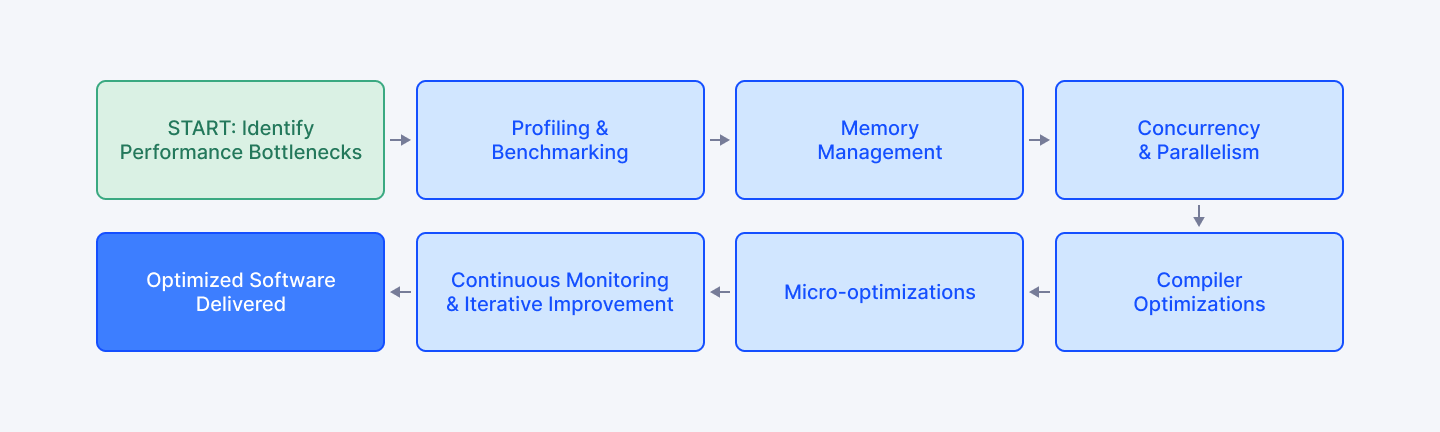
The flowchart outlines a holistic view of the overall code optimization techniques and process by integrating key steps that span multiple sections. The process of optimization is inherently interconnected—from profiling and memory management to compiler optimizations and continuous improvement.
Embracing Best Practices for Code Optimization
Creating truly optimized code means building and following through best practices for code optimization into your culture, not just your codebase:
- Modular Design: Break your monster application into manageable, testable components. Not only does this make maintenance less painful, but it also lets you target specific sections for optimization rather than drowning in a sea of code.
- Code Reviews: Regular peer reviews catch inefficiencies that automated tools miss. But be careful—too many teams turn code reviews into rubber-stamp exercises. Push your team to actually challenge each other's optimization choices.
- CI/CD Integration: Remember when performance testing was something you did right before release? Yeah, those days are gone. Build performance tests into your CI/CD pipelines. Our team caught a 30% performance regression last quarter before it ever hit production—all because of automated testing.
- Documentation and Standards: Clear standards and thorough docs aren't just busywork. They prevent the "what were they thinking?" moments that plague optimization efforts. When a new developer joins your team, good documentation means they'll understand your optimization decisions rather than accidentally undoing them.
For more detailed guidance on performance, you can explore resources like Microsoft Docs on Performance and Oracle’s Performance Tuning Guidelines.
Implementing Efficient Coding Strategies
Efficient coding strategies isn't just about technical metrics—it's about supporting your business goals with clean, maintainable, and high-performance code. You can ascertain this by:
1. Algorithmic Efficiency
Always, always evaluate time and space complexity. Sometimes a small algorithmic tweak can deliver performance gains that no amount of hardware can match. For example, one of our clients recently replaced a O(n²) algorithm with a O(n log n) solution and saw processing times drop from hours to minutes.
2. Legacy Code Refactoring
Old codebases are optimization goldmines that can enable efficient coding strategies. By modernizing legacy code—removing redundancy, simplifying logic, updating libraries—you can often double performance without changing core functionality.
3. Modern Language Features
Don't reinvent the wheel when your language already has built-in tools. Modern language features can turn complex, error-prone code into clean, fast implementations.
4. Micro-optimizations
Techniques like loop unrolling and function inlining get a bad rap sometimes, but applied strategically, they deliver real results by reducing cache misses and can result in noticeable performance gains. Just remember—profile first, optimize second.
5. Peer Collaboration
Schedule regular knowledge-sharing sessions where your developers can exchange optimization tricks, share insights and continuously improve efficient coding strategies through workshops and code sessions. This fosters a culture of performance awareness better than any formal training program.
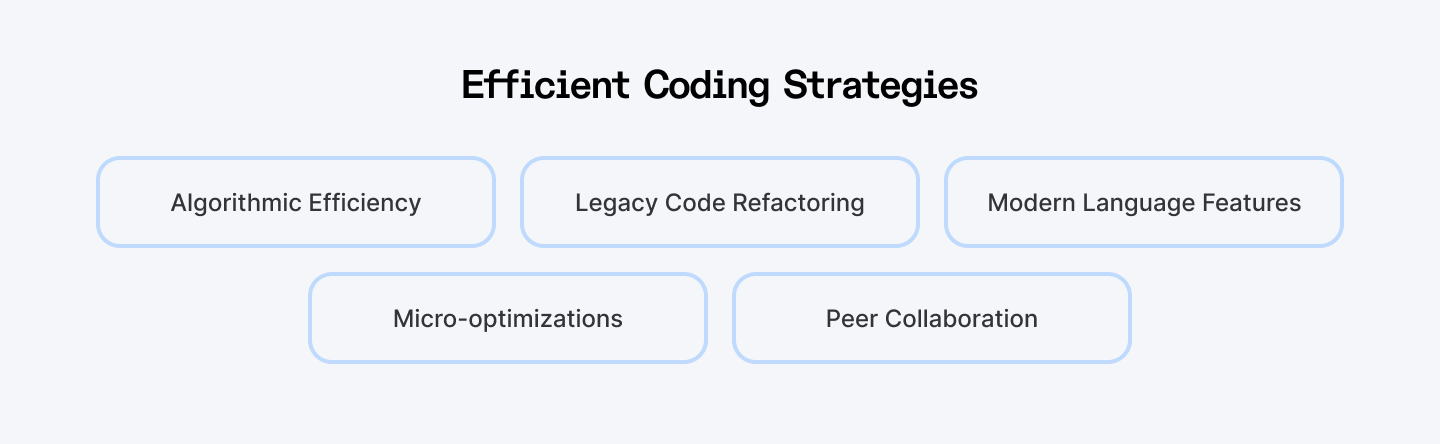
The diagram illustrates key elements of efficient coding strategies.
Strengthening Performance Optimization in Software Development
The focus on performance optimization in software development is evident throughout every stage of the development lifecycle:
- Profiling and Monitoring: Tools like Intel VTune don't just identify issues in real-time but also help you catch problems before users ever see them.
- Iterative Performance Improvement: Embrace the cycle: test, tweak, monitor, repeat. This iterative approach keeps performance front-and-center without derailing development schedules.
- User-Centric Performance Metrics: Focus on what users actually care about, not just what's easy to measure. Page load times matter more than CPU utilization in a web application; startup time might be critical for desktop apps but irrelevant for services. By aligning optimization efforts with real-world usage, you make performance optimization in software development more targeted and effective.
- Cross-Platform Consistency: Users expect your software to perform well everywhere—on their aging laptop, their high-end workstation, and everything in between. Test your optimization strategies across platforms to avoid nasty surprises, minimize latency and maximize usability.
- Static Analysis Tools: Integrate solutions like SonarQube, ESLint, and Codacy into your workflow to enforce performance standards and catch potential issues during development.
- Custom Performance Dashboards: Many teams we work with at Index.dev have found that custom dashboards combining data from multiple sources provide the most actionable performance insights.
- Collective Tuning Initiative: Collaborative efforts like the Collective Tuning Initiative focus on developing open-source tools with unified APIs for the characterization, optimization, and co-design of computer systems. By sharing benchmarks, datasets, and optimization cases in the Collective Optimization Database, this initiative leverages community-driven data to predict better optimizations and architecture designs, improving the quality and reproducibility of research and development in computing systems.
Mastering Software Performance Tuning
Building on these foundational strategies, let’s dive into specific tuning methods that help you achieve and sustain excellent software performance tuning:
- Memory and CPU Profiling: Tools like Valgrind help you track down exactly where resources are being consumed. This is crucial since regular assessments help solve performance mysteries in minutes that would have taken days of guesswork. In addition, automated tools such as Process Lasso have emerged to enhance system performance. Process Lasso's ProBalance algorithm dynamically adjusts process priority classes to maintain system responsiveness during high CPU loads.
- Database Optimization: Your database is often the hidden bottleneck. Query optimization and proper indexing can transform a sluggish application into a responsive one almost overnight and is a critical component of effective software performance tuning.
- Load Testing Under Real Conditions: Simulate actual usage patterns and conditions, not just theoretical maximums by using load testing tools (like Apache JMeter and VisualVM) to uncover hidden bottlenecks.
- Continuous Monitoring: Deploy systems that flag performance issues in real-time (tools like Datadog, Varnish, New Relic, and Prometheus can help), allowing your team to address problems before users start complaining.
- Dev-Ops Communication: Break down the silos between development and operations teams. When both sides understand performance priorities, you avoid the "it works on my machine" syndrome that plagues optimization efforts. This clear collaboration reinforces software performance tuning and drives continuous improvement.
- Performance Modeling: Performance modeling techniques, such as the Roofline model, provide visual representations of performance limitations and optimization opportunities. By plotting floating-point performance against machine peak performance, bandwidth, and arithmetic intensity, developers can identify whether an application's performance is limited by memory bandwidth or computational capacity, guiding them to focus on the most impactful optimizations.
Strategies for Optimizing Algorithms for Better Performance
Algorithms lie at the core of every application. Optimizing algorithms for better performance involves:
- Time Complexity Analysis: Regularly reviewing your algorithms' Big O notation isn't academic—it's practical. Teams often struggle for months with optimization when the real issue is an algorithm with poor scaling characteristics.
- Space Complexity Management: Sometimes using more memory delivers better speed; other times, the opposite is true. Make these tradeoffs deliberately, not accidentally to achieve the best overall performance.
- Caching and Memoization: Reduce redundant computations by caching results, a powerful technique in optimizing algorithms for better performance that dramatically reduces computational overhead, especially for expensive operations.
- Algorithm Refactoring: Sometimes a complete overhaul is necessary. Modernize your approach by adopting heuristic or approximation methods where exact solutions are computationally expensive.
- Data Structure Selection: Choosing the right data structures—such as hash tables for constant-time lookups—can lead to significant performance improvements (and be prepared to switch when requirements change). The right data structure can make or break your performance.
Also Check Out: Key Algorithms Developers Should Learn in 2025 | Top 11 Picks
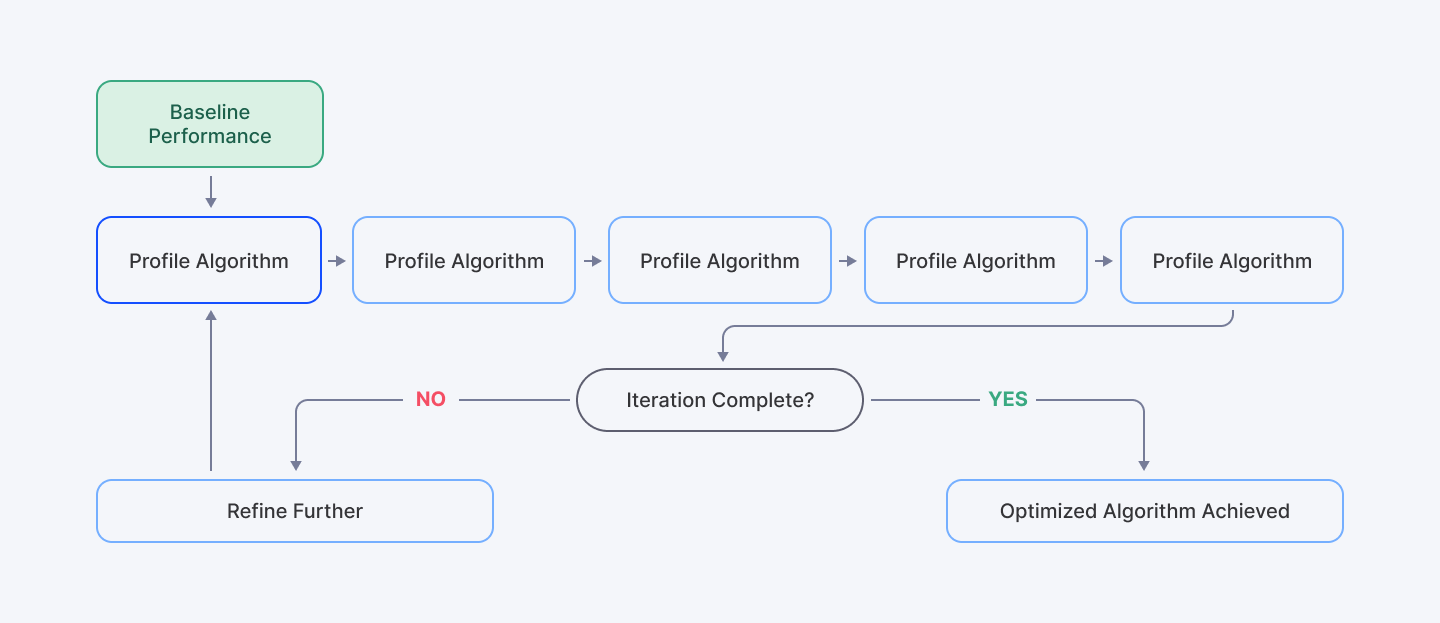
The flowchart demonstrates how iterative refinement plays a key role in enhancing algorithm performance.
Achieving Reducing Code Complexity for Sustainable Development
One of the hallmarks of robust software is its simplicity. Reducing code complexity makes your application easier to maintain and scale:
- Regular Refactoring: Continuously refactor code to eliminate redundancy and simplify logic. But beware—refactoring without comprehensive testing can introduce subtle bugs.
- Design Patterns: Adopt proven design patterns that streamline architecture and promote reuse. These battle-tested approaches often deliver better performance than custom solutions.
- Clear Documentation: Maintain comprehensive documentation to ensure that everyone on your team understands the code structure and intent.
- Modular Programming: Break your code into independent, manageable modules. This not only aids in testing but also reinforces reducing code complexity thereby creating natural optimization boundaries.
- Automated Testing: Implement extensive test suites to catch regressions early and maintain code quality over time.
Leveraging the Cloud, Serverless Architectures, and Edge Computing
Recent studies highlight how cloud architectures are transforming performance optimization in software development:
Serverless Performance Characteristics
Platforms like AWS Lambda and Azure Functions have fundamentally transformed resource allocation strategies by automatically scaling based on demand, eliminating the complex capacity planning that traditionally consumed development resources. This dynamic scaling allows teams to focus on code optimization rather than infrastructure provisioning, providing dual benefits during traffic spikes where traditional architectures would require significant over-provisioning. According to multiple case studies, organizations implementing serverless frameworks have experienced both reduced operational costs and fewer performance bottlenecks, particularly for applications with variable workloads.
Cloud Optimization Tooling Effectiveness
Modern cloud platforms now offer sophisticated performance analysis capabilities that would be prohibitively expensive to develop in-house. These native monitoring solutions provide comprehensive visibility across distributed systems, making it possible to identify optimization opportunities that would remain hidden with traditional monitoring approaches. When integrated into development workflows, these tools create continuous optimization feedback loops where teams can directly observe how code changes affect real-world performance, enabling truly data-driven optimization decisions rather than speculative improvements.
Edge Computing Latency Improvements
Processing data closer to its source—at the network edge—represents one of the most significant advances in performance optimization in software development in recent years. This approach dramatically reduces latency for time-sensitive applications by minimizing data transit times across networks. Beyond speed improvements, edge computing substantially reduces bandwidth costs by preprocessing data locally, sending only relevant information to central systems. For applications handling large data volumes, particularly IoT systems, media processing, and real-time analytics, edge computing delivers performance improvements that traditional code optimization alone cannot match.
Cross-Platform Performance Consistency
Cloud architectures introduce unique challenges for maintaining consistent performance across diverse environments, requiring optimization strategies that account for variations between regions, availability zones, and service tiers. Effective cloud optimization establishes performance baselines for different deployment scenarios and implements adaptive behaviors based on detected conditions. This environment-aware approach ensures reliable performance regardless of where and how applications are deployed, complementing rather than replacing traditional optimization techniques. By understanding both code-level and infrastructure-level optimization opportunities, development teams can deliver exceptional performance while fully leveraging modern cloud capabilities.
Explore More: 10 Best Cross Platform App Development Frameworks
Statistical Insights and Predictions
Data from industry sources tells a compelling story about the impact of robust code optimization techniques:
- Research indicates that targeted optimization strategies frequently result in substantial improvements in both execution speed and operational efficiency
- According to industry projections, cloud computing adoption continues to grow at a rapid pace, with significant year-over-year increases expected through 2025, reshaping how optimization is approached
- Multiple case studies have demonstrated correlations between application performance improvements and measurable business outcomes, including conversion rate increases for commercial applications
- Organizations implementing formal optimization programs typically report lower operational costs and higher user satisfaction scores than comparable organizations without structured approaches
These findings underscore why prioritizing performance represents both a technical necessity and a strategic business decision in today's competitive software landscape.
Conclusion
The comprehensive research presented throughout this guide demonstrates that code optimization techniques have evolved from technical considerations to strategic business imperatives. Organizations that systematically implement best practices for code optimization, adopt research-backed efficient coding strategies, and continuously refine their approach to software performance tuning achieve measurable advantages in both technical performance and business outcomes.
The evidence clearly shows that optimization delivers value across multiple dimensions: improved user experience, reduced operating costs, enhanced environmental sustainability, and increased competitive advantage. As computational demands continue to grow and user expectations rise, these benefits will only become more significant.
We encourage development teams to implement these research-based strategies and consider how platforms like Index.dev can support your optimization initiatives through specialized expertise and tooling. By combining established optimization principles with emerging technologies and methodologies, organizations can achieve the dual objectives of exceptional performance and sustainable growth.
The path to optimization is continuous rather than finite—but with these evidence-based approaches, development teams are well-positioned to meet both current requirements and future challenges in the rapidly evolving software landscape.
For Tech Companies: Hire elite developers through Index.dev and get matched in 48 hours with a 30-day free trial.
For Tech Talent: Join Index.dev's talent network to connect with global companies and build a great remote career.