
Web APIs are critical infrastructure in modern enterprise software, enabling seamless communication between heterogeneous systems. If you're considering technological agility for your organization, you'll find that migrating from Java to .NET represents a strategic architectural transformation. We've seen this driven by our needs for performance optimization, ecosystem alignment, and cost efficiency.
We have compiled a comprehensive guide providing you with a systematic approach to cross-platform API migration, addressing nuanced architectural challenges, and providing actionable implementation strategies.
🚀 Join Index.dev and get matched with global companies. Grow your remote career by working on innovative Java and .NET projects from anywhere!
Concept Explanation
Framework Comparison
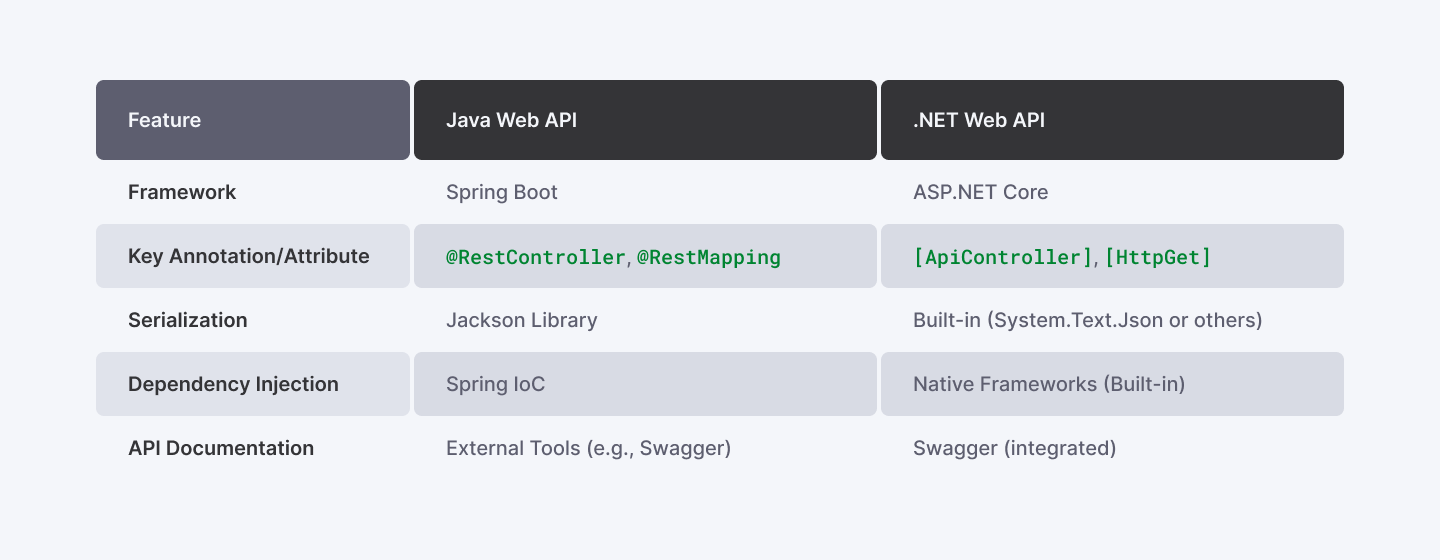
Key Differences
Annotations vs Attributes
- Java: Uses annotations such as @RestController, @RequestMapping.
- .NET: Uses attributes like [ApiController], [HttpGet].
Dependency Injection
- Java: Spring Boot provides a versatile IoC (Inversion of Control) container.
- .NET: Offers built-in dependency injection by default.
Serialization Libraries
- Java: Primarily uses Jackson for data serialization.
- .NET: Uses System.Text.Json or Newtonsoft.Json for serialization.
Read More: Java Persistence API (JPA) Framework for Database Access with Example
Technical Context and Migration Rationale
Platform Architectural Differences
As you develop modern enterprise applications, you'll need flexible, performant, and scalable API architectures. When we guide teams through migration from Java to .NET, we emphasize that it's not just about syntactical translation – you're embarking on a comprehensive architectural reimagining.
Here are the key motivations that might drive your decision:
- Performance Optimization: Leveraging .NET's high-performance runtime
- Ecosystem Integration: Seamless alignment with Microsoft technologies
- Cost Efficiency: Potential licensing and infrastructure cost reductions
Migration Methodology
Dependency Mapping Strategy
c#
private Type ResolveServiceType(object sourceDependency)
{
    // Add intelligent type resolution logic
    return sourceDependency.GetType().GetInterfaces().FirstOrDefault()
        ?? sourceDependency.GetType();
}

private Type ResolveImplementationType(object sourceDependency)
{
    return sourceDependency.GetType();
}

private DependencyScope DetermineScope(object sourceDependency)
{
    // Add scope determination logic based on source dependency characteristics
    return DependencyScope.Transient; // Default fallback
}
Problem Addressed:
Dependency lifecycle management differs between Spring and .NET, requiring intelligent translation of service scopes.
Technical Solution:
- Implements a switch expression for precise scope mapping
- Throws explicit exceptions for unsupported scopes
- Ensures type-safe dependency translation
Use Cases:
- Enterprise application migration
- Microservices architecture refactoring
- Complex dependency management in large-scale systems
Improved Controller Transformation
c#
public class User {
    public int Id { get; set; }
    public string Username { get; set; }
    public string Email { get; set; }
}

public record PaginationMetadata(
    int TotalCount,
    int PageSize,
    int CurrentPage
);

public record PaginationRequest(int Page, int PageSize);

[ApiController]
[Route("api/[controller]")]
public class EnhancedUserController : ControllerBase
{
    private readonly IUserService _userService;
    private readonly ILogger<EnhancedUserController> _logger;

    public EnhancedUserController(
        IUserService userService,
        ILogger<EnhancedUserController> logger)
    {
        _userService = userService ??
            throw new ArgumentNullException(nameof(userService));
        _logger = logger;
    }

    [HttpGet("users")]
    [ProducesResponseType(typeof(List<User>), StatusCodes.Status200OK)]
    [ProducesResponseType(StatusCodes.Status404NotFound)]
    [ProducesResponseType(StatusCodes.Status500InternalServerError)]
    public async Task<IActionResult> GetUsersAsync(
        [FromQuery] PaginationRequest request)
    {
        try
        {
            _logger.LogInformation("Retrieving users with pagination");
            var users = await _userService
                .GetUsersAsync(request.Page, request.PageSize);

            return users.Any()
                ? Ok(users)
                : NotFound("No users found");
        }
        catch (Exception ex)
        {
            _logger.LogError(ex, "Error retrieving users");
            return StatusCode(
                StatusCodes.Status500InternalServerError,
                "Internal server error"
            );
        }
    }
}
Problem Addressed:
Implementing robust API endpoint with comprehensive error handling and pagination support.
Technical Solutions:
- Async/await pattern for non-blocking operations
- Explicit error logging
- Comprehensive HTTP status code management
- Pagination support via query parameters
Use Cases:
- Large-scale user management systems
- Enterprise resource retrieval
- High-traffic API endpoints requiring efficient data fetching
Service Layer Transformation
c#
public interface IUserRepository
{
    Task<List<User>> GetUsersAsync(int page, int pageSize);
}

public interface ICacheService
{
    Task<T> GetOrCreateAsync<T>(
        string cacheKey,
        Func<Task<T>> factory,
        TimeSpan? expiration = null);
}

public interface IUserService
{
    Task<List<User>> GetUsersAsync(int page, int pageSize);
}

public class UserService : IUserService
{
    private readonly IUserRepository _repository;
    private readonly ICacheService _cacheService;

    public UserService(
        IUserRepository repository,
        ICacheService cacheService)
    {
        _repository = repository;
        _cacheService = cacheService;
    }

    public async Task<List<User>> GetUsersAsync(int page, int pageSize)
    {
        var cacheKey = $"users_page_{page}_size_{pageSize}";

        return await _cacheService.GetOrCreateAsync(
            cacheKey,
            async () => await _repository.GetUsersAsync(page, pageSize),
            TimeSpan.FromMinutes(10)
        );
    }
}
Problem Addressed:
Optimizing data retrieval through intelligent caching and repository abstraction.
Technical Solutions:
- Dynamic cache key generation
- Centralized caching mechanism
- Async repository pattern
- Configurable cache expiration
Use Cases:
- Performance-critical applications
- Reducing database load
- Implementing read-through caching strategies
Performance Optimization Techniques
- Async/Await Pattern: Maximize thread efficiency
- Caching Strategies: Reduce database load
- Minimal Dependency Injection: Optimize startup time
- Explicit Error Handling: Enhance system reliability
Migration Challenges and Mitigation Strategies
Common Pitfalls
- Incorrect lifecycle management
- Performance overhead in dependency translation
- Serialization inconsistencies
- Inadequate error handling
Recommended Migration Toolchain
- Swagger/OpenAPI: API documentation
- Postman: API testing
- SonarQube: Code quality analysis
Explore More: Top 6 StackOverflow Alternatives for Software Developers
Conclusion
When you are tackling API migration from Java to .NET, you will discover it goes beyond technological translation. You should look at holistic architectural reimagining. Your success hinges on:
- How you approach strategic planning
- Your comprehensive dependency mapping
- The rigorous performance optimization you implement
- The continuous architectural validation practices
By embracing these principles together, you can transform potential migration challenges into opportunities. These solutions enable you to strengthen your system performance and scalability while simultaneously opening up new possibilities for technological alignment and cost efficiency.
You can explore more here.
…
Don't just migrate - innovate. Transforming your Java APIs to .NET opens new opportunities for optimization and scalability. Whether you're a developer seeking challenging projects or a company looking for skilled .NET talent, Index.dev has you covered.
- For Developers: Advance your Java and .NET career! Join Index.dev to land top remote jobs with leading global companies. Apply now!
For Companies: Need expert developers for Java or .NET projects? Hire from Index.dev’s elite 5% vetted talent, get matched in 48 hours, and start with a 30-day free trial!


