
Imagine creating a new fintech app only to find out that storing your users' financial information in the wrong country would mean huge penalties. It's not a theory, it's already occurred to multiple businesses.
In 2023, approximately 60% of fintech companies had data breaches, illustrating just how significant data has to be treated.
At the heart of this challenge is the idea of data residency. It's where your data sits on servers all over the globe.
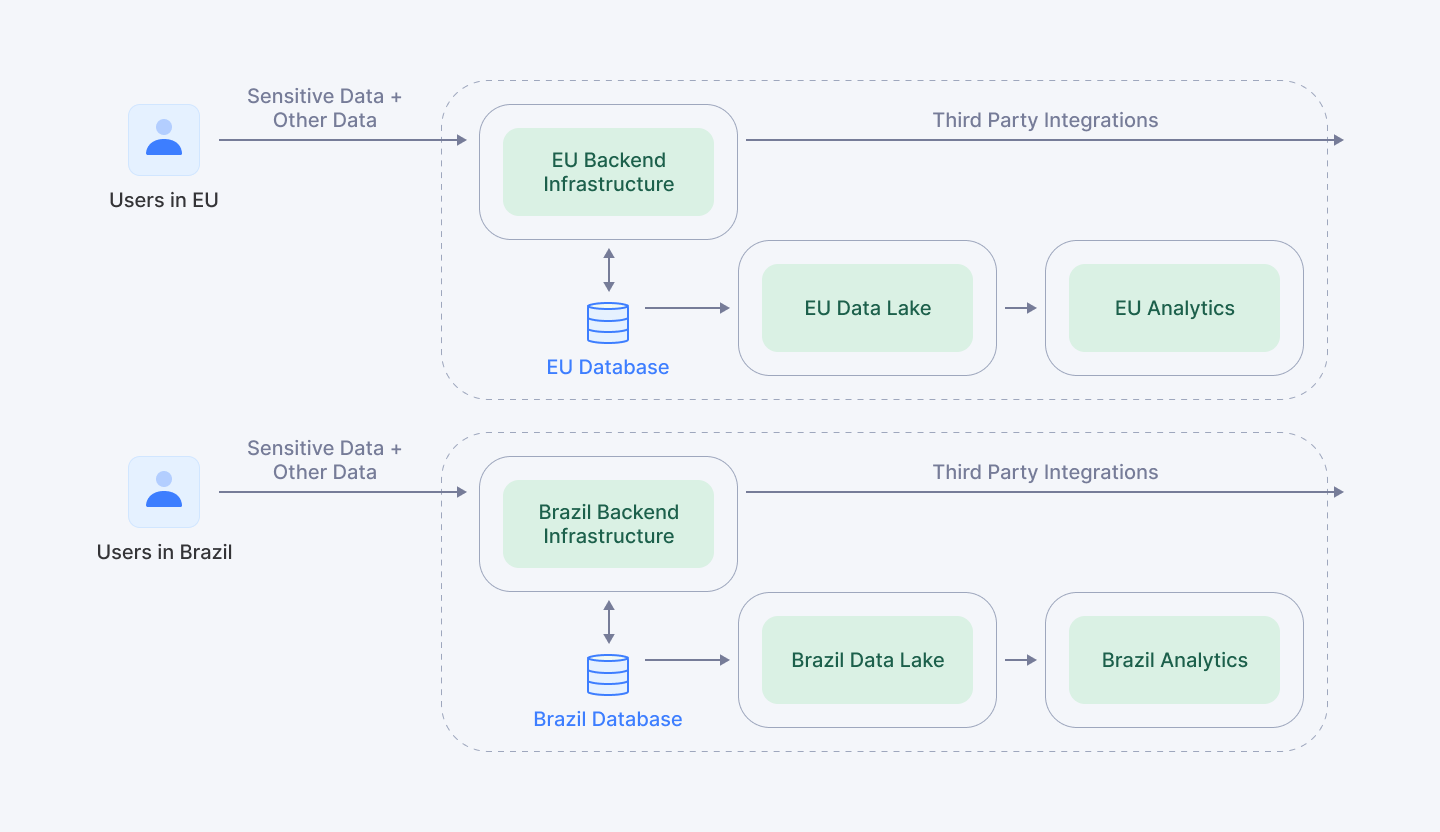
Looking to scale your fintech app securely? Index.dev connects you with top-tier developers skilled in cloud-based financial solutions.
What is Data Residency?
Consider data residency as the selection of a safe for your valuables. Just as you wouldn't put jewels in a neighborhood that isn't secure, you can't hold sensitive information on any server.
For fintechs, it's not merely a matter of checking regulatory boxes, it's building trust and going global, something Index.dev’s fintech developers prioritise in every deployment.
When you mess up data residency, it can result in hefty penalties, legal problems and lost customer confidence. But when executed correctly, data residency enables businesses to grow securely and establish long-term relationships with users.
Fintechs who begin with proper data residency plans are likely more responsive to audits, legal changes and unexpected growth opportunities.
Data Residency vs Data Sovereignty
Numerous individuals mix up these terms. Following is a quick overview:
Aspect | Data Residency | Data Sovereignty |
| Definition | Where data physically kept | Which laws govern the stored data |
| Example | EU customer data kept on German servers | Complying with GDPR since data is stored in the EU |
| Focus | Location | Legal Control |
| Implementation | Selecting server locations | Enforcing legal policies |
| Impact | Impacts performance and expense | Impacts legal requirements and risk |
One aspect that is too often overlooked is the fact that sovereignty can take precedence over residency. Even if your data is hosted in France, if it's run by a US business, it could still be covered by American legislation. This nuanced difference has enormous implications for compliance and protection in law.
Why Data Residency Is So Important in Fintech
Fintech firms handle sensitive financial information and if that information is mishandled, things can get out of hand.
The following are the top reasons why data residency is important:
1. Compliance with Regulations
Governments make stringent regulations to protect personal information. Index.dev’s fintech teams routinely architect systems that automatically adapt to these regional policies. Fintechs must comply with these regulations or face heavy fines.
Some of the most important regulations include:
- GDPR (Europe): Regulates how one should process personal data.
- CCPA (California): Gives people control over their personal data.
- PSD2 (EU): Focuses on secure electronic payments.
- PIPL (China): Imposes localisation rules for personal and sensitive data.
Violations are taken seriously. Meta, for example, was fined $1.3 billion under GDPR. For a fintech startup, such penalties could be a death sentence.
2. Building Customer Trust
About 78% of users stop using a service after a data breach. In fintech, trust is not optional. If customers are not comfortable with how their information is being managed, they will switch to an alternative provider.
Transparency in where data is stored and demonstrating compliance with local regulations is one way to establish that trust; something Index.dev’s fintech engineers focus on every deployment. Such openness can also be used as a marketing tool. Marketing materials for safe data storage resonate well with privacy-conscious users.
3. Global Expansion
Entering a foreign market means adapting to their domestic legislation. China and India, for example, have domestic laws of where financial data needs to be stored.
If you do not comply with these laws initially, it will become more difficult and costly to expand afterward.
Companies that design systems with global compliance in mind from day one can grow faster and more smoothly. Having pre-set architecture that aligns with regional policies makes scaling easier and reduces the cost of retroactive changes.
4. Competitive Advantage
Appropriate planning of data residency can be a competitive advantage. Companies that manage data responsibly tend to leverage that advantage in B2B sales pitches and investor decks. Having the ability to state "we already have compliance in these markets" is a sign of maturity and preparedness to grow.
Challenges in Managing Data Residency
1. Complexity of Multi-Cloud
Utilising several cloud providers is the norm. A fintech may host on AWS, use Azure for analytics and GCP for machine learning. This ties together a web of data that is difficult to monitor. Index.dev’s cloud specialists often streamline these architectures to ensure clarity and compliance.
For instance, payment information may be kept in AWS-US and user accounts may be in Azure-EU. Without the map, it is easy to fall out of compliance. Fintech companies need to keep detailed records of data storage and movement patterns.
2. Contradictory Legislation
Legislation in various territories can contradict each other. While GDPR has emphasis on upholding user rights, the US CLOUD Act (Clarifying Lawful Overseas Use of Data Act) permits access to data stored by US-based entities even if located outside of the country.
This makes it challenging to build systems that obey all laws at once. Often, companies go with the strictest rule to stay safe. A growing number of firms are considering vendor nationality and jurisdiction when choosing cloud partners.
3. Performance vs. Compliance
Users prefer apps to be fast. Optimal performance is achieved by placing data near them. But if regulations demand data within a country, performance might be impacted.
Example:
- Southeast Asian users might be better at speed if data is stored within Singapore. However, laws might require data to stay in each user's home country.
Fintechs typically get around this by employing hybrid cloud facilities, sensitive data stored locally but analytics or less sensitive information related to faster global servers.
4. Stringent Localisation Laws
Some countries, including Russia and Indonesia, have laws requiring that certain data remain domestically based. To navigate this, fintechs often turn to solutions built by Index.dev’s developers, who design region-specific systems that ensure compliance without compromising performance.
5. Vendor Risk
Even when your systems are compliant, your vendors may not be. A fintech that employs third-party APIs or services has to make sure that their partners play by the same rules. Due diligence is critical. Contracts need to have clear terms regarding data handling. Periodic audits need to form part of the process of vendor management.
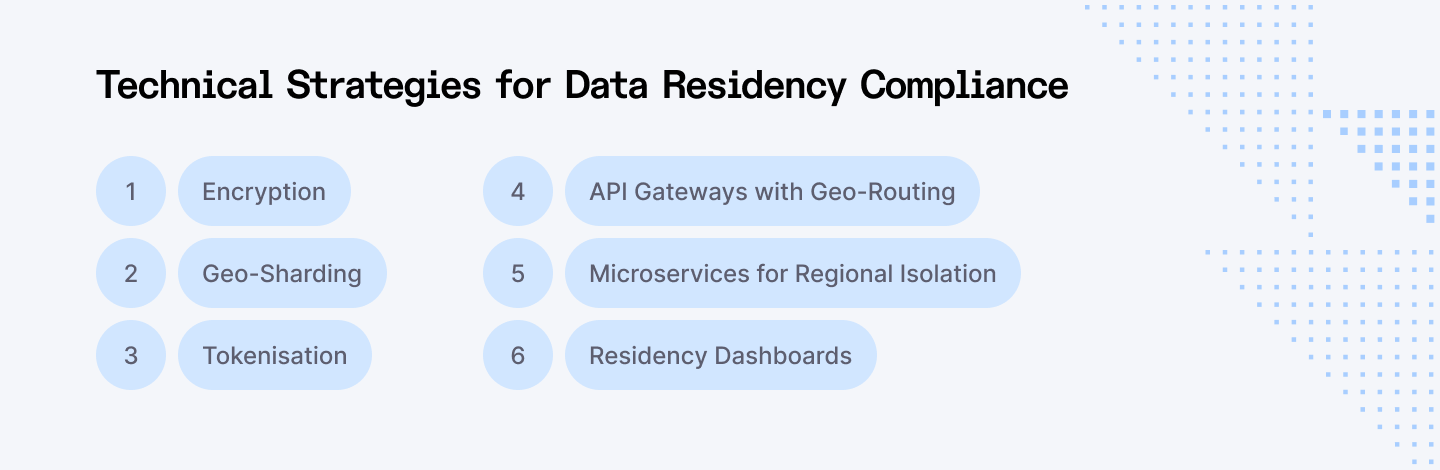
Technical Strategies for Data Residency Compliance
Here are some of the most important steps fintechs take to keep pace with data residency regulations while maintaining efficient systems:
1. Encryption
Encryption wraps data so that even when accessed, it cannot be read without a key.
- At rest: Use AES-256 encryption.
- In transit: Use TLS 1.3 for secure transfer.
Platforms like Metomic search databases and codebases to highlight sensitive data for encryption.
2. Geo-Sharding
Shred databases by region so user data is where it needs to be.
Example:
- European user data is routed to EU servers
- US user data is stored in the US
MongoDB and other software offer zonal sharding to achieve this automatically the kind of pattern financial app developers use to keep fintech platforms compliant with regional data laws without sacrificing performance.
3. Tokenisation
Replace sensitive data with holder (token) fields meaningless if stolen.
Example:
- Credit card number is a random token
Tokenisation is offered by platforms like Skyflow for financial data.
4. API Gateways with Geo-Routing
API gateways direct traffic to regional servers based on location.
Tools:
- Kong
- AWS API Gateway
Tools guarantee data requests are handled by only compliant servers; a practice built into the backend logic by Index.dev’s distributed API engineers.
5. Microservices for Regional Isolation
Divide applications into smaller microservices. Every region will have its own microservices and databases.
Use Kubernetes namespaces to manage and isolate resources for different regions.
6. Residency Dashboards
Real-time dashboards track where data lives, allowing teams to catch compliance holes early. Datadog, Splunk or New Relic can be set to show location-based metrics.
Tools and Technologies That Help
Several platforms and services make it easier for fintech companies to meet data residency, security and compliance requirements across regions:
Cloud Providers
- AWS Local Zones: Makes services local to cities.
- AWS GovCloud: Government-level high-security compliance.
- Azure Sovereign Clouds: Regulated industries isolated instances.
- Google Cloud Assured Workloads: FedRAMP, CJIS and others.
Data Governance Platforms
- IBM Cloud Pak for Data: AI is utilised to label data and implement proper policies.
- BigID: Provides real-time discovery and compliance mapping.
- OneTrust: Facilitates tracking consent, privacy policies and world compliance.
- Privacera: Provides fine-grained access control for hybrid cloud environments.
How Index.dev Helps Fintechs Navigate Data Residency
New York fintech wanted to serve customers in Germany. To meet EU data residency requirements, it used AWS Frankfurt servers to store user data. Because the data was in the EU, they had to comply with GDPR (data sovereignty).
Index.dev’s assigned developers who supported this fintech company by developing microservices specifically for EU users. It enabled secure, local data storage using TLS and AES-256 encryption. API gateways, configured by Index.dev’s developers, routed requests based on location.
By taking these steps early on, they were able to bypass subsequent legal hurdles and enter the EU market unproblematically. Index.dev’s team also engaged a local law firm in Germany to make their contracts and data policies conform to national interpretations of GDPR, one step deeper than mere surface compliance.
Read More: Freelance Software Developer Rates by Country (2025 Guide)
The Road Ahead
For fintech businesses, data residency is not a compliance checkbox. It's a critical component of gaining user trust and international expansion.
Using the right tools, transparency with consumers and top regulatory standards, technology disruptors can turn data residency into a business advantage, rather than an operational challenge.
Partner with Index.dev to future-proof your fintech stack! Hire vetted fintech engineers in 48h with Index.dev, experts in data residency, security, and compliance. Start with a free 30-day trial.


