As a recruiter, hiring the wrong full stack developer could potentially be your biggest nightmare. If you don’t use effective strategies for screening full stack developers before hiring, it will surely take a toll on the whole organisation. It will not only disrupt the morale of the team but it will also hinder the long-term company goals.
In this guide, we will dive into the role of a full stack developer, types of full stack development frameworks, required skills based on experience, top pre-screening strategies, a list of technical and non technical questions, and the best place to hire remote full stack developers.
Hire full stack developers vetted for technical and soft skills from a global talent network →
Understanding the Role of a Full Stack Developer
Full stack developer roles and responsibilities are not limited. Throughout the development process, they have to look after multiple aspects of building a complete online web app. They are familiar with backend, front-end, databases, and servers along with hosting environments Let’s explore some of the key tasks they are typically responsible for:
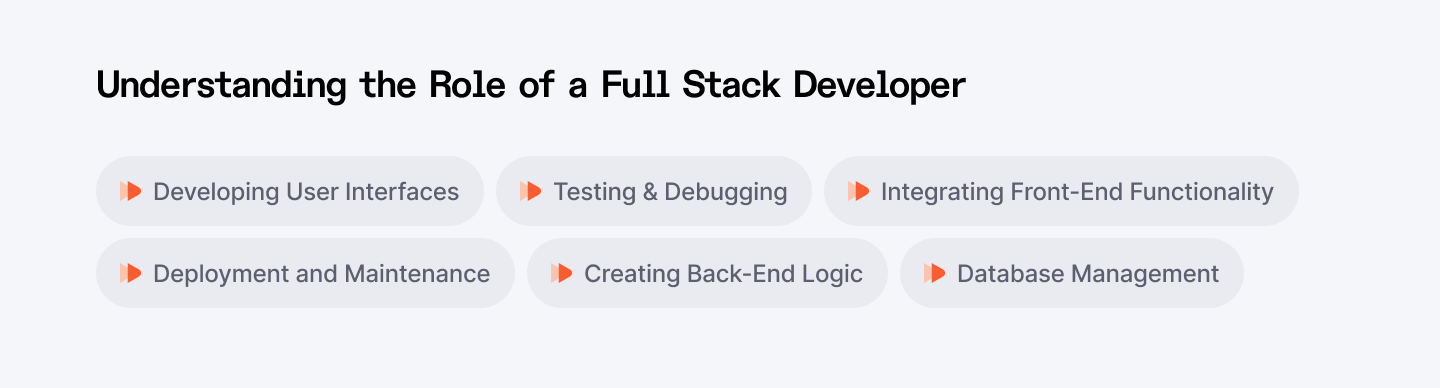
Developing User Interfaces
A full stack developer is responsible for building visually appealing, intuitive, and responsive user interfaces. They must be well-informed about the UI/UX concepts and the ability to produce designs that give a consistent user experience.
Testing & Debugging
Full stack developers test and debug their code to verify that it works as they want it to. They should be able to detect and resolve any problems or defects that may occur throughout the development process.
Integrating Front-End Functionality
Full stack developers are responsible for implementing the front-end features of a website or application. This includes developing HTML, CSS, and JavaScript code to generate interactive components, handle user input, and manage data presentation.
Deployment and Maintenance
Full stack developers are frequently engaged in deploying the application to a production environment and ensuring it runs well. They should understand server management and the ability to monitor and maintain the application's performance and security.
Creating Back-End Logic
Full stack developers are in charge of developing the backend logic for a website or application. This entails creating server-side code to handle data processing, business logic, and interaction with other services or APIs.
Database Management
They should have a solid grasp of databases and how to work with them. They are in charge of designing and administering the database structure, developing efficient queries, and maintaining data integrity and security.
Also Read: Effective Remote Recruitment Strategies for Engineering Managers
Types of Full Stack Developers
Full stack developers specialise in a variety of technological stacks, including:
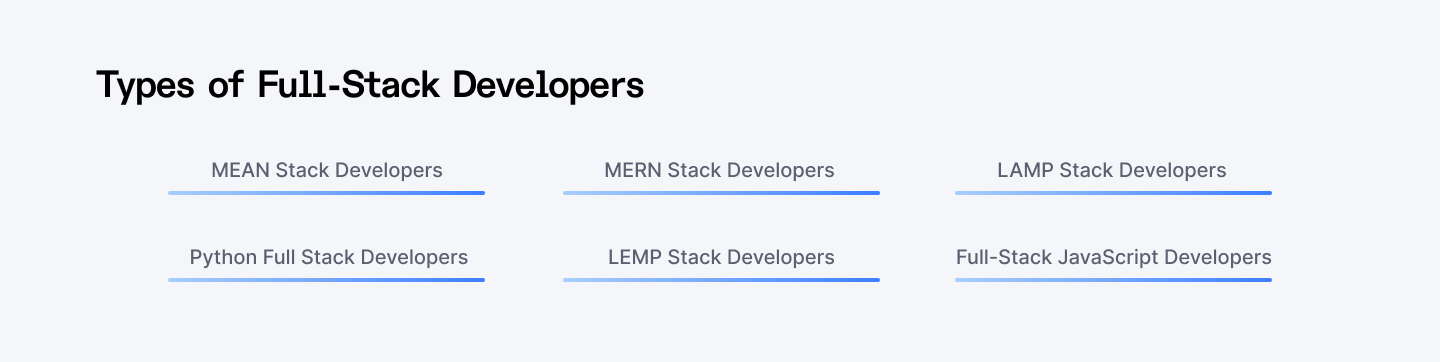
MEAN Stack Developers
All of the MEAN stack support applications are developed in JavaScript. Furthermore, experts believe MEAN is the ideal tech stack for any web development project. It includes MongoDB (NoSQL database), Express.js (back-end web framework), Angular (front-end framework), and Node.js (an open-source, cross-platform server) and can be used to create advanced web and mobile apps.
MERN Stack Developers
MERN is one of many variants of the MEAN stack in which React, a JavaScript library, replaces the standard Angular framework. The MERN stack takes advantage of JSX, a JavaScript modification suited for developing single-page apps with interactive user interfaces.
LAMP Stack Developers
LAMP stands for Linux, Apache, MySQL, and PHP. It is popular among web developers because it was one of the first to exist and is simple and stable.
Python Full Stack Developers
Python has a number of libraries that are suited for both the front and back end. Typically, Python is used with MongoDB and MySQL for database development. Front-end development may be integrated with the most used languages and frameworks, such as JavaScript, React.js, Angular.js, and Bootstrap.
LEMP Stack Developers
LEMP is an acronym for Linux, NGINX, MySQL, and PHP. This stack is identical to the LAMP stack, with the sole difference being that it uses Nginx instead of Apache. As a result of this update, the server can now autoscale as required.
Full-Stack JavaScript Developers
A Full Stack Developer with JavaScript knowledge is a flexible individual who can work on both the front and back ends of projects. They have a thorough grasp of JavaScript frameworks and libraries such as React, Angular, Node.js, and Express, which allows them to create smooth, responsive user interfaces and powerful server-side applications. They handle databases, APIs, and cloud services, ensuring that all components of a web application work together seamlessly.
Overview of Full Stack Development Frameworks
A framework is a set of reusable software components that minimises the time required to develop new applications. It contains resources such as code libraries, compilers, debuggers, and APIs. Using frameworks improves code quality, reduces development time, and ensures program security. The following are some common frameworks used in full stack development.
1. Spring Boot
Spring Boot is a Spring framework module that aims to ease initial setup and development. Spring Boot, written in Java, focuses on swiftly constructing production-ready apps by removing most of the boilerplate code and setup that is typical of Java development.
Key features: It is extremely adaptable and compatible with nearly all types of application needs, making it a great option for developing enterprise-level applications.
2. Laravel
Laravel is a PHP web application framework that is both exquisite and well-documented. It provides a clear, logical syntax aimed at making web development activities easier and faster.
Key features: Laravel offers a wide range of features similar to Ruby on Rails, including an ORM, routing, caching, and authentication, among others. Its extensive library collection and built-in techniques help to expedite web app creation and maintenance.
3. Ruby On Rails
The Ruby on Rails framework allows you to create interactive web apps using the Ruby programming language. It is a server-based framework that uses Model View Architecture (MVC) to create server-side web applications.
Key features: It includes ready-made code libraries for cards, forms, menus, and other HTML-based components, allowing developers to create online applications without reinventing the wheel.
4. Django
Django is a high-level Python web framework that promotes fast development and simple, practical design. Django adheres to the batteries-included principle, providing nearly anything developers could wish to accomplish ‘out of the box.’
Key features: As it is built in Python, it can be easily integrated with other Python libraries. It's also suitable for applications that need machine learning, data processing, and other difficult activities. Django handles much of the setting automatically, allowing developers to concentrate only on application development. It is commonly used to create strong and scalable web applications.
5. Angular
Angular Framework is a TypeScript-based framework for creating user interfaces for online and mobile apps. It is a UI-based component-based UI library that creates components using the command line. This framework creates Progressive web apps with server-side rendering and Firebase support for application authentication in one step.
Key features: It has a powerful CLI (Command Line Interface) tool for generating the application's first template, pre-configured routing, and testing support, as well as an inbuilt style processor such as Tailwind CSS or another.
6. GraphQL
Meta created the GraphQL Framework, which is a query language for APIs. It gives a schema for the data in the API. This framework serves as a bridge between the front-end client and the back-end services, aggregating many resource requests made by the end user into a single query.
Key features: It supports mutation, which alters the data resources and subscriptions in order to notify clients of any data alterations that have occurred. Simply said, GraphQL sends and receives HTTP requests and answers. This framework enables front-end developers to submit several requests to different services in order to populate the UI or user interface with data.
Also Read: 10 Best Cross Platform Mobile App Development Frameworks
Full Stack Developer Skills Based on Experience
The skills necessary for a Full Stack Developer change substantially as they develop in their careers. For those just starting out, the emphasis is on learning the essential technical skills required to create and manage online applications. As Full Stack Developers progress to the career pyramid to mid-level jobs, they must polish their technical competence.
They should take on increasingly complicated projects that demand a combination of technical and soft abilities. At the senior level, Full Stack Developers are required to have a strategic mentality, leadership abilities, and a thorough awareness of the business ramifications of their work. Let’s have a look at the skills required by full stack developers as per their level of experience.
Entry-Level Full Stack Developers
Entry-level Full-Stack Developers should focus on mastering front-end technologies like HTML, CSS, and JavaScript, as well as back-end languages like Python, Ruby, and Java. Database knowledge, version control systems such as Git, and basic server administration skills are also required.
These core abilities are significant since they serve as the framework for web development. Furthermore, entry-level developers should improve their problem-solving skills and learn how to interact successfully within a team, frequently utilising Agile development approaches. Developing these fundamental abilities is critical for contributing to all phases of the development process and future job advancement.
Mid-Level Full Stack Developers
Mid-level Full Stack Developers ought to develop their technical talents while also branching out into areas like API design, complex database administration, and cross-platform interoperability. They should be able to use current frameworks and libraries such as React or Angular on the front end and Node.js or Django on the backend.
At this level, there is a greater emphasis on producing clean, maintainable code and applying optimal software development techniques. Mid-level developers are also required to coach junior colleagues, which requires them to improve their communication and leadership abilities. They should be able to manage parts of a project and make architectural decisions that will impact the entire program.
Senior Full Stack Developers
Senior Full Stack Developers must comprehend the technical and business elements of their projects. They should be knowledgeable in system architecture and design patterns, and capable of leading the development of sophisticated, scalable systems. Senior developers are frequently responsible with making high-level technical choices, which necessitates a strategic approach to problem solving and a thorough awareness of market trends.
Leadership abilities are essential since they may lead many development teams and must be able to motivate and assist their peers. They should also have good negotiating skills and be able to engage successfully with stakeholders, including non-technical team members, in order to align technical direction with the company's strategic goals.
Hire senior Full Stack developers through Index.dev with a 30-day risk-free trial.
Top 7 Strategies for Screening Full-Stack Developers Before Hiring
If you invest your time and resources in screening the full stack developers before hiring, chances are you are going to have a quality hire and a worthy addition to the team. We have compiled top strategies for you so that you are able to hire even more proficiently.
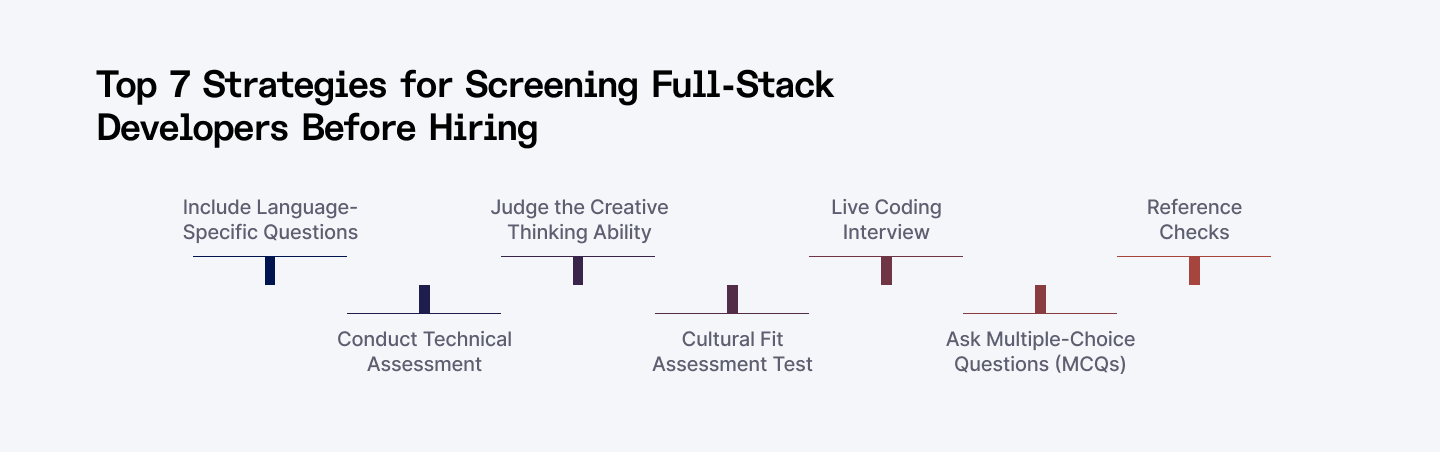
1. Include Language-Specific Questions
The Full Stack developer recruiting evaluation can be personalised to one of these areas, such as HTML, CSS, and JavaScript, as well as a knowledge of responsive design and user interface development. On the backend, you may ask questions on server-side languages like Node.js, databases like MySQL or MongoDB, and API creation and consumption.
It will help you find a devoted Full Stack developer with great practical abilities. A fundamental understanding of Git version management, debugging methodologies, and web security principles should all be reviewed.
2. Conduct Technical Assessment
Conducting technical evaluations is an important stage in the screening process. Here's how to handle it:
- Coding Challenge: Provide applicants with a coding challenge to test their problem-solving abilities and technical knowledge. This might include developing a user interface for the front end, as well as implementing an API or database integration for the backend.
- Algorithmic Skills: Assess their algorithmic abilities and data structure understanding to guarantee they can optimise code and perform complicated jobs efficiently.
- Database Querying: Evaluate their abilities to develop and optimise database queries, particularly if your company relies extensively on databases.
- Version Control: Ask candidates to show their knowledge of Git and version control technologies.
3. Judge the Creative Thinking Ability
The capacity to think outside the box and generate the greatest ideas is a valuable talent for a full-stack developer. A pre-employment evaluation allows you to determine whether a developer is capable of working on the backend by devising an innovative way of data storage. When you have a developer with these talents, you may increase your website's performance, which leads to a better user experience.
4. Cultural Fit Assessment Test
Cultural fit is critical for long-term success in your company. Consider whether the applicant is compatible with your company's values, work culture, and team dynamics:
- Behavioural Interview: Conduct behavioural interviews to see how well the candidate's values correspond with your organisation's culture.
- Team Interaction: Allow the candidate to meet possible team members or peers to assess their fit into the team.
5. Live Coding Interview
A live-coding interview is another essential component of a complete stack developer assessment test. Use this approach for the evaluation for the best-fit prospects. These applicants will be interviewed in person after passing the take-home exam and demonstrating that their personalities and skill sets would benefit the team. As a result, they'll go on to the live coding interview.
6. Ask Multiple-Choice Questions (MCQs)
In a Full Stack developer interview, MCQs are an effective way to test a developer's technical expertise. They can assist assess a developer's mastery of full stack basics. These are the important questions asked during the Python developer recruiting evaluation that cover both general and technical topics.
7. Reference Checks
Reach out to the candidate's references to learn about their work ethic, dependability, and performance in past employment. References might provide important details about the candidate's skills and limitations.
Top 10 Technical and Non-Technical Pre-screening Questions
Apart from the basic questions, here are some other questions that you can ask before hiring full stack developers.
Non-Technical Questions
- Do you like to work independently or as part of a team?
- What is your preferred language, and why?
- What is the most difficult project you've faced in your learning journey?
- How can you manage multiple undertakings at the same time?
- When you identify a code error made by a coworker, how should you proceed?
- What components of our business culture appeal to you, and how do you see yourself fitting within it?
- Can you give an example of when you exceeded your work responsibilities?
- What drove you to apply for this position, and what do you expect from it?
- Can you give an example of when you had to quickly learn something in order to accomplish a project? How did you approach it?
- How do you stay up-to-date on new industry trends?
Technical Questions
- Explain Pair Programming.
- What exactly do you mean by Cross-Origin Resource Sharing (CORS)?
- Tell us about a time when you debugged a difficult program.
- How Does Rolling Deployment Differ from Blue-Green Deployment?
- What factors are required for successful integration?
- Discuss the advantages and disadvantages of using "use strict".
- Do you prefer AMD or CommonJS? Why?
- What's the difference between the JavaScript keywords var, const, and let?
- Explain the difference between GET and POST.
- What is Multithreading? What are its applications?
Read More: The Ultimate Checklist for Releasing Your Full-Stack Web Application
5 Common Mistakes While Hiring Full Stack Developers
When screening full stack developer prospects, it is essential to be aware of typical mistakes and impacts that might result in poor recruiting decisions. Here are some errors you should avoid:
1. Excessive Focus on a Particular Technologies
While specialised technological knowledge is required, don't focus solely on individuals with experience in a certain stack. Full stack engineers are required to understand and adapt to new technologies. Assess their core capabilities and problem-solving abilities rather than simply evaluating if they've utilised the same technology stack as you do.
2. Ignoring Soft Skills
Technical abilities are essential but do not underestimate the value of soft skills such as communication, teamwork, and flexibility. A developer that excels in these areas can be an excellent addition to your team.
3. Rushing the Procedure
Avoid speeding through the screening process because of the need to fill the position fast. A well-thought-out and thorough screening procedure is required for making sound hiring judgments.
4. Not Checking Past Work and References
A developer's prior work demonstrates their knowledge, problem-solving ability, and ingenuity. Neglecting to evaluate this critical issue may result in employing a developer whose abilities do not match the needs of your project. Similarly, references might provide information about a developer's work cooperation abilities and ability to fulfil deadlines. During interviews, some aspects may take time to unfold.
5. Restricting Your Search
Traditional employment strategies like recommendations and college recruitment are fine, but in the twenty-first century, you need to broaden your horizons. Hiring prospects using social media is becoming increasingly popular, and it may expand your applicant pool beyond your referral base. While most firms prefer to recruit in-office staff, remote workers are becoming increasingly common, and research suggests that they can be more productive than in-office personnel.
When looking for a full stack developer, don't be hesitant to go beyond your local community, especially if you're in a non-tech-heavy location. Instead, seek the best applicant, no matter where they are, even if it's in another nation. Remote teams are becoming increasingly popular, and if you don't know where to search, freelancing platforms like Index.dev can link you with top freelance full stack engineers from all around the world. The broader your search, the better talent you'll find.
Hire Remote Full Stack Developers via Index.dev
Index.dev is a global talent network that offers access to 15,000 vetted tech talent for software development, UX/UI design, data engineering, AI/ML, product development, quality assurance and cybersecurity roles. Each developer who makes the final cut on the platform is rigorously vetted by a team of experienced recruiters and matches for English proficiency, remote performance, hard skills, soft skills, and culture fit.
The platform combines human field experience with smart technology to ensure accurate and personalized matching when hiring remote software developers. Plus, developers can directly engage with job postings on the o platform, creating a dynamic hiring ecosystem.
Index.dev’s talent sourcing focus is Latin America (Brazil, Argentina, Mexico, Peru and Colombia), Central Eastern Europe (Poland, Hungary, Romania), Balkan countries (Serbia, Bosnia & Herzegovina, Albania, and Northern Macedonia), and Asia (Turkey, India and Pakistan). The platform screens thousands of senior developers from these regions monthly, with only the elite 5% joining its talent pool.
Key Features of Index.dev
- Provides 3 to 5 senior developers for any open role in just 48 hours
- Thorough vetting process of developers: Only 5% make the final cut
- Assigned developers go through consistency checks regularly
- Full refund if you’re not satisfied within 30 days
- Zero upfront costs, no platform fees, and hiring charges
- 24/7 dedicated support whenever you need it
- Handling talent onboarding, paperwork, payroll, and compliance
So if you're looking to hire full-stack developers, register with Index.dev and receive 5+ experienced developers for any role within just 48 hours.