Ever tried explaining to your CEO why you need both permanent devs and contractors on the same project? That's one tough conversation.
Development teams constantly grapple with this question: should we hire full-timers or bring in freelance talent? The answer impacts everything from your sprint velocity to your quarterly budget reviews.
The tech workforce doesn't look anything like it did ten years ago. A surprising 38% of U.S. workers now freelance in some capacity, pumping over $1.3 trillion into our economy. And get this, nearly half (45%) of American workers take on freelance gigs at least occasionally. Gone are the days when "serious developers" only took full-time roles.
These numbers reflect fundamental changes in how technical talent approaches employment, driven by advanced collaboration tools and global talent accessibility, as highlighted in Index.dev’s 2025 hiring trends report.
In the sections that follow, we’ll unpack key differences, cost structures, and benefits thereby equipping you with the insights to choose the optimal staffing model for your next development initiative.
Access the elite 5% of vetted developers through Index.dev with 48-hour matching and a 30-day free trial!
At A Glance
Engagement Models
- Full-Time: Salaried, integrated into roadmap/culture, deep institutional knowledge.
- Freelance: Hourly/project-based, autonomous, specialist skills on demand.
Commitment & Control
- Full-Time: High organizational control, career-path incentives, predictable availability.
- Freelance: Flexible allocation, potential availability gaps, requires clear scopes & milestones.
Ramp-Up & Offboarding
- Full-Time: 2-4 weeks onboarding, cultural immersion; low offboarding cost.
- Freelance: Rapid start, upfront knowledge transfer; minimal exit formalities.
Cost Breakdown
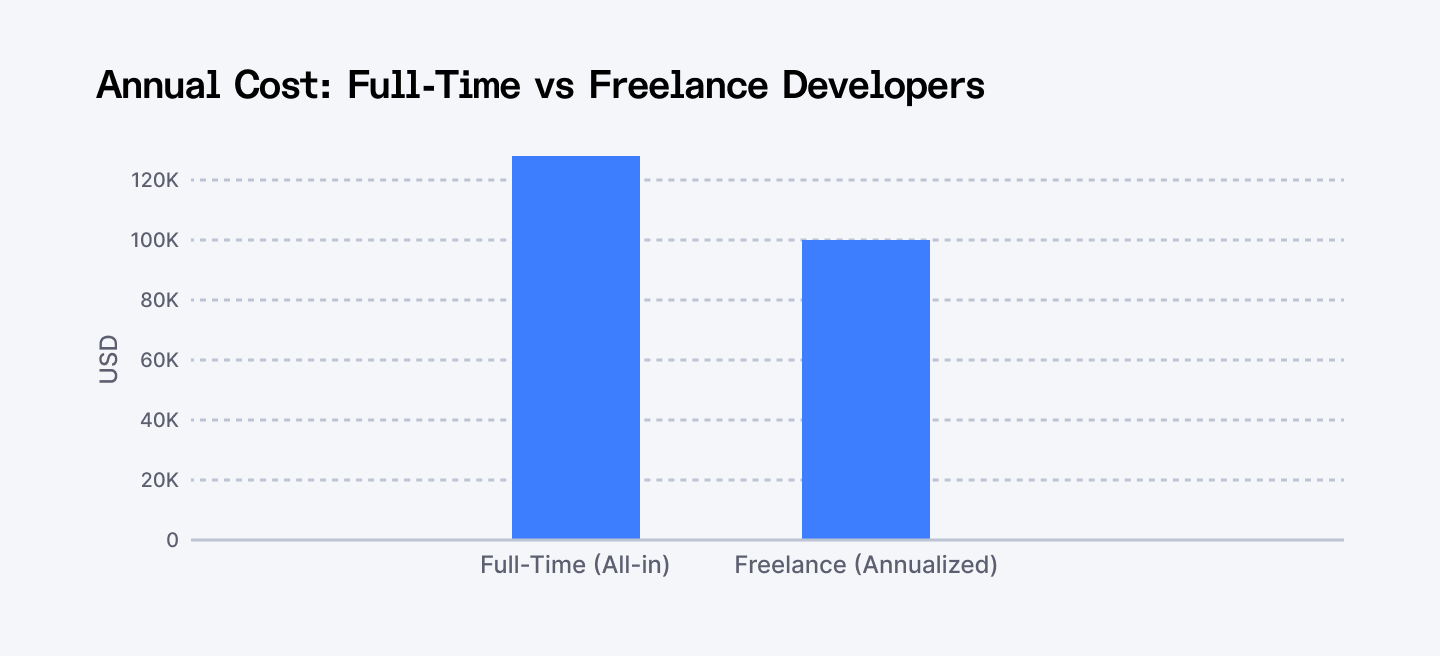
- Full-Time: $101K salary + 30-40% benefits (~$128K total) + $4K onboarding + hidden (training, turnover).
- Freelance: $48/hr (~$99.8K/yr) + up to 15% platform fees + vetting time + contract/admin overhead.
Pros and Cons
- Stability
- Full-Time: Predictable salary + benefits
- Freelance: Variable income; no paid leave
- Full-Time: Predictable salary + benefits
- Flexibility
- Full-Time: Fixed hours
- Freelance: Choose your projects & schedule
- Full-Time: Fixed hours
- Expertise
- Full-Time: Deep knowledge of your codebase
- Freelance: Broad, niche skill sets
- Full-Time: Deep knowledge of your codebase
- Team Alignment
- Full-Time: Strong cultural fit & cohesion
- Freelance: Short-term focus; less embedded
- Full-Time: Strong cultural fit & cohesion
- Administration
- Full-Time: HR handles compliance & payroll
- Freelance: You manage contracts & invoicing
- Full-Time: HR handles compliance & payroll
Defining Engagement Models
Full-Time Employment
Full-time developers come with the whole package - salary, benefits, and those inevitable company-wide meetings every quarter. They generally work predictable hours, though remote work has certainly blurred the lines of the traditional 9-to-5. Most organizations spend considerable time onboarding these developers, from setting up workstations to introducing them to the subtleties of company culture that never quite make it into the handbook.
The real advantage? Companies maintain substantial control over their day-to-day priorities, seamlessly integrating them into product roadmaps and long-term initiatives that might pivot three times before completion. While this creates much-needed stability for complex projects, it demands significant upfront investment - not just in recruitment, but in continuous professional development to keep skills current in our rapidly evolving technical landscape.
Freelance Contracting
Freelance developers typically work on hourly or project-based arrangements with client-defined scopes. Some charge by the hour (often with surprising variation based on specialization), while others prefer project-based arrangements with carefully defined scope boundaries. Many freelancers develop their own efficient workflows after years of adapting to different client environments, allowing them to maintain autonomy while still meeting deliverables.
We've noticed that freelancers often gravitate toward cutting-edge technical domains like AI implementation, cybersecurity architecture, or specialized front-end frameworks where demand outpaces the supply of full-time experts. Both parties benefit from inherent flexibility: developers select projects aligning with their expertise and preferred working style, while companies access specialized talent without navigating the complexities of permanent employment relationships.
Outsourced Agency vs Freelance
Though not central to our analysis, distinguishing between individual freelancers and agency relationships provides important context. Agency partnerships typically feature pre-assembled teams with standardized delivery methodologies and defined communication channels. Their comprehensive approach often comes with correspondingly higher overhead costs reflected in their rates.
Individual freelancers, by contrast, offer direct communication with the technical talent implementing your solution, generally at lower overall cost. The trade-off? You'll need more robust vetting procedures and oversight mechanisms to ensure consistent quality and timeline adherence.
…
When evaluating these engagement models for your specific needs, four factors consistently emerge as decisive: expected project duration (weeks versus years), requirements for specialized technical expertise, budget predictability constraints, and organizational culture considerations. Each model offers distinct advantages depending on your specific development needs. Leveraging hybrid models (where Index.dev helps you build a core team and supplement with experts) delivers stability and nimbleness, optimizing both cost and expertise without sacrificing quality.
Also Check Out: Top 6 Websites to Hire European (EU) Developers in 2025
Key Differences
Employment Structure
- Full-Time Employees: Full-time employees integrate deeply into company operations with established working hours, comprehensive onboarding processes, and cultural alignment. As full-timers climb the ladder, their growth path tends to mirror what the company needs, sometimes frustratingly so. A brilliant front-end specialist might reluctantly shift toward management because that's where the organization has gaps. Still, this alignment usually creates valuable institutional knowledge where developers remember why certain architectural decisions were made three years ago.
- Freelancers: On the freelance side, contractors chart their own course through the tech landscape. They typically work from wherever they please (home office, co-working space, that noisy café with surprisingly good WiFi) and often develop strong opinions about their tools and workflows. Their engagement concludes when deliverables are met, creating clear boundaries around scope and timeline expectations.
Commitment and Control
- Full-Time: Organizations maintain high control over full-time developers' workflows, ensuring priority for company projects. Long-term retention strategies like career paths and continued education foster loyalty and knowledge retention within the organization.
- Freelance: Freelance arrangements offer flexible resource allocation but may create availability gaps when demand fluctuates. These relationships require exceptionally clear scope definitions, milestone tracking, and quality assurance mechanisms to ensure deliverable consistency.
Onboarding and Offboarding
- Full-Time: Full-time developers typically require a substantial ramp-up period (2 to 4 weeks average) for training, orientation, and cultural assimilation. This investment frontloads costs but yields dividends through deeper organizational understanding.
- Freelance: Freelancers can often begin contributing quickly but may need more intensive knowledge transfer sessions at project kickoff. Offboarding costs remain minimal beyond final deliverable review, though knowledge retention represents a potential challenge.
Cost Structures and Financial Implications
Full-Time Developer Costs
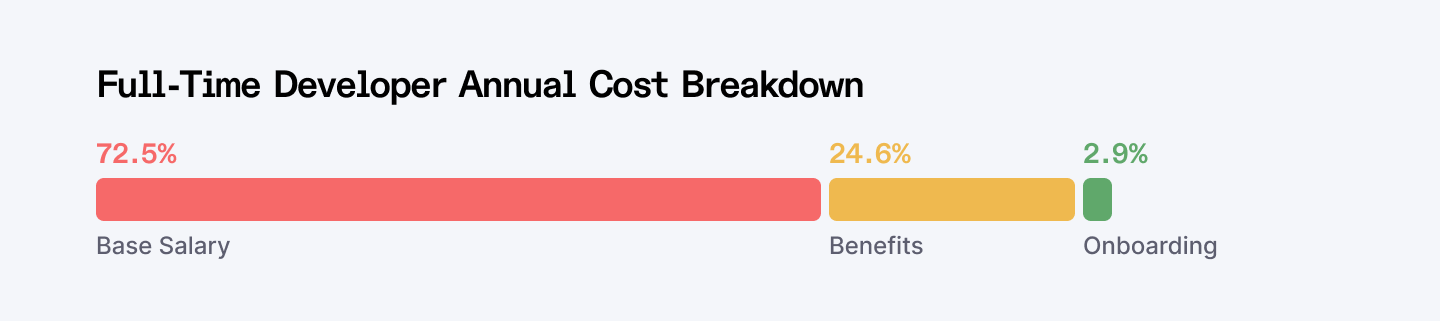
- Base Salary: $132,270 median annually (when accounting for benefits and overhead)
- Benefits Overhead: 34-37% additional cost (~$45,000) covering health insurance, retirement plans, and other benefits
- Onboarding: $4,000 per hire average for recruitment and integration
- Hidden Costs: Training, management overhead, equipment, workspace, and potential turnover expenses
Freelance Developer Costs
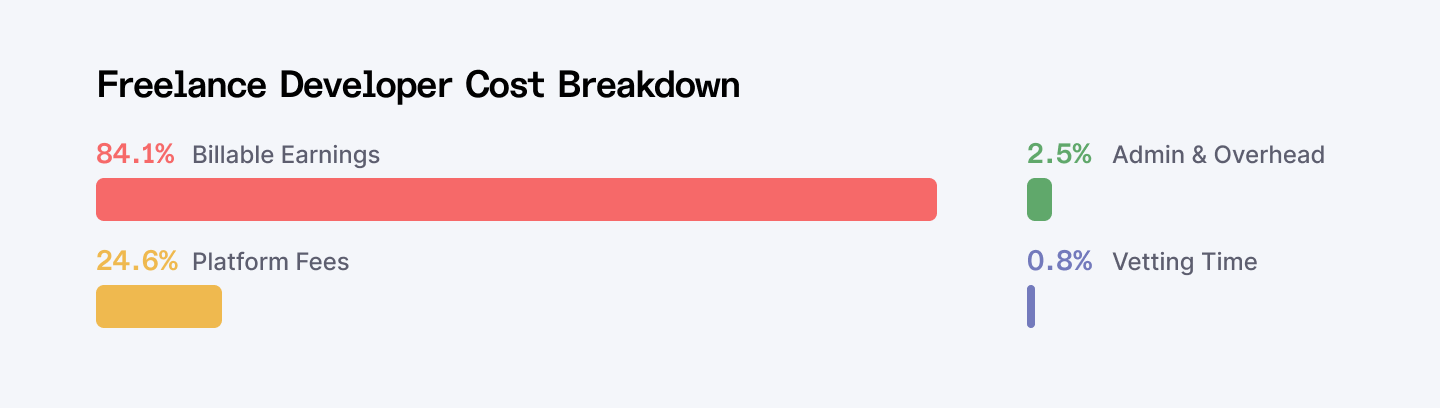
- Hourly Rate: $48/hr average for U.S.-based developers
- Annual Equivalent: Approximately $99,840 for full utilization (without the additional expenses of benefits, taxes, or long-term commitments)
- Platform Fees: Up to 15% on freelance marketplaces like Upwork
- Vetting Investment: 15-20 hours per hire for review, interviews, and test projects
- Hidden Costs: Contract administration, quality control, and knowledge transfer
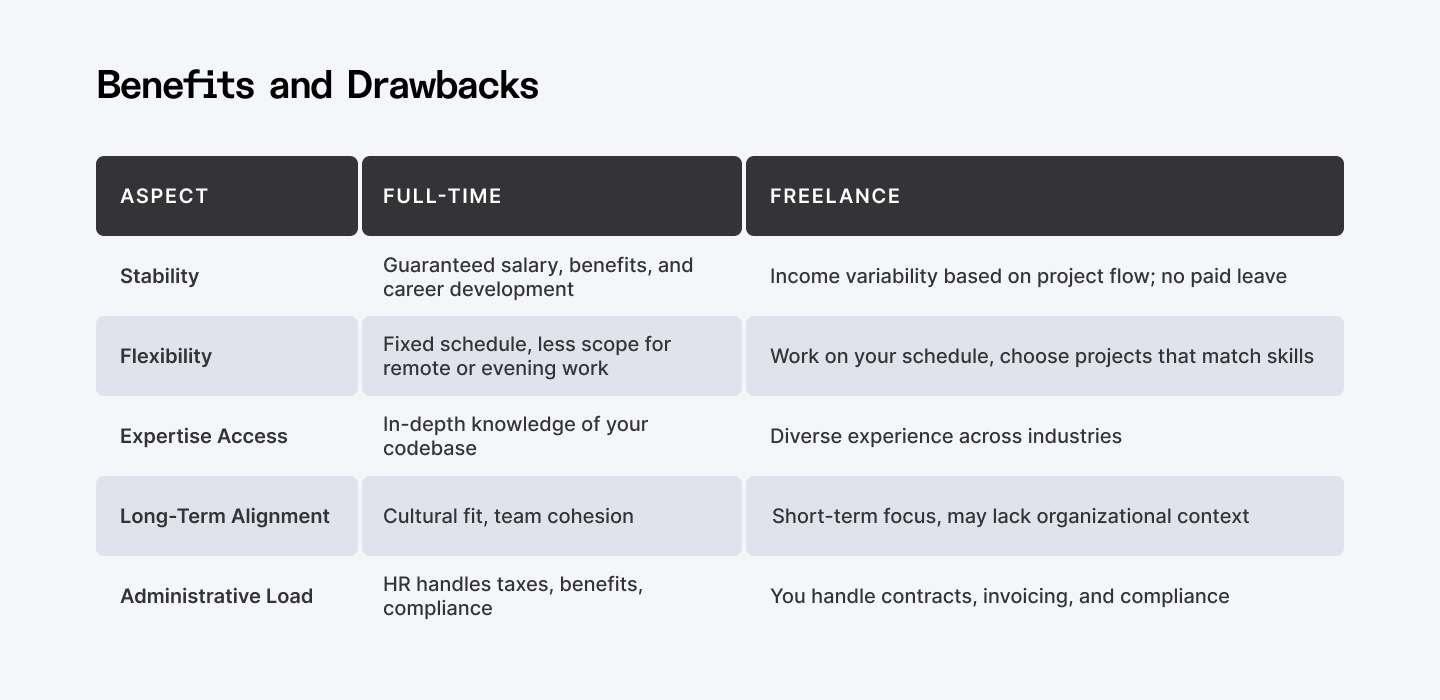
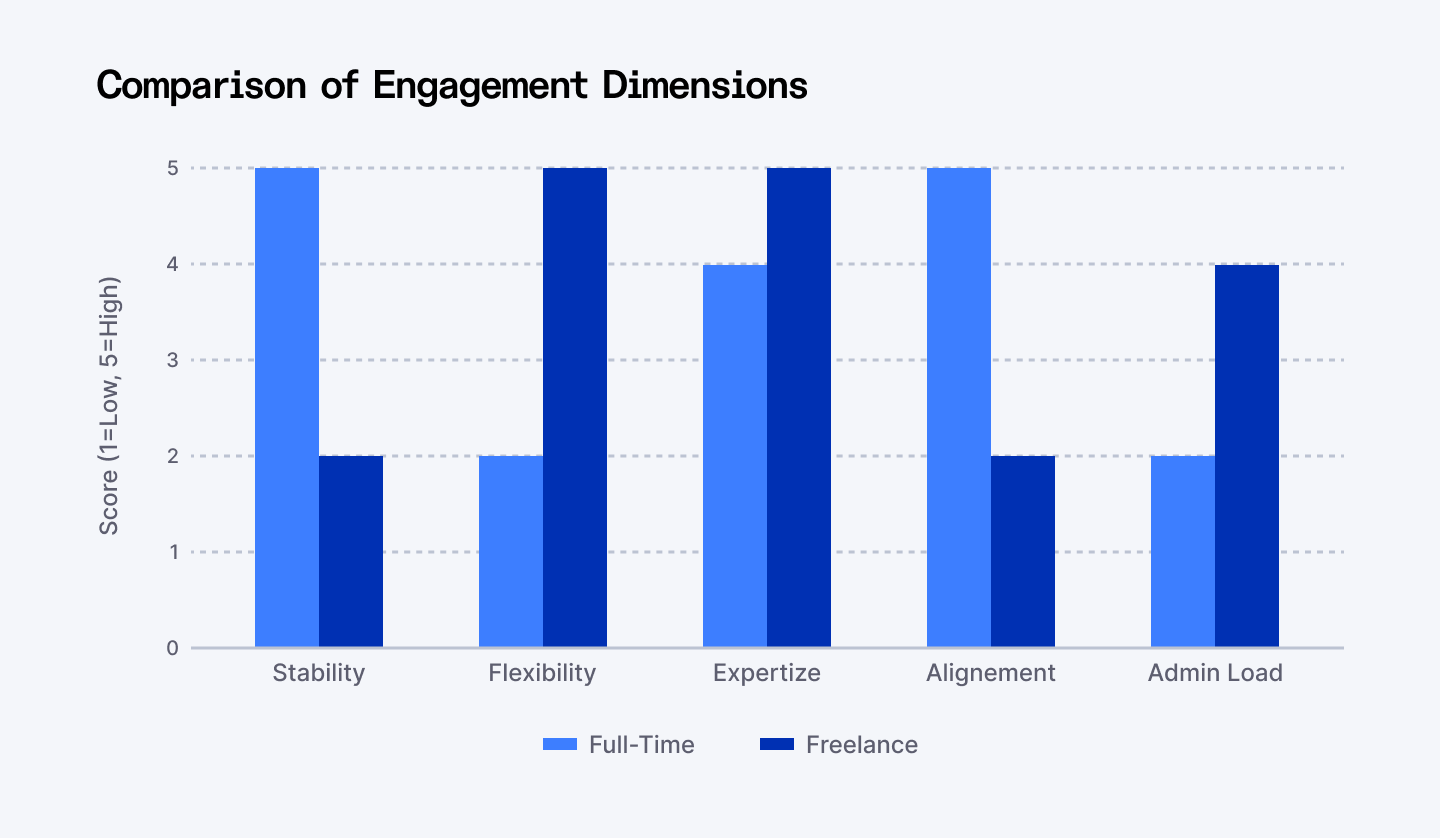
Benefits and Drawbacks
Aspect | Full-Time | Freelance |
| Stability | Guaranteed salary, benefits, and career development | Income variability based on project flow; no paid leave |
| Flexibility | Fixed schedule, less scope for remote or evening work | Work on your schedule, choose projects that match skills |
| Expertise Access | In-depth knowledge of your codebase | Diverse experience across industries |
| Long-Term Alignment | Cultural fit, team cohesion | Short-term focus, may lack organizational context |
| Administrative Load | HR handles taxes, benefits, compliance | You handle contracts, invoicing, and compliance |
Work Quality, Productivity and Reliability
Institutional Knowledge
Full-time roles typically yield 34% higher team productivity in Agile environments due to consistent collaboration patterns and shared technical context. Team members develop specialized knowledge about internal systems that accelerates problem-solving and feature development.
Specialized Expertise
Survey data indicates that 58% of businesses hire freelancers specifically for technical skills unavailable in their current teams. Freelancers often develop deep expertise in emerging technologies through diverse project exposure across industries.
Career Satisfaction
Approximately 80% of freelance developers report positive career growth and work-life balance, potentially translating to higher motivation and output quality when project parameters align with their expertise.
Turnover Considerations
Replacing a full-time developer means that your budget will take a serious hit of around 50-60% of their annual salary. For a mid-level developer, that's roughly $66K down the drain between recruitment costs, productivity dips, and onboarding time. This means that retention strategies are crucial for maintaining team consistency and project continuity.
Read More: How to Assess Candidate's Skills for Engineering Positions
Decision Guide
1. Project Scope & Duration
- Long-Term Product Development: Full-time developers provide the deep domain expertise and consistent output necessary for complex, ongoing projects.
- Short-Term or Specialized Tasks: Freelancers allow you to quickly onboard niche skill sets without long-term commitments, ideal for discrete technical challenges.
2. Budget Predictability
- Stable Budget Environment: Full-time roles smooth out monthly expenditures and benefit planning, creating predictable cashflow.
- Variable Budget Constraints: Freelance relationships align costs directly to deliverables, reducing idle resource expenses during development lulls.
3. Risk Tolerance
- Low Risk Tolerance: Full-time employment mitigates talent gaps through retention strategies and knowledge redundancy.
- High Agility Requirements: Freelancers enable rapid pivots but necessitate robust quality control mechanisms.
4. Hybrid Approach
- Platforms like Index.dev allow you to build a core full-time team while supplementing with vetted freelance experts. This hybrid approach blends predictability with agility without creating overhead spikes during scaling phases.
5. Intellectual Property and Knowledge Management
- Organizations with sensitive intellectual property considerations often benefit from stronger in-house development teams, though properly structured contracts can mitigate risks with freelance relationships.
6. Compliance and Tax Implications
- Freelance management platforms increasingly handle compliance verification and tax documentation, reducing administrative burden compared to traditional HR processes for full-time employees.
Strategic Considerations
Scenario | Recommended Model |
| Long-term, complex product development | Full-time team |
| Niche feature sprint (AI/ML implementation, etc.) | Freelance specialists |
| Fluctuating budget environment | Freelance with clear milestones |
| Core stability with occasional burst capacity | Hybrid via Index.dev |
2025 Market Trends and Technical Skills
Rising Skills Demand
AI/ML integration capabilities, cloud-native engineering expertise, and cybersecurity specialization top the list for 2025 technical roles according to Deloitte and Index.dev's comprehensive market analysis. No-code platform proficiency and multi-language capabilities continue gaining traction across both employment models.
Remote & Hybrid Models
Approximately 56% of technical professionals now work remotely at least part-time, with 34% maintaining hybrid schedules. Collaboration tools like Slack, Notion, and specialized project management platforms have significantly reduced traditional risks associated with distributed teams.
Future Outlook and Recommendation
The freelance technical workforce is expected to reach nearly 47% global participation by 2025, according to McKinsey research. AI-driven development tools are shifting both employment models toward hybrid "developer-plus-AI" roles, emphasizing strategic oversight rather than repetitive implementation tasks.
Platforms like Index.dev continue standardizing vetting procedures, contract structures, and payment systems, reducing friction in the freelance engagement process while maintaining quality assurance.
Conclusion
Choosing between full-time and freelance developers ultimately depends on your organization's specific circumstances: project timeline, skill requirements, budget parameters, and risk profile. Full-time positions deliver deep integration and consistency; freelance relationships provide cost efficiency and rapid scaling capabilities.
For most organizations, hybrid approaches like leveraging specialized platforms to build core teams supplemented with vetted freelance expertise, delivers the optimal balance for navigating today's dynamic technical landscape. By thoughtfully assessing your specific development needs against these factors, you can create a staffing strategy that maximizes both technical quality and business value.
For Clients:
Stop overpaying for software development! Access the elite 5% of vetted developers through Index.dev with 48-hour matching and a 30-day free trial. Find the perfect full-time or freelance talent for your next project.
For Developers:
Want to work on top projects, your way? Join Index.dev to get matched with global companies, whether you prefer full-time or freelance, remote careers start here!