
AI is no longer the future; it has already impacted businesses across industries. Artificial intelligence has become the foundation of digital transformation, automating everyday operations and enabling totally new business models. But as we approach 2025, the talent environment is changing rapidly. Hiring "AI developers" will no longer be sufficient.
Enter a new wave of upcoming AI jobs that go well beyond coding. Organizations today need strategists, ethicists, compliance experts, and operations and security professionals to guarantee that AI programs are scalable, responsible, and quantifiable. These developing AI job titles demonstrate how deeply AI is ingrained in key business processes, impacting everything from product design to regulatory compliance.
To remain competitive, leaders must rethink their AI team structures and plan to employ individuals with technical, ethical, and strategic skills. Ignoring this trend risks falling behind as AI maturity increases.
Future-proof your AI team. Index.dev connects you with vetted experts for the 10 must-have AI roles, helping you scale smarter and faster.
Why Are Traditional AI Teams No Longer Enough?
Most AI initiatives began as experimental pilots led by small, developer-heavy teams. Model accuracy, rather than long-term business effect, was used to judge success. By 2025, AI will have been used at a business scale, powering consumer interaction, financial forecasting, and supply chain optimization. This transition demands more than just technical execution.
Beyond code, companies must focus on strategy, governance, ethics, and operations. AI product managers, MLOps engineers, and AI governance leaders are becoming important. Without these specific AI job titles, businesses risk operating projects that are technically sound but do not fulfill regulatory requirements, ethical norms, or user trust expectations.
Simply said, traditional AI teams cannot meet current AI expectations. Specialized skill is now the key to long-term AI adoption.
Explore 10 emerging AI roles to hire in 2025 (beyond developers).
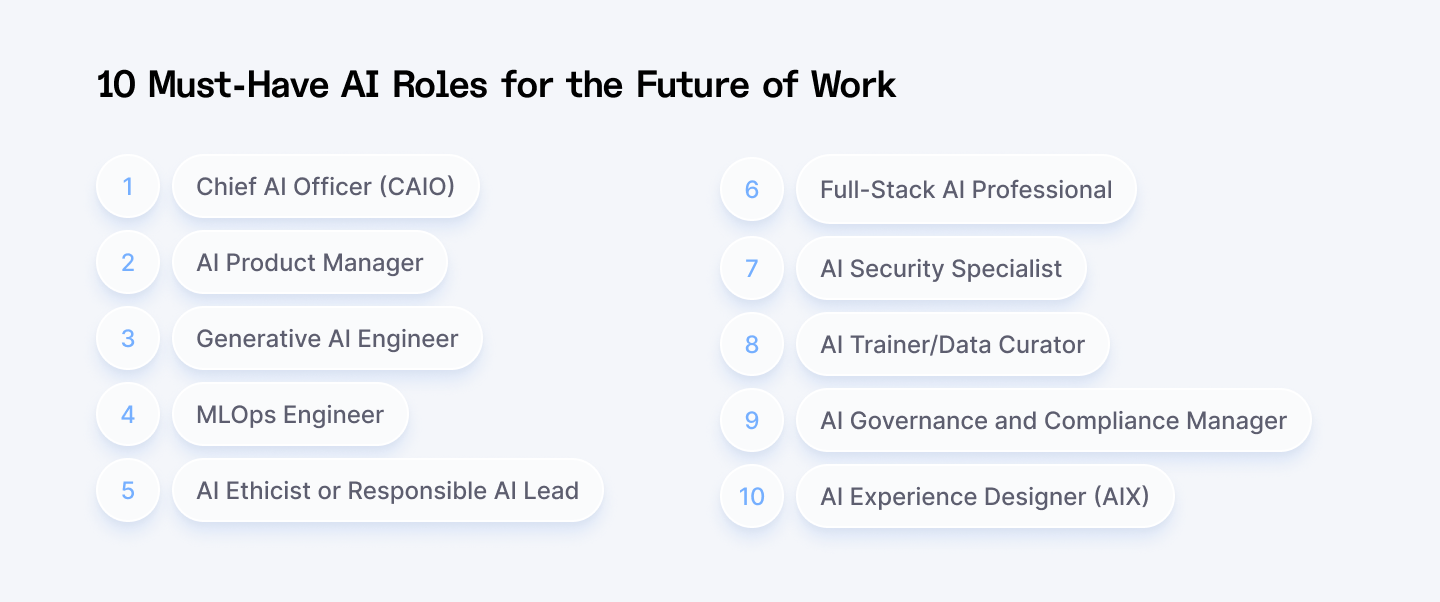
10 Must-Have AI Roles for the Future of Work
As AI use grows, firms realize that simply employing engineers isn't enough. The next wave of new AI positions represents a trend towards governance, ethics, strategy, and end-to-end operations. The following are eleven essential AI job titles you may anticipate seeing in hiring plans in 2025.
1. Chief AI Officer (CAIO)
The chief AI officer position is rapidly becoming a cornerstone of company leadership. CAIOs, similar to Chief Data Officers in the 2010s, are now responsible for aligning AI investments with overall company objectives.
Key responsibilities/skills
- Develop an enterprise-wide AI strategy and roadmap.
- Ensure the ethical adoption of AI and regulatory compliance.
- Manage cross-functional coordination across the IT, product, and legal departments.
- Promote AI education and awareness within the organization.
Why it’s emerging in 2025
As governments tighten AI legislation and boards demand verifiable ROI, a CAIO guarantees that AI initiatives are not only experimental but also essential for revenue and risk management.
Business Impact
A CAIO enables firms to expand AI safely, eliminate regulatory concerns, and preserve a competitive advantage.
2. AI Product Manager
AI-powered products are growing more popular, necessitating executives who can balance corporate strategy with technological feasibility. Enter the AI Product Manager, a critical job for developing products in which AI is not an add-on but a fundamental competency.
Key responsibilities/skills
- Define the product vision and plan for AI-driven features.
- Collaborate with engineers and designers to strike the right mix between accuracy, explainability, and usability.
- Monitor user trust and feedback to improve AI models.
- Transform technical possibilities into business value.
Why it’s emerging in 2025
With generative AI tools infiltrating SaaS, e-commerce, and consumer platforms, firms want product managers who grasp AI's limitations and potential.
Business impact
AI Product Managers guarantee that innovation leads to useful, trustworthy, revenue-generating solutions.
3. Generative AI Engineer
The generative AI engineer job description is one of the most in-demand jobs in 2025. These individuals specialize in developing and optimizing large language models (LLMs), generative design tools, and creative automation systems.
Key responsibilities/skills
- Fine-tune and implement generative AI models.
- Learn prompt engineering and retrieval-augmented generation (RAG).
- Create fake datasets for training.
- Collaborate with product and creative teams to create innovative AI experiences.
Why it’s emerging in 2025
With firms spending extensively in content automation, chatbots, and design tools, generative AI engineers are the driving force behind innovation.
Business impact
These engineers assist firms in lowering costs, accelerating innovation, and launching completely new product categories.
4. MLOps Engineer
MLOps engineer roles are becoming more important as firms try to expand AI beyond prototypes. MLOps connects data science with DevOps, ensuring that AI models perform well in production rather than simply in the lab.
Key responsibilities/skills
- Develop CI/CD pipelines for machine learning models.
- Monitor live system performance, drift, and dependability.
- Manage the infrastructure for scalable deployment.
- Ensure repeatability and compliance.
Why it’s emerging in 2025
Scalability and security are becoming increasingly important as organizations integrate AI into customer-facing products. MLOps engineers enable production-ready AI.
Business impact
They minimize downtime, cut operational risks, and ensure that AI performs as intended at scale.
5. AI Ethicist or Responsible AI Lead
AI adoption presents both opportunities and concerns, including prejudice, disinformation, and societal damage. Here's where the AI Ethicist comes in.
Key responsibilities/skills
- Evaluate datasets for fairness and inclusion.
- Develop frameworks for explainable AI.
- Keep an eye out for potentially detrimental outcomes from AI systems.
- Consult with regulators and internal governance teams.
Why it’s emerging in 2025
Companies cannot afford to ignore ethics in the face of stronger AI legislation in Europe, the United States, and Asia.
Business impact
Ethicists protect reputations, avoid expensive legal fights, and maintain user confidence.
6. Full-Stack AI Professional
A full-stack AI expert combines abilities in data engineering, modeling, and deployment. They're especially useful for startups and lean teams.
Key responsibilities/skills
- Gather and preprocess datasets.
- Develop, refine, and deploy machine learning models.
- Completely integrate AI into your apps.
- Work in both cloud and on-premise environments.
Why it’s emerging in 2025
With the desire for fast AI experimentation, adaptable individuals who can cross silos are in great demand.
Business impact
They lower recruiting costs, expedite innovation, and offer flexible assistance throughout the AI lifecycle.
7. AI Security Specialist
AI systems are increasingly excellent candidates for assaults, including data poisoning and hostile inputs. The AI Security Specialist is responsible for safeguarding this new frontier.
Key responsibilities/skills
- Identify and address vulnerabilities in AI systems.
- Secure training data pipelines.
- Protect against hostile examples and model theft.
- Collaborate with the cybersecurity and IT teams.
Why it’s emerging in 2025
As AI becomes more prevalent in finance, healthcare, and defense, the cost of compromised AI rises rapidly.
Business impact
A dedicated AI Security Specialist protects intellectual property and minimizes operational disruptions.
8. AI Trainer/Data Curator
AI is only as good as the data it is trained on. AI Trainers and Data Curators guarantee that the inputs are correct, diverse, and representative.
Key responsibilities/skills
- Label and annotate datasets.
- Curate domain-specific training materials.
- Act as a human-in-the-loop for reinforcement learning.
- Detect and delete biased or irrelevant data.
Why it’s emerging in 2025
With LLMs requiring enormous, high-quality data, the human element in training is still critical.
Business impact
Curated data improves model accuracy, decreases bias, and increases user pleasure.
9. AI Governance and Compliance Manager
With rules like the EU AI Act and India's DPDP Bill, governance responsibilities are now critical for compliance.
Key responsibilities/skills
- Monitor worldwide AI legislation to maintain organizational alignment.
- Develop internal AI policy and compliance frameworks.
- Conduct audits to ensure appropriate AI use.
- Collaborate with the legal and regulatory departments.
Why it’s emerging in 2025
Governments are enforcing tough penalties for noncompliance.
Business impact
Strong governance reduces penalties, safeguards brand reputation, and assures responsible AI deployment.
10. AI Experience Designer (AIX)
The AI Experience Designer creates natural, human-centered AI interactions, which are critical for adoption and trust.
Key responsibilities/skills
- Create conversational, multimodal AI interfaces.
- Ensure that AI systems are accessible and inclusive.
- Balance automation and human control.
- Work closely with the product and UX teams.
Why it’s emerging in 2025
As generative AI drives more consumer-facing applications, usability becomes a key competitive differentiation.
Business impact
AIX Designers encourage adoption by making AI feel natural, dependable, and powerful to end users.
How to Future-Proof Your Hiring Strategy?
To be competitive in 2025, companies must future-proof their personnel management strategies. The first approach is to train current staff for hybrid jobs that combine technical and strategic competence. Encourage ongoing education in fields such as generative AI, data governance, and full-stack AI professional skills.
Second, form collaborations with academic and AI groups to gain access to cutting-edge information and talent streams.
Third, invest in role-specific job descriptions that are suited to the most recent AI job titles, from Chief AI Officer to MLOps Engineer, to ensure that recruiting efforts focus on the proper capabilities.
Companies that prepare ahead of time may form agile, cross-functional teams capable of expanding AI ethically and strategically, assuring long-term success in an ever-changing world of emergent AI jobs.
Discover 12 AI team scaling strategies: grow from 3 to 50 engineers in under a year.
Conclusion
The future of AI hiring is not about recruiting more coders, but about forming interdisciplinary teams that value strategy, ethics, and scalability. Demand for emerging AI professions is increasing, ranging from chief AI officer to specialized positions in compliance, security, and design. Organizations that foresee these transitions will be better positioned to innovate, remain compliant, and earn user trust. Leaders must reconsider hiring tactics and adopt the new wave of AI job titles that will characterize AI maturity in 2025.
Start mapping your AI hiring strategy today!
Hire the AI specialists your business needs: Chief AI Officers, MLOps Engineers, Generative AI Developers, AI Ethicists, and more. Access the top 5% of vetted talent, get matched in 48 hours, and start your 30-day risk-free trial with Index.dev today.


