The world’s best talent is finite. And the United States has just signaled it’s willing to pay a premium for it.
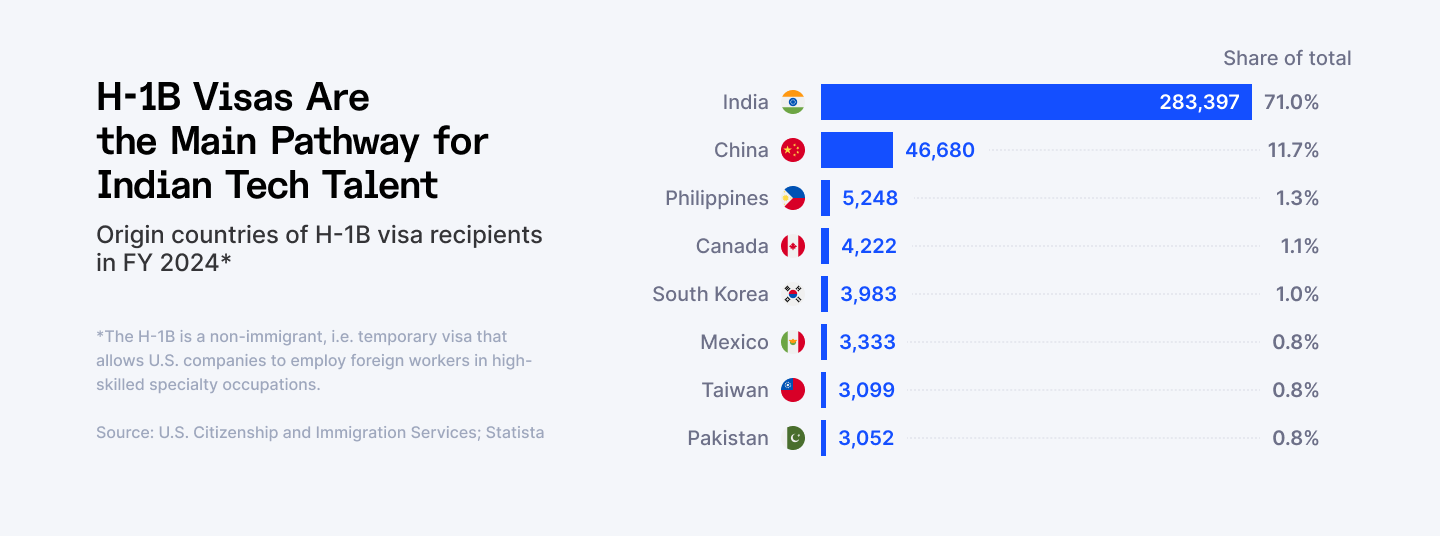
The Trump administration’s proposal of a $100,000 annual fee for H-1B visas landed with a bang. For decades, H-1Bs have been the backbone of U.S. tech hiring, bringing in highly skilled workers in engineering, research, and specialized fields. To many, this feels like another chapter in the broader immigration crackdown. For others, it’s a gut punch to Indian IT firms that account for 71% of H-1B approvals, with China trailing far behind at 11.7%.
A six-figure visa is undeniably a steep cost. Smaller firms and startups will feel the squeeze. Some argue it will deter foreign talent from entering the U.S. altogether, slowing down growth in industries that already struggle to hire enough specialists.
But here’s the bigger picture. At Index.dev, we don’t see this as a penalty. We see it as a massive, unmissable valuation signal for high-end global tech talent.
A $100,000 price tag doesn’t close the door on international talent. It raises the bar. It says that if you’re bringing someone into the U.S., they’d better be the kind of professional who delivers ten times that value in innovation, expertise, and impact.
And this is the moment for American companies (70% of Index.dev’s client base) to stop framing global talent as a cost-saving lever. It’s time to see them for what they really are: the most strategic asset a business can have.
Why the Old ‘Lottery’ Was Never About Merit
The previous H-1B system, with its low fees and massive oversubscription, was never truly about merit. Five applicants competed for every available visa, creating an inefficient system that often left highly specialized, uniquely skilled individuals out, while firms often flooded the system with generic applications just to boost their odds.
Some companies abused the program. They weren’t chasing rare talent; they were chasing cheap labor. Qualified Americans were sometimes sidelined in favor of lower-cost international hires. That’s not a talent strategy. That’s Vegas.
The proposed $100,000 fee changes the calculus entirely. Suddenly, companies have to slow down and ask hard questions:
- Is this person truly exceptional?
- Do they bring skills we cannot replicate domestically?
- Are they worth a six-figure investment over three years?
That shift turns a “spray and pray” lottery into a deliberate, high-stakes decision. And no company will pay $100,000 just to suppress wages. At that price point, you're making a significant investment in an individual. You're admitting this person brings unique value. And you're probably paying them accordingly, because if you're dropping six figures on the visa alone, you're competing for genuine A-players.
Google didn’t become Google because it hired the cheapest engineers. It became Google because it attracted extraordinary minds from around the globe and treated them as core assets, not cost-cutting hacks.
This policy shift, paradoxically, could lead to better treatment, higher salaries, and stronger career paths for the global talent that makes it through the new barrier.
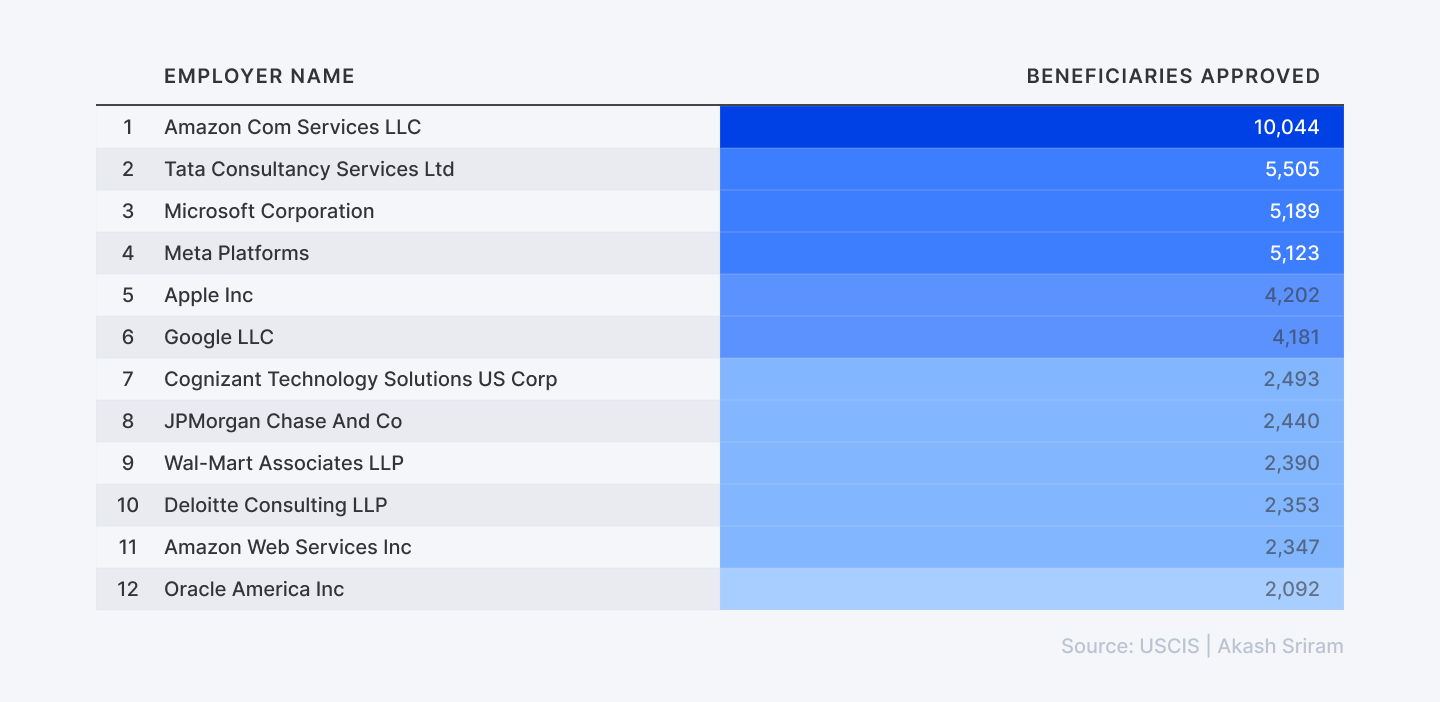
Companies most dependent on U.S.-based employees with H-1B visas
A Visa for the Best of the Best
Think of this new $100K fee not as a tax, but as a filter. It forces U.S. companies to be intentional, selective, and bold about who they bring across borders. It reframes immigration costs as investments in innovation.
It demands a true talent shortage justification
Paying six figures just for the right to hire someone means you’re signaling something powerful: this talent simply doesn’t exist in the domestic market. It nudges companies to try local first. But when they hit a wall, whether it’s in frontier AI research, cutting-edge semiconductor design, or breakthrough biotech, they now have a clear, structured way to justify going global.
It dismantles wage abuse
One of the loudest criticisms of H-1B visas has always been wage suppression. Too often, the system was used to import cheaper labor, leaving both American workers and international talent shortchanged. A $100K entry fee changes that equation. Nobody pays that sum to cut corners. Companies will only use this pathway for roles that demand, and will reward, world-class compensation and treatment.
It elevates the value of the 'Super Talent'
When you pay a fee this steep, you’re not just hiring an engineer. You’re investing in Super Talent, someone capable of generating 10x, 50x, even 100x ROI in innovation, intellectual property, and competitive edge.
The U.S. has already reaped the rewards of this model. Consider:
- Satya Nadella, who came to the U.S. from India on a student visa, later rising to transform Microsoft into a $3 trillion powerhouse.
- Sundar Pichai, another Indian-born leader, now steering Alphabet/Google at the center of global AI.
- Elon Musk, who immigrated from South Africa, went on to revolutionize entire industries, from electric cars to space exploration.
These are not “cost-saving hires.” They are the types of individuals who justify massive bets, and in return, create trillion-dollar industries, millions of jobs, and national competitive advantage.
By setting a high bar, the U.S. essentially says: If you are worth this investment, you are welcome here.
Closing the Talent Gap in Critical Areas
There’s a heated debate about whether America’s “tech talent shortage” is real or manufactured. Some say it’s a lobbying tactic; others argue it’s economic fiction.
But here’s the reality I’ve seen from working in global tech recruitment: in certain specialized, frontier-level fields, the shortage is not only real, it’s urgent. And the U.S. is at risk of falling behind if it doesn’t secure access to the world’s best minds.
AI and Machine Learning
We’re not talking about junior Python developers. We’re talking about experts in reinforcement learning, generative AI, and large-scale natural language processing. These engineers are the architects of automation, autonomous vehicles, and enterprise AI platforms.
Semiconductor Design
There are roughly a thousand engineers worldwide who are qualified to design next-generation semiconductors. A thousand. Most are concentrated in Taiwan, South Korea, and increasingly China. The U.S. may build fabs at home, but without the brains behind the designs, the factories are just buildings.
Biotech and Life Sciences
Specialists like bioinformaticians and computational biologists sit at the intersection of biology, data science, and medicine. They’re essential for developing next-gen therapies, personalized medicine, and genomic breakthroughs. The truth? Most of the pipeline for these roles comes from universities in China, India, and Europe. U.S. universities are producing some, but not nearly at the scale required.
Quantum Computing
The number of people in the world who truly understand both quantum physics and practical engineering could fit into a single conference room. They are scattered across a handful of labs in Switzerland, Canada, Singapore, and the U.S. Whoever attracts and retains these minds will dominate the next computing revolution.
Robotics and Automation
In banking, logistics, and manufacturing, demand for automation architects – engineers who can design complex robotic process automation (RPA) pipelines – far exceeds supply. These aren’t plug-and-play roles. They require years of cross-disciplinary expertise across software, mechanical systems, and enterprise workflows.
These aren’t jobs you can just “train an American” for in a bootcamp. The training cycle is measured in decades. By the time you produce enough domestic talent, the technology frontier has already shifted to something new.
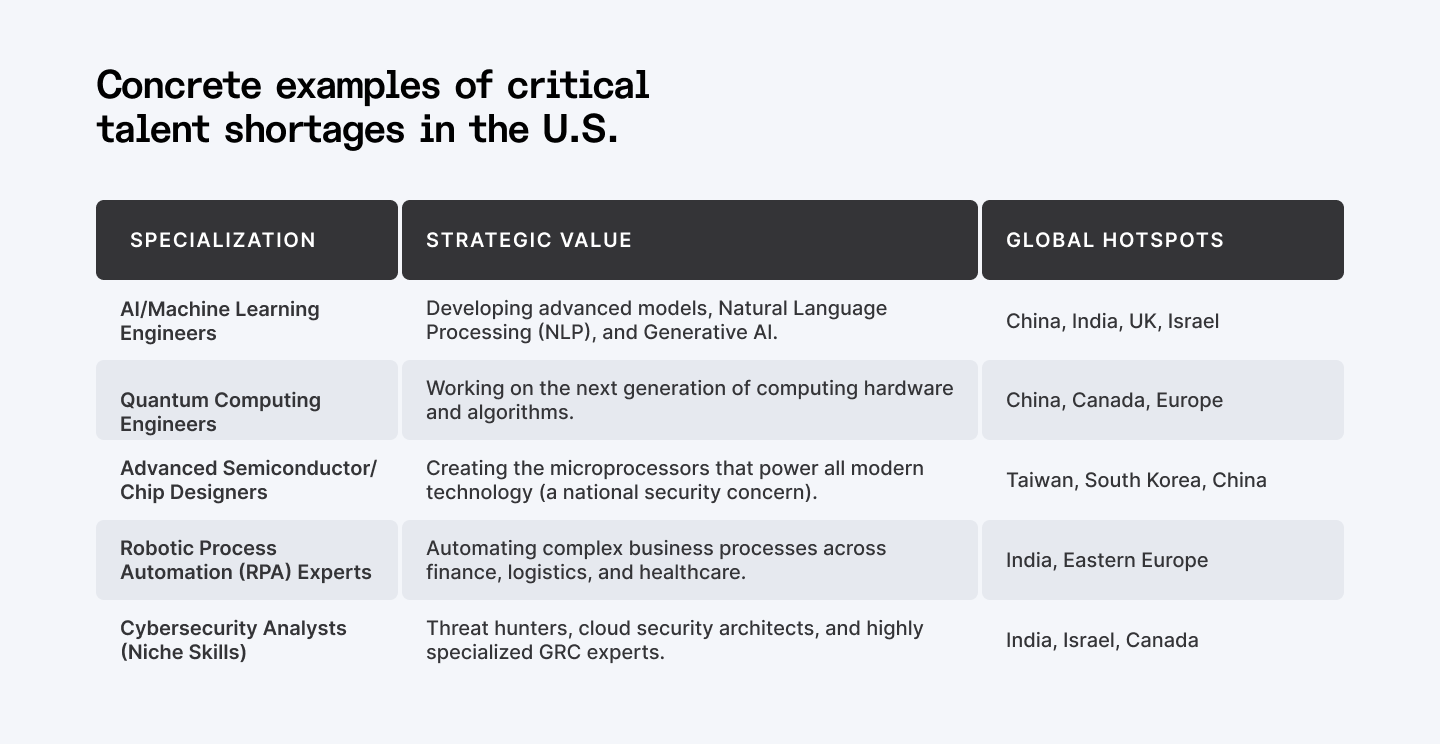
Concrete examples of critical talent shortages in the U.S. include:
| Specialization | Strategic Value | Global Hotspots |
| AI/Machine Learning Engineers | Developing advanced models, Natural Language Processing (NLP), and Generative AI. | China, India, UK, Israel |
| Quantum Computing Engineers | Working on the next generation of computing hardware and algorithms. | China, Canada, Europe |
| Advanced Semiconductor/Chip Designers | Creating the microprocessors that power all modern technology (a national security concern). | Taiwan, South Korea, China |
| Robotic Process Automation (RPA) Experts | Automating complex business processes across finance, logistics, and healthcare. | India, Eastern Europe |
| Cybersecurity Analysts (Niche Skills) | Threat hunters, cloud security architects, and highly specialized GRC experts. | India, Israel, Canada |
The Uncomfortable Truth About Competition
America is not the only country training the next generation of innovators. China now produces more STEM graduates each year than any other nation. India, Russia, and a wave of countries across Southeast Asia and Eastern Europe are following closely.
Yes, the United States still has the best university system in the world. But the sheer output of domestic graduates can’t keep up with how fast technology evolves. Even if we doubled the number of engineering programs tomorrow, the pipeline wouldn’t keep pace with the speed at which new roles emerge.
Think about it:
- Five years ago, nobody was hiring prompt engineers or MLOps specialists.
- Today, those roles are critical to building scalable AI systems.
- And most of that talent didn’t come from formal degrees. It came from self-directed learning, online communities, and hands-on work in fast-moving international ecosystems.
This is where the U.S. faces its greatest challenge: the talent race isn’t just about volume. It’s about adaptability. By the time America trains enough domestic workers in a field like quantum, another field will have opened up: synthetic biology, neuromorphic chips, or something we can’t even name yet.
And if America wants to lead in AI, quantum computing, and biotechnology, it can’t afford to wait for the domestic pipeline to catch up. It must be able to tap into global talent pools in real time, capturing the world’s brightest minds in the narrow windows when their skills are scarce, invaluable, and transformative.
What This Means for American Innovation
Let’s get specific: what does a shortage of specialized talent look like in practice?
A couple of months ago, Index.dev worked with a San Francisco-based robotics startup trying to fill a role for a robotic process automation (RPA) architect with experience in warehouse logistics. Not just someone who understood RPA in theory, they needed someone who had deployed autonomous systems in real warehouse environments, someone who knew how to handle the chaos of real-world operations.
They searched domestically for six months. Dozens of candidates. Plenty of smart people. But no one with the exact combination of skills required.
Through Index.dev, we connected them with an engineer in Germany who had spent five years implementing automated systems for European logistics companies. That hire likely saved the startup a year of trial and error, and positioned them to compete with giants like Amazon, rather than be steamrolled.
This isn’t about Americans “losing jobs.” It’s about American companies staying competitive in a hyper-global market.
Consider AI safety research. As AI systems grow exponentially in capability, companies need experts in adversarial machine learning, model interpretability, and alignment theory. Most of this cutting-edge work is happening in a handful of labs globally, in the U.K., Canada, France, and Switzerland.
Without access to these experts, American AI companies won’t halt development. They’ll keep building, but often without the critical oversight needed to ensure safety and ethical deployment.
Global talent is strategic insurance. It ensures American companies can innovate safely, quickly, and sustainably.
What This Means for Global Talent
Here’s where the conversation gets truly interesting for companies thinking strategically about talent.
The new H-1B reality doesn’t mean American companies can’t access global talent. It means they need to be smarter and more intentional about how they do it.
Remote work has fundamentally changed what’s possible. Companies can now engage with exceptional engineers in Tbilisi, Nairobi, Buenos Aires, or Hanoi. They can evaluate that talent over months of contract work, seeing exactly what they can deliver, and then make the H-1B investment when it truly matters.
For global talent, the $100,000 fee is not a barrier, it’s an opportunity. It signals that if a company is willing to make that investment, they see you as a critical hire, not a commodity. You are valued, and the compensation and growth opportunities will reflect that.
This also validates the remote-first, contractor-to-full-time pathway. Demonstrate your value remotely, become indispensable, and the company is far more likely to commit to bringing you onshore full-time.
At Index.dev, we’ve seen this model work again and again. A company hires a senior backend engineer from Eastern Europe on a contract basis. Six months later, they realize this engineer is absolutely critical to their infrastructure. Suddenly, the $100,000 H-1B fee isn’t a gamble, it’s a strategic investment in someone who’s already proven indispensable. We facilitate the transition from contractor to full-time employee, often with relocation support, making the process seamless for both parties.
This is how elite talent acquisition should work. You’re not betting on a resume or three interviews. You’re making an informed, data-driven decision based on demonstrated performance.
The Path Forward
Let’s be honest. The $100,000 H-1B fee will create challenges. Smaller startups will feel the upfront pinch. Some talented individuals will get caught in bureaucracy. There will be unintended consequences we can’t fully predict.
But here’s the principle at the heart of it:
If you’re bringing someone from another country to work in America, it should be because they bring something genuinely unique and valuable.
This isn’t anti-immigration. It’s pro-innovation with standards.
- For American companies, this means getting strategic about global talent. Build relationships with engineers and researchers internationally. Use contract work to evaluate fit. When you find someone exceptional, make the investment.
- For global talent, the message is equally direct: be so good they can’t ignore you. Build a track record, demonstrate unique expertise, and companies will pay the premium.
- For platforms like Index.dev, this reinforces our model: connecting vetted, proven tech talent with companies that need them, and facilitating the transition from remote contractor to full-time team member when the fit is right.
The future of work is global. The new H-1B structure doesn’t change that, it changes how companies access it.
The companies that figure this out, those that build global talent networks and invest in truly exceptional people, will be the ones leading the next decade of innovation.
Those that don’t? They’ll be competing with one hand tied behind their back, while rivals in Beijing, Berlin, and Bangalore move forward.
America has always attracted the world’s best talent. The question now is: are companies willing to pay what that talent is actually worth?
Based on what I've seen, the best ones already know the answer.