Tech outsourcing looks nothing like it did before COVID hit. Remote work used to be this cutting-edge concept only forward-thinking companies embraced - now it's just how business gets done. The question facing companies in 2025 isn't whether to choose nearshoring or offshoring, but figuring out exactly where your tech operations should live.
Industry analysts are predicting the IT outsourcing market to reach a staggering $591 billion this year. That's pushed the IT nearshoring vs offshoring debate from occasional boardroom discussions to critical strategic planning.
Here's the truth though - there's no universal "winner" in this debate. Each approach has distinct strengths that might perfectly match your company's needs or become an expensive headache if you choose poorly.
Need expert developers for your IT outsourcing needs? Hire the top 5% of pre-vetted talent with Index.dev, risk-free for 30 days!
Understanding Outsourcing Models
Before diving into trends and statistics, it’s crucial to distinguish the two primary outsourcing strategies.
Defining Nearshoring and Offshoring
Nearshoring happens when you partner with dev teams close to home - places that are a quick flight away. American companies typically look to Mexico, Costa Rica, or Argentina. European firms tend to choose Poland, Romania, or Ukraine. The big advantage? You're in similar time zones with shared cultural backgrounds, making real-time conversations and occasional in-person meetings practical. Companies that need hands-on management and quick pivots often prefer this setup.
Offshoring takes your work to far-flung locations where time zones barely overlap. Think Western businesses connecting with teams in India, the Philippines, or Vietnam. Companies choose this path mainly for the dramatically lower costs and massive talent pools available. The trade-off? You'll wrestle with those middle-of-the-night calls and sometimes subtle (but important) cultural misunderstandings. These challenges directly impact your project quality, how effectively teams communicate, and your day-to-day operations.
The choice often boils down to what matters most: cost savings or operational smoothness. We've seen both models succeed and fail spectacularly depending on the project needs and management approach.
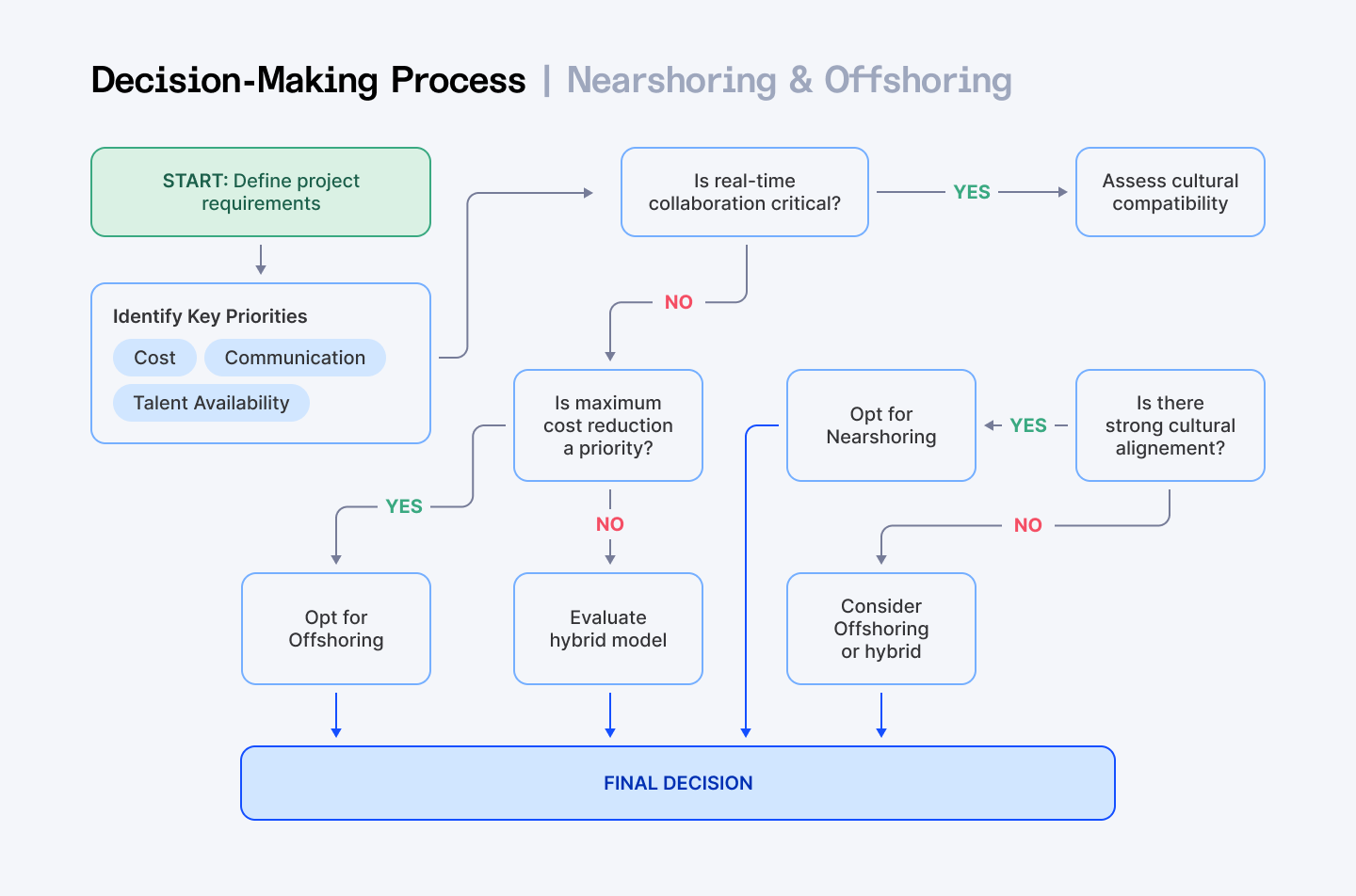
The flowchart compares the decision-making process between nearshoring and offshoring
Communication and Cultural Alignment
When we compare IT nearshoring and offshoring, the difference really shows in how communication affects project outcomes. Offshoring might look attractive due to lower costs, but we've seen that those benefits can quickly disappear if you end up with extra meetings, constant clarifications, or rework because of misunderstood requirements.
Nearshoring, by contrast, has a tangible advantage with time zone alignment. For example, if you have an urgent issue at midday, partners in regions like Mexico or Argentina are still in working hours, ready to address it immediately. This real-time collaboration often helps speed up projects significantly.
There’s also a cultural side to consider. Teams operating in similar economic environments tend to share an intuitive grasp of local business practices. We’ve noticed that professionals in places like Mexico or Colombia often understand North American expectations - whether it’s delivery timelines, quality standards, or customer service - without everything needing to be spelled out.
Both approaches have their trade-offs. Offshoring can deliver solid cost savings if managed well, while nearshoring generally improves communication and cuts down on coordination hassles. Ultimately, you should weigh these factors - communication, coordination, and cultural fit - to decide which approach best meets your business goals.
Also Check Out: Eastern Europe Web Development | Costs, Skills & Top Outsourcing Firms
2025 Outlook: Market Trends and Predictions
Recent research by Gartner and Deloitte underscores that the IT outsourcing market will increasingly favor flexible, hybrid models that blend nearshore and offshore strategies. Here are a few key trends shaping the market:
Digital Transformation Acceleration
As companies continue to digitize, there is growing pressure to optimize IT spending. The debate of IT nearshoring vs offshoring becomes even more relevant when aligning digital transformation goals with operational efficiency. Companies across industries have compressed digital roadmaps from years into months, creating unprecedented demand for specialized technical talent.
Enhanced Communication Tools
The global shift to remote work has dramatically improved virtual collaboration tools and methodologies. Teams that previously struggled with distance now have powerful platforms for asynchronous and real-time collaboration, reducing some traditional barriers in the IT nearshoring vs offshoring debate.
Risk Management and Data Security
With cybersecurity threats growing and regulatory requirements expanding globally, security considerations have become increasingly central to outsourcing decisions. Both nearshoring and offshoring models have responded with enhanced security protocols and compliance frameworks.
Evolving Cost Equations
While offshore development typically offers lower hourly rates (often 40-60% less than domestic teams), the total cost equation has become more sophisticated. ompanies looking to hire offshore developers now factor in:
- Management overhead requirements
- Communication efficiency impacts on timelines
- Quality assurance needs
- Knowledge transfer investments
These considerations have reshaped how organizations calculate ROI when comparing offshore software development vs nearshore alternatives.
Growth Projections
Industry data from Statista points to explosive growth in IT outsourcing. What's driving this surge? Companies everywhere are racing through digital transformation while desperately needing IT solutions that can scale fast and adapt quickly - these factors are reshaping IT outsourcing trends in 2025.
Looking at specific segments, the picture gets even more interesting:
- Nearshore IT Services: For nearshore IT services, BySix’s (2025) research shows they're growing at 8.28% annually. This isn't surprising given how many companies are hunting for specialized talent in AI, automation, and cybersecurity close to home.
- Offshoring: Meanwhile, offshoring hasn't lost its appeal despite the well-known communication hurdles and management headaches. The math still works out - dramatic cost savings plus massive talent pools continue to make distant outsourcing attractive for many businesses.
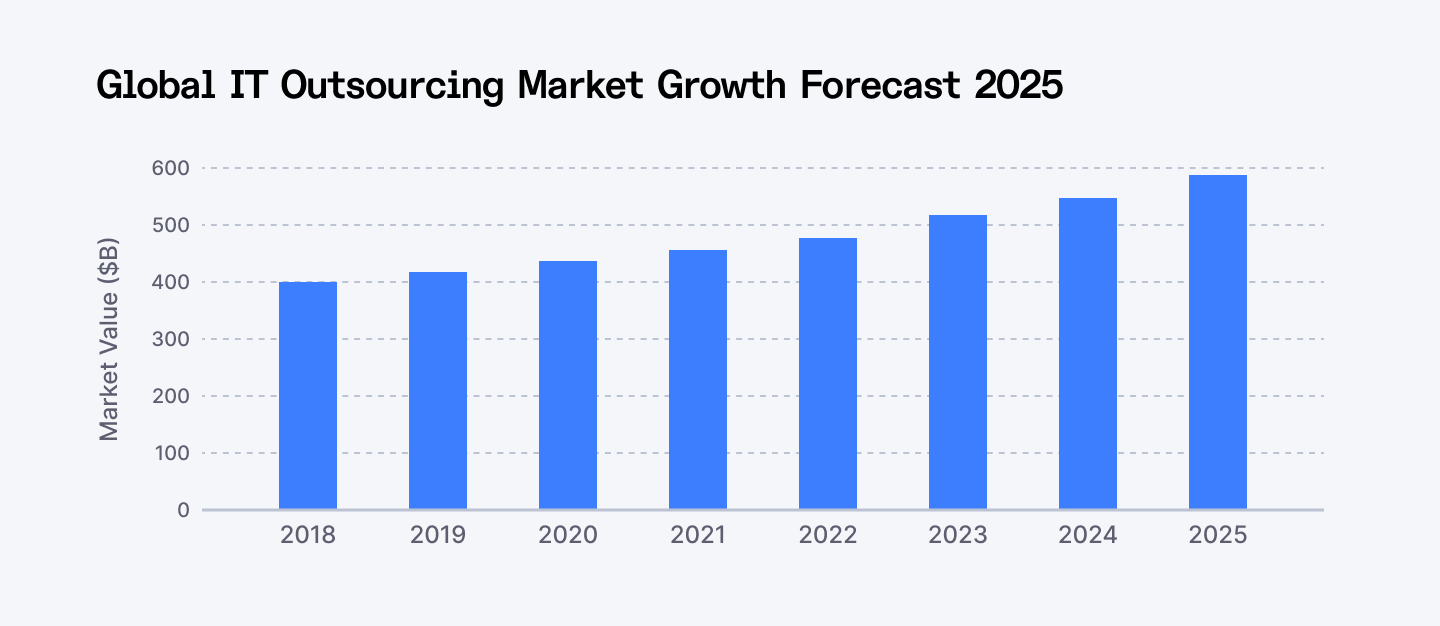
Global IT Outsourcing Market Growth Forecast 2025
Evaluating Nearshore vs Offshore IT Services for Your Business
For companies trying to decide between these models, assessing the real-world application of nearshore vs offshore IT services is essential.
Quality and Efficiency
For developers and companies alike, the quality of deliverables is non-negotiable. Based on industry reports (and some insider information), quality is often higher in nearshore models due to the ease of real-time collaboration. We’ve watched firsthand how teams in similar time zones fix problems in hours instead of days. This speed advantage isn't just nice to have - it's critical when technology environments change weekly and competitors release features daily.
Strategic Alignment and Flexibility
Your outsourcing strategy ultimately succeeds or fails based on one crucial factor: how well your development partner understands and aligns with your company's bigger picture. When weighing IT nearshoring vs offshoring options, finding a partner who truly gets your business goals matters more than hourly rates. You need someone who can pivot when market conditions change, not just execute today's requirements.
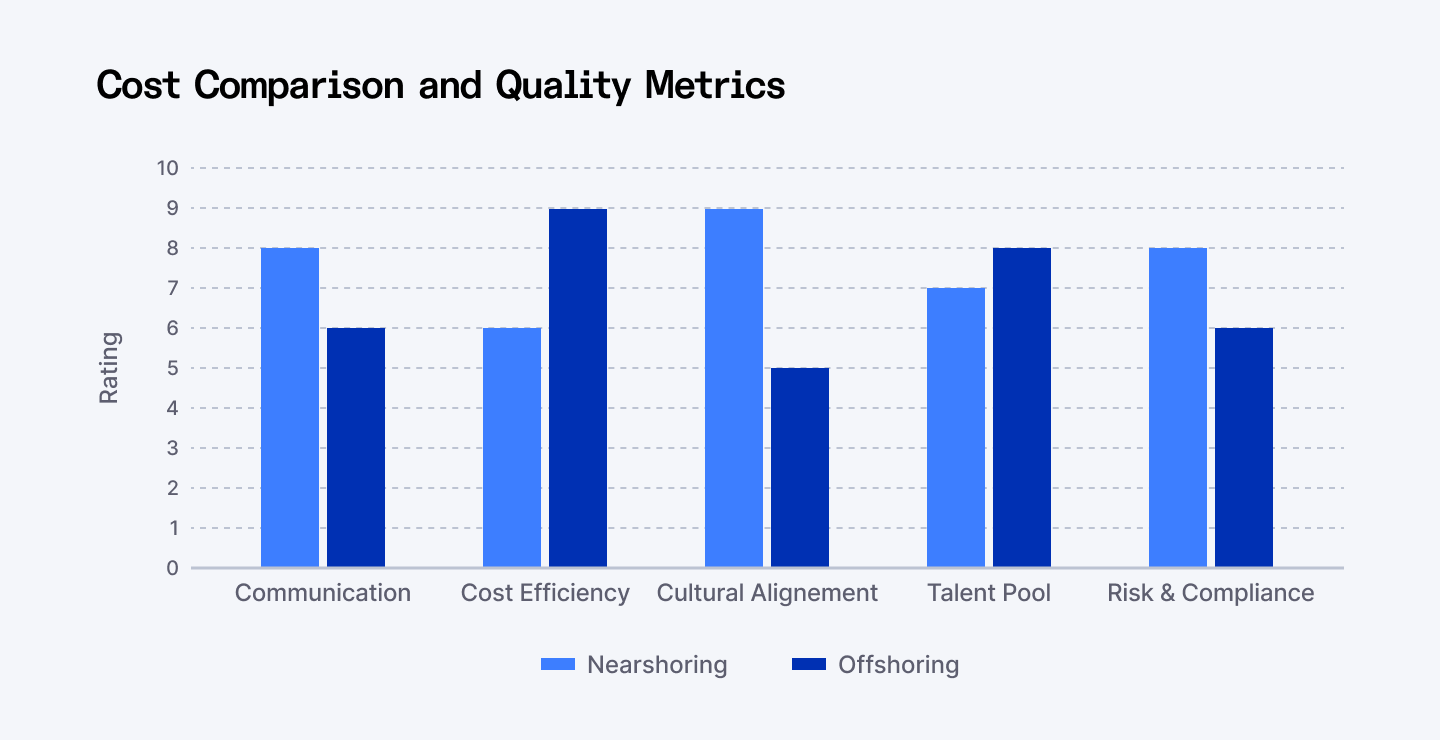
Cost Comparison and Quality Metrics
Access to Specialized Talent
Finding specialized talent in AI, machine learning, and cybersecurity has become a major headache for tech leaders, completely changing how we think about outsourcing. Nearshoring gives you access to talent hubs that aren't just technically skilled but also understand your market context.
Take Latin America for example - Mexico alone has over 700,000 tech professionals now. When you're building products where regional insight matters, that combination of technical skill and cultural understanding becomes invaluable.
Simultaneously, traditional offshore locations have cultivated exceptional depth in specific technical domains. India has established remarkable proficiency in enterprise software development, while Vietnam demonstrates growing specialization in mobile application development and quality assurance automation.
Automation and AI Integration
AI and automation aren't just fancy PowerPoint fodder anymore - they're rewiring the outsourcing game from the ground up. The data suggests AI will spawn roughly 97 million fresh jobs globally by 2025. Translation? Your outsourcing partner better bring more than just AI buzzwords to the table - you need folks who've actually rolled up their sleeves and implemented these systems in the real world.
Doesn't matter if you're betting on IT nearshore vs offshore - your competitive edge increasingly boils down to how quickly and intelligently your organization embraces these tech shifts. We've seen it firsthand: companies that get smart automation right consistently leave their competitors in the dust when it comes to operational efficiency and scaling capabilities. You simply can't afford to overlook this reality when you're sizing up IT outsourcing trends 2025 for your organization.
Weighing the Nearshoring vs Offshoring Pros and Cons
When examining nearshoring vs offshoring pros and cons, you need to carefully consider what each approach offers. Getting this decision wrong can be painfully expensive, so let's break down the real advantages and challenges of each model.
Pros and Cons of Nearshoring
Pros
- Improved Communication: When your teams are in similar time zones, collaboration just flows better. Problems get solved in hours instead of days, and you don't waste time waiting for responses from someone who's fast asleep.
- Cultural Alignment: Teams that share similar cultural backgrounds understand each other's unspoken expectations. This cultural alignment means fewer misunderstandings and smoother team dynamics, which directly improves what you deliver.
- Flexibility: Nearshore teams can pivot quickly when requirements change. Being able to jump on a call during overlapping work hours makes adjusting to new priorities much easier than with teams halfway around the world.
Cons
- Higher Costs: The price tag for nearshoring can be higher, especially in economically developed regions. You're essentially paying a premium for those communication benefits and cultural alignment.
- Limited Talent Pool: Depending where you look, you might hit talent ceiling issues. Some nearshore markets simply don't have the depth of specialized talent you'd find in massive offshore hubs.
- Cultural Nuances: Don't assume cultural alignment is automatic just because you're in neighboring countries. Subtle differences in business practices still exist and can cause friction. Regular communication and some cultural training usually pays off here.
- Scalability: Scaling quickly can be challenging with nearshoring. When you suddenly need to double your team size for a major project, the more limited local talent pools can become a real constraint.
Pros and Cons of Offshoring
Pros
- Cost Efficiency: The cost savings with offshoring are real and substantial. Labor costs in traditional offshore locations can be 40-60% lower than domestic rates, which makes CFOs very happy.
- Large Talent Pool: Places like India, the Philippines, and Vietnam have developed massive tech talent pools. Whatever specialized skill you need, chances are good you'll find it - and often with impressive qualifications.
- Scalability: Need to double your team size in a month? Offshore hubs can typically accommodate rapid scaling because of their sheer population size and established tech sectors.
Cons
- Communication Hurdles: When your team is sleeping, theirs is working, and vice versa. This time zone disconnect creates inevitable delays in problem-solving and decision-making. Language barriers can further complicate things, turning simple clarifications into multi-day affairs.
- Cultural Differences: Different approaches to hierarchy, conflict resolution, and even what constitutes "urgent" can create friction. What seems obvious to you might be interpreted completely differently by an offshore team.
- Increased Risk: Working across international boundaries introduces complex legal, regulatory, and data security considerations. Data protection laws vary dramatically between countries, and navigating these differences often requires specialized legal expertise - adding hidden costs to your budget.
- Quality Control: Maintaining consistent quality across geographically distant teams requires robust management and oversight.
This detailed comparison helps clarify the nuances of nearshoring vs offshoring pros and cons, allowing you to weigh cost against quality, risk against reward, and communication efficiency against global reach.
Factor | Nearshoring | Offshoring |
| Communication | Better due to proximity and similar time zones | Challenged by time zones and language differences |
| Cost Efficiency | Generally higher costs | Often lower labor costs |
| Cultural Alignment | Stronger due to similar cultural norms | Potential cultural misalignment |
| Talent Pool | May be smaller | Access to a broader, diverse talent pool |
| Risk and Compliance | Lower risk with better control | Higher risk related to legal and data security issues |
Source: Deloitte Insights & Gartner
The Dynamics of Offshore Software Development vs Nearshore
When we compare offshore software development vs nearshore options, the real issue boils down to balancing cost savings against everyday operational efficiency. Offshoring can offer some pretty attractive cost advantages - think of it like snagging a great deal on a software subscription - but if you don’t have the right management in place, those savings can quickly be eaten up by miscommunications, extra email chains, and quality hiccups.
On the flip side, nearshore solutions might come with a slightly higher price tag, but in our experience, they often sync better with your internal processes. For example, we’ve observed development teams in places like Cluj-Napoca who integrate into agile workflows almost seamlessly. They understand the unstated rules of sprint planning and retrospectives, share similar approaches to problem-solving, and communicate in ways that minimize confusion. This cultural compatibility makes a real difference in project timelines and output quality.
The Hybrid Approach: Perhaps the Best Outsourcing Model 2025?
As many of our clients have discovered, it’s not a black and white decision between offshore software development vs nearshore. Maybe the answer lies in a carefully balanced mix of both. The hybrid approach involves:
- Strategic workload distribution: After assessing each team’s capabilities, you can start assigning different types of work to nearshore or offshore teams based on their respective strengths.
- Function-based allocation: It would be a wise move to assign certain functions (like product development or UX design) to nearshore teams while moving others (like QA or maintenance) to offshore teams.
- Tiered support models: Implement offshore teams for initial support tiers with escalation paths to nearshore specialists. This way both teams utilize their talent to resolve a common problem.
A retail analytics company we worked with adopted a hybrid model that really made a difference. Their offshore teams handled the mundane reporting and number-crunching (saving a small fortune in the process), while their nearshore talent focused on building those slick dashboards and analytics tools that clients actually interact with. This split approach let them have their cake and eat it too - tapping into dirt-cheap rates for the predictable, well-documented stuff while keeping the collaborative, customer-facing work with teams they could easily hop on a call with when things got complicated.
Deciding on the Best Outsourcing Model 2025
As we look toward the future, determining the best outsourcing model 2025 requires a nuanced approach that considers cost, efficiency, risk, and strategic alignment. Here are some key steps to guide your decision:
1. Assess Your Priorities
Reflect on what matters most - cost savings, quality, speed, or cultural alignment. The discussion of IT nearshoring vs offshoring should start with a clear understanding of your organizational goals.
2. Analyze Data and Trends
Leverage insights from reputable sources such as Statista and industry reports from McKinsey to evaluate IT outsourcing trends 2025. Data-driven decisions will help you determine whether nearshoring vs offshoring 2025 is more aligned with your needs.
3. Pilot Projects
Test the waters with smaller projects to evaluate the real-world impact of both models. Whether it’s offshore software development vs nearshore or nearshore vs offshore IT services, a pilot project can reveal potential pitfalls and opportunities before a full-scale rollout.
4. Engage with Experts
Consult with industry experts or trusted partners - like the innovative team at Index.dev - to gain insights into current practices and future forecasts. Their expertise can be invaluable in choosing the best outsourcing model 2025 for your organization.
5. Consider Scalability and Flexibility
Ensure your chosen model can adapt as your company grows and technology evolves. This flexibility is a critical factor in making decisions around IT nearshoring vs offshoring.
The choice between offshore and nearshore isn't a one-size-fits-all decision. Think about what your project actually needs - are you scraping pennies from the budget, hunting for rare technical skills, or is smooth day-to-day collaboration your priority? Your answer should reflect the real-world constraints of your project, how your team actually works, and what keeps your executives up at night.
Explore More: 10 Best IT Staffing Companies in Eastern Europe: 2025 Rankings
Final Thoughts: Making the Choice That’s Right for You
When weighing IT nearshoring vs offshoring, you'll need to look beyond the buzzwords. Sure, nearshoring gives you that time zone advantage, fewer cultural hiccups, and easier communication. Meanwhile, offshoring still wins on pure cost savings and opens doors to massive talent pools you can't find locally. But honestly? Which way you should lean depends entirely on what your company is trying to accomplish, the nature of your project, and where you want to be in five years.
We've talked to countless technology leaders who've struggled with the nearshoring vs offshoring pros and cons. Many found that drawing a hard line between the two approaches just created new problems. The companies that seem happiest with their decisions often cherry-pick elements from both worlds. In today's landscape where digital transformation never stops and AI keeps reshaping the rules, being dogmatic about your outsourcing approach can backfire spectacularly.
…
At Index.dev, we understand the changing trends in technology partnerships. We help companies choose the right outsourcing model for 2025 by combining hands-on experience with data-driven insights. Whether you’re deciding between nearshoring or offshoring, our team will guide you to the approach that truly fits your business needs.
Hire senior developers through Index.dev, with 48-hour matching and a 30-day free trial, to access the best talent for your projects.