To negotiate freelance developer rates fairly you need to conduct market research, define scope clearly, negotiate with transparency, and respect each developer’s expertise to attract top talent and avoid costly skill‑gap delays.This balanced approach ensures both you and your freelance talent succeed.
Skilled freelance developers are in high demand and command a wide range of rates. Recent industry research underscores this trend: in 2023, 64 million Americans (38% of the U.S. workforce) freelanced, contributing about $1.27 trillion to the economy. Nearly half of those freelancers provided specialized knowledge services (computer programming, IT, etc.).
Surveys by platforms like Upwork and Payoneer also show growing demand and rising rates: about 46% of freelancers saw demand increase and 38% raised their hourly rates in the past year. At the same time, the global average freelance rate is roughly $21/hour, reflecting huge variability by skill, experience, and region. Under-paying talented developers can backfire: an IDC study warns that unfilled IT skill gaps could cost businesses $5.5 trillion by 2026 in lost revenue and delays.
If you're a hiring manager or HR professional, it's important to use facts and data when discussing salaries. The tips below will help you offer fair pay for different roles (like front-end, back-end, or mobile developers) while staying within your budget and avoiding mistakes that could lead to underpaying good talent.
Hire top freelance developers through Index.dev! Vetted talent, fair rates, 48-hour match, and 30-day free trial to get started risk-free.
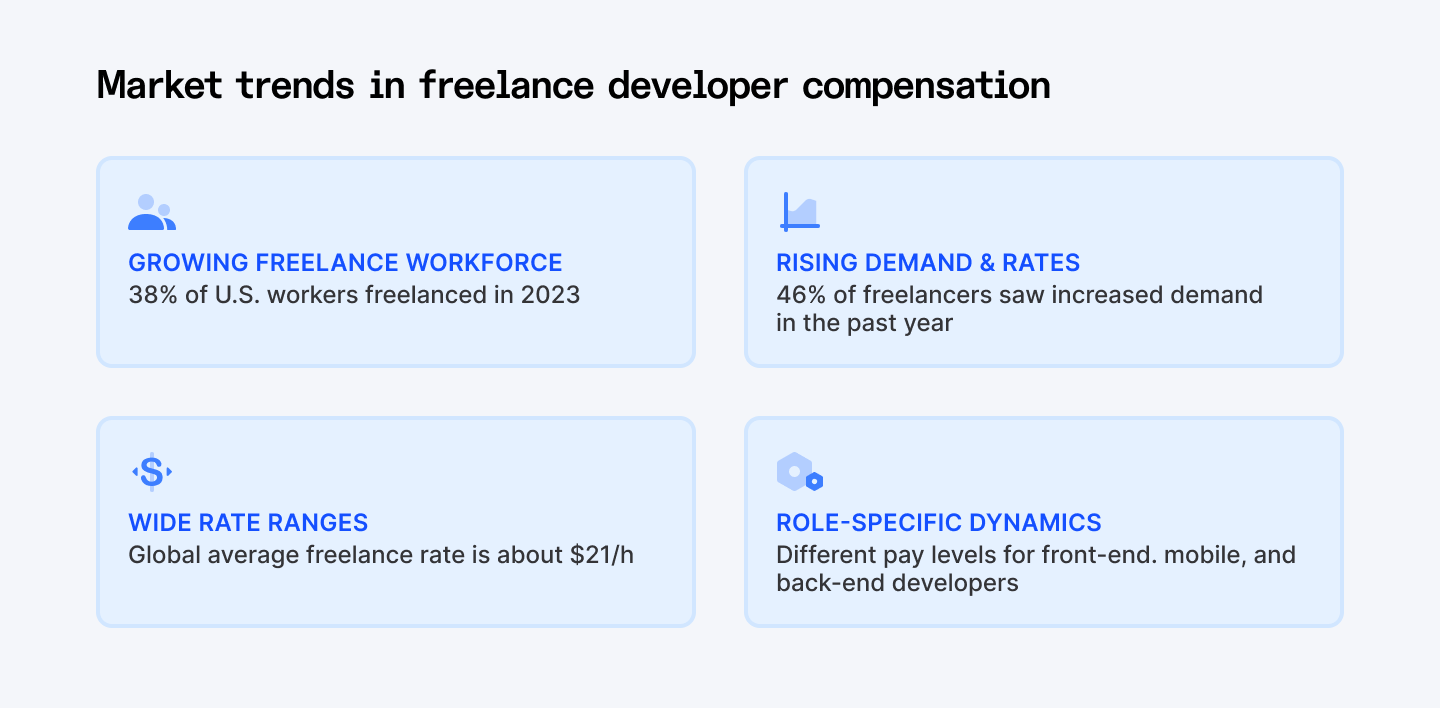
Market Trends in Freelance Developer Compensation
Growing freelance workforce
Freelancing is no niche trend. 38% of U.S. workers freelanced in 2023, and a large share are tech professionals. Platforms report record-high participation (64M people) and earnings, driven by flexible work preferences and remote tools.
Rising demand & rates
Economic uncertainty and cost-of-living increases have led many freelancers to raise their prices. Payoneer’s survey found 46% of freelancers saw increased demand and 38% hiked hourly rates last year. In practice, you may find developers quoting higher fees than before, so checking up-to-date market data (from industry reports or platforms like Upwork) is wise.
Wide rate ranges
Global benchmarks show average freelance rates around $21/hour, but experienced developers can charge much more, especially in high-cost markets. For example, U.S. mid-career software developers bill ~$43/hour on average, while senior engineers can exceed $50/hour or more. Rates also vary by specialty and location (a back-end Java specialist in Silicon Valley earns more than an entry-level developer in another region). Always tailor your expectations to the role and region.
Role-specific dynamics
Different developer roles attract different pay levels. Front-end/web developers (focused on UI/UX) may compete in large talent pools, sometimes moderating rates, whereas mobile (iOS/Android) and back-end engineers often command premium rates for their specialized skills. Full-stack or DevOps roles, which combine skills, are typically at the higher end. When negotiating, consider each role’s typical market value: for instance, candidates with niche expertise (machine learning, security) can justifiably ask for more due to scarcity.
Platform insights
Reputable platforms (Upwork, Toptal, Index.dev, etc.) regularly publish freelancer stats and guides. They confirm these trends and offer role-by-role data. For example, Upwork’s Freelance Forward report highlights that almost half of all freelance gigs are skilled services like programming. Knowing these trends helps you set realistic pay ranges that attract talent without overpaying.
Why Fair Compensation Matters
Quality and productivity
Undervaluing developers often means hiring less experienced or disengaged talent. Poor code and project delays can cost far more than a fair rate.
In fact, IDC estimates that skills shortages (often from under-hiring) could drain $5.5 trillion from the economy by 2026 due to delays and lost deals. Paying competitive rates helps ensure you attract competent, motivated freelancers who meet deadlines and quality standards.
Retention and reputation
Even as freelancers by nature are not permanent staff, fair pay encourages them to prioritize your project and avoid simply dropping it for a better-paying gig. Word-of-mouth in freelancer communities is strong: consistently lowbidding companies may develop bad reputations. On the flip side, being known for fair compensation and transparent negotiations makes top freelancers more likely to accept and stay on your projects.
Diversity and equity
Data also shows undervaluation can be systemic. For instance, Payoneer reports female freelancers earn about 92 cents for every dollar earned by men, meaning bias or negotiation gaps can hurt talent supply. By consciously offering equitable rates and allowing fair negotiation, you widen the pool of quality candidates and support an inclusive workforce.
Long-term value
Remember that freelancers often bring specialized knowledge. Their work can accelerate product development or fill critical skill gaps. Viewing contract fees as an investment (rather than just a line-item expense) helps you negotiate with a value mindset.
In other words, weigh the benefit of a freelancer’s expertise against their rate. A mid-level developer who boosts your product’s stability might be worth more per hour than a junior at a lower rate.
Best Practices for Negotiating Rates
1. Define clear project scope upfront
Before negotiations start, be clear (internally) about what you need, whether it is features, timelines, and/or deliverables. Sharing this scope with candidates lets them give accurate quotes. A precise scope avoids misunderstandings and scope creep (unexpected extra work) that could strain budgets.
2. Research market rates
Use available data to set benchmarks. Check salary surveys, freelancing platforms, or industry reports for rates by role and region. For example, hiring an experienced back-end developer in North America may cost substantially more than a similarly skilled developer in a lower-cost country. This research arms you to recognize fair proposals and justify your budget.
3. Focus on value and fit
During negotiations, emphasize the project’s value rather than just slashing costs. For example, a developer might charge more, but if they deliver higher efficiency or specialized skills, that can save money later. Communicate long-term project goals and how the freelancer’s work aligns. As one expert puts it, highlight how their skills solve your problems, not just their hourly cost.
4. Encourage freelancers to quote
Invite candidates to propose their rates based on the provided scope. Often skilled freelancers will quote a number that reflects their worth. You can then discuss adjustments. A transparent approach (“What rate do you normally charge for a project of this scope?”) can make them comfortable and avoid under- or over-pricing.
5. Be open to different pricing models
Not all projects fit a simple hourly rate. Consider fixed-price contracts for well-defined tasks, or hybrid models (e.g. an hourly rate up to certain milestones). As per industry reports, freelancers who mix billing methods often earn more on average, perhaps because it lets them package value. For lengthy development work, negotiate checkpoints or deliverables tied to payments.
6. Communicate transparently
Share your budget range or constraints early if possible. This prevents wasting time on negotiations with mismatched expectations. Likewise, encourage freelancers to ask questions about the project. Good communication fosters trust and helps both sides see what a “fair” rate looks like for the work involved.
After agreeing on scope, rate, and schedule, set clear receipt requirements. Ask freelancers for standardized receipts each milestone. The Invoice simple receipt maker ensures consistent, professional receipts. Sharing a template upfront reduces delays and keeps clean audit trails.
7. Use reputable platforms
Hiring through established channels (such as Index.dev) gives extra assurance of quality and fairness. Index.dev and similar services vet developers, which means you can be more confident a freelancer’s rate matches their verified skill. These platforms often provide support (like an escrow or trial period) that protects both parties and clarifies compensation terms.
8. Offer non-monetary value
Sometimes you can create a win-win by sweetening the deal in other ways. Examples include offering flexible schedules, referrals to other projects, or the chance to build a long-term collaboration. While rate is key, a supportive, professional experience is also highly valued by freelancers.
Read More: How to Negotiate Salary for Software Engineer Job Offer
.png)
Best Practices from the Freelancer’s Perspective
- Know their worth: Freelance developers should calculate all business costs (tools, taxes, downtime) into their rates. Encourage them to do this; it means they won’t propose unsustainably low bids. When they explain how their rate is built (experience, certifications, past success), it makes negotiation rational rather than emotional.
- Encourage portfolio discussions: Ask freelancers to showcase previous work or client testimonials. Seeing what they’ve accomplished helps justify their quote. It also gives you confidence they can deliver, making you more willing to meet their rate.
Discuss skill relevance: A developer may offer a discount if a project is simpler than their usual scope. Alternatively, if your project is high-stakes or uses cutting-edge tech, they may rightly charge a premium. Understand how their specific skills fit your needs. For example, a front-end specialist with deep UX expertise might charge more than a generalist, and that could be justified if design quality is key to your app.
Common Pitfalls and How to Avoid Them
- Rushing to the lowest bid: It’s tempting to hire the cheapest developer, but this often leads to problems. Underselling talent can mean missed requirements, buggy code, or high turnover (the freelancer leaving mid-project). Instead, focus on value per dollar: sometimes paying a bit more yields much better results.
- Ignoring hidden costs: Failing to account for all costs (benefits, tooling, management overhead) can skew negotiations. Remember, a low hourly rate doesn’t cover what you don’t get: backup staff, training, or paid leave. The arc.dev analysis shows hiring full-time staff has large overheads, but even freelancers come with indirect costs (communication time, onboarding, etc.). Factor these into your budget so the agreed rate truly reflects the developer’s take-home pay.
- Unclear scope or milestones: If you haven’t defined the project well, negotiations can break down later over extra tasks. To avoid this, always outline deliverables clearly. For example, list features, platforms (iOS, Android, web), and how you’ll measure completion. Without this, a lower bid might be based on a narrower scope than what you need.
- Neglecting local and global differences: Developers from different countries have different living costs. A “fair” rate in one region might be exploitative or unnecessarily high in another. Be mindful of currency exchange and local wages. Use salary benchmarks or the knowledge that, for instance, a skilled developer in Eastern Europe or Asia may charge a fraction of a U.S. peer. This doesn’t mean they are less talented, but you should adjust expectations to avoid over- or under-paying relative to their location and expertise.
Overlooking ongoing market shifts: Tech markets change fast. Rates that were fair a year ago might be outdated now (consider AI tools, new frameworks, or inflation). Regularly update your rate charts. The Payoneer and Upwork reports highlight how frequently freelancers adjust their fees in response to the economy. Treat rate negotiation as a dynamic process, not a one-time decision.
Roles and Negotiation Dynamics
Front-End Developers
These specialists handle user interfaces, working closely with designers. Clients hiring front-end devs should emphasize UI/UX requirements. In negotiations, be prepared for discussions about design complexity or performance optimization.
Front-end talent can sometimes be more plentiful, so while you should still offer fair pay, candidates may negotiate more on project responsibilities (e.g. handling some design tasks vs. coding only).
Mobile Developers
iOS and Android experts often command premium rates due to platform expertise. When negotiating, clarify if the project is cross-platform (React Native, Flutter) or native, since native specialists typically charge more. Consider that mobile devs might ask for higher pay for extra services like app store deployment or design for multiple screen sizes.
Back-End Developers
These engineers work on servers, databases, and business logic. They often require advanced problem-solving skills, which can justify higher rates.
In negotiations, expect them to ask detailed questions about system architecture. Be transparent about project scale and traffic expectations, since back-end complexity directly affects the effort (and thus rate).
Full-Stack Developers
Because they cover both front-end and back-end, full-stack devs may ask for higher rates reflecting their versatility. When working with full-stack candidates, clearly define which parts of your project they’ll handle.
You might negotiate on scope: for example, you could pay a senior full-stack developer a bit more in exchange for them managing both development and some team coordination.
Data/AI Specialists
If your project involves data processing or AI/ML, rates can be significantly higher. These roles are in high demand and short supply, so expect a steeper negotiation.
Here, budgeting appropriately from the start is key. Undervaluing data roles is a common pitfall because clients may not fully grasp the expertise required.
Each role has its own market dynamics. Use this awareness during negotiations. For example, if you choose the right role for the job (don’t hire a highly-paid ML expert for a simple website, or a junior full-stack dev for a critical backend), you save money without sacrificing quality. Align your ask (or offer) to the role’s typical responsibilities.
Also Check Out: Average Developer Salaries in Eastern Europe | Country Comparison
Conclusion
Negotiating fair freelance developer rates is both an art and science. You must stay informed about current market trends and data, set clear project expectations, and communicate openly with candidates. By focusing on value and treating freelancers as professional partners, you’ll reach agreements that honor their skills without breaking your budget.
Remember to leverage reputable talent networks (like Index.dev) and up-to-date reports for guidance. Doing so, your team gains the right talent at a fair price, projects run smoothly, and your company avoids the hidden costs of undervaluing developer expertise.
For Tech Companies:
Hire from Index.dev’s elite 5% vetted developers with 48-hour matching and a 30-day free trial! Secure top talent fast and risk-free.
For Freelance Developers:
Join Index.dev to get matched with companies that value your skills, pay fair rates, and offer long-term remote work opportunities.