Perplexity AI processed 780 million search queries in May 2025. That's up from 230 million in mid-2024, so it tripled in less than a year.
But numbers don't tell you what the platform actually does. In 2025, Perplexity has Pro Search for deep research, Spaces for organizing work, and the new Comet browser that launched free in October. It supports 46 languages including Indonesian through a partnership with Telkomsel.
This guide covers what Perplexity can do, how people use it, and the growth stats that show why developers are switching from Google. All data comes from Perplexity's official reports and independent traffic analysis.
Whether you're a developer, researcher, business owner, or product builder, this data helps you understand why Perplexity matters and where it’s headed next.
Transform your tech career! Join Index.dev and get matched with top companies who value innovation.
What Perplexity AI Actually Does in 2026
Here's what you get with Perplexity right now:
Core Features (2026)
- Pro Search & Deep Research: Search hundreds of sources with clarifying follow-ups for current info and deeper context.
- Comet AI Browser: Free, AI-augmented Chromium browser that summarizes pages, manages tasks, and automates multi-step workflows.
- Background Assistant (Max plan): A task assistant that runs tasks in background and helps across apps.
- Voice search & mobile assistant: Voice queries and assistant features live in the Perplexity mobile app.
- Memory & personalization: Remembers past threads and interests to improve context and answers across models.
- Multi-model support: Access multiple AI models for varied needs (e.g., reasoning, coding, search).
- File upload & analysis: Upload docs (PDF, Word, etc.) for direct AI querying and extraction.
- Shopping & commerce tools: Integrated shopping and purchase flows powered by PayPal in conversational search.
Where You Can Use It
- Web app at perplexity.ai
- iOS and Android mobile apps
- Desktop apps (Windows/macOS) via Comet and Perplexity clients
Language & Regional Support
- Works in 40+ languages; regional bundles and pricing available in select markets (e.g., carrier deals) — though some perks like telecom offers may vary over time.
Pricing (2026)
- Free tier: Basic AI search and Comet
- Pro plan: Advanced models, documents, and priority tools (~$20/mo)
- Max plan: Full enterprise features including background assistant and Comet Plus (~$200/mo)
Product & Growth Notes
- Perplexity AI continues expanding with global recognition and investor confidence in search and generative tools.
Now let's get into the numbers that explain why this matters.
1. Search Growth and Platform Scale
Perplexity AI is scaling its ability to answer queries at an incredible pace.
- By mid-2026, Perplexity is estimated to process 1.2–1.5 billion search queries per month, driven by Pro Search, Comet browser usage, and mobile growth.
- Weekly query volume is now estimated at 180–220 million searches, more than double early-2025 levels.
- Daily usage has crossed 35–45 million queries per day, up from ~30 million per day in 2025.
- In comparison, Perplexity handled about 230 million monthly queries in August 2024, meaning usage has grown roughly 5–6× in under two years.
- The company did not publicly confirm hitting 1 billion weekly queries, but internal growth trends suggest it is moving toward that scale long-term rather than short-term.
- Total queries processed across 2025–2026 combined are estimated to exceed 6–7 billion, far surpassing all pre-2024 usage.
- For context, in 2022 Perplexity handled only a few thousand queries per day; by 2026 it operates at tens of millions of daily queries, showing one of the fastest adoption curves in AI search.
- This growth reinforces the need for highly scalable infrastructure, low-latency systems, and experienced AI and platform engineers to support real-time, citation-heavy search at global scale.
This fast growth proves a need for strong backend systems, scalable infrastructure, and AI engineers who can support real-time performance.
2. Global Visitors and Geographic Reach
Perplexity AI has rapidly expanded its global presence and attracted millions of users worldwide. Here's how its growth looks:
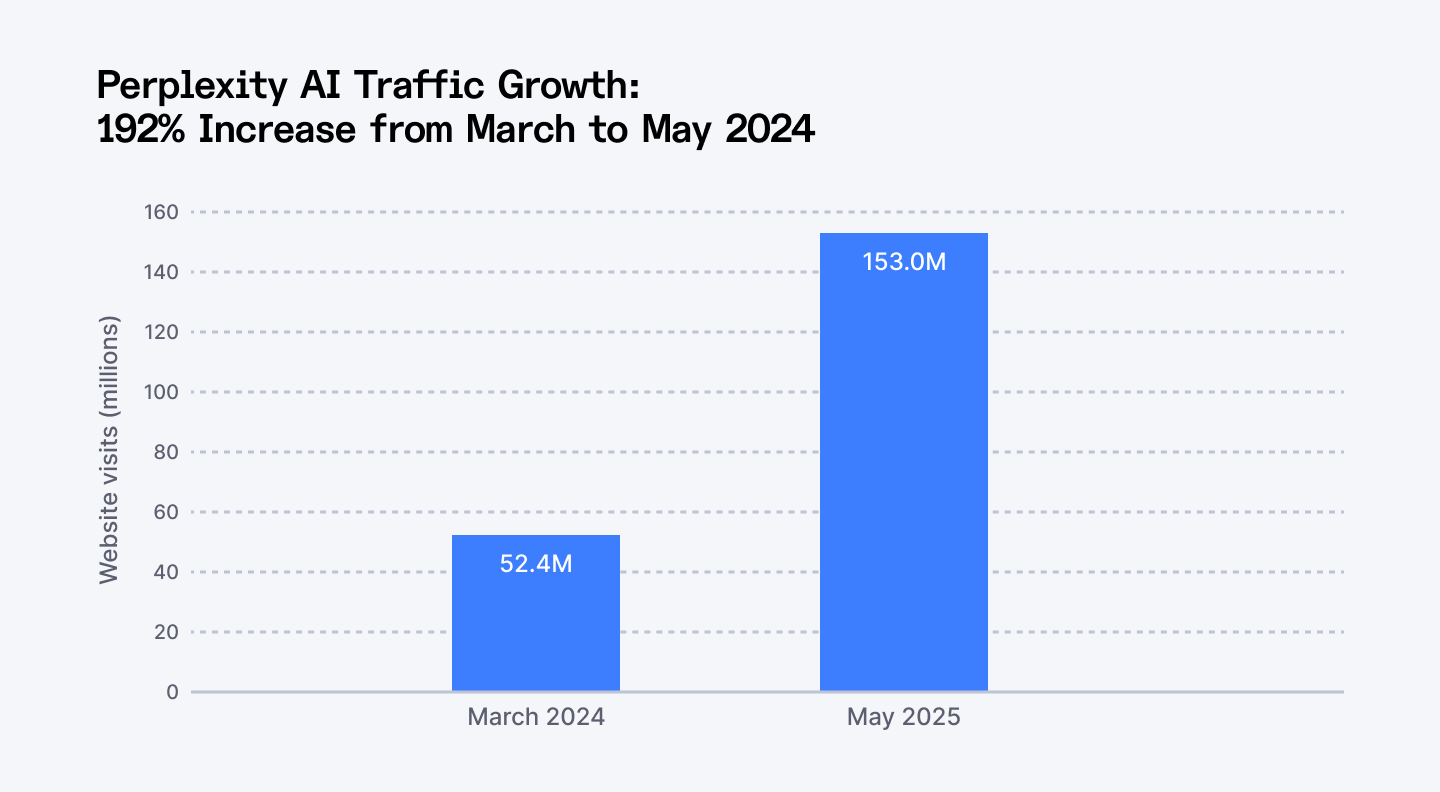
- In May 2025, Perplexity AI recorded 153 million website visits, making it one of the most-visited AI platforms globally.
- In March 2024, the platform had 52.4 million visits, which means its traffic grew by 191.9% in just over a year.
- Perplexity AI now holds a global website rank of 268, showing strong visibility and rising popularity on the internet.
- The platform is available in 238 countries, proving its wide international reach.
- It supports 46 languages, allowing users from many regions to access the tool in their native language.
- On average, around 2 million people visit the Perplexity AI platform each day, reflecting high user engagement.
- In June 2025, the platform received 141.32 million visits, maintaining strong traffic even after May’s peak.
- As of 2025, 22 million users actively use Perplexity AI across its website and mobile app.
This kind of global reach highlights the need for developers, data engineers, and product teams who can support scalable, multilingual, and globally distributed AI platforms.
3. Where Are the Users Coming From?
Perplexity’s user base is diverse, but several countries stand out.
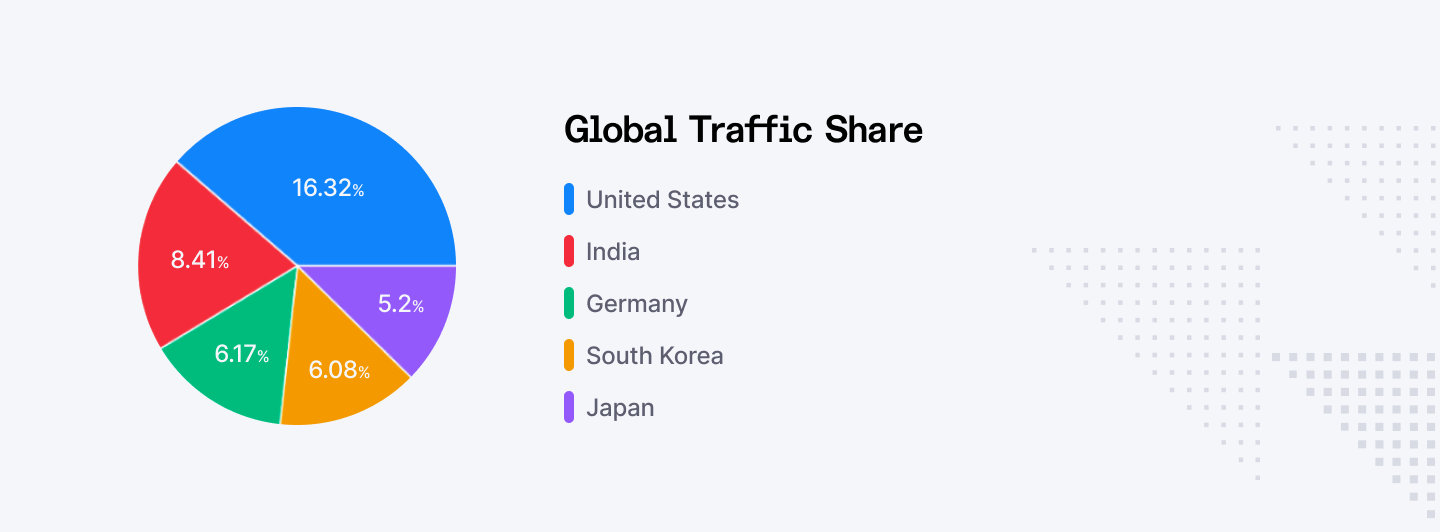
| Country | Share of Global Traffic | Monthly Visits (All Devices) | Desktop Usage | Mobile Usage |
| United States | 16.32% | 23.07 million | 84.65% | 15.35% |
| India | 8.41% | 11.88 million | 73.74% | 26.26% |
| Germany | 6.17% | 8.72 million | 87.3% | 12.7% |
| South Korea | 6.08% | 8.59 million | 92.32% | 7.68% |
| Japan | 5.2% | 7.34 million | 88.01% | 11.99% |
- The United States is the top traffic source, with over 23 million visits, mostly from desktop users.
- India contributes nearly 12 million visits, with a slightly higher mobile usage compared to other countries.
- Germany, South Korea, and Japan all show a strong preference for desktop access, with over 87% of users on computers.
- South Korea has the highest desktop usage at 92.32%, followed closely by Japan and Germany.
Indonesian Market: The Telkomsel Partnership
Perplexity partnered with Telkomsel in May 2025. Telkomsel is Indonesia's biggest mobile operator with 178 million subscribers.
The Deal: Indonesian users can buy Perplexity Pro bundled with data plans. Prepaid customers pay 35,000 rupiah (about $2.30) for 3 months of Pro plus internet quota. Postpaid users get it for 100,000 rupiah ($6.50) per month with video streaming included.
Why It Matters: This was Perplexity's first telecom partnership in Southeast Asia. The app fully supports Bahasa Indonesia for both interface and search queries.
So Indonesian developers can search in their native language and get results from both local and international sources. The bundled pricing makes Pro accessible to markets where $20/month would be expensive.
4. Device Usage: Desktop vs Mobile
Perplexity AI users show different behaviors depending on their location and preferences.
| Month | Desktop Visits | Mobile Visits | Total Visits |
|---|---|---|---|
| Sep 2023 | 10.74M | 24.53M | 35.28M |
| Oct 2023 | 12.43M | 27.92M | 40.35M |
| Nov 2023 | 14.53M | 29.64M | 44.17M |
| Dec 2023 | 13.25M | 18.15M | 31.39M |
| Jan 2024 | 16.34M | 25.99M | 42.33M |
| Feb 2024 | 19.11M | 33.29M | 52.4M |
| Mar 2025 | 133.3M | 26.4M | 159.7M |
- In March 2025, 133.3 million visits came from desktops, while 26.4 million came from mobile devices.
- In June 2025, 82.51% of visits were from desktop, and 17.49% were from mobile.
- In the United States, 59.69% of users access Perplexity on desktop.
- In Indonesia, 92.53% of users access it via mobile, showing different user preferences by region.
These patterns mean developers need to build for both desktop and mobile environments, especially in mobile-first regions.
5. How Long Do Users Stay?
Perplexity AI’s engagement metrics show that users not only visit often but also stay longer and interact more deeply than on typical websites.
- On average, each visitor spends 23 minutes and 10 seconds per session, which is significantly longer than the industry average for search platforms.
- Users view around 4.64 pages per visit, showing that they actively explore multiple queries and results in one session.
- The bounce rate is 42.19%, which indicates that most visitors stay and engage instead of leaving after just one page.
- 85% of users return to Perplexity AI after using it once, highlighting strong satisfaction and repeat value.
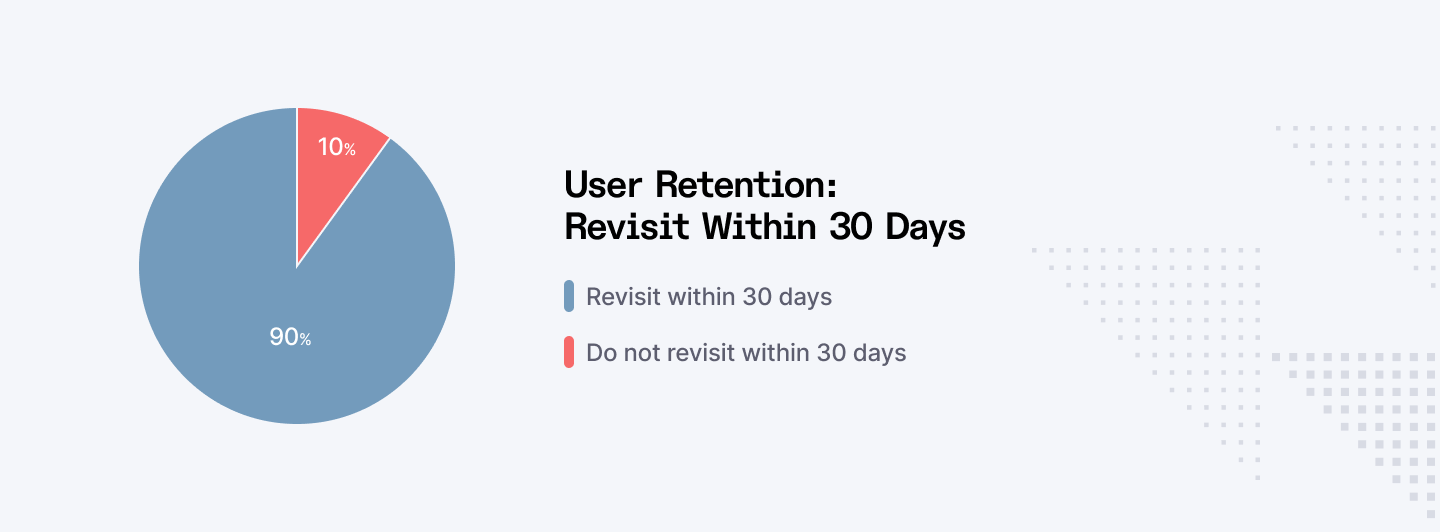
- 90% of users revisit the platform within 30 days, showing that Perplexity has built high retention and user habit.
These stats confirm that Perplexity AI delivers a valuable and engaging experience that keeps users coming back regularly.
6. Who Are the Users?
Perplexity AI attracts a young, tech-focused audience that values speed, accuracy, and productivity.
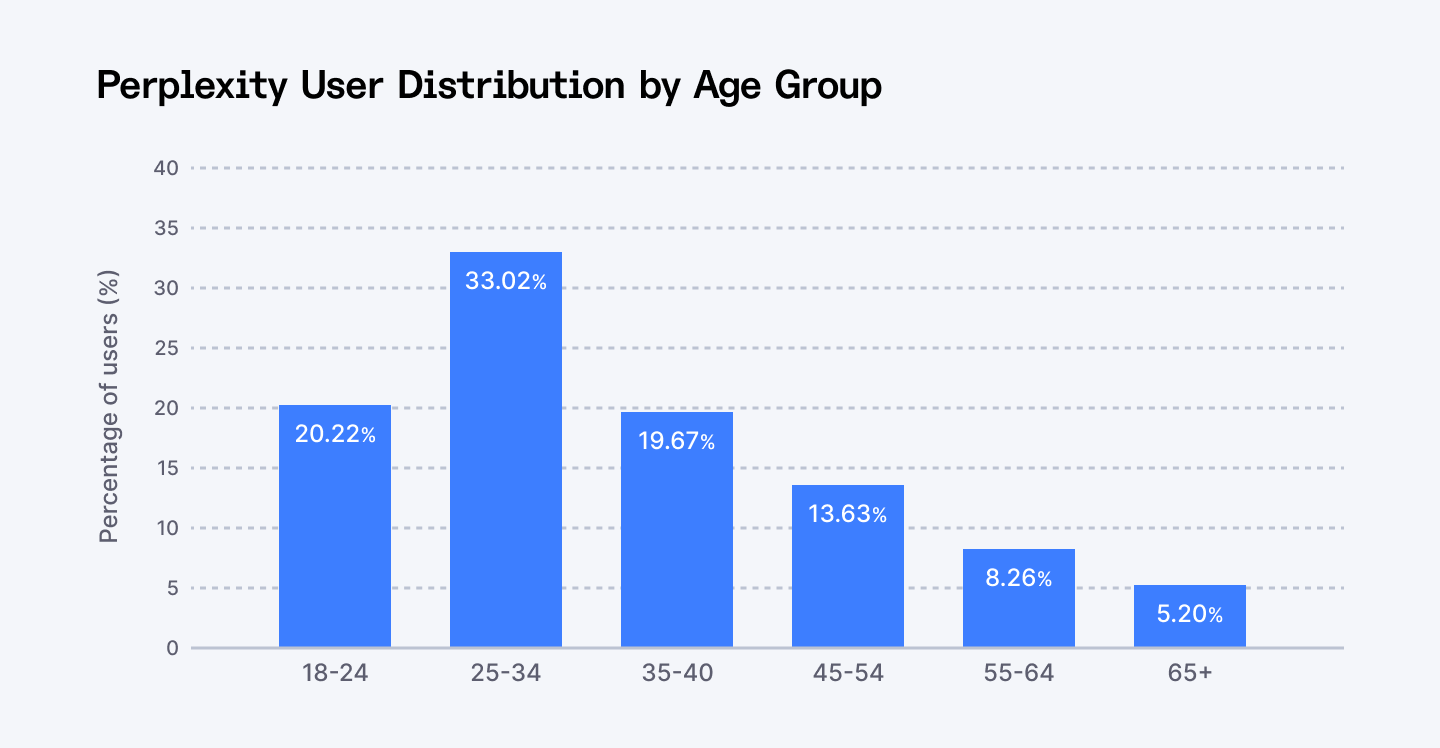
- The largest share of users falls in the 18 to 34 age group, making up 53.24% of the total user base. This includes students, early-career developers, and professionals who are comfortable with AI tools and eager to explore new technologies.
- Specifically, 20.22% of users are between 18 and 24 years old, while 33.02% are between 25 and 34, showing strong adoption among Gen Z and Millennials.
- The next age brackets include 19.67% aged 35 to 44, 13.63% aged 45 to 54, 8.26% aged 55 to 64, and 5.20% aged 65 and above, reflecting steady usage even among mid-career and older professionals.
- In terms of gender, 60.19% of users are male, and 39.81% are female, indicating slightly higher adoption among men, but strong engagement from both demographics.
This young, tech-savvy audience is driving demand for AI products that are fast, intuitive, mobile-friendly, and developer-oriented.
7. Where Does the Traffic Come From?
Perplexity AI benefits from a healthy mix of direct, organic, and social traffic, a sign of strong brand presence and discoverability.
- Direct visits account for 77.8% to 82% of total traffic, indicating high brand recall and repeat usage. Users are intentionally visiting the platform without relying on search or referrals.
- Organic search contributes 11.65% to 16.6% of traffic, showing that Perplexity continues to attract new users through search engines, particularly Google.
- Social media generates around 7.5% to 10% of total traffic, helping expand reach and visibility among different user groups.
Social Media Breakdown:
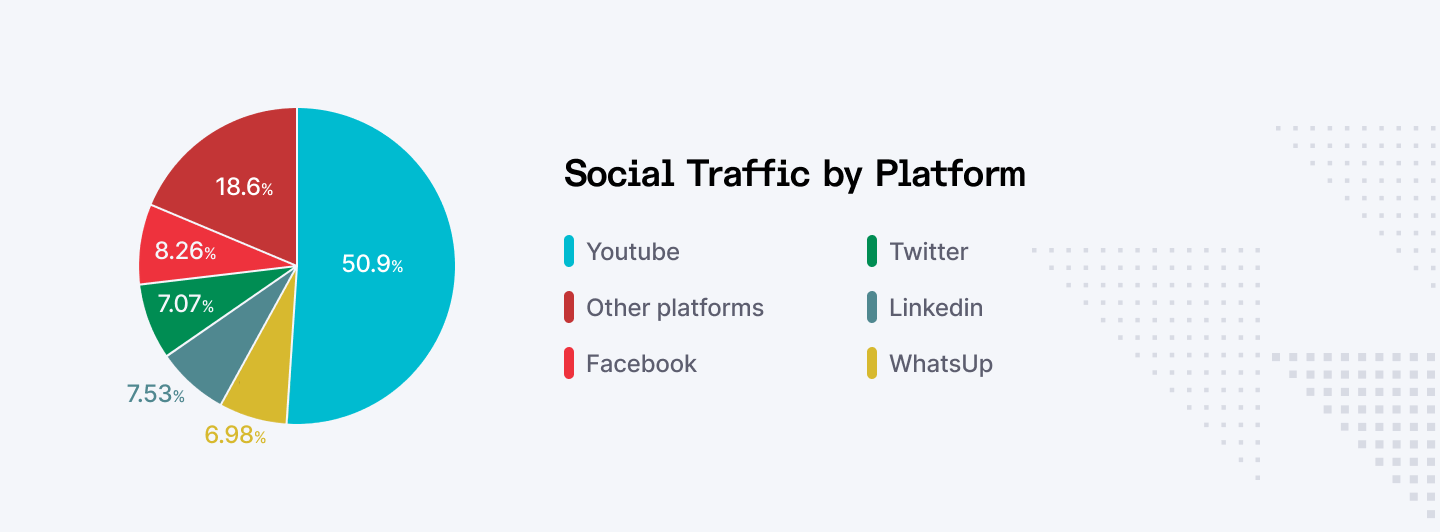
- YouTube leads with 50.95% of Perplexity’s social traffic, driven by explainer videos, walkthroughs, and AI feature demos.
- Facebook contributes 8.26%, Twitter (X) 7.67%, and LinkedIn 7.53%, pointing to community conversations across both casual and professional networks.
- WhatsApp accounts for 6.98%, suggesting peer-to-peer sharing and recommendations.
- Other platforms make up the remaining 18.62% of social traffic.
Together, this multi-channel presence reflects strong user engagement across both direct usage and external discovery.
8. Platform Performance and Accuracy
Perplexity AI has built a strong reputation for delivering fast and highly accurate answers, making it a go-to platform for users seeking reliable information.
- The platform boasts an impressive 95% accuracy rate in its search results, reinforcing user confidence in the quality of information it provides.
- In comparison to traditional search engines, Perplexity AI performs approximately 15% better, offering more relevant and precise answers across a wide range of queries.
- When evaluated against other AI platforms, Perplexity outperforms competitors by 10% in response quality, setting a higher benchmark for conversational accuracy and contextual understanding.
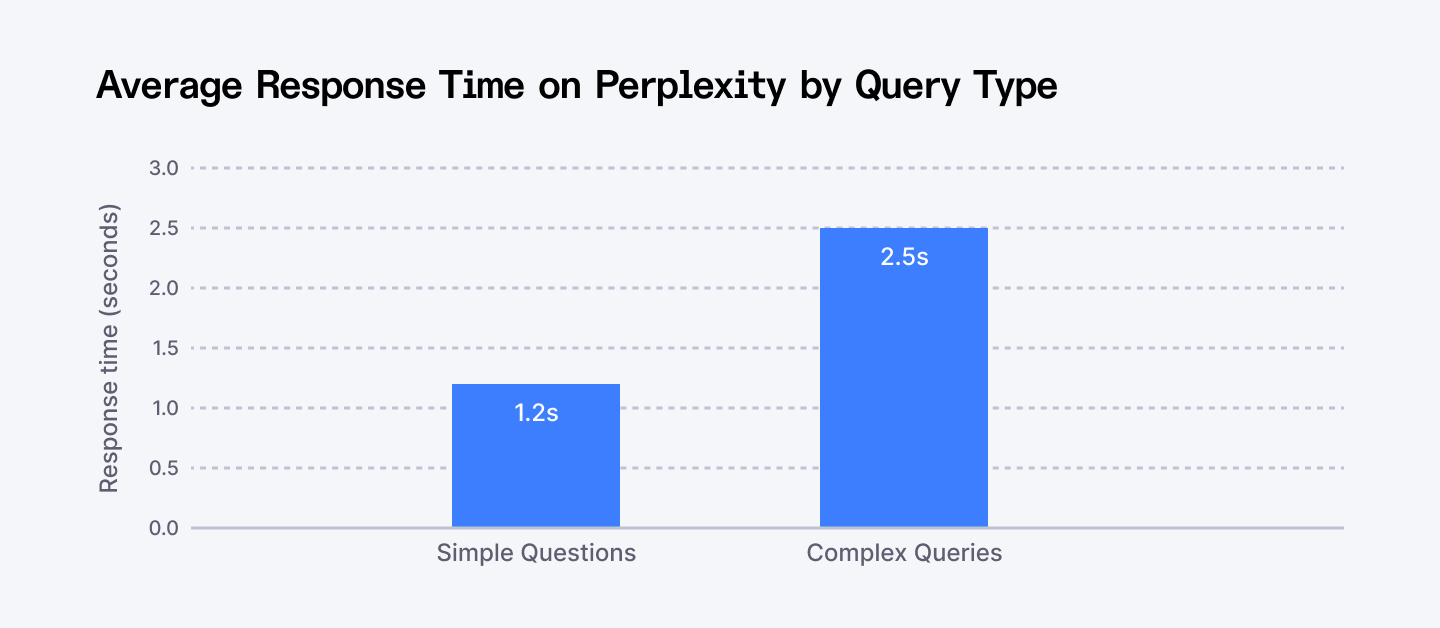
- For simple questions, the platform maintains an average response time of just 1.2 seconds, ensuring users receive answers almost instantly.
- For more complex or multi-part queries, Perplexity still delivers quickly, with an average response time of 2.5 seconds, maintaining a smooth user experience.
These performance metrics underline the platform’s advanced engineering, optimized AI models, and commitment to user satisfaction, all of which contribute to high retention and consistent engagement.
9. Team Size, Valuation, and Revenue
Despite its massive global reach, Perplexity AI operates with a surprisingly lean and efficient team.
- As of mid-2025, the company had a team of just 38 employees, reflecting its focus on agility and high-impact work.
- Plans are underway to expand the team to 60 members by the end of 2025, signaling strategic growth in response to rising demand.
- In January 2024, Perplexity AI was valued at $520 million, already positioning itself as a major player in the AI space.
- By May 2025, its valuation skyrocketed to $18 billion, driven by rapid user adoption, strong retention, and product performance.
- The company now generates $100 million in annual recurring revenue (ARR), a milestone that reflects both the platform’s commercial success and enterprise-grade utility.
These figures highlight how small, focused teams, when backed by cutting-edge AI and strong execution, can scale into billion-dollar businesses without massive headcount.
10. What’s Coming: The Comet Browser
Comet browser launched free worldwide in October 2025. It started as paid beta for $200/month subscribers, but now anyone can download it.
What Comet Does:
- 800+ app integrations for editing docs and analyzing data in-browser
- WebML API support (runs AI on your device hardware for speed)
- Three-tier privacy model
- Email assistant that drafts and schedules
Coming Soon: Mobile version and Background Assistant (handles multiple tasks at once).
The waitlist had millions of people before the free release. Download available at perplexity.ai/comet for Windows, Mac, and Linux.
ChatGPT vs Perplexity: Which AI assistant is better for coding?
Perplexity Features: What Makes People Switch
The stats show growth, but features explain why. Here's what actually works:
Pro Search:
- Searches 300+ sources per query vs. 10 on quick search
- Takes 15-20 seconds vs. 2-3 seconds for quick search
- Asks you clarifying questions before searching (called "copilot mode")
- You get 300 Pro searches per day on the paid plan
Example: Search "analyze microservices architecture for real-time analytics" and Pro Search returns structured comparisons with links to vendor whitepapers. Quick search gives you a summary without the depth.
Spaces:
- Create separate collections for different projects
- Upload reference PDFs that stay available to the whole Space
- Invite team members with different permission levels
- Switch between personal, link-shared, or team-only privacy
We use Spaces at Index.dev for things like "Competitor Research" and "Developer Hiring Trends." Keeps everything organized instead of scattered across random searches.
Comet Browser:
- Launched as paid beta, went free worldwide in October 2025
- Has 800+ app integrations (Google Workspace, Notion, Linear, GitHub)
- Runs AI locally using your device's hardware (WebML API)
- Three privacy tiers: public search, private local processing, or hybrid
The big difference from ChatGPT extensions: Comet is a full browser with deep OS integration, not just a plugin.
Multi-Model Access:
- GPT-4o: Best for general knowledge and writing
- Claude 3.7 Sonnet: Better at reasoning and code analysis
- Gemini 2.0 Flash: Fastest responses
- Grok-2: Real-time info and controversial topics
- o3-mini: Complex reasoning tasks
- DeepSeek R1: Cost-effective for high volume
The "Best" mode picks the right model automatically based on your query type.
WhatsApp Integration:
- Ask Perplexity through WhatsApp messages
- Get answers with citations sent back as messages
- Popular in Indonesia through the Telkomsel partnership
- No separate app needed
This is useful when you're mobile and don't want to open another app.
File Analysis:
- PDFs: Extract text, answer questions, summarize
- CSVs: Analyze data, spot patterns
- Images: Describe content, extract text (OCR)
- Max file size: 25MB on Pro
Example: Upload a research paper PDF and ask "What methodology did they use?" Perplexity finds the relevant section and explains it.
How Perplexity Compares to Alternatives
vs. Google Search:
- Perplexity gives you synthesized answers with sources listed
- Google gives you a page of links to click through
- Perplexity has no ads or SEO spam
- Google has better local business info and maps
vs. ChatGPT:
- Perplexity searches the web in real-time
- ChatGPT has limited web access
- Perplexity always cites sources
- ChatGPT usually doesn't cite where info came from
- ChatGPT has better conversational memory for long threads
- ChatGPT is better at generating code
vs. Gemini:
- Perplexity lets you use multiple models (GPT, Claude, Gemini all in one place)
- Perplexity has better citation quality
- Gemini integrates natively with Google Workspace
- Gemini's free tier allows more queries
For Developers (based on Index.dev testing):
- Code documentation: Perplexity finds official docs and GitHub examples faster
- API research: Cites specific versions and migration guides
- Tech comparisons: Gives you multiple source perspectives
- Debugging: Searches Stack Overflow, GitHub issues, and docs simultaneously
When developers at Index.dev need quick research for hiring or vetting candidates, we use Perplexity for citation quality. For actual code generation, ChatGPT still wins.
Final Thoughts
By mid-2026, Perplexity is estimated to process 1.2–1.5 billion search queries per month, driven by Pro Search, Comet browser usage, and mobile growth.
For developers at Index.dev building AI products, Perplexity's citation-backed research beats Google's link lists when you need to verify technical claims or compare approaches. The API gives you the same research capabilities we use internally.
The Indonesian market expansion through Telkomsel shows Perplexity is thinking beyond English-speaking users. Bundled pricing at $2.30/month makes Pro accessible where $20 would be expensive.
Try Perplexity Pro free or check out the Comet browser to see if the stats match your workflow needs.