
Software teams rely on robust Quality Assurance to deliver stable, functional products that meet user expectations.
Companies searching for exceptional QA leads face a challenging task, one that requires careful preparation and thoughtful evaluation.
Likewise, professionals aiming to advance into QA leadership roles must thoroughly prepare to demonstrate both technical expertise and management capabilities during tough interviews. Success on either side of the table depends on understanding what truly matters in modern quality assurance leadership.
Our team at Index.dev has put together an in-depth set of interview questions focused on test strategy and team management, along with digital portfolio evaluation techniques and measurable business outcomes. Our ultimate goal is to equip you with the knowledge to ace your interview or to strengthen your hiring process.
Need a QA lead? Hire top 5% developers via Index.dev. Try free for 30 days!
1. Understanding Test Strategy
A well-developed test strategy is the backbone of quality assurance. Hiring managers should look for candidates who can articulate a detailed and actionable roadmap for the testing process.
They should seek candidates who can clearly articulate their testing roadmap. This means integrating traditional QA methods with modern approaches, including DevOps and shift‐left testing.
Key Components
- Risk Assessment: Ask how they identify and prioritize risks. Candidates should use risk matrices or similar analytical tools to identify and prioritize critical areas. For example, the Gartner Quality Trends Report 2024 indicates that 72% of QA teams integrate automation specifically to address risks effectively.
- Resource Allocation: Look for familiarity with balancing manual testing with automation. Many forward-thinking companies adopt a 75:25 manual-to-automated testing ratio. Effective allocation minimizes waste and ensures that critical functionalities receive appropriate attention.
- Timeline Management: The right candidate is efficient to the point of flawlessness. Assess their strategies, prod about their agile sprint reviews, and look into milestone tracking using collaborative project management tools (e.g., JIRA, Azure DevOps), and real-time dashboards.
Modern QA Approaches: DevOps & Shift-Left Testing
- DevOps Integration: Candidates should explain how they integrate QA into the CI/CD pipeline for continuous testing, faster releases, and early defect detection. They might describe the use of automated testing frameworks (e.g., Selenium) that trigger tests with every code push.
- Shift-Left Testing: Emphasis on testing early in the development lifecycle helps prevent issues downstream. Look for candidates who advocate for earlier involvement in requirements and design discussions.
A strong candidate will describe their strategy in detail and support their explanation with quantifiable outcomes.
Also Check Out: 20 Best Technical Lead Interview Questions [+ Sample Answers]
2. Team Management Techniques
Effective QA leadership not only relies on technical expertise but also on strong people management skills. especially as modern software environments expand to include mobile apps and IoT devices. When evaluating candidates, hiring managers should look for:
Effective Communication and Conflict Resolution
- Communication: Ask the candidates to describe how they use daily stand-up meetings, demo sessions, and collaboration tools (e.g., Slack) to ensure clear communication.
- Conflict Resolution: Ask for examples of resolving team conflicts—where a candidate used structured methods (like the STAR method) to mediate disputes and drive consensus. This means a rundown on detailed situations, actions, and outcomes.
Security Testing Integration
- Security Testing: Given rising security concerns, QA leads should integrate security testing early using practices such as penetration testing, vulnerability scanning, and static code analysis. Look for familiarity with tools like OWASP ZAP and Burp Suite.
Mobile and IoT Testing Strategies
- Mobile Testing: Candidates should discuss challenges unique to mobile environments (device compatibility, network conditions, usability) and may reference tools like Appium.
- IoT Testing: Effective QA leads understand that testing IoT devices involves hardware, connectivity, and security. Look for strategies that include field testing, simulation environments, and integration testing between devices and cloud platforms.
Skills Development and Mentorship
- Focus: Inquire how candidates drive continuous learning. A good answer will include initiatives like pair testing, regular internal training sessions, attendance at industry workshops, and mentorship programs.
These insights help determine whether a candidate can foster both a productive and innovative team culture.
3. Digital Portfolio: Evaluating Evidence of QA Leadership
An impressive digital portfolio is now essential for any QA Lead candidate. As a hiring manager, you should look for candidates who present a well-organized portfolio that offers digital proof of their work. When reviewing portfolios, look for:
Project Case Studies with Quantifiable Outcomes
- What to Evaluate: Detailed case studies that include context, challenges, methodologies, implemented test strategies, and measurable outcomes (e.g., “reduced defect rates by 35%”).
- Digital Evidence: Candidates should include the following for a pertinent portfolio:
- Links to GitHub repositories containing automated test scripts or test frameworks.
- Screenshots or interactive dashboards from CI/CD pipelines demonstrating real-time metrics.
- Sample test plans, case documents, and test environment setups in PDF or interactive web formats. - Presentation Formats: Effective formats include:
- PDF Portfolios: Well-organized documents with visual summaries.
- Interactive Websites: Dynamic, navigable sites that showcase digital artifacts.
- GitHub Repositories: Clearly documented code and test cases with README files that outline the candidate’s contributions.
Testing Artifacts
- What to Evaluate: Comprehensive test plans, test case documents, bug reports, and execution summaries.
- Presentation: Artifacts organized by project with clear annotations showing the candidate’s direct contributions.
Certifications and Professional Development
- What to Evaluate: Relevant certifications such as ISTQB, CSTE, or CSQA. Also, evidence of participation in continuous education (e.g., webinars, conferences) and up-to-date training in modern QA methodologies.
Visual Proof of Business Impact
- What to Evaluate: Dashboards or infographics displaying key metrics such as reduced time-to-market, decreased defect leakage, and cost savings. These visuals demonstrate the ROI of effective QA leadership.
4. Portfolio Examples
GitHub Repository – QA Automation Portfolio Example

Link: https://github.com/daszkass/Portfolio
Here’s another example:

Link: https://github.com/jeanyvesgarcin/QA-Portfolio-Ryanair
These repositories are organized to showcase a candidate’s test automation framework. It typically includes folders for automated test scripts, modular test cases, detailed documentation (README files), and CI/CD pipeline configurations.
You can visit Test Automation University by Applitools for examples of how to document end-to-end test automation projects digitally.
5. Business Value Metrics and Modern QA Approaches
QA leadership is not just about ensuring software quality; it also directly impacts business outcomes. In interviews, candidates should explain:
Business Impact
- Metrics to Consider: Defect leakage ratio, test execution coverage, time saved through automation, and overall improvements in release efficiency.
- Modern Approaches: Candidates should be familiar with DevOps integration, shift-left testing, and the use of AI/ML in test automation. For example, a candidate might cite that a new automation framework integrated into the CI/CD pipeline reduced test execution time by 40%, as reported in a recent Forrester study.
ROI of Effective QA
- What to Evaluate: Ask candidates to provide examples where their leadership led to improved productivity, cost savings, or higher customer satisfaction. Look for tangible evidence that quality improvements contributed to better business outcomes.
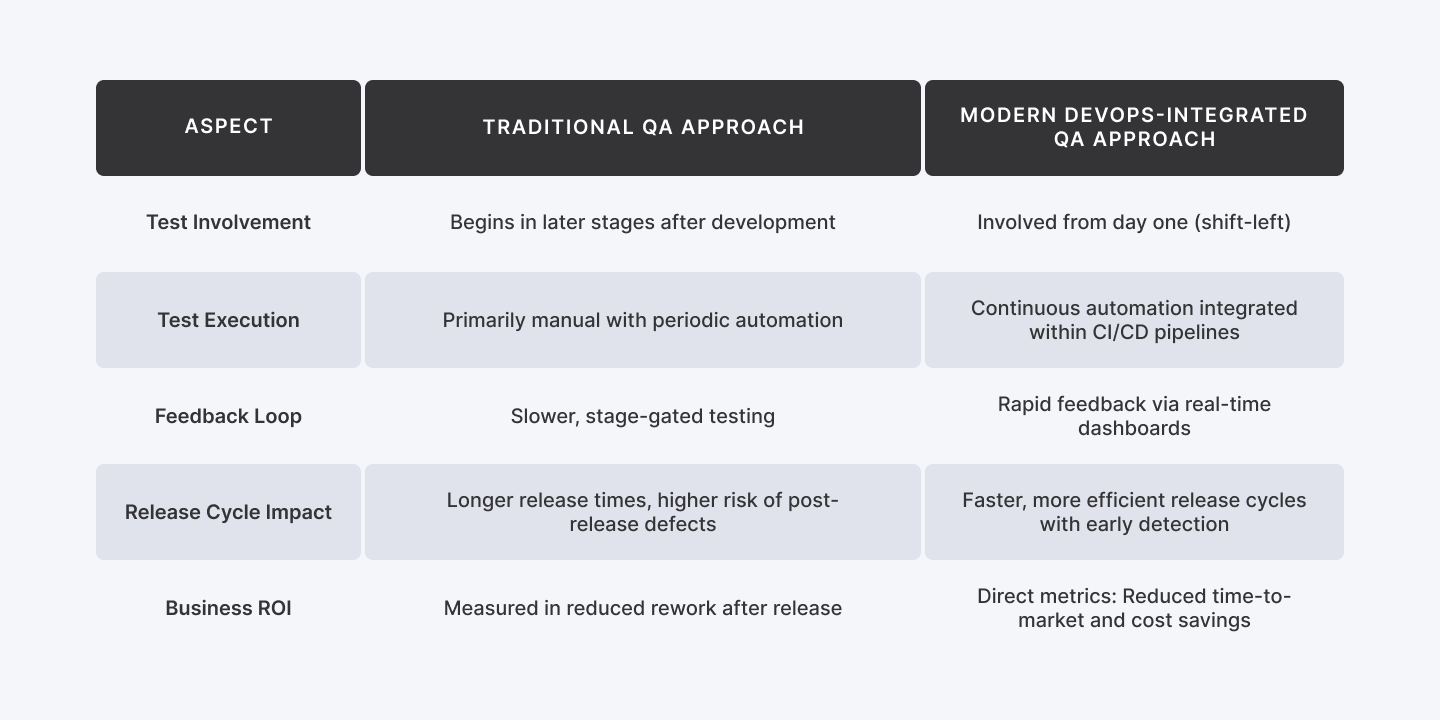
6. Business Impact: Comparing Traditional and DevOps-Integrated QA Approaches
Assessing a candidate’s knowledge of business impact through QA practices is crucial. Use a comparative table to evaluate their understanding:
Aspect | Traditional QA Approach | Modern DevOps-Integrated QA Approach |
| Test Involvement | Begins in later stages after development | Involved from day one (shift-left) |
| Test Execution | Primarily manual with periodic automation | Continuous automation integrated within CI/CD pipelines |
| Feedback Loop | Slower, stage-gated testing | Rapid feedback via real-time dashboards |
| Release Cycle Impact | Longer release times, higher risk of post-release defects | Faster, more efficient release cycles with early detection |
| Business ROI | Measured in reduced rework after release | Direct metrics: Reduced time-to-market and cost savings |
Candidates should be able to discuss how modern QA practices improve ROI by reducing defect leakage, improving product quality, and accelerating release timelines.
7. Red Flags: What to Watch For During QA Lead Interviews
When evaluating QA Lead candidates, be mindful of certain red flags:
- Vague Responses: A huge potential red flag would be round-a-bout or unclear responses from candidates. Answers that lack specific examples or measurable outcomes indicate either a knowledge gap or inexperience.
- Overemphasis on Traditional Methods: A reluctance to discuss modern approaches (e.g., DevOps, shift-left, mobile/IoT testing).
- Lack of Digital Evidence: Watch out for portfolios lacking tangible proof. When candidates talk big but can't show GitHub repositories, test code samples, or dashboard screenshots, that's a warning sign. Empty portfolios often indicate experience gaps or exaggerated resumes.
- Poor Communication Skills: Pay attention to how clearly candidates explain complex testing concepts. Those who struggle to break down technical approaches into understandable language will likely face similar challenges when communicating with stakeholders across the organization.
- Insufficient Security Focus: Be wary of candidates who downplay security testing or treat it as an afterthought. In today's threat landscape, security must be woven throughout the testing process and not as an afterthought.
8. Key Interview Questions for Hiring Managers
Hiring managers can ask the following questions to help uncover both technical depth and leadership potential in QA candidates:
1. How would you approach developing a test strategy when faced with aggressive deadlines?
Expected Answer: During evaluation, listen for pragmatic approaches to risk assessment—do they prioritize critical user paths over nice-to-have features? Strong candidates typically describe how they leverage automation strategically, integrate testing within CI/CD pipelines to save time, and make calculated trade-offs based on business impact rather than simply cutting corners (aka risk assessment and resource prioritization).
2. Describe your approach to managing a QA team in a rapidly changing environment.
Expected Answer: Look for examples of effective team communication, conflict resolution, and continuous training initiatives.
3. What digital evidence (e.g., GitHub repos, CI/CD dashboards) do you include in your portfolio to showcase your achievements?
Expected Answer: When evaluating responses, push for candidates to share tangible proof through case studies backed by actual numbers. Strong applicants will mention GitHub repos containing their test code, screenshots from dashboards showing key metrics, and interactive demos that demonstrate their technical capabilities.
4. Can you provide examples of how your QA initiatives led to cost savings or improved business outcomes?
Expected Answer: Focus on candidates who connect their testing work to concrete business results. Watch for specific metrics like defect reduction percentages, measurable improvements in release cycles, or customer satisfaction scores that improved following QA process changes.
5. How do you stay updated with emerging QA technologies and methodologies?
Expected Answer: The QA field evolves rapidly, so candidates should demonstrate ongoing learning. Listen for mentions of specific industry publications, professional forums, hands-on tool experimentation, and peer networks. Ask follow-up questions about their preferred testing management tools and their rationale for choosing them.
6. How do you ensure effective communication and resolve conflicts within your QA team, particularly when handling remote or distributed teams?
Expected Answer: Effective candidates will describe specific communication strategies beyond generic answers. Look for details about documentation approaches, meeting cadences, tool selections, and examples of how they've successfully navigated difficult team situations.
7. What are the most critical factors you consider when selecting testing tools for your projects?
Expected Answer: This reveals decision-making abilities. Strong candidates will discuss team capabilities assessment, integration with existing systems, cost-benefit analysis, scalability considerations, and involving end-users in the evaluation process.
8. Describe a time you had to resolve critical conflicts within your QA team. What was your approach?
Expected Answer: Responses should naturally follow a problem-solution-result pattern rather than a rigid formula. Look for candidates who acknowledge tensions without finger-pointing and describe how they brought conflicting parties together to find solutions. This is where candidates need to showcase strong interpersonal and leadership skills using the STAR method.
9. How do you integrate modern methodologies like shift-left testing and DevOps into your QA strategy?
Expected Answer: Expect a discussion on early engagement in the SDLC, continuous integration, and automation tools. Listen for practical examples of testing throughout the development lifecycle, product quality, implementation of automated test pipelines, and collaboration with development teams from project inception.
10. How do you integrate security testing into your overall test strategy?
Expected Answer: Security awareness is non-negotiable in modern QA. Discuss the use of automated tools, manual penetration testing, and collaboration with security teams.
Additional questions may focus on coding skills, automation frameworks, and the practical application of industry-standard metrics.
Explore More: 20 Best Technical Architect Interview Questions [+ Sample Answers]
9. Tips for Candidates
While this article is written primarily for hiring managers, the following tips can help top candidates prepare for QA Lead interviews:
- Prepare a Digital Portfolio: Show tangible evidence by including links to GitHub repositories, CI/CD pipeline dashboards, documented case studies with before-and-after metrics, and detailed test plans.
- Know Your Metrics: Be ready to discuss how you measure business impact through QA metrics. Use specific figures and reliable sources (e.g., Gartner, Forrester) to back up your claims.
- Practice the STAR Method: Structure your responses with Situation, Task, Action, and Result. Provide detailed examples that highlight your problem-solving, leadership, and technical skills.
- Deepen Your Technical Knowledge: Stay updated on modern QA practices such as DevOps integration, shift-left testing, AI-driven test automation, and risk-based testing strategies. Certifications and recent training sessions will add credibility.
- Refine Your Communication Skills: Articulate your thoughts clearly in mock interviews. Focus on both technical depth and the ability to simplify complex concepts for various stakeholders.
- Research the Company: Understand the company’s culture, testing tools, and methodologies. Tailor your portfolio and responses to align with the organization’s specific requirements.
10. Conclusion
Finding the right QA Lead means digging beneath surface qualifications. Great candidates bring these three things to the table: deep technical know-how, proven leadership skills, and a track record of delivering measurable results.
When interviewing, focus on how clearly they explain their testing approach. Do they have concrete examples of innovative team leadership? Can they show you—not just tell you—evidence of their impact through metrics and visual data?
The strongest candidates don't just talk about DevOps and shift-left testing - they share war stories of implementing these approaches and the battles they won. These are the people who will transform your QA processes and directly boost your bottom line.
For job seekers preparing for QA Lead interviews: your portfolio speaks volumes. Fill it with real artifacts from previous projects: GitHub repos, dashboards with actual metrics, and annotated test plans that showcase your personal contributions. Back up your claims with hard numbers and practice explaining complex concepts in straightforward terms.
The interview process works best when both sides come prepared. Hiring managers who understand what truly matters in modern QA leadership will make better hires. Candidates who can demonstrate their expertise through concrete examples and measurable results will stand out in a competitive field.
In the end, the most successful QA Leaders blend technical mastery with people skills and business acumen—a rare combination that's worth the extra effort to find.
For Clients:
Need a QA Lead who delivers results? Hire top 5% vetted talent with Index.dev—48-hour match, 30-day trial, zero hiring headaches.
For QA Engineers:
Ready to lead QA for top global tech teams? Join Index.dev and get matched with high-impact remote roles.

