
The tech landscape is evolving fast. What worked in hiring last year might already be outdated. Throughout 2025, we've noticed both companies and candidates asking themselves tough questions:
- Which skills actually matter right now?
- Which roles truly move the needle for our business?
There aren't simple answers, but patterns are emerging.
At Index.dev, we connect top developers with great job opportunities, helping both companies and talent succeed. Our Sales team engages daily with companies seeking specialized technical expertise, giving us direct insight into genuine market demands rather than speculative trends.
This guide shares what we're seeing on the front lines. We've analyzed patterns from hundreds of client conversations and complemented these observations with targeted research to help you make more informed decisions about talent acquisition or career development. Our focus remains practical rather than theoretical. We'll explore the roles companies are actually hiring for, the skills that genuinely matter, and the trends that appear most likely to endure beyond current hype cycles.
Hire senior developers in 48 hours. Try Index.dev's 30-day free trial!
In-Demand Tech Roles: Who Are Companies Looking For?
Our Sales team’s interactions with clients reveal a consistent pattern in the roles most in demand:
1. AI and Machine Learning Engineers
Companies across industries are clamoring for professionals who can integrate AI into existing projects. With the drive to embed intelligent systems into products and services, AI expertise remains at the top of the list. According to a report by the Wall Street Journal, AI-related skills now appear in about 25% of all tech job listings across the country - that's one in four positions requiring some AI capability. Information-sector companies lead this charge, with over a third of their postings mentioning AI requirements.
Learn More: Your 5 Biggest AI Hiring Questions, Answered
2. Backend Engineers
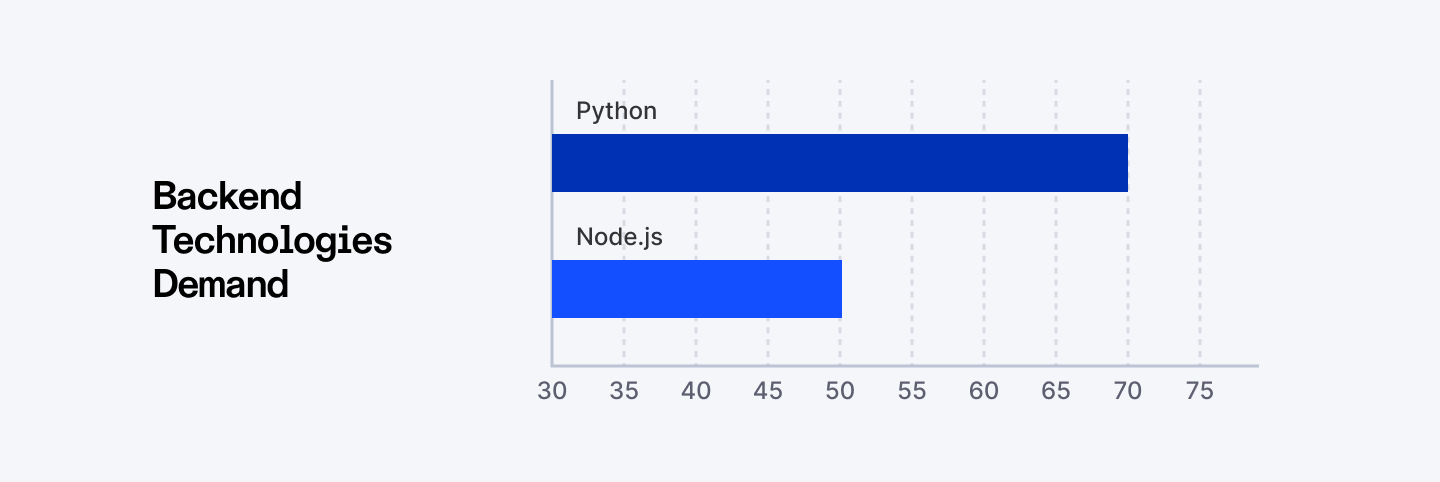
As applications grow more complex, backend developers who can design scalable, robust infrastructures are essential. Experience with AI-integrated solutions only heightens their value.
3. DevOps Engineers
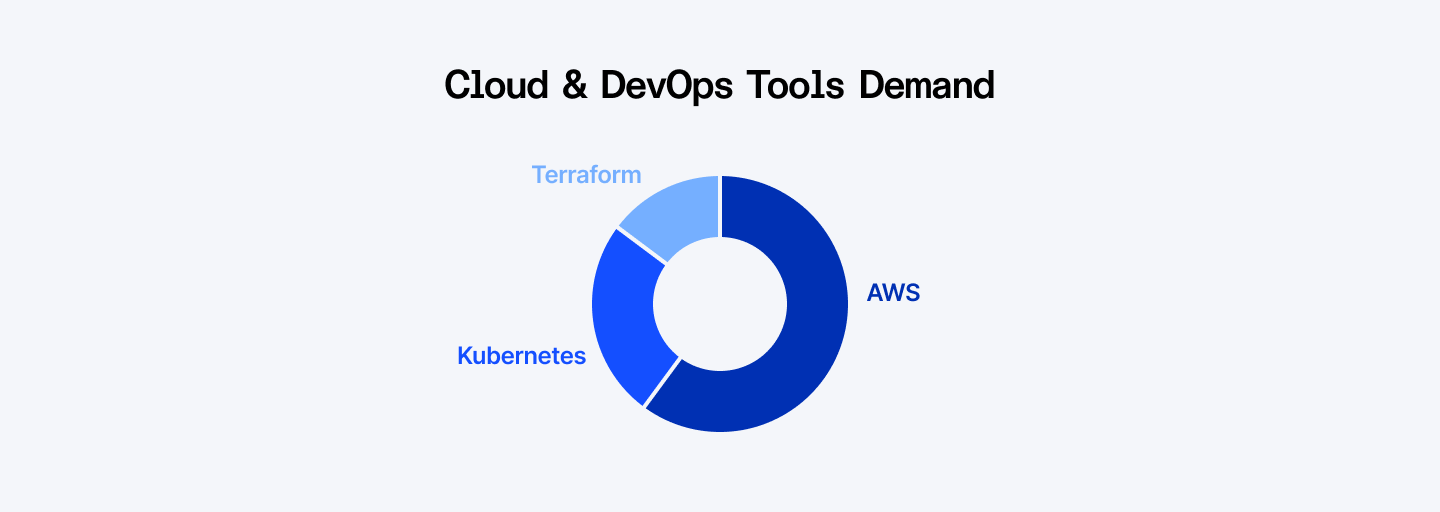
DevOps Engineers continue to grow in importance as more companies embrace cloud-native approaches. These professionals do much more than just manage deployments – they're the bridge between development and operations that keeps modern software delivery running smoothly. We've seen countless projects accelerated by months simply because a skilled DevOps engineer joined the team at the right moment.
4. Frontend Developers (with an AI edge)

On the Frontend side, the game has changed noticeably. Yes, companies still need developers who can build beautiful, responsive interfaces. But there's a new expectation emerging: familiarity with AI tools and techniques. Frontend developers who understand how to integrate AI capabilities into user experiences find themselves with a significant advantage. It's not just about making things look good anymore – it's about making interfaces that adapt, learn, and respond intelligently.
Together, these roles create the foundation that supports current tech innovation. They're the difference between companies that merely talk about digital transformation and those that actually deliver it through efficient, scalable systems.
Capitalizing on Emerging Trends
It’s not just about today’s needs—future growth is fueled by emerging trends that reshape the talent landscape:
Fluctuating Hiring Booms
Our team has observed that hiring surges for specific skills can occur every few months. One moment, there’s a rush for React Developers; the next, the focus shifts toward Machine Learning or .NET Engineers. Despite this fluctuation, one trend remains constant: companies are eager to integrate AI into every aspect of their operations.
AI as the Common Denominator
Whether you’re looking at ML Engineers or backend developers with AI integration experience, the overarching trend is clear—AI-driven expertise is set to dominate. This push for AI is not limited to tech companies; industries like finance, healthcare, and e-commerce are also accelerating their adoption of AI and cloud-related solutions.
Skills & Qualifications: The Game-Changers
What qualifications truly matter in today's hiring landscape? Our Sales team reports that practical experience consistently outweighs certifications:
- Experience is Paramount: Senior-level experience is prioritized by most clients, who seek candidates who can contribute immediately with minimal onboarding. The ability to handle complex challenges is far more valuable than a long list of certifications.
- Demonstrated Problem-Solving: Demonstrated problem-solving abilities and portfolios showcasing real-world impact carry significantly more weight than formal credentials. Employers are looking for tangible evidence of success in previous projects.
- Core Tech Competencies: Core technical competencies remain essential, though the specific requirements vary by role. For backend positions, Python leads in demand (particularly for AI integration), with Node.js and .NET following closely. React continues to dominate frontend requirements. In the DevOps and cloud space, AWS expertise remains most requested, followed by Kubernetes and Terraform knowledge.
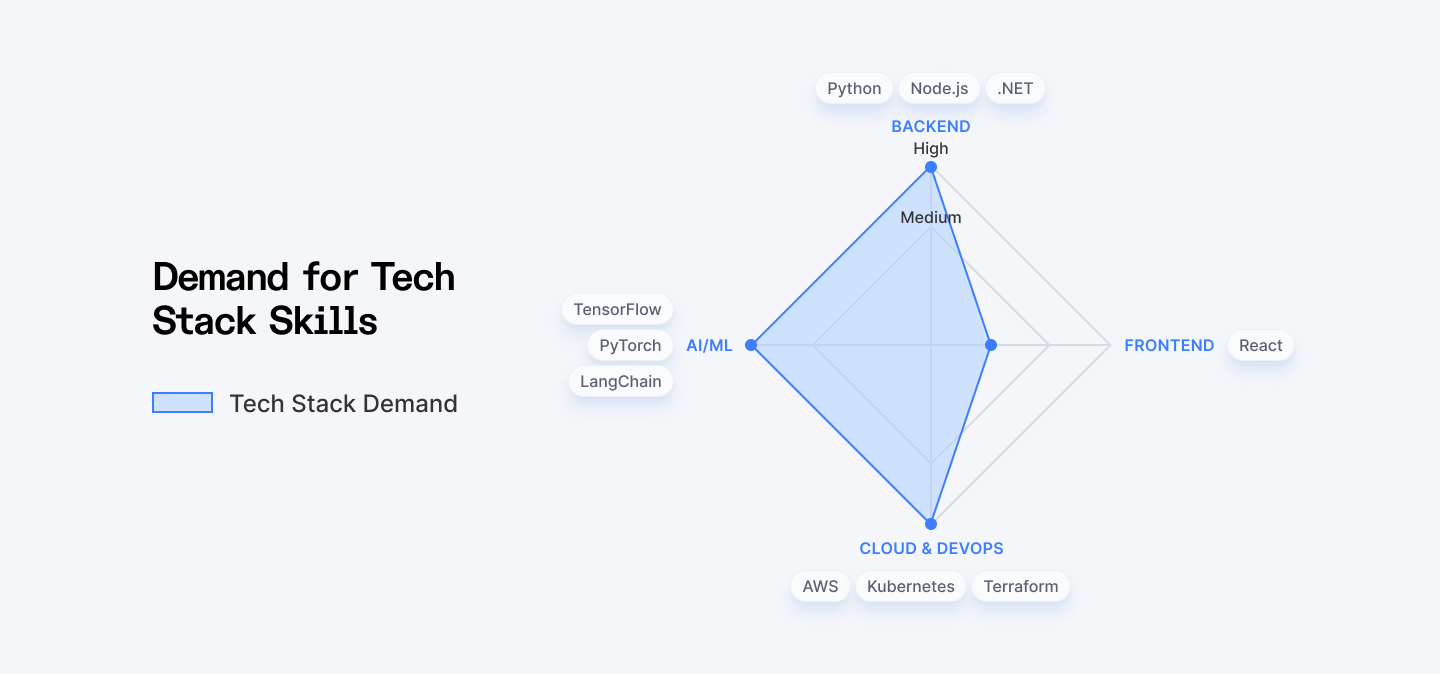
In this radar chart, each axis represents a category of the tech stack, and the plotted points indicate the demand for specific skills within those categories. For instance, Python appears at the highest point on the Backend axis, signifying its leading demand in that area. Similarly, React is prominently positioned on the Frontend axis, reflecting its dominance in UI development.
Staying updated with these technologies can significantly enhance a candidate’s job prospects.
Industries & Regional Insights: Where Is the Demand?
While tech companies with proprietary software represent our primary client base, we're seeing increasing demand from finance, healthcare, and e-commerce sectors. These traditional industries are accelerating their adoption of AI and cloud-related technologies to remain competitive.
Regional Preferences:
Regional hiring patterns follow practical considerations.
- North America: Companies targeting North American markets typically seek talent from Latin America due to overlapping business hours and collaboration efficiency.
- Europe: European clients often look to the Balkans, Eastern Europe, and parts of Western Asia (Armenia, Georgia, Turkey) where technical education is strong and working hours align well with EU business operations.
Industry Reach:
The demand for tech talent extends well beyond traditional technology companies with other industries jumping on board too. Take pharmaceuticals, for example. As per a report by Business Insider, major players like J&J and Merck aren't just hiring AI experts – they're investing heavily in training their existing staff.
We're seeing finance firms competing for the same AI experts that software companies want. Healthcare organizations that once focused exclusively on clinical credentials now seek cloud architects and machine learning specialists. E-commerce players increasingly look for developers who understand both customer experience and predictive algorithms. This cross-industry demand signals how deeply advanced technologies have penetrated virtually every sector.
Company Size Matters: Startups vs. Enterprises
Tech hiring requirements differ significantly between startups and large enterprises:
- Startups: Startups typically seek versatile professionals who can thrive in fast-paced, rapidly changing environments with minimal structure. These environments rarely provide detailed onboarding documents or extensive training periods. Instead, developers are often expected to jump in, figure things out, and contribute quickly. Here, comfort with ambiguity and rapid shifts in priorities becomes as important as technical skills.
- Enterprises: Enterprises generally prefer candidates with experience in structured workflows, clean code practices, and enterprise-level scalability. These positions typically involve more defined processes focused on long-term stability.
Overcoming Hiring Challenges
Despite high demand, several unique challenges persist in the hiring process:
Lack of Structured Onboarding
Many startups struggle with bringing new team members up to speed. Without proper onboarding, even brilliant engineers can flounder. We've seen it repeatedly - companies hire great talent but skip the crucial step of helping them understand context, expectations, and workflows. The result is teams struggle, deadlines slip, and sometimes good people walk out the door too soon. Many smaller companies see thorough onboarding as something they just can't spare time for right now. "We'll get to that next quarter," they say. But here's the reality we've observed: skipping proper integration isn't saving time or money; it's costing both. When new hires flounder without context, everyone pays the price in rework and frustration.
Unclear Hiring Needs
Job descriptions often reveal a company's hiring maturity. We've noticed startups and growth-stage companies frequently struggle with articulating exactly what they need in technical roles. "We need a developer" just doesn't cut it when trying to find the right match in today's specialized market.
Broad vs. Specific Job Descriptions
The numbers tell an interesting story here. About 40% of the companies we work with initially approach us with rather vague requirements. These broader descriptions typically originate from business leaders who understand they need technical talent but haven't fully defined the specifics. "We need someone who knows AI" leaves a lot of room for interpretation.
The other 60% come prepared with detailed technical requirements. These companies usually have technical leaders driving the hiring process who can articulate specific frameworks, tools, and experience levels needed. When companies fall into that first category with loosely defined needs, we don't just shrug and hope for the best. Our team spends time helping them refine what success looks like in the role. Sometimes this means asking tough questions about project roadmaps or technical architecture that they hadn't considered. This collaborative approach leads to much better matches and fewer false starts.
Contract vs. Full-Time: The Current Hiring Landscape
Traditional employment still dominates tech hiring, but change brews beneath the surface. Our current placement data from the Sales team tells an interesting story:
- 80% of roles are full-time, reflecting a current focus on long-term stability. These permanent arrangements continue providing stability for both companies and professionals. For mission-critical systems and long-term initiatives, businesses still prefer dedicated team members fully integrated into company culture and processes.
- 20% are contract-based or part-time, though this could shift as remote and flexible work arrangements gain further traction. While numerically smaller, this segment shows interesting growth patterns, particularly for specialized roles where deep expertise matters more than organizational knowledge.
This balance underscores the importance of full-time positions in today’s market, even as the landscape evolves. But why does this split exist? Several factors shape the landscape:
- Tax and regulatory frameworks still favor traditional employment in many regions. Legal complexities around contractor classification deter some organizations from flexible arrangements despite potential advantages.
- Project-based work naturally lends itself to contract relationships. When companies need specific expertise for defined periods, permanent hiring often makes little sense for either party.
- Remote work normalization has gradually decoupled location from employment. When teams already collaborate virtually, the psychological distinction between employees and contractors diminishes.
Looking forward, we expect this 80/20 split to shift gradually toward more flexible arrangements. Not dramatically – traditional employment won't disappear – but perhaps toward 70/30 over the next few years. This prediction stems from several observations: companies increasingly structure work around projects rather than departments, professionals increasingly value autonomy alongside stability, and technology continues making distributed collaboration more seamless.
Looking Ahead: Long-Term Trends and Priorities
Predicting the future is always challenging, but based on our interactions, several trends are likely to continue:
- Remote and Distributed Teams:
The demand for flexible, remote work arrangements is set to remain strong. - Continued AI and ML Adoption:
As companies across industries integrate AI deeper into their operations, the need for specialized roles in this area will only grow. - Increased Focus on DevOps and Cloud Specialists:
With the move toward cloud-native architectures, the need for experts in DevOps and cloud technologies will continue to rise. - Leadership Roles are Critical:
Positions such as CTOs, Team Leads, and Engineering Managers are top priorities for hiring. These roles are crucial not only for technical oversight but also for structuring teams and driving innovation.
Also Check Out: 5 Worrying Workplace Trends Managers Can’t Ignore in 2025
Conclusion
Tech hiring won't get simpler anytime soon. If anything, the landscape grows more varied and specialized yearly. Companies need talent. Talent needs opportunity. But matching the right people with the right roles at the right time remains stubbornly difficult. What helps? Grounding decisions in reality rather than hype. The trends outlined throughout this guide reflect actual hiring patterns observed across hundreds of companies. Not predictions, not aspirations – what's actually happening today.
Several themes emerge consistently:
- Experience trumps credentials.
- Companies want proven problem-solvers, not just impressive resumes.
- AI expertise creates opportunities across disciplines.
Whether you're a backend developer, UX designer, or product manager, understanding artificial intelligence applications provides competitive advantage. Cultural fit matters enormously, particularly regarding company size and structure. Technical excellence alone rarely determines success. Remote and distributed models continue gaining traction, though at evolutionary rather than revolutionary pace. Leadership roles – from team leads to CTOs – remain particularly challenging to fill effectively.
At Index.dev, we take a practical, real-world approach to hiring—focusing on what truly works, not just how it "should" work. For companies, this means clear hiring goals, strong onboarding, and valuing more than just technical skills. For developers, it’s about proving impact, staying AI-savvy, and finding the right work environment. While tech trends shift, these hiring fundamentals remain constant. We’re here to help you build teams and careers that last.
For Tech Companies:
Hire top developers fast! Get matched with elite, vetted talent in 48 hours with Index.dev’s trusted hiring network.
For Tech Talent:
Want a top remote tech job? Join Index.dev to connect with global companies hiring AI engineers, backend developers, DevOps pros, and more!


