
According to the latest Stack Overflow survey, 76% of developers are using or planning to use AI coding tools, up from 70% last year. Developers now have access to an unprecedented array of robust tools, including AI-driven solutions, sophisticated code editors, and advanced debugging platforms.
This article explores 25 key technologies and tools that every developer should consider adding to their toolset in 2026. These tools can boost productivity, improve code quality, and optimize workflows to keep up with fast-paced development needs.
Ready to take your coding skills global? Join Index.dev to find high-paying remote jobs with top companies worldwide.
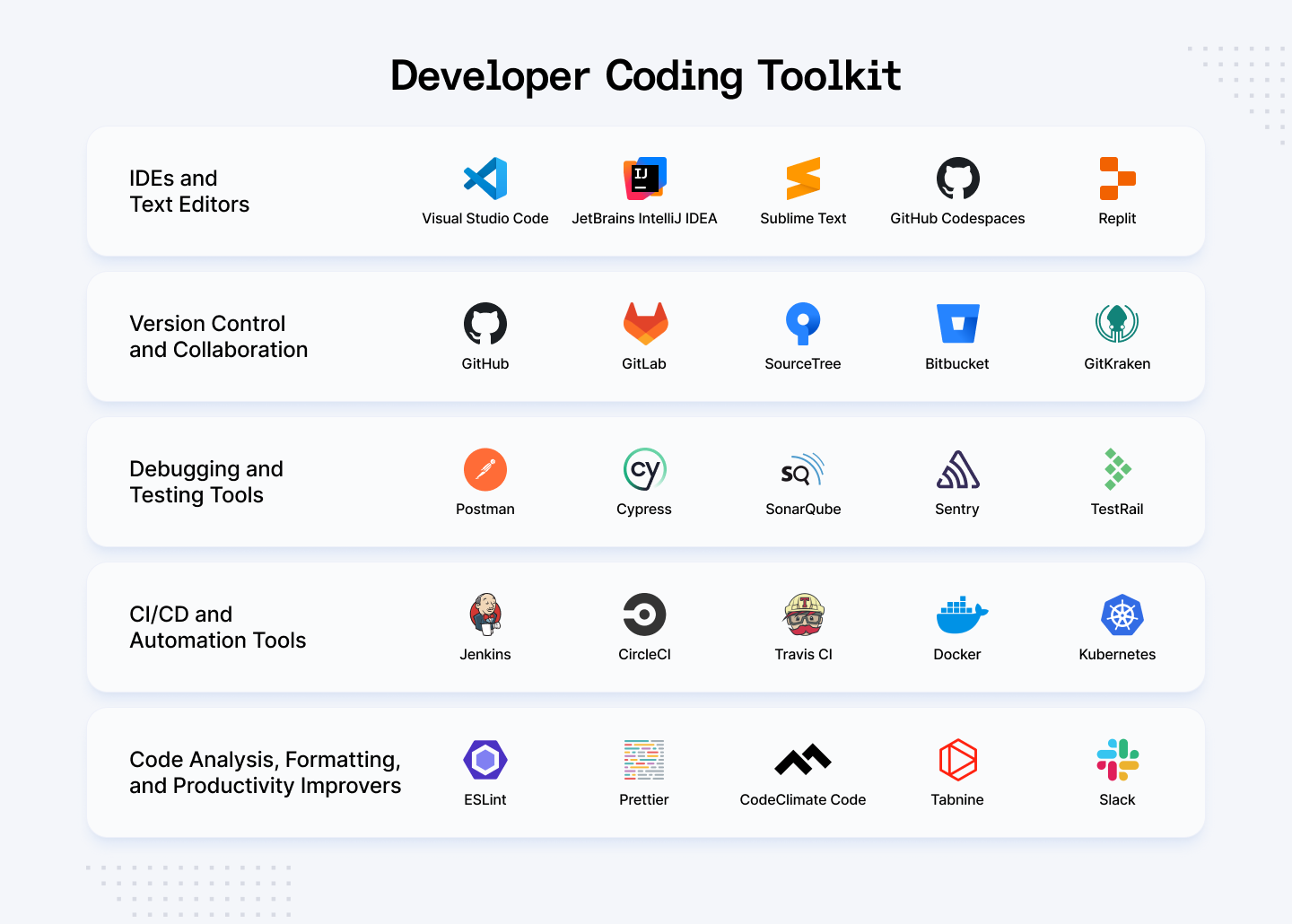
IDEs and Text Editors
The cornerstone of a developer's work is their Integrated Development Environment (IDE) or text editor. The appropriate editor may significantly impact your experience, regardless of whether you are programming in JavaScript, Python, or C++.
1. Visual Studio Code
Visual Studio Code (VS Code) has established itself as a preferred editor for developers worldwide. It is lightweight, fast, and extensively adaptable via its extensive array of extensions. The significant advancement in 2025 is the enhanced AI integration within VS Code.
GitHub Copilot integrated provides intelligent code recommendations, auto-completions, and real-time generation of complete function implementations. Live collaboration features facilitate real-time pair programming or code review, regardless of geographical proximity.
2. JetBrains IntelliJ IDEA
IntelliJ IDEA continues to be a dominant choice for Java and Kotlin developers. The robust refactoring tools, intelligent code completion, and integrated version control are unparalleled. In 2025, IntelliJ maintains its leadership with AI-driven code recommendations and efficiency improvements for large codebases.
Furthermore, whether you are engaged in Spring or Android programming, IntelliJ offers integrated functionality specifically designed for those frameworks, rendering it indispensable for enterprise-level projects.
3. Sublime Text
Despite being regarded as a lightweight editor, Sublime Text offers substantial capabilities for those who choose simplicity. The editor is recognized for its exceptional speed and responsiveness, especially with large files. Multi-caret editing facilitates extensive modifications to your code effortlessly, with its 2025 upgrades concentrating on efficiency enhancements and improved compatibility with contemporary build systems.
4. GitHub Codespaces
Cloud development environments are increasingly popular, with GitHub Codespaces leading this trend. Codespaces enables the rapid establishment of a comprehensive cloud-based programming environment within seconds.
There is no need to be concerned about environmental inconsistencies; your code, dependencies, and configurations are all securely kept on the cloud. In 2025, Codespaces' comprehensive support for full-stack development, along with easy GitHub connection, renders it ideal for distant teams or mobile devs.
5. Replit
Replit is a web-based coding platform that provides immediate development environments for more than 50 programming languages. It is ideal for rapid prototyping or disseminating code snippets; but, in 2025, Replit's AI integration elevates the experience significantly. Replit's real-time collaboration, immediate deployments, and AI-driven code recommendations provide it a formidable option for efficient development processes, whether working independently or in a team.
Read More: Top 18 Open-Source Apps Every Developer Should Know
Version Control and Collaboration
According to 84% of the software developers surveyed, source code collaboration tools, such as GitHub, GitLab, and Bitbucket, are the most regularly used tools among software developers. No project, regardless of its scale, can endure without effective version control. These are the instruments that will ensure the security of your codebase and maintain team synchronization.
6. GitHub
GitHub is the epicenter of open-source development, however it encompasses far more than only a repository hosting service. By 2025, GitHub has enhanced its functionalities with AI-driven code reviews, astute pull request recommendations, and augmented code security features such as dependency vulnerability scanning. The collaboration tools, including Discussions and Actions, render GitHub a vital instrument for overseeing extensive projects.
7. GitLab
GitLab is recognized for its extensive DevOps functionalities, providing integrated CI/CD pipelines immediately available. It further offers integrated security scanning and real-time communication features. In 2025, GitLab implements enhanced AI automation for code quality assessments and deployment optimizations, facilitating expedited and secure releases.
8. SourceTree
SourceTree continues to be a premier option for developers that choose a graphical interface for Git operations. Its streamlined and user-friendly design facilitates even the most intricate Git procedures. Features such as interactive rebasing, conflict resolution, and visual branch representation provide SourceTree a formidable tool for engineers requiring capabilities beyond the command line.
9. Bitbucket
Bitbucket emphasizes collaborative efforts among teams, especially those utilizing Jira and Confluence. Bitbucket's integration within the Atlassian ecosystem renders it essential for Agile teams. In 2025, Bitbucket enhances support for containerized apps and refines CI/CD pipelines to provide seamless deployments across environments.
10. GitKraken
GitKraken is a robust Git client that provides an easy graphical interface. It streamlines branching, merging, and conflict resolution through its visual depiction of Git procedures. In 2025, GitKraken introduces improved collaboration functionalities, enabling teams to review code, handle pull requests, and monitor bugs from within the application.
Debugging and Testing Tools
Software developers spend 35-50% of their time validating and debugging software. Errors are unavoidable; however, utilizing appropriate tools enables you to identify and rectify them before they escalate into significant issues.
11. Postman
Postman continues to be the preeminent tool for API testing and development. Its robust automation capabilities enable developers to conduct extensive API testing, and in 2025, Postman unveils innovative AI-driven technologies for creating test cases and enhancing error detection. Postman, including integrated version control and monitoring, is indispensable for any API-driven project.
12. Cypress
Cypress is an efficient and dependable testing framework for online applications. Its real-time testing features, integrated debugging, and user-friendly API render it a preferred choice among front-end developers. In 2025, Cypress enhances cross-browser testing support and implements AI-driven issue predictions, guaranteeing the faultless performance of web apps across all environments.
13. SonarQube
SonarQube is the preeminent solution in the industry for code quality and security assessment. It fits effortlessly into CI/CD pipelines and offers immediate feedback on code vulnerabilities, duplications, and maintainability concerns. In 2025, SonarQube's AI-enhanced bug detection facilitates the identification of probable security vulnerabilities prior to exploitation.
14. Sentry
Sentry is essential for real-time error tracking. It identifies and documents exceptions in your application, providing insight into the nature and location of the issues. The 2025 upgrades enhance Sentry's extensive integrations across several languages and frameworks, facilitating fault troubleshooting in distributed applications.
15. TestRail
Effective administration of test cases is essential in any QA process, and TestRail continues to be a frontrunner in test management. TestRail facilitates high test coverage and accountability through sophisticated reporting and interface with widely-used CI technologies. The 2025 release emphasizes enhancing cooperation for distant teams and including new AI-driven reporting functionalities to identify deficiencies in test coverage.
CI/CD and Automation Tools
44% of developers now confirm regular usage of CI/CD tools, with 22% of them adopting a new tool within the past year. Automating the procedures of building, testing, and deployment may save several hours. Below are the premier tools for enhancing your DevOps operations.
16. Jenkins
Jenkins is a prominent entity in continuous integration, and justifiably so. Its extensive ecosystem of plugins renders it one of the most adaptable CI/CD technologies accessible. In 2025, Jenkins implements AI-assisted pipeline improvements that autonomously modify build configurations to enhance performance and save costs.
17. CircleCI
CircleCI has established itself as a pioneer in cloud-based CI/CD, providing rapid and scalable build pipelines. Its effortless interaction with GitHub and Bitbucket facilitates setup, and in 2025, CircleCI unveils additional features to manage larger, more intricate build pipelines with diminished latency and enhanced parallelization.
18. Travis Continuous Integration
Travis CI continues to be a preferred choice for open-source projects. The streamlined YAML configuration and seamless interface with GitHub facilitate the setup and initiation of automation for build and deployment operations. In 2025, Travis CI unveils additional connections with Kubernetes and several containerization technologies, establishing itself as an excellent choice for containerized apps.
19. Docker
Docker persistently transforms the methodology by which developers bundle and deploy programs. Containerization enables developers to guarantee consistent code execution across all environments. In 2025, Docker's enhancements concentrate on advancing multi-cloud compatibility and streamlining orchestration using Docker Compose for distributed applications.
20. Kubernetes
Kubernetes is the prevailing standard for container orchestration in the industry. It automates the deployment, scaling, and administration of containerized applications. In 2025, Kubernetes implements enhanced AI-driven workload management, simplifying the administration of large clusters and optimizing resource allocation.
Explore More: How to Set Up and Optimize CI/CD Pipelines for Faster Development and Deployment
Code Analysis, Formatting, and Productivity Improvers
These tools guarantee that your code is functional, clean, maintainable, and efficient.
21. ESLint
ESLint is essential for developers of JavaScript and TypeScript. It enforces code standards and assists in identifying typical problems before deployment. For developers aiming to strengthen their foundations or Learn javascript in greater depth, tools like ESLint play a critical role in maintaining clean and scalable code.
In 2025, ESLint incorporates support for the most recent ECMAScript features and AI-generated rule recommendations tailored to your project's requirements.
22. Prettier
Prettier autonomously formats your code to guarantee uniformity in style throughout your project. The capability for several languages facilitates efficiency for teams aiming to implement style rules autonomously. In 2025, Prettier enhances its functionalities with more customisable rules and AI-generated formatting recommendations.
23. CodeClimate Code
Climate offers insights about code quality, maintainability, and security. It assimilates into your CI process and delivers instantaneous feedback on each commit. In 2025, CodeClimate implements advanced AI analysis, enabling the anticipation of code quality concerns prior to their emergence.
24. Tabnine
Tabnine is an AI-driven code completion tool that improves your coding experience by offering intelligent suggestions derived from deep learning models. In 2025, Tabnine will unveil enhanced language support and more sophisticated completions, customizing to your coding style and providing project-specific suggestions.
25. Slack
Effective communication is essential in every development team, and Slack continues to be the premier tool for team interaction. In 2025, Slack will enhance its developer connectors, allowing real-time notifications from CI pipelines, GitHub repositories, and monitoring tools, therefore ensuring team synchronization.
Explore More: How to Scale Applications Efficiently
Conclusion
2025 is anticipated to be a remarkable year for developers, including an abundance of tools aimed at optimizing workflows, improving code quality, and increasing productivity. This collection of tools will assist front-end developers seeking the newest web testing solutions and back-end engineers in search of optimal CI/CD platforms, enabling them to remain competitive. By adopting these essential technologies, you can guarantee that your development process is efficient, collaborative, and future-oriented.
For Developers:
Join Index.dev for a long-term remote career! Take on innovative frontend, backend, and full-stack projects, and find high-paying remote jobs. Apply today!
For Clients:
Access Index.dev's vetted talent network to find senior remote developers for roles like full-stack, DevOps, front-end, and AI. Get the right engineer for your critical projects in just 48 hours.


