Agile POD teams are self-contained, cross-functional groups dedicated to achieving specific business goals or customer journeys.
Unlike typical SCRUM teams, pods frequently contain designers, marketers, analysts, and even support roles, all working towards the same goal.
If you're a product leader, project manager, or enterprise coach looking to scale agility across departments, knowing what to monitor inside pods is critical. KPIs are your guide to assuring velocity, alignment, and sustainability.
This article will assist you in identifying the most important pod-specific KPIs, so that your teams are not merely busy, but productive in producing value and interacting without friction.
Need developers who understand POD performance metrics? Hire top 5% vetted talent with Index.dev to reduce project timelines and save thousands in development costs.
Why KPIs Are Important for Agile Pod Teams
In agile organizations, measurements drive behavior, and what you measure is what teams optimize for. This is especially true in the POD model, in which teams work with a high level of autonomy and responsibility.
While autonomy enables speed and creativity, it also poses a challenge: how do you know whether each pod is genuinely adding value? This is where Key Performance Indicators (KPIs) come in.
Well-defined KPIs provide insight into how a pod operates, not just in terms of outputs like velocity, but also in outcomes such as customer satisfaction and product uptake. They provide leadership with data to assist and coach teams, rather than micromanage them. Most importantly, they provide pod members with a common scoreboard to unite behind.
Here's what the correct KPIs may reveal:
- Are pods connected with strategic company objectives?
- Are they supplying value rather than simply code?
- Is the team's morale strong and sustainable?
- Are dependencies slowing them down?
Unlike regular teams, people in a pod often do different kinds of work, so you need to track how well they perform together across all those jobs, not just how much development they do.
But be careful: measurements can be misused. If the numbers we track (KPIs) are used to punish people or don't actually help users, they'll just break trust and lower morale. The goal isn't to measure everything, but to measure what truly matters.
Read More: McKinsey | Keys to Organizational Agility
Core Categories of KPIs to Track
To efficiently manage agile pods, aggregate KPIs into four areas. These cover delivery, outcomes, cooperation, and culture, providing a holistic picture of pod performance.
Here is the Agile Pod KPI Framework:
1. Delivery Metrics
Track how effectively the pod ships value:
- Velocity: Story points completed per sprint.
- Lead Time: From ticket creation to release.
- Cycle Time: The time required to accomplish a single job.
2. Outcome Metrics
Evaluate the impact of the supplied job.
- Feature Adoption Rate: % of users that actively use new features.
- Customer NPS/CSAT: Direct User Sentiment
- Business OKR alignment: Pod's contribution to quarterly targets.
3. Team Health Metrics
Assess sustainability and morale:
- Burnout indicators: Include missed retros and excessive after-hours activity.
- Engagement Score: Pulse Survey Results
- Workload Balance: Distributing responsibilities across pod members
4. Collaboration and Dependency Metrics
Monitor how effectively pods function within the ecosystem:
- Cross-Pod Blockers: Percentage of work delayed by external teams
- Review Cycle Time: The time taken for peer reviews and quality assurance.
- Number of Inter-Team Touch Points: Dependency health check.
By measuring a combination of these, leaders and pods may enhance delivery flow, remove bottlenecks, and keep focused on business and user results.
Must-Have KPIs for Pod Teams
Tracking success in agile pod teams involves more than sprint metrics. Because pods are multi-functional and self-sufficient, the KPIs you track must represent velocity, value, quality, and sustainability. Here's a summary of must-have KPIs per category, aimed to provide both pod teams and leadership with clear visibility into how work is moving and what results are being accomplished.
A. Delivery and Efficiency KPIs
These KPIs help measure how fast and predictably pods complete tasks. They are critical for determining cadence, bottlenecks, and planning capacity.
Velocity
Measures the story points completed per sprint.
Velocity establishes a baseline for sprint planning and forecasting. While it should not be used to compare pods, watching a single pod's progress over time might assist in identifying deviations and blocks.
Cycle Time
Measures the time from the beginning of work on a task to completion.
Shorter cycle times suggest smoother processes. Monitoring this helps to detect jobs that are blocked in the review, QA, or handoff stages.
Lead Time
Measures the time from ticket creation in backlog to production release.
This end-to-end measurement reflects the whole efficiency of your product development lifecycle. An increasing gap frequently indicates priority or deployment concerns.
Pro Tip
If velocity is consistent but lead time is growing, optimize your backlog grooming or release cycles.
B. Product and Outcome Alignment KPIs
Pods exist to produce results, not only to execute tasks. These KPIs measure whether supplied features generate business value.
Feature Adoption Rate
Measures the percentage of people engaged with a new feature.
High feature uptake indicates that the team is creating what the users desire. Low adoption might indicate a missing product-market fit or inefficient onboarding.
Customer Feedback Loops (NPS and CSAT)
Measures the user attitude after release (Net Promoter Score or Customer Satisfaction Score).
Agile teams must ship quickly while simultaneously making course corrections quickly. Tracking feedback enables pods to check that their outputs are addressing real-world user concerns.
% of Objectives Met (OKR Tracking)
Measures the alignment of deliverables with business goals.
This KPI connects sprint-level work with quarterly OKRs. It guarantees that pods do not become obsessed with building and instead remain focused on what is genuinely important.
Pro Tip
Use a common OKR dashboard to link pod objectives with demonstrable business benefits (for example, "Reduce support tickets by 20%" or "Increase checkout conversion by 10%").
C. Quality and Technical Excellence KPIs
There is no use in rushing if the quality suffers. These KPIs guarantee that pods provide durable, scalable, and maintainable systems.
Bug Rate Post-release
Measures the number of production defects per feature or sprint.
A rise in post-release problems indicates quality degradation. This KPI helps to enforce better testing and promotes shift-left practices.
Code Review Coverage
Measures the percentage of code modifications that get peer review.
High review coverage promotes knowledge exchange, early fault identification, and coding standards, which are particularly crucial in distributed pod settings.
Automatic Test Coverage
Measures the percentage of code covered by automated unit/integration tests.
It serves as a proxy for maintainability and reduces regression risk during fast-paced delivery. Balanced test coverage ensures that subsequent sprints are efficient.
D. Team Health and Engagement KPIs
Burnout, misalignment, and a lack of interest quietly undermine pods. These key performance indicators assist in measuring culture and sustainability.
Team Sentiment Score
Measures the regular pulse surveys (1-5 scale), asking team members how they feel.
A quick decrease may indicate interpersonal problems, overburden, or a lack of clarity. Anonymous polls promote honest feedback.
Participation in Retrospectives
Measures the percentage of team members who actively participate in retros.
Retrospectives drive ongoing progress. Low involvement may indicate disengagement or a lack of psychological safety.
Work Distribution Balance
Measures the task burden among pod members.
Even distribution promotes learning and prevents fatigue. If only a few people do key tasks on a regular basis, the pod is in danger if one of them departs or takes time off.
Anchor Reference: Discover how Spotify utilizes Team Health Checks to measure agile performance.
Spotify's Squad Health Check is an established technique that assesses variables like enjoyment, learning, purpose clarity, and process satisfaction. Consider using a simpler version of this check-in during retros.
How Pod KPIs Differ from Scrum Metrics
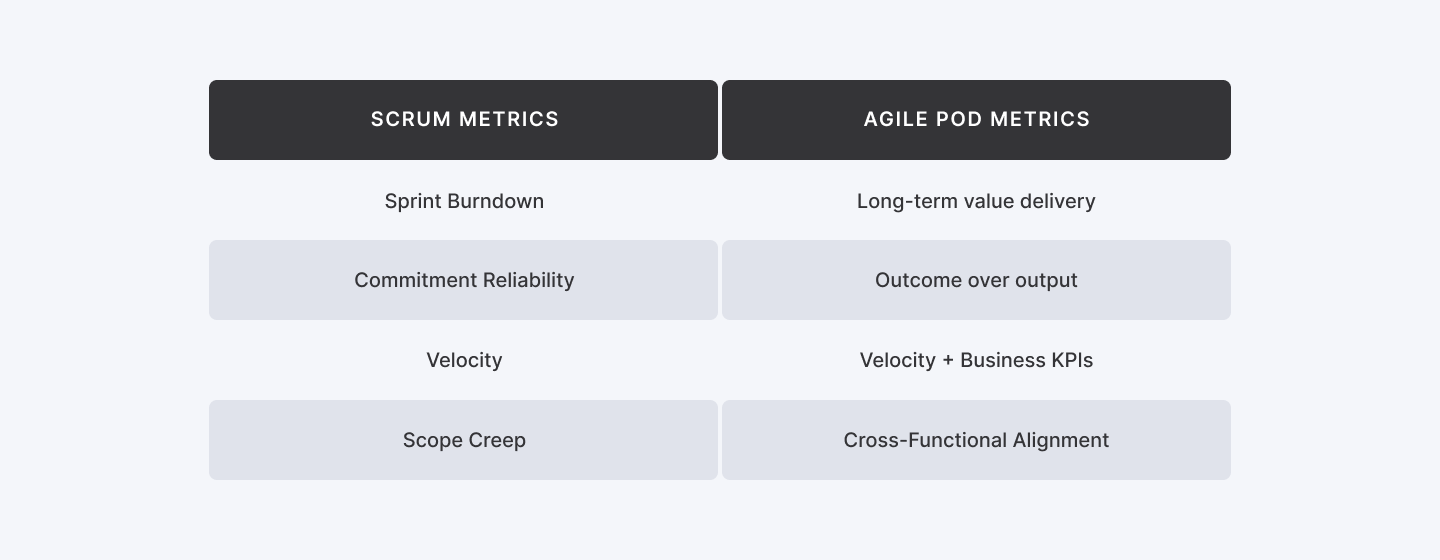
While both Scrum and Pod models share agile roots, the metrics they prioritize differ significantly in scope and intent.
Scrum Metrics | Agile Pod Metrics |
Sprint Burndown | Long-term value delivery |
Commitment Reliability | Outcome over output |
Velocity | Velocity + Business KPIs |
Scope Creep | Cross-Functional Alignment |
Scrum focuses on measuring development team performance across short iterations. Burndown charts and commitment dependability metrics are designed to guarantee that sprints are predictable and that teams deliver on their promises.
However, agile pod teams do more than just building software. They combine design, product, marketing, and even analytics under a single tent. As a result, pod KPIs must transcend functional boundaries, assessing not just delivery speed but also real business outcomes, customer feedback, and operational sustainability.
This transformation demands a larger perspective:
- Are the marketing and design cycles aligned?
- Are product features adopted?
- Are dependencies effectively resolved across pods?
Pod measurements assist in guaranteeing that all disciplines inside a pod are rowing in the same direction, not just sprinting, but sprinting for meaningful results.
Learn key strategies to improve Scrum team productivity.
Enterprise-Wide Metrics for Pod Governance
As enterprises expand their pod structures across departments or continents, governance becomes crucial.
This is where Tribe Leaders, Chapter Heads, and Program Managers come in. What is their goal? Ensure that numerous pods move in sync while providing consistent value.
Here are key metrics to monitor:
- Delivery Predictability Across Pods
Determine how reliably pods achieve their deadlines.
- Cross-Pod Dependency Resolution Time
Monitor delays caused by interteam interdependence.
- Customer Outcomes By Product Line
Correlate collective pod output with feature uptake, retention, or conversion.
- Pods contribute to strategic OKRs
The percentage of pods that are actively related to corporate goals.
A Pod-to-Product Line Mapping Dashboard helps governance leaders discover bottlenecks and misalignments.
Companies such as Accenture and Google manage governance using internal platforms and OKR tracking technologies, which ensure visibility without micromanagement. The objective is to empower pods while guiding them to collaborative success.
Tools to Track and Visualize Pod KPIs
Choosing the correct technologies ensures that pod KPIs are tracked and acted upon. Each tool provides visibility and structure for functional responsibilities.
- Jira + Advanced Roadmaps are perfect for tracking delivery metrics such as velocity, cycle duration, and sprint progress, particularly in engineering-heavy pods.
- Notion or Confluence Dashboards provide recordkeeping, opinion polls, and retrospective comments, providing a comprehensive perspective of pod health.
- Miro allows for real-time communication, which is particularly useful for retrospectives, workflow mapping, and graphically spotting bottlenecks.
- Productboard and Mixpanel excel at evaluating product uptake, user interaction, and feedback loops, which are critical for connecting pod effort to outcomes.
Consider adding Slack notifications for KPIs such as NPS drops or GitHub activity. This keeps data visible without requiring frequent human verification.
A well-integrated stack keeps teams focused while uncovering insights that drive improvement, without introducing additional complexity.
Best Practices for Implementing KPI Tracking
To make pod KPIs useful and successful, start with purposeful, limited tracking.
- Start small: Concentrate on 3-4 important KPIs that are directly related to the pod's objective. Don't track everything at once.
- Co-create metrics: Let pod members determine what success looks like. Buy-in improves engagement and responsibility.
- Connect KPIs to OKRs: Ensure that measurements lead to strategic outcomes rather than merely activity measures. This improves clarity regarding impact.
- Automate dashboards: Use technologies to decrease manual entry and provide real-time visibility.
- Review regularly: Include KPIs in retrospectives and demonstrations. Reflecting on them promotes a culture of constant progress.
"Don't weaponize metrics. Use them to enable teams, not punish them."
The goal of tracking KPIs is to provide pods with insights, not surveillance. Healthy teams employ measurements as feedback loops rather than scorecards. The more consistent and transparent your measurements are, the more likely your pods will succeed.
Explore the best software development KPIs to measure developer performance.
Conclusion
Agile Pod KPIs are more than just performance statistics; they provide insight into how your team functions, collaborates, and generates value.
Whether you're expanding pods across regions or testing one for the first time, the correct metrics may help create alignment, accountability, and agility. To construct a well-rounded scorecard, include indicators for delivery, outcome, quality, and team health.
Are you ready to make your pod teams high-performing and data-informed? Begin with a simple KPI dashboard and iterate with your team. Your metrics reflect your map.
For Clients:
Need high-performing Agile Pods? Hire from Index.dev’s top 5% vetted developers, matched in 48 hours, risk-free.
For Developers:
Build products that matter. Join Index.dev and work with Agile PODs at top global companies.