Agile changed how teams work, making them faster and more flexible. But as companies grow, a new question comes up: should you use Scrum Teams or Agile PODs?
While Scrum is still the gold standard for organized delivery, PODs are gaining popularity for their cross-functional, business-aligned autonomy.
Tech giants such as Google, Spotify, and Accenture are redesigning team structures to balance agility and responsibility. So, which model best suits your team?
In this article, we'll compare Scrum Teams vs Agile PODs in terms of structure, workflow, autonomy, and use cases to help you decide which method is best for creating high-performing, scalable teams in today's fast-paced situations.
Hire elite developers for your Scrum teams or Agile PODs with Index.dev. 5% top talent, 48-hour match, 30-day free trial.
Definitions and Key Concepts
What Is a Scrum Team?
A Scrum Team is a small, cross-functional group formed to develop software in short, time-boxed iterations known as sprints.
It generally contains three basic roles:
- The Product Owner (PO) establishes the backlog and priorities.
- The Scrum Master (SM) aids the process and removes barriers.
- Developers build the product increment.
Scrum Teams adhere to a defined rhythm that includes sprint planning, daily standups, sprint reviews, and retrospectives. The optimal team size is 5-9 persons, which fosters close collaboration and attention.
What Is a POD Team?
A POD Team (Product-Oriented Delivery) is a self-sufficient, goal-oriented unit that comprises not just developers, but also designers, QA testers, product marketers, and even DevOps engineers.
PODs often include:
- Aligned with a particular product, feature, or business result
- Autonomously controlling their backlog, deployment timelines, and KPIs.
- Structured around goals rather than merely methods.
PODs do not rely on external teams to deliver. They are built for speed, ownership, and experimentation.
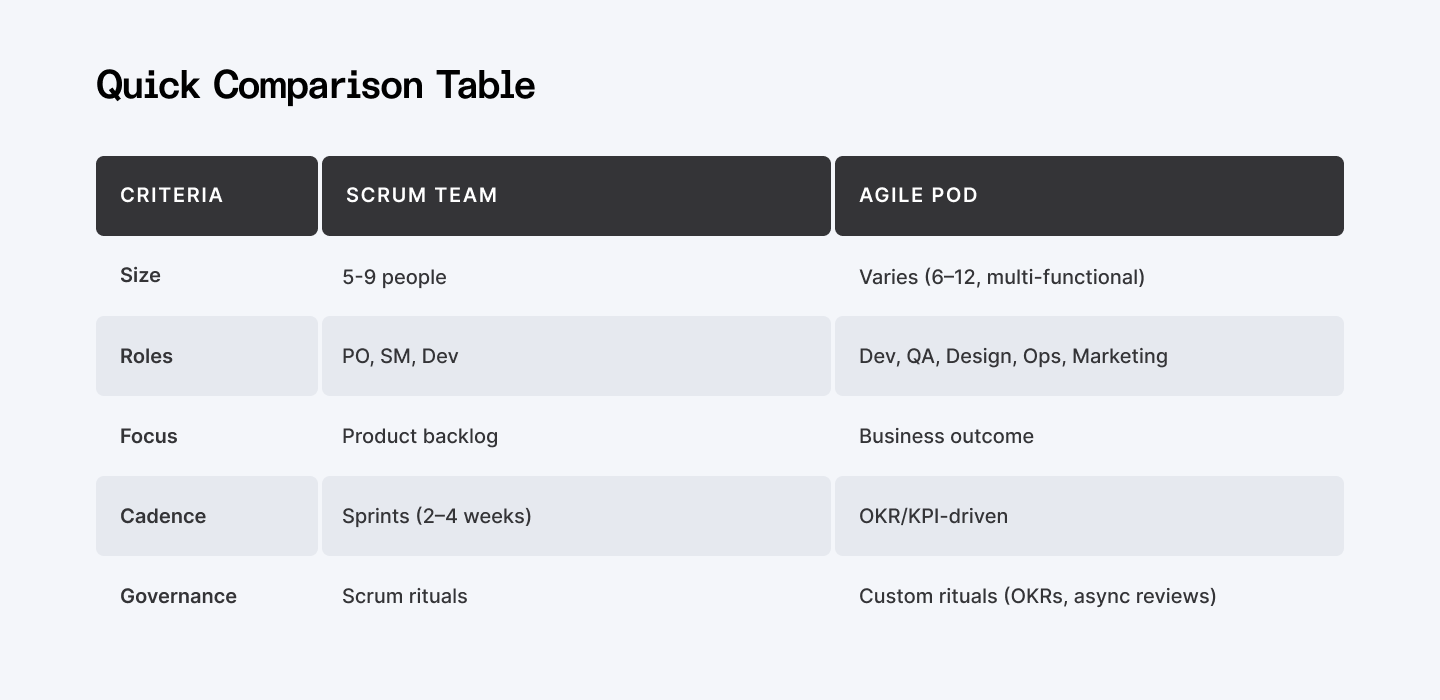
Quick Comparison Table
Criteria | Scrum Team | Agile POD |
Size | 5-9 People | Varies (6–12, multi-functional) |
Roles | PO, SM, Dev | Dev, QA, Design, Ops, Marketing |
Focus | Product backlog | Business outcome |
Cadence | Sprints (2–4 weeks) | OKR/KPI-driven |
Governance | Scrum rituals | Custom rituals (OKRs, async reviews) |
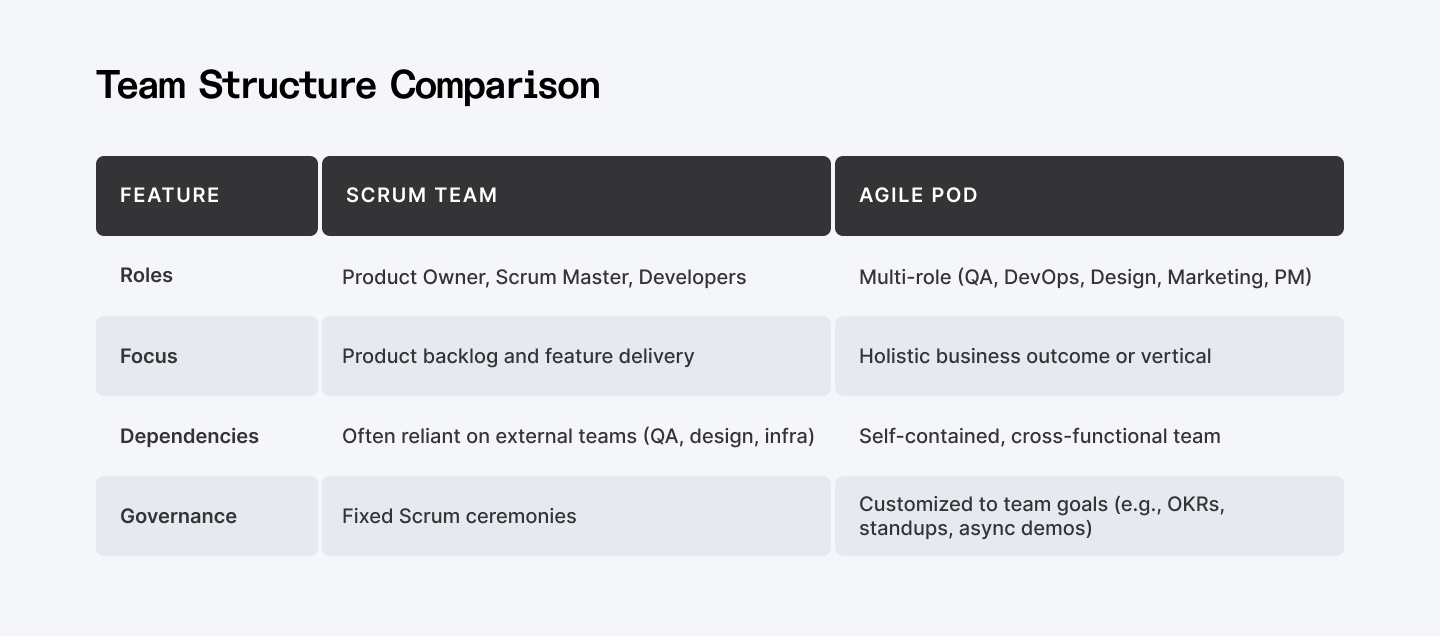
Team Structure Comparison
To understand when to use Scrum or PODs, let’s first compare how they’re structured:
Feature | Scrum Team | Agile POD |
Roles | Product Owner, Scrum Master, Developers | Multi-role (QA, DevOps, Design, Marketing, PM) |
Focus | Product backlog and feature delivery | Holistic business outcome or vertical |
Dependencies | Often reliant on external teams (QA, design, infra) | Self-contained, cross-functional team |
Governance | Fixed Scrum ceremonies | Customized to team goals (e.g., OKRs, standups, async demos) |
Mini Use Case 1: Scrum for SaaS Feature Delivery
Scrum is used by a midsize SaaS firm to deploy CRM upgrades. The team's sprint goals are determined by the PO, and the sprints last two weeks. External teams provide comments on quality assurance and user experience. This system works because delivery is predictable, compliant, and responsive to iterative feedback.
Click here to know the benefits of Agile Scrum in SaaS
Mini Use Case 2: POD for Enterprise Product Marketing
A large company introduces a new financial app. Instead of having distinct development, design, and marketing teams, they build a POD that includes a dedicated PM, engineers, a marketer, and a UX leader. This enables concurrent product development and go-to-market execution, resulting in faster launch cycles and user acquisition.
Read More: How to Hire Contract Staff More Efficiently
Workflow and Autonomy
Scrum and PODs are not just structurally different; they also have diverse attitudes about how work flows and decisions are made.
Scrum workflow is process-driven
Scrum is characterized by time-boxed sprints and well-defined rituals. The backlog determines what gets done. The Scrum Master oversees adherence to the framework, while the PO handles priorities.
Common tools include Jira, Trello, and Confluence.
Workflows are visible, but non-development tasks require external coordination (for example, marketing and testing).
POD Workflow is outcome-driven
PODs follow a KPI or OKR-driven workflow, with more freedom to alter how they function. Instead of rigorous sprints, PODs focus on results, such as increasing sign-ups or decreasing turnover.
Common tools include Asana, Notion, ClickUp, and OKR dashboards.
PODs determine their rituals: some do weekly reviews, while others employ async updates.
Decision-making in PODs
Unlike Scrum, where the PO sets priorities, PODs decentralize decision-making. Teams might prioritize depending on effect, experimentation, or cross-functional conversations.
Real-World Example: Uber Launches PODs
Uber's launch teams for new markets function like PODs. Each team consists of engineering, operations, legal, marketing, and supply chain representatives. This strategy enabled Uber to launch in over 700 cities quickly and with local alignment, something Scrum alone would not have permitted.
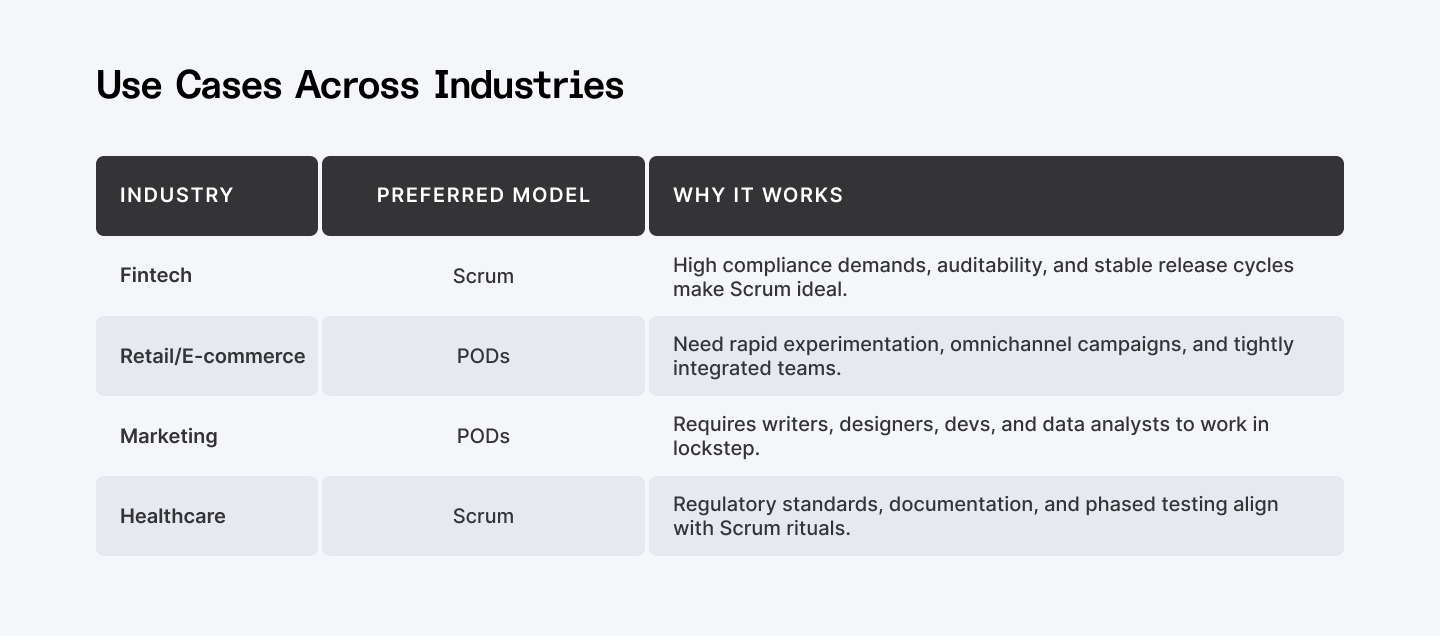
Use Cases Across Industries
Agile frameworks must fit not just with team preferences, but also with industry standards. Some businesses naturally gravitate toward Scrum due to structure, autonomy, and risk tolerance, whilst others choose PODs for speed and cross-functionality.
| Industry | Preferred Model | Why It Works |
| Fintech | Scrum | High compliance demands, auditability, and stable release cycles make Scrum ideal. |
| Retail/E-commerce | PODs | Need rapid experimentation, omnichannel campaigns, and tightly integrated teams. |
| Marketing | PODs | Requires writers, designers, devs, and data analysts to work in lockstep. |
| Healthcare | Scrum | Regulatory standards, documentation, and phased testing align with Scrum rituals. |
Fintech: Scrum for Compliance-Driven Delivery
A digital payment service uses Scrum to satisfy PCI-DSS and regional compliance requirements. Each sprint involves rigorous code reviews, QA, and release checklists. Scrum's ceremony-based paradigm ensures traceability, making it excellent for audit trails and rollback strategies.
Retail: PODs for Real-Time Agility
A worldwide retail chain conducts sales campaigns on the web, mobile, and in-store kiosks. Each POD-based customer journey team consists of a developer, a marketer, and a data analyst. They test pricing strategies and page layouts in real time, which is unachievable with segregated Scrum teams.
Marketing: PODs for Full-Functional Execution
According to McKinsey's research on agile marketing pods, businesses that implemented PODs witnessed a 5-10% boost in marketing ROI within months. These teams can launch, test, and optimize ads without relying on external designers or engineers.
Healthcare uses Scrum for rigorous QA and validation
Healthcare software, such as EMR systems or patient applications, must adhere to controlled product life cycles. Scrum is well-suited to this, with its sprint planning, definition of done, and release controls. Validation is thorough, and functional responsibilities are kept distinct for clarity.
Benefits and Limitations
Scrum Teams
Benefits
1. Predictable sprints improve planning
Scrum's time-boxed sprints (2–4 weeks) let teams plan, estimate, and deliver work in increments. Predictability lowers scope creep and aligns stakeholder expectations, especially in high-stakes or regulated contexts.
2. Process discipline guarantees quality
Standardized roles (PO, SM, Devs), rituals (daily stand-ups, sprint reviews), and artifacts (product backlog, sprint backlog, increment) impose structure. This avoids uncertainty and promotes consistent delivery, especially in complicated multi-team contexts.
3. Clear roles improve team focus
Scrum reduces overlap and confusion by dividing tasks. The Product Owner prioritizes business goals, the Scrum Master manages team performance, and developers complete tasks, producing a focused and efficient working style.
4. Traditional organizations are easier to coach and scale
Scrum is widely used, therefore, there are many qualified coaches, training resources, and tool integrations (Jira, Azure DevOps). Hierarchical or departmental organizations find Scrum simpler to implement into their governance systems.
5. Incremental delivery lowers risk
Small releases allow teams to get user input early and adjust. It reduces delivery risk by identifying blockages and technical debt quickly.
Limitations
1. Silos cause external dependencies
In principle, Scrum teams are cross-functional, yet many companies still have QA, UX, DevOps, and analytics divisions. This causes bottlenecks, delays, and rework, especially when the team requires urgent cross-disciplinary input.
2. Delivery can be separated from business results
Scrum emphasizes user stories and sprint pace. Teams may develop a “feature factory” approach and lose sight of customer happiness, retention, and revenue impact.
3. Process over flexibility
Teams may struggle to pivot mid-sprint, experiment, or adjust workflow models due to Scrum rituals and inflexible sprint architecture. Experimental or fast-paced product teams may find this structure excessively confining.
4. Role clarity and discipline drive success
Scrum teams function poorly if Product Owners lack decision-making authority or Scrum Masters operate as project managers instead of agile instructors. Poor results and process fatigue result from role misalignment.
Agile PODs
Benefits
1. Business outcomes drive impact
PODs focus on business goals like minimizing churn, releasing a feature, or entering new markets, unlike Scrum. This alignment holds members accountable for task completion and demonstrable results.
2. Cross-functional and self-sufficient
POD teams include developers, designers, testers, analysts, and marketers. This eliminates handoffs, speeds feedback loops, and allows ideation-to-delivery ownership.
3. Faster continuous deployment and experimentation
PODs can swiftly test, learn, and iterate. They may leverage lean processes, perform A/B testing, and deliver MVPs on demand without sprint cycles, enabling quick innovation and market responsiveness.
4. Sharing accountability promotes teamwork
Not simply outputs, but POD members' own outcomes. Engineers worry about marketing results, and designers consider backend feasibility in this collaborative atmosphere. It dispels "that's not my job" thinking.
5. Autonomy retains and engages talent
By letting PODs pick their tools, procedures, and rituals, businesses boost intrinsic motivation. This methodology improves psychological safety, team morale, and senior talent retention.
Limitations
1. Implementation requires organizational maturity
Trust, decentralisation, and outcome-based measurements are essential for PODs. Traditional command-and-control organizations or fragmented data access may struggle with PODs.
2. Governance complexity rises with scale
Teams struggle to coordinate with multiple independent PODs. Duplication, drift, and misalignment may arise without OKRs, Chapter Syncs, or architecture guardrails.
3. Onboarding and role clarity can fail
As PODs erode conventional boundaries, recruits may struggle to comprehend team structure, roles, and performance evaluation. Without good onboarding, misunderstandings may damage teamwork.
4. Hard to compare POD success
Many PODs set their KPIs. While this supports autonomy, leadership may struggle to evaluate performance, assign money, and analyze ROI without a single performance framework.
Also Check Out: Why Big Tech Companies Are Hiring More Contractors
Decision Matrix: Which Model Suits You?
Selecting between Scrum Teams and Agile PODs requires aligning your team structure with your organization’s operational realities and strategic goals.
Use the matrix below to guide your decision:
| Question | Recommended Model | Why It Matters |
| Do you operate in a regulated industry (e.g., finance, healthcare, government)? | Scrum | Scrum’s defined roles, ceremonies, and sprint documentation support audit trails and process compliance. |
| Do you need cross-functional innovation spanning dev, design, QA, and marketing? | POD | PODs integrate all functions into one team, enabling rapid ideation, testing, and deployment without external handoffs. |
| Are your teams often blocked by dependencies across departments or external teams? | POD | Self-sufficient PODs eliminate handoffs, reduce bottlenecks, and improve cycle time. |
| Do you require continuous feedback from business, GTM, or product stakeholders? | POD | PODs enable close collaboration with business units, aligning delivery with customer and market signals. |
| Is your top priority predictable delivery velocity and sprint planning accuracy? | Scrum | Scrum's fixed sprint cadence and velocity metrics enable consistent forecasting and release planning. |
Conclusion
Agile isn't universal. Agile PODs thrive in dynamic, fast-paced workplaces that require cross-functional ownership and quicker innovation cycles, whereas Scrum Teams provide procedural discipline and structured delivery for predictable workflows.
Your team structure should develop with your company.
Assess your bottlenecks, velocity gaps, and ownership fragmentation. Pilot a POD in one cross-functional area and compare its business effect to Scrum teams.
Building agility involves matching delivery with objectives, not just speed.
For Clients:
Building POD or Scrum teams? Index.dev delivers the right developers for both models. Get our top 5% vetted talent, 48-hour matching, and 30-day free trial to scale fast.
For Developers:
Build the future with Agile PODs or Scrum! Join Index.dev and work with top global companies on high-paying remote projects.