The question isn’t whether AI agents can write code; they already can. The real question for developers is whether AI agents will replace software developers in the near future.
From GitHub Copilot to Gemini Code Assist, these tools now generate production ready code, automate tests, and even refactor large codebases.
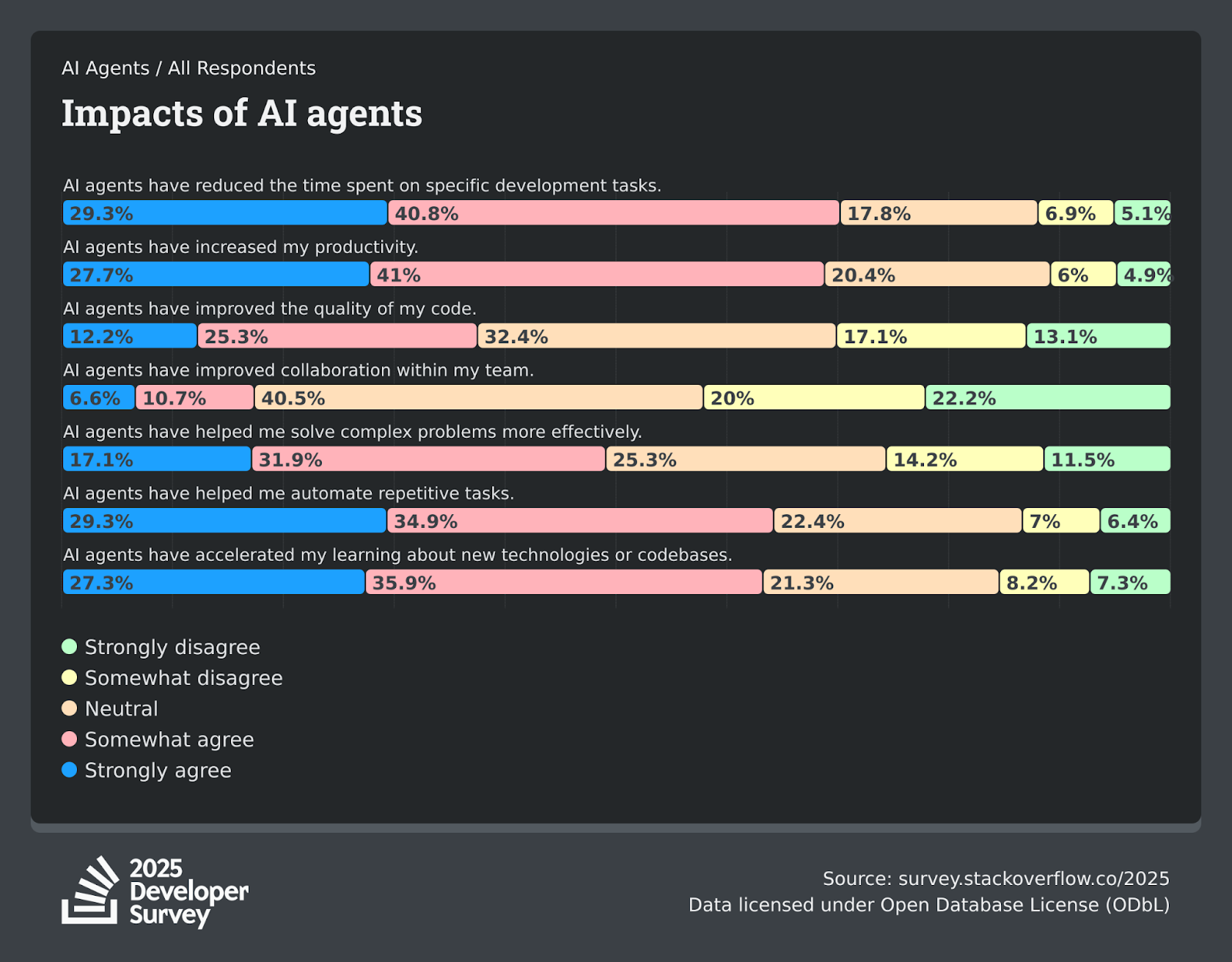
Source: 2025 StackOverflow Developer Survey
However, industry data tells a different story. While AI agents can boost developer productivity and speed up repetitive work, they still struggle with complex decision making, full context integration, and long term maintainability.
This guide explains 8 key reasons backed by benchmarks, case studies, and enterprise usage stats on why AI is transforming developer workflows without replacing human expertise.
Work alongside AI, not be replaced. Join Index.dev and build global remote careers as a top-tier developer.
Will AI agents replace software developers?
The short answer is NO, at least not in the way the hype sometimes suggests. AI agents are changing the way we write code, test software, and even collaborate across teams, but they are not a wholesale replacement for human developers. Instead, they’re becoming powerful partners, speeding up certain tasks while leaving critical thinking, architecture, and decision-making in human hands.
Here are 8 reasons why our answer is “No”:
1. AI agents will streamline coding tasks, but cannot fully replace the expertise and decision-making of human developers
AI agents excel at speeding up repetitive parts of coding. They can generate boilerplate code, build common UI components, or even write a simple API endpoint in seconds. According to the Google Cloud AI Trends Report (2025), developers using AI-based coding assistants completed 26% more weekly tasks, made 13.55% more code updates, and compiled code 38.38% more often than those without them.
This frees developers to focus on bigger challenges, like designing architecture, making technology trade-offs, or aligning features with business goals.
However, AI is still limited. It works best when solving standard, well-defined problems. When faced with unusual requirements or incomplete documentation, it can produce incorrect, inefficient, or irrelevant code.
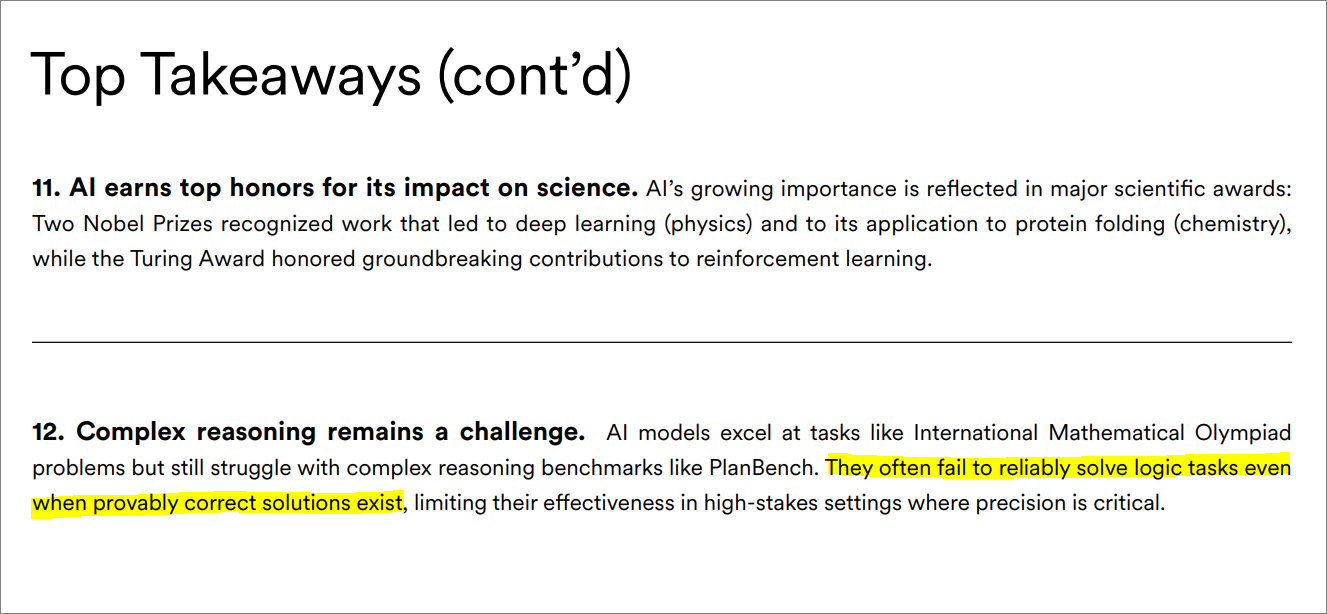
The Stanford AI Index Report (2025) noted that AI produced correct solutions for common problems but struggled in unconventional scenarios, like tasks that involve long-term planning or open-ended problem-solving.
Here’s a screenshot from the report:
Think of it as working with a capable junior developer: quick with routine tasks but still needing a senior to handle complex decisions.
Discover the top 5 AI coding agents that help developers write, test, debug, and automate code faster.
2. Complex, high-stakes software systems still require human judgment and control
AI can generate functional code, but in industries like aviation, healthcare, and finance, small mistakes can be costly or even dangerous. These systems involve nuanced business rules, strict compliance, and deep integration with multiple platforms, areas where AI lacks full judgment.
For example, developers have reported cases where AI-generated code used deprecated APIs or missed critical security checks, which could cause major failures. Even with automation, you need a human to validate that the solution is safe, compliant, and future-proof.
This is why 71% of executives believe AI agents will improve workflow automation and customer service, but not replace human oversight for mission-critical software.
3. AI often lacks a full project context and can introduce integration challenges
AI agents work best when tasks are small and isolated. You can give them a single function to write, and they’ll do it quickly. But when working in a large, interconnected codebase, they can break patterns, misplace files, skip key steps, or use inconsistent naming conventions.
Even when given a repository context, AI doesn’t always interpret it correctly. This means developers must still review every change to ensure it fits the existing architecture.
The PwC AI Agent Survey found that only 19% of companies can fully connect AI agents across workflows, leaving most AI tools operating in silos. This lack of integration means outputs can be misaligned with other parts of the project, creating rework for developers.
Another key insight of the same report is that 68% of companies say half or fewer of their employees use AI agents daily, limiting the data and context these tools have. For developers, this can lead to AI-generated code that works in isolation but fails when merged into a larger codebase. It misses dependencies, conflicts with standards, or errors happen while duplicating functions.
Until AI gains full project visibility, human oversight is crucial to ensure quality, maintain consistency, and prevent costly integration issues.
4. Unchecked AI-generated code can create significant technical debt
Technical debt is like borrowing time from the future; you take shortcuts now, but you eventually pay for them with extra maintenance, rewrites, or costly fixes. When AI agents generate code without proper oversight, this debt can pile up fast.
AI can produce solutions that “work” but are bloated, inefficient, or inconsistent with the project’s architecture. Over time, these small misalignments create brittle systems that are harder to maintain and scale.
According to the State of AI Agents 2024 survey, performance quality is the single biggest limitation to putting more agents into production, ranked twice as significant as cost or safety concerns. This is especially true for smaller companies, where 45.8% cite quality issues as their top blocker.
For developers, this means every line of AI-written code must be reviewed, tested, and aligned with project architecture to avoid costly rewrites. Without these safeguards, such as human approval steps, offline evaluation, or read-only permissions, teams risk accumulating technical debt that can slow down future development and inflate maintenance costs.
5. Past automation trends show that new tools change developer roles rather than eliminate them
Previously, we believed, tools like low-code platforms, graphical programming, and even COBOL would replace developers. Instead, they changed workflows and allowed engineers to focus on more advanced tasks.
AI is following the same path. It increases speed for simple work but has diminishing returns in complex projects. Developers who adapt by learning how to guide AI and integrate it into their workflow can stay relevant and even more valuable. AI tools increase productivity, but the value of human problem-solving, creativity, and judgment never disappears.
6. AI is more likely to replace low-skill, generic coding tasks than specialist roles
AI will have the biggest impact on routine coding jobs, things like CRUD applications (Create, Read, Update, Delete), boilerplate scripts, and one-off static landing pages. These are tasks where the requirements are simple, the code patterns are predictable, and the risk of failure is low.
For example, AI can already clone a basic micro-SaaS app in minutes by combining templates and existing code snippets. In many cases, these apps can be deployed without a human ever touching the code.
But specialist roles are different. A machine learning engineer working on medical diagnostics, or a backend developer building a low-latency trading platform, is dealing with unique challenges AI can’t yet master, like optimising performance under real-world constraints, complying with strict regulations, or inventing entirely new approaches.
7. Human–AI collaboration produces better results than AI alone
When developers use AI as a supporting tool rather than a replacement, results improve dramatically. AI brings speed and consistency, while humans add creativity, context, and critical thinking.
For example, Best Buy’s gen AI-powered customer agents cut resolution times by up to 90 seconds, but those agents still work alongside human support staff for complex issues.
You can think of it like pilots using autopilot; it handles routine flying, but the pilot is still there for decision-making, emergencies, and overall safety.
Explore why Human + AI Collaboration is the future of talent acquisition.
8. The role of developers will shift toward high-level architecture, specialised domain knowledge, and quality control of AI-generated code
The developer of the future will spend less time typing out every single line of code and more time directing AI, checking its work, and integrating it into complex systems.
This means new skills will become essential:
- Architecture & system design — to ensure the software is scalable, secure, and easy to maintain.
- Domain expertise — so the software truly fits the needs of industries like finance, healthcare, or manufacturing.
- AI oversight — catching subtle bugs, optimising performance, and preventing unintended behaviour before deployment.
According to Gartner, by 2027, 80% of the engineering workforce will need to upskill to work effectively with generative AI. The rise of “AI engineers”, professionals with a mix of software engineering, data science, and AI/ML skills, will be essential for building AI-powered applications at scale.
AI may speed up coding, but human oversight will remain essential to validate accuracy, ensure maintainability, and align solutions with real-world needs.
How AI agents are transforming software development and coding
AI agents are reshaping software development by streamlining routine and repetitive coding work, freeing developers to focus on more strategic and creative tasks. Instead of spending hours on boilerplate code or setup, developers can use AI to quickly generate, test, and refine solutions.
Key transformations include:
- Faster prototyping:
- AI can turn an idea into a working draft within minutes.
- AI can turn an idea into a working draft within minutes.
- Automated debugging and refactoring:
- Speeding up error detection and improving code quality.
- Speeding up error detection and improving code quality.
- Integration support:
- Assisting with CI/CD pipelines and multi-tool workflows.
- Assisting with CI/CD pipelines and multi-tool workflows.
This shift doesn’t replace human expertise. Developers still guide architectural decisions, ensure maintainability, and align outputs with business needs. The future of coding lies in human-AI collaboration, where AI agents handle speed and scale, and developers bring creativity, context, and critical judgment.
Final words
For developers, AI agents are powerful accelerators, not replacements. They write boilerplate code, refactor with speed, and even suggest design improvements, but they still need human guidance to ensure code quality and business alignment. AI still lacks the contextual awareness, creativity, and strategic thinking that experienced developers provide.
The future belongs to those who can use AI’s capabilities while applying their own expertise to complex challenges. The best results come when AI handles repetitive or well-defined tasks, while humans focus on architecture, optimisation, and innovation.
This partnership is redefining the developer’s role, shifting it toward higher-value problem-solving and AI oversight. As adoption grows, the most successful teams will be those that master this human-AI collaboration.
FAQs
1. Will AI agents completely replace software developers in the future?
No, AI agents can automate certain coding tasks, but they cannot replace the critical thinking, domain expertise, and decision-making skills of human developers. They work best as tools that support and speed up development.
2. What coding tasks can AI agents handle effectively?
AI agents excel at repetitive tasks such as generating boilerplate code, automating testing, refactoring, and creating prototypes. They can also assist with debugging and integrating systems, but complex problem-solving still requires humans.
3. Why do software developers still have an advantage over AI agents?
Software developers bring business context, creativity, and architectural judgment that AI lacks. They can design scalable systems, ensure compliance, and adapt solutions to unique project requirements, something AI cannot fully do.
4. Can AI agents work on large, complex projects?
Not reliably on their own. While AI can assist with parts of a project, large-scale, mission-critical systems, such as in healthcare, finance, or aviation, require human judgment and rigorous quality control.
5. Will junior developer jobs be at risk due to AI agents?
Junior developer jobs will be at risk, especially the entry-level coding roles involving simple, repetitive tasks. However, developers who upskill in architecture, AI oversight, and domain expertise will remain in demand.
6. How can developers prepare for working with AI agents?
Developers need to learn how to integrate AI into workflows, verify AI-generated code, and focus on high-value skills such as system design, security, and industry-specific problem-solving.