Recruiters, talent acquisition leaders, and HR tech buyers face increasing pressure to recruit more quickly, smarter, and inclusively. Traditional sourcing tactics often fall short, particularly when it comes to identifying passive candidates and building diverse pipelines at scale.
This blog looks at how AI sourcing tools are revolutionizing talent finding. You'll discover the limitations of manual sourcing, how AI recruitment software works, the best automated candidate sourcing tactics, and what to look for when assessing AI sourcing platforms for your firm.
Access pre-vetted developers instantly. Index.dev's AI-powered matching connects you with the top 5% of developers. Start your 30-day free trial today.
The Limitations of Traditional Sourcing Methods
While technology has advanced in other aspects of human resources, many firms still rely heavily on manual sourcing. Traditional candidate finding approaches, which rely largely on job boards, keyword searches, and manual screening, are not only inefficient but also unable to fulfill current needs for speed, variety, and scalability.
The main restrictions listed below offer a compelling argument for AI sourcing tools and automated candidate sourcing in 2025.
1. Keyword-Based Search Excludes High-Potential Talent
Recruiters usually utilize Boolean searches to discover prospects on LinkedIn, Indeed, or internal applicant tracking systems. However, this strategy is hampered by stringent keyword matching, which frequently ignores profiles with slightly altered phrasing.
A recruiter seeking for "frontend developer" may overlook candidates who mention "UI engineer" or "web interface specialist."
Because traditional systems do not grasp semantics or purpose, they fail to identify profiles that are highly relevant yet linguistically distinct. AI sourcing addresses this by using Natural Language Processing (NLP) to comprehend the meaning of words rather than simply the exact terms.
2. Manual Resume Screening Is Time-Intensive and Inconsistent
According to studies, recruiters evaluate resumes for an average of 7.4 seconds. Given the number of submissions, this results in hasty assessments and crucial errors. Worse, screening standards differ per recruiter, resulting in uneven candidate evaluations within the same employment role.
In contrast, AI recruitment tools can rapidly standardize resume assessment and extract relevant skills, experiences, and certifications, saving time per hire and decreasing human error.
3. Scaling Hiring Is Resource-Intensive Without Automation
Traditional sourcing becomes inefficient when a company is quickly expanding or has to fill many jobs. Hiring ten developers requires ten times the sourcing and screening work—unless automated.
Without automated candidate sourcing, recruiting teams either burn out or expand their workforce. AI systems, on the other hand, can quickly evaluate hundreds of profiles, ranking top matches based on relevance and likelihood of engagement.
According to LinkedIn's Future of Recruiting Report, 56% of recruiters believe they spend too much time on repetitive sourcing operations that can be automated.
4. Passive Candidates Are Out of Reach
According to LinkedIn Talent Trends, passive applicants, or those who do not actively seek employment, account for 70% of the worldwide talent pool. Traditional sourcing approaches provide few options for engaging these persons successfully.
AI-powered sourcing solutions may examine public data (GitHub, Dribbble, Behance, Kaggle, Stack Overflow) and social signals to predict job-change likelihood, interests, and professional activity, discovering and reaching out to passive talent before they begin looking for work.
5. Bias & Diversity Manual Screening Gaps that Persist
Unconscious prejudice continues to influence employment decisions. According to research, similar resumes elicit distinct responses depending on perceived gender or race. Traditional systems lack built-in bias-reduction measures, as well as the ability to anonymize resumes and impose organized review.
In contrast, leading AI sourcing systems encourage anonymous sourcing, blind screening, and diversity filters to ensure more equal shortlisting.
6. Underutilization of Rich Candidate Data
Manual sourcing seldom uses external datasets. Most ATS systems only retain candidate information from previous applications or résumé uploads, leaving out key indications such as:
- Technical contributions (such as GitHub commits)
- Speaking engagements or publications.
- Stack Overflow reputation and certifications
- Community participation or LinkedIn activity trends
AI candidate sourcing solutions may combine data from public and proprietary sources to provide a 360° perspective of a candidate's full potential, which is unattainable with traditional methods.
7. Delayed Time-to-Fill and Increased Hiring Costs
According to the Society for Human Resource Management (SHRM), the average time to fill a position is 36 days, with tech jobs taking longer. Manual sourcing frequently results in increased time and expense per hiring owing to repeated cycles of seeking, screening, and rejecting.
AI sourcing automates and speeds the pipeline, reducing sourcing hours by up to 80% in some firms, according to vendor case studies on platforms such as Index.dev, HireEZ, and SeekOut.
How AI Sourcing Tools Work: A Look Under the Hood
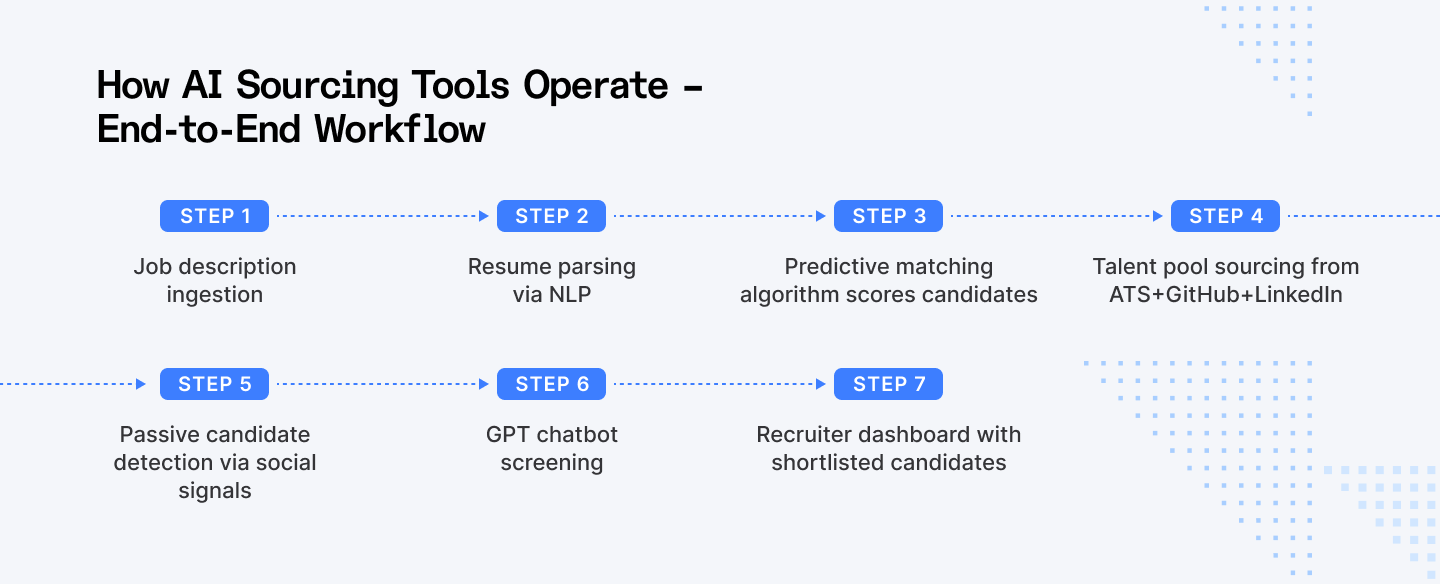
Modern recruiting necessitates speed, precision, and scale—which is precisely where AI sourcing technologies come into play. Unlike traditional approaches, which depend primarily on manual keyword searches and intuition, AI-powered platforms use powerful machine learning, automation, and data integration to quickly and precisely find the best-fit candidates. Let's look at the basic technology and procedures that drive automated candidate sourcing.
Parsing Resumes and Job Descriptions Using NLP
Natural Language Processing (NLP) is key to any good AI recruiting program. NLP allows robots to read and comprehend unstructured language such as resumes, cover letters, and job descriptions. Traditional algorithms match precise keywords; NLP goes a step further, understanding context, synonyms, and industry-specific terminology.
For example, if a job description specifies "React.js experience," the AI can discover individuals who have identified "frontend development with JavaScript frameworks" as a potential match, even if the term "React" is not explicitly included.
According to IBM, NLP not only improves information extraction accuracy but also allows for more in-depth insights such as sentiment analysis, intent identification, and language standardization.
Predictive Matching Algorithms
Once a resume has been analyzed, AI sourcing systems employ predictive algorithms to assess applicant suitability. These models use past recruiting data, job criteria, and candidate profiles to compute a "match score" or "fit probability."
Unlike inflexible filters, these models adapt to recruiter preferences and hiring outcomes over time. For example, if your organization frequently hires high-performing applicants from specific sectors or educational backgrounds, the algorithm will automatically highlight comparable profiles.
This constant feedback loop turns AI candidate sourcing into a self-improvement engine.
Integrate with CRMs, ATS, and Public Talent Databases
One important advantage of AI sourcing technologies is their capacity to combine data from numerous sources. Leading programs such as SeekOut, HireEZ, and AmazingHiring integrate smoothly with:
- Applicant Tracking Systems (ATS), such as Greenhouse and Lever
- Customer Relationship Management (CRM) solutions, such as Salesforce
- Public data sources include GitHub, Stack Overflow, LinkedIn, Kaggle, and more.
This integration provides recruiters with a single talent intelligence perspective by merging internal databases (prior applications, silver medalists) with external open-source talent. The AI compares several signals (skills, seniority, education, and company history) to find the best matches instantaneously.
Gartner predicts that by 2026, 75% of organizations will employ AI-based talent solutions connected with basic HR systems.
Assessing Behavioral and Social Signals
AI sourcing software extends beyond resumes. It assesses behavioral cues that show if a candidate is open to new chances, such as:
- The frequency of LinkedIn updates
- Recent GitHub Commits
- Participate in online hackathons or webinars
- Publication of essays or thought leadership pieces
This predictive layer assists in identifying passive prospects who have not applied but may be ready for a chat, significantly extending the attainable talent pool.
Platforms such as HireEZ use "Availability Scores" to rate passive applicants based on their likelihood of participation based on their online behavior patterns and duration in their present employment.
Screening Using GPT-Powered Chatbots and Summarization
Once high-potential individuals are identified, AI recruiting software frequently automates preliminary screening with GPT-powered chatbots. These robots can:
- Ask targeted pre-screening questions (skills, notice period, and compensation expectations).
- Understand candidates' replies in plain language.
- Summarize important facts in a recruiter-friendly way.
Furthermore, resume summarizing tools may reduce a candidate's experience into short bullet points for speedier assessment, reducing time-to-value for recruiting teams.
Explore 17 AI recruiting tools that make finding software engineers easier.
Top 5 AI Sourcing Strategies for Finding Passive Candidates
While job boards and inbound applications might help fill some positions, the best applicants are frequently passive: employed, not actively looking for work, but open to new chances.
According to LinkedIn's worldwide Talent Trends report, passive talent accounts for 70% of the worldwide workforce. This makes it critical for recruiters to proactively discover, categorize, and interact with them. Fortunately, AI sourcing technologies are transforming the process.
Here are five tried-and-true AI sourcing tactics that can help recruiters locate and attract passive prospects more successfully than ever before.
1. Semantic Search Using Boolean Expansion
Exact matches are the limit of traditional keyword search. If a recruiter searches for "Node.js developer," they may miss profiles that include "JavaScript engineer" or "backend specialist." Semantic search solves this.
AI recruiting software, such as HireEZ and SeekOut, interprets search query intent using Natural Language Processing (NLP). The technology automatically extends searches based on Boolean logic, synonyms, job descriptions, and comparable abilities.
For example, a search for "product manager SaaS" may yield profiles branded "technical product owner," "agile product lead," or "platform strategist", all related but differently written.
This approach considerably broadens the breadth and quality of the findings, guaranteeing that no qualified applicant is overlooked owing to terminology mismatches.
2. Public Profile Mining Using APIs (GitHub, Kaggle, Behance)
AI sourcing tools are no longer limited to job postings and resumes. Today, platforms may mine public professional data sources, such as
- GitHub: For Engineers and Developers
- Kaggle: For Data Scientists and Machine Learning Engineers
- Behance & Dribbble: For Designers and Creatives
- Google Scholar: For Researchers and Academics
AmazingHiring and SeekOut use APIs to collect organized, real-time candidate data, including code contributions, project portfolios, and publishing histories. These indications are frequently more accurate representations of talent and potential than a typical CV.
According to SeekOut, more than 65% of suitable applicants identified through public repositories are not on LinkedIn.
This AI-driven method unlocks a hitherto untapped passive talent pool, particularly for technical and creative professions.
3. Behavioral Signals: Job Switch Likelihood and Activity Patterns
Not all passive applicants are equally willing to move jobs. AI sourcing software may examine behavioral cues to forecast which people are most likely to respond to outreach.
Key indications are:
- Duration in present role (e.g., approaching two years)
- Recent LinkedIn profile updates
- Increased activity on GitHub or Stack Overflow.
- Attendance at industry webinars and certifications
Candidates are assigned a "switch probability score" by platforms such as HireEZ, allowing recruiters to focus outreach based on intent rather than credentials.
This predictive function enables recruiters to focus their efforts on the most "recruitable" applicants, increasing response rates and eliminating wasted outreach.
4. AI Chatbots for Passive Outreach at Scale
After identifying passive prospects, the next issue is to engage them. Sending hundreds of customized texts individually is not scalable. This is where GPT-powered chatbots and AI messaging assistants come in.
Tools like Fetcher.ai and Paradox Olivia allow for hyper-personalized outreach efforts at scale.
These Bots:
- Craft personalized communications leveraging the candidate's background and position fit.
- Engage in multi-turn discussions (availability, interest, and location).
- Refer interested prospects to recruiters or application sites.
Case Study: A SaaS startup in Eastern Europe used Fetcher to minimize manual outreach time by 75% and quadruple participation from passive engineers. These AI-powered communications beat templated InMails or generic cold emails in terms of open and response rates.
5. Automated Talent Pool Segmentation and Re-Engagement
One of the most underutilized recruiting tools is the internal talent pool, which includes prior applicants, silver medalists, and sourced leads that are inactive in the ATS. AI sourcing technologies make this data come to life.
The advanced platforms can:
- Talent can be segmented by skill, locality, and level of experience.
- Monitor changes (e.g., new skills, role adjustments).
- Activate re-engagement initiatives when someone becomes a better fit.
LinkedIn Talent Insights and Beamery are two examples of systems that notify recruiters when someone in their talent pool becomes active or makes a significant career change.
This continuing segmentation keeps your sourcing pipeline dynamic and flexible, allowing you to uncover passive applicants that were previously missed or not ready.
Before and After: Manual Sourcing vs. AI-Powered Sourcing Pipeline
Step | Manual Sourcing | AI-Powered Sourcing |
| Candidate Discovery | Manual search via job boards | NLP & semantic search with Boolean expansion |
| Data Sources | Limited to resumes and LinkedIn | Enriched with GitHub, Kaggle, and Behance |
| Intent Signals | None | Behavioral indicators & passive engagement data |
| Outreach | Manual emails or InMails | GPT-powered personalized chatbot messaging |
| Talent Pool Utilization | Static, often ignored | Real-time segmentation and re-engagement |
| Time-to-Identify | Days to weeks | Minutes to hours |
This change demonstrates the efficiency and depth that AI sourcing technologies add to the employment process.
Building a Diverse Talent Pipeline with AI
Diversity, equity, and inclusion (DEI) are increasingly integral to modern recruiting strategies, not only for ethical reasons, but also because diverse teams have been shown to outperform homogenous ones.
According to a landmark McKinsey research, organizations with the highest quartile of ethnic and cultural diversity on executive teams were 36% more likely to succeed in profitability.
However, traditional approaches make it difficult to establish a varied talent pipeline on a large scale. That's where AI sourcing tools are making a difference, by anonymizing prejudices, revealing neglected talent, and allowing for organized, bias-free evaluation.
1. Using AI to Anonymize Resumes
Unconscious prejudice frequently originates during the resume screening process. A widely referenced Harvard Business Review research discovered that similar resumes with different names—for example, "Lakisha" vs "Emily"—had drastically different response rates.
Modern artificial intelligence recruiting tools can avoid this prejudice by automatically anonymizing resumes. This entails identifying information such as:
- First and last names
- Gender pronouns
- University names (where prestige bias may exist)
- Photos or aging indications
- Address/location (to prevent regional prejudice)
By requiring decision-making to be based only on abilities and experiences, AI enables recruiters to evaluate prospects solely on merit. Platforms like Applied and Pymetrics are spearheading the anonymization endeavor.
2. Diversity Filters and Structured Rankings
AI sourcing systems frequently integrate diversity metrics and filters to assist teams in achieving specific DEI recruiting objectives. These filters do not impose quotas, but they do highlight underrepresented groups across gender, ethnicity, handicap status, and other factors based on publicly accessible or voluntarily submitted data.
Tools like SeekOut provide a "Diversity Search" feature, which enables businesses to:
- Prioritize reaching out to female software developers.
- Discover Black or Latinx applicants in leadership positions.
- Surface talent from HBCUs (Historically Black Colleges and Universities) or Tier-2/3 colleges is sometimes overlooked in elite hiring.
According to LinkedIn Talent Solutions, 76% of recruiters prioritize diversity recruiting, yet most lack the capabilities to do so successfully without AI.
3. Identifying Talent from Overlooked Regions or Institutions
Traditional sourcing frequently favors top-tier schools or applicants based in tech hotspots such as San Francisco or London. AI sourcing technologies level the playing field by searching global databases and assessing personnel from unconventional backgrounds and underserved places.
For example:
- A bright data scientist from Lagos, Nigeria, is contributing to open-source AI projects.
- A female engineer from a rural institution in India, with a high GitHub ranking.
- A Latin UX designer with an award-winning Behance portfolio situated in Colombia.
Because AI can assess abilities, contributions, and potential rather than just lineage, it dramatically expands the talent pipeline.
4. Bias Inside AI Models
Despite its promise, AI is susceptible to prejudice. If the training data supplied into a model reflects previous inequities, the algorithm may unintentionally exacerbate current discrepancies.
For example, if historical hiring preferred Ivy League grads, a model trained on that data may over-index comparable traits while deprioritizing individuals from different backgrounds.
To address this, the leading AI recruitment software suppliers are now:
- Conducting bias audits.
- Using Diversity-Aware Training Data
- Providing explainable AI for transparent scoring.
- Complying with regulatory rules like the EEOC and GDPR
Tools like Eightfold.ai have made significant investments in auditing their AI for fairness and transparency, making it simpler for businesses to remain compliant while meeting DEI objectives.
5. Case Study: Enterprise Increases URM Hiring with AI
A Fortune 500 retail firm used SeekOut's Diversity Sourcing Suite to enhance participation of underrepresented minorities (URMs) in engineering and sales positions.
Challenge
The high dependence on recommendations and network-based hiring resulted in homogenous teams.
Solution
- All resumes were anonymized at the initial screening step.
- Applied diversity filters to find missed profiles at regional colleges.
- Used behavioral AI to grade candidates on leadership and adaptability attributes.
Result
- URM hiring increased by 41% within 6 months.
- A double rise in female tech candidates reaching the interview stage.
- Significant reduction in screening bias and increased interview conversion rates.
This instance highlights how AI sourcing tools may help shift the focus from aspirational DEI goals to measurable recruiting achievements.
Discover 7 proven strategies to build a talent pipeline that helps you hire faster and cut hiring costs.
Evaluating and Selecting the Best AI Sourcing Platform
With the rise of AI recruitment software, firms are now faced with the difficulty of picking the proper platform to meet their sourcing objectives. Whether you want to reduce time-to-fill, improve diversity outcomes, or increase passive applicant involvement, rigorous tool evaluation is critical.
Here's a strategy for evaluating and comparing AI sourcing technologies successfully.
Key Evaluation Criteria
Matching Accuracy
At the heart of any AI sourcing platform is the ability to identify the most relevant prospects. Look for platforms that enhance precision through machine learning and semantic search, rather than just keyword matching. Some providers additionally provide explainable AI to demonstrate why a candidate was shortlisted.
Speed and Automation
Modern recruitment needs systems that automate sourcing, outreach, and screening. Choose systems that can source and assess applicants in minutes, avoiding hours of manual labor. Look for technologies like auto-shortlisting, AI email sequencing, and chatbots that pre-screen.
Diversity Capabilities
Ensure that the platform provides diversity filters, anonymous screening, and DEI dashboards. Tools such as SeekOut and Arya AI have built-in features for tracking and improving diversity indicators throughout the sourcing process.
Integration with ATS/CRM
A strong AI recruitment tool should be integrated with your applicant tracking system (ATS) and customer relationship management (CRM) technologies. Popular connectors include Greenhouse, Lever, Salesforce, and Workday.
Data Source Coverage
The more data you have access to, the larger your skill pool. Seek out platforms that use LinkedIn, GitHub, Stack Overflow, Kaggle, Behance, and internal ATS pools for complete sourcing.
User Experience and Collaboration
Usability affects adoption. Look for simple dashboards, team-sharing capabilities, hiring manager access, and collaborative workflows. Fetcher and HireEZ excel in recruiter-friendly interfaces and multi-user functionality.
Comparative Table: Top AI Sourcing Platforms
Platform | Strengths | Ideal For |
| Index.dev | AI-powered talent & services | Elite freelancers to full-scale engineering teams. |
| HireEZ | AI-powered outbound sourcing, CRM integration | Enterprise tech hiring |
| SeekOut | Diversity filters, GitHub/Stack Overflow mining | DEI-focused and technical recruiting |
| Fetcher | Automated outreach + shortlist suggestions | Startups and scaling teams |
| AmazingHiring | Global talent search with social profile aggregation | Engineering and developer talent |
| Arya AI | Bias mitigation, predictive analytics | Large-scale, high-volume hiring |
G2 reports that systems with automated matching and outreach cut sourcing time by 50-70%.
Questions to Ask Vendors Before Buying
- How does your AI model identify and rate candidates?
- What integrations are available for our current ATS/HRIS?
- Do you anonymize resumes or use DEI filtering?
- How frequently is your data updated from other sources?
- Can we tailor sourcing procedures by department or region?
- Is there help during onboarding and after deployment?
These questions assist in determining feature depth, transparency, and vendor reliability, all of which are crucial for corporate deployment.
Deployment and Pricing Models
The majority of AI sourcing tools are SaaS-based, with cloud-first implementation. However, some business providers provide on-premise or API-first approaches for more advanced integration or data privacy compliance.
Pricing generally depends on:
- Number of users
- Candidate credits or searches
- Access to outreach automation
- Integration complexity
Vendors such as Index.dev provide tiered pricing, but Fetcher charges depending on usage, ideal for startups or seasonal recruiting surges.
Real-World Examples: AI-Powered Sourcing in Action
While the potential of AI sourcing tools is enticing, the true evidence is in how businesses are really implementing them to alter recruitment procedures.
The case studies below show how businesses ranging from small startups to multinational corporations have used AI recruitment tools to accelerate hiring, cut expenses, and promote workforce diversity.
Case Study 1: Tech Startup Hires 10 Engineers in 14 Days
Company
Berlin-based early-stage SaaS business.
Challenge
There is an urgent need to employ ten full-stack engineers with no in-house recruiter and a limited budget.
Solution
- Used the GitHub API to scrape open-source contributions from candidates in Latin America and Eastern Europe.
- A GPT-4-powered chatbot was deployed for conversational pre-screening, which included questions about talents, availability, and remuneration expectations.
- Codility was used to integrate the score and rank applicants automatically.
Outcome
- 80% time savings in sourcing and screening.
- Ten engineers were employed within 14 days.
- The average cost per hiring decreased from $6,500 to below $2,500.
Case Study 2: Enterprise Scaling Diverse Hiring in Five Regions
Company
Global logistics corporation with offices in APAC, the Middle East, and North America.
Challenge
Leadership demanded better DEI results in the tech and operational departments.
Solution
- Adopted SeekOut's AI-powered diversity filters.
- Activated continuous anonymization during the early screening.
- Utilized behavioral indications (tenure, skill refreshment, LinkedIn activity) to identify passive diversified talent
Outcome
- URM hiring grew by two times within six months.
- The interview-to-offer ratio improved by 40%.
- The DEI compliance audit passed with zero flags.
According to McKinsey's DEI Report, organizations with diverse teams perform 36% better than their peers.
Case Study 3: Remote SaaS Firm Replaces Agency with AI Stack
Company
100-person, remote-first SaaS company
Challenge
Agency reliance resulted in $20k each hiring, which was sluggish and costly for a bootstrapped firm.
Solution
- Implemented Fetcher for automated sourcing and outreach.
- Integrated Codility for assessing applicants' capabilities without recruiter oversight
- Use AI email sequencing for passive engagement.
Outcome
- Hiring expenditures have decreased by 35%.
- No internal recruiters were employed.
- Time-to-fill decreased from 38 to 16 days.
Insight: According to G2 Crowd, 63% of recruiters employing AI report reduced dependency on third-party hiring firms.
Before vs After – Impact of AI Sourcing
Metric | Before AI | After AI Sourcing Tool |
| Time-to-Hire | 30–45 days | 10–20 days |
| Cost-per-Hire | $8,000–$20,000 | $2,000–$5,000 |
| DEI Representation | <15% URM in shortlists | >35% URM in shortlists |
| Manual Hours Spent | 20–40 per role | <5 hours per role |
These case studies demonstrate how AI sourcing platforms deliver concrete ROI and scale talent acquisition in ways that traditional techniques cannot.
Future Trends: What's Next in AI Candidate Discovery?
As businesses seek quicker, fairer, and more predictive recruiting processes, AI sourcing becomes increasingly sophisticated and integrated into end-to-end talent plans.
Here is what the future holds for AI recruitment software in the next 1-2 years:
Autonomous Sourcing Agents
Consider AI bots that constantly check job boards, GitHub, ATS databases, and Slack channels. These agents will automatically propose candidates based on changing team needs, market trends, and pipeline drop-off rates.
Companies like Eightfold.ai are pioneering this "always-on" AI strategy, which can reshape talent pipelines in real-time.
Emotion-Aware AI for Assessing Candidate Sentiment
Next-generation AI sourcing tools use affective computing to assess candidates' emotional tone and engagement level in written and spoken replies. Recruiters may use these signs to highlight applicants who are both qualified and truly interested.
According to Gartner, emotion AI will be widely used in pre-screening by 2026, assisting teams in reducing drop-offs and ghosting.
Integration with Internal Talent Marketplaces
Future-ready platforms go beyond sourcing external candidates and maximize internal mobility by connecting to internal talent marketplaces. AI will propose internal applicants for available positions, career pivots, or job possibilities.
According to LinkedIn's Internal Mobility Index, firms that prioritize internal recruiting have 41% higher employee retention rates.
Multilingual and Cross-Border Talent Discovery
AI models are expanding to accommodate multilingual parsing and matching, allowing for genuinely global recruiting.
Platforms will soon support:
- Resume parsing in more than 30 languages.
- Cultural context grading for cross-border hiring.
- Localization of Chatbot Outreach
This makes AI sourcing an essential tool for multinational corporations hiring in Latin America, APAC, and Eastern Europe.
By 2026, AI-First Hiring Will Be the Default
By 2026, AI-first recruiting—in which sourcing, screening, and first evaluation are completely automated—will be the norm, particularly for volume and tech hiring. Human recruiters will prioritize high-touch interaction, branding, and closing top applicants.
Conclusion
AI sourcing tools are no longer optional; they are required for expanding recruiting, minimizing prejudice, and identifying hidden potential. AI recruitment software is changing the way firms interact with top applicants, from processing resumes with NLP to automating outreach with GPT-powered bots. AI allows you to make quicker, smarter, and more inclusive recruiting decisions for engineers, marketers, and remote teams around the world. Are you ready to adapt your talent strategy?
Start by piloting a platform that meets your needs, as the future of employment is already here.
Contact Index.dev and see AI sourcing in action now.