What sets forward-thinking companies apart from those that struggle to grow? Simple: they prioritize building strong talent pipelines to outsmart and outperform competitors. Instead of scrambling to fill roles at the last minute, they stay ahead—overcoming talent shortages and anticipating both current and future hiring needs.
Yet, in a recent survey, 72% of CEOs and board leaders cited the availability of key talent and skills as one of the top five biggest threats to their organization’s growth. Finding the right people isn’t easy, but a well-structured talent pipeline turns the tide. It ensures a steady stream of qualified candidates, cutting down hiring time and making hiring smarter.
So, how do you build one? In this guide, we’ll break down seven proven strategies to help you build, engage, and optimize a high-performing talent pipeline. You’ll learn how to reduce hiring costs, speed up recruitment, and effortlessly fill even the toughest roles—without the rush of sorting through endless resumes or conducting back-to-back interviews. Plus, we’ll explore the key benefits of having a talent pipeline and how to measure its effectiveness.
No guesswork. Just tested, results-driven hacks to help your business win the race for talent. Let’s dive in.
Hire vetted developers in 48 hours with a 30-day free trial through Index.dev. Start now!
What Is a Talent Pipeline?
Think of a talent pipeline as your company’s go-to pool of pre-qualified candidates—people you’ve already vetted, met, or even interviewed. When a position opens up, you’re not starting from scratch. Instead, you have a lineup of high-potential candidates ready to step in. A strong talent pipeline includes:
- Past applicants who made it to the final rounds but weren’t the right fit at the time.
- Candidates from networking events or informational interviews.
- Industry professionals who align with your company’s culture and goals.
Because these candidates are already familiar with your business, your mission, and your values, you skip the time-consuming “getting to know each other” phase. When the right role appears, it’s just a matter of a focused interview and a quick offer.
But here’s the real advantage: a talent pipeline lets you engage with top talent before they even start job hunting. You’re not waiting for them to apply—you’re proactively building relationships. That means when key employees leave or unexpected vacancies arise, you’re not scrambling. You have ready-to-hire talent on standby, ensuring continuity and stability.
Learn More: How to Vet Software Developers
Talent Pipeline Challenges for HR Teams (+ How to Overcome Them)
Building a talent pipeline isn’t just about filling roles—it’s about finding the right people at the right time. But this comes with its fair share of challenges. Here’s how to tackle them head-on.
Finding the Right-Fit Candidates
Not every skilled candidate is the right candidate. Identifying people who not only have the right skills and experience but also align with your company’s culture and values is tough. Craft clear, detailed job descriptions, leverage AI-driven resume screening, and use skill-based assessments to ensure a strong match before moving forward.
Skills Shortage
The tech industry is constantly evolving, but the talent pool isn’t always keeping up. A shortage of specialized skills can slow innovation, stall projects, and leave key roles unfilled.
Invest in upskilling and reskilling programs. Build a learning culture where employees can grow their expertise in AI, cloud computing, data science, and software development.
Sourcing Top Talent
Great candidates won’t just show up at your door. You need a proactive approach to engage them. Use multiple sourcing strategies including:
- Employee referrals (your best hires often come from within your network).
- Industry events and networking (tech conferences, meetups, hackathons).
- Partnerships with universities and tech organizations.
Engaging Talent Long-Term
Tech talent moves fast, and turnover is a reality. If candidates don’t feel connected to your company’s mission and vision, they won’t stick around. Build relationships from day one. Hire for human potential first and train for technical skills later. When candidates see themselves in your company’s story, they’ll be invested for the long run.
Adapting to Changing Workforce Demographics
Today’s workforce is more diverse than ever—spanning different generations, backgrounds, and work preferences. A one-size-fits-all approach won’t cut it. Foster an inclusive culture that values diversity. Offer flexible work arrangements, remote options, and personalized communication to meet the needs of different employee groups.
| Challenge | Solution |
| Finding Right-Fit Candidates | Clear job descriptions, AI resume screening, skill assessments. |
| Skills Shortage | Upskilling/reskilling programs, learning culture. |
| Sourcing Top Talent | Employee referrals, industry events, university partnerships. |
| Engaging Talent Long-Term | Hire for potential; train for skills; build relationships early. |
| Adapting to Changing Workforce Demographics | Foster inclusive culture, flexible work options, personalized communication. |
Now that we've outlined the challenges of building a talent pipeline, let's dive into the essential steps for creating a robust and healthy one.
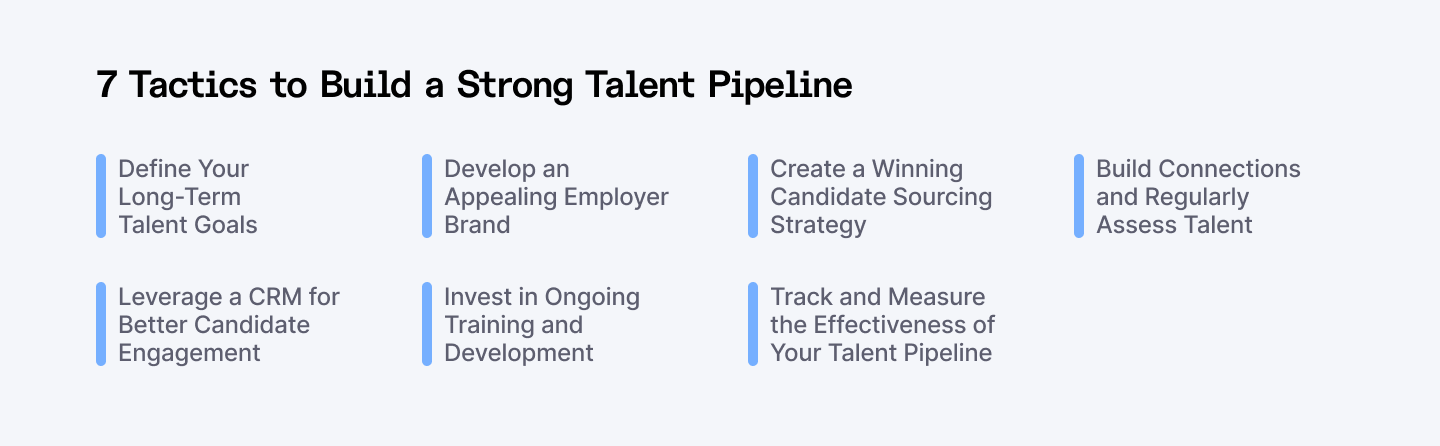
Key Steps to Develop a Strong Talent Pipeline
1. Define Your Long-Term Talent Goals
A survey by edX found that nearly half (49%) of the skills that were relevant in 2023 won’t be in 2025. Even more concerning? 47% of executives believe their teams aren’t prepared for the future of work. So, how do you stay ahead? Start with a clear vision of where your company is headed and align your talent strategy accordingly. That means filling current gaps while also preparing for future hiring needs. Consider the following:
- Is your company expanding? Are you planning to scale operations in the next 1, 2, or 5 years?
- Are major changes on the horizon? Mergers, acquisitions, or new business lines could shake up your hiring needs.
- How will your talent needs evolve? New technologies, business offerings, or market shifts can change which skills and roles you need most.
- What does the job market look like? Are key roles competitive to fill? Would remote contractors or freelance talent be a good fit?
- Are you conducting regular talent reviews? Are you actively identifying skills gaps and evaluating your current team’s potential for growth?
- Is your succession plan solid? When key employees leave, do you have a plan to backfill roles quickly?
Adopt a “what if?” mindset. Anticipate potential challenges and plan ahead. Yes, this step requires deep brainstorming and cross-team discussions. But trust us—it’s worth it. A well-thought-out strategy today will save you time, money, and stress in the long run.
2. Develop an Appealing Employer Brand
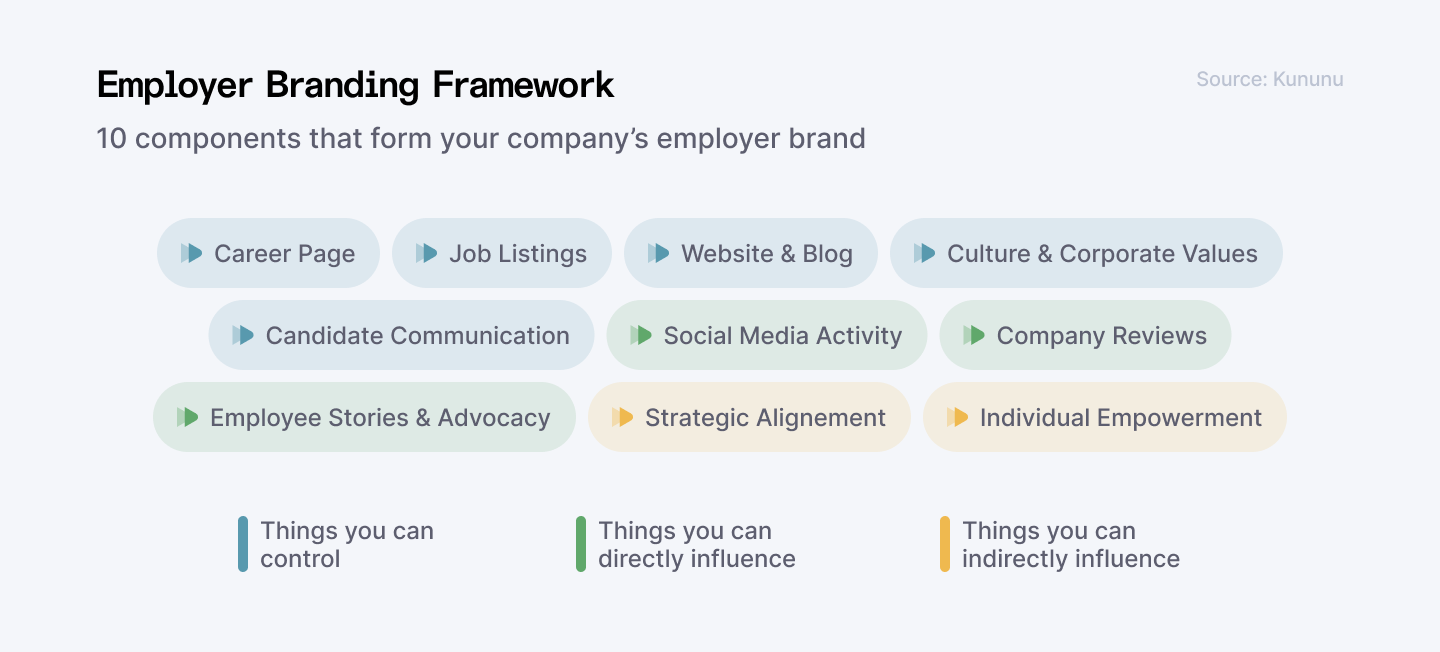
Your employer brand isn’t just about a logo or tagline—it’s the reputation your company has in the job market. And in today’s world, where culture, well-being, and flexibility are top priorities, your brand is what gives you the edge in attracting top talent. In fact, 50% of candidates wouldn’t work for a company with a bad reputation—even if the salary was higher (Randstad).
That’s why you need to sell your organization to candidates just as much as they need to sell their skills to you. So, how do you polish an employer brand that stands out?
- Define and promote your mission, vision, and values. Make it clear what your company stands for and ensure this is reflected on your careers page and recruitment materials.
- Create a compelling Employee Value Proposition (EVP). What’s in it for your employees? Clearly outline the benefits, career growth opportunities, and unique aspects of working with you.
- Showcase career growth opportunities. Highlight potential career paths on your website so candidates see a future with your company.
- Highlight employee stories. Feature testimonials, success stories, and behind-the-scenes content on your careers page and social media. Let your team tell potential hires why they love working with you.
- Engage on social media. Share office tours, Q&A sessions with leadership, team event highlights, and company culture insights. Keep the conversation going.
- Encourage employee reviews. Ask current employees to leave honest feedback on Glassdoor and similar platforms to boost your credibility.
- Earn recognition. Apply for industry awards and ‘best place to work’ rankings to validate your reputation and attract more candidates.
A strong employer brand draws in motivated professionals, keeps passive candidates interested, and makes hiring easier when the time comes.
3. Create a Winning Candidate Sourcing Strategy
Filling your talent pipeline isn’t a one-time task—it’s an ongoing effort. You need to proactively seek out qualified candidates who align with your company’s technical needs and culture. Sourcing is about actively searching for talent instead of waiting for them to come to you. Here are some of the most effective strategies:
- Use LinkedIn and other networks to search for candidates with specific skills and experience that match your hiring needs.
- You can also hire a virtual assistant to support your sourcing efforts, handling tasks like shortlisting candidates, scheduling outreach, and maintaining your talent database so your internal team can focus on higher-level strategy.
- Create a referral program using tools like ReferralCandy that rewards employees for recommending candidates who turn into successful hires.
- Collaborate with specialized talent networks or recruiting platforms that give you access to pre-vetted, high-quality candidates.
- Attend networking events and engage with professionals in your industry to build relationships and stay connected with potential hires.
- Make it easy for candidates to save your contact information with business cards, with tools like Uniqode's Digital Business Card helping you exchange information quickly without relying on paper cards.
- Offer returnships for former employees looking to re-enter the workforce after an extended break.
The best time to strengthen your pipeline is during hiring freezes or slow seasons. Use this time to strengthen sourcing activities. The key is to meet top talent where they are. If you're hiring developers, platforms like GitHub or and specialized talent networks like Index.dev will be more effective than traditional job boards. If you're looking for sales and marketing talent, LinkedIn and industry-specific job boards will be better sources.
4. Build Connections and Regularly Assess Talent
Sourcing candidates is only the first step—now, it’s time to build real connections. At this stage, you’re not asking candidates to apply for a job. Instead, you’re starting a conversation, learning about their goals, and establishing trust. The key to long-term engagement is making your outreach personal and relevant. Ask informed questions to understand:
- Cultural fit – Would they align with your company’s values and work environment?
- Experience – How does their past experience relate to potential roles at your company?
- Challenges – What obstacles might they face, and are they equipped to overcome them?
- Growth potential – What new skills could they develop with you?
- Career alignment – Can your company support their long-term career aspirations?
Many candidates in your pipeline will be passive—they’re not actively looking for a new role, but they might be open to the right opportunity. So don’t bombard them with job offers. You don’t want to irritate them. Instead, share relevant industry insights, career development tips, or company updates that align with their interests. Keep communication warm, consistent, and personalized. When the right opportunity arises, they’ll already trust you enough to consider it seriously.
5. Leverage a CRM for Better Candidate Engagement
Recruiting used to be slow, manual, and resource-heavy. Hours were lost tracking candidates in spreadsheets, sending one-off emails, and struggling to keep engagement alive. That approach no longer works—qualified tech talent moves fast, and if you’re not keeping up, you’re losing out.
A Candidate Relationship Management (CRM) system changes everything. It centralizes candidate data, automates outreach, and helps you build a proactive, engaged talent pipeline. Some of the top CRMs include:
- Beamery – An AI-driven platform that helps companies attract, engage, and nurture talent. It builds pipelines through career pages, events, and campus recruiting while driving engagement through personalized messaging via email, WhatsApp, and SMS.
- Fetcher – An automation tool that strengthens your sourcing and outreach. It provides deep insights into candidate engagement, qualifications, and diversity metrics, helping you to make data-driven hiring decisions.
But technology alone won’t build relationships for you. A CRM can handle the admin work, track candidate interactions, and even suggest outreach strategies. But it’s your personal touch that keeps talent engaged.
Even something as technical as email warm up plays a supporting role here, ensuring your outreach actually lands in inboxes so those personal connections have a chance to form. Your pipeline is only as strong as the relationships you build
Learn More: Top 17 AI Recruiting Tools for Hiring Engineering Talent in 2025
6. Invest in Ongoing Training and Development
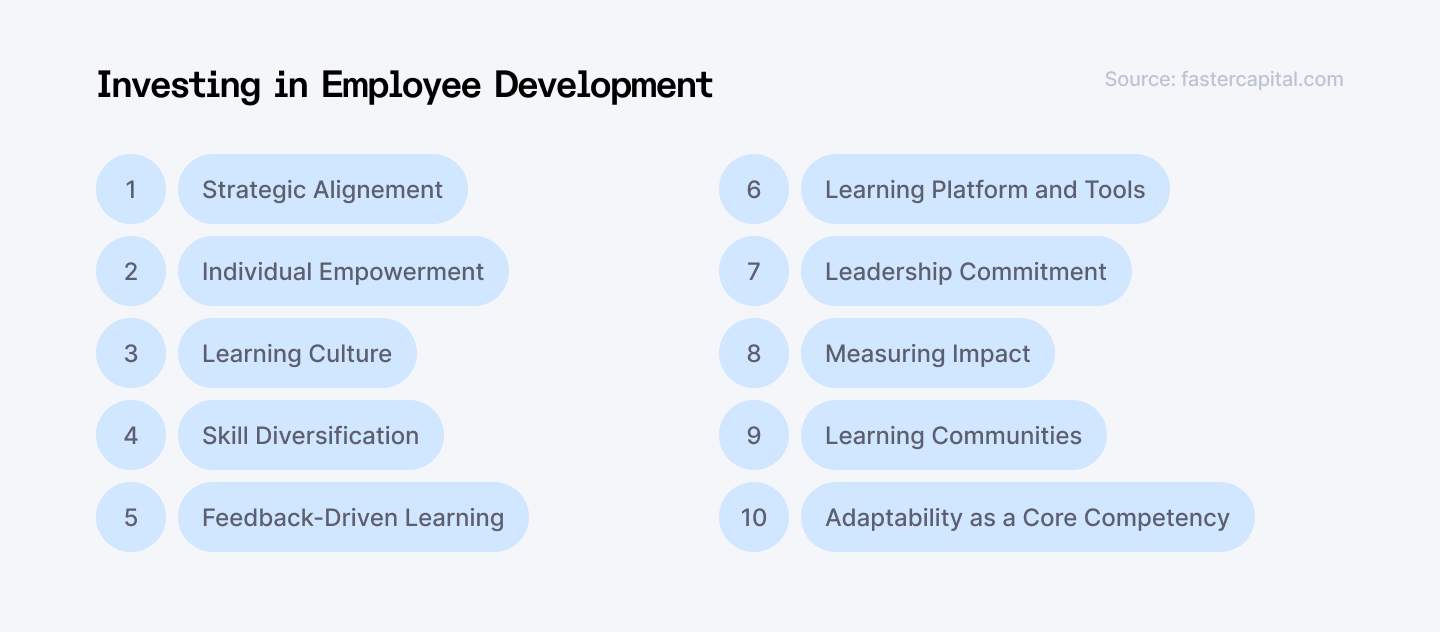
Your job doesn’t end once a candidate accepts an offer. If you want to keep your best people engaged, continuous learning should be a core part of your company culture.
Yet, some companies hesitate to invest in learning and development (L&D) due to time and cost concerns. That’s a mistake. The numbers speak for themselves:
- 70% of employees say job-related training influences their decision to stay.
- 87% of Millennials consider professional development a top priority.
L&D isn’t just an expense—it’s a retention strategy. Employees who see clear growth opportunities stay longer, perform better, and contribute more. And when you upskill your team, you future-proof your business.
So, how do you make learning a priority? Go beyond onboarding and create a culture of continuous growth with:
- On-the-job learning. Give employees stretch assignments that challenge and develop new skills.
- Mentorship programs. Pair newer employees with seasoned team members to accelerate learning and build internal networks.
- Coaching. Provide personalized feedback and guidance to help employees grow in their roles.
- Workshops and training sessions. Keep your team up to speed with industry trends and emerging technologies.
7. Track and Measure the Effectiveness of Your Talent Pipeline
Wondering if your talent pipeline is actually working? Without proper metrics, it’s impossible to know where you’re excelling and where you need improvement. Regular assessment helps optimize your hiring strategies and ensures that your pipeline is aligned with your business goals. Here are a couple of key areas to focus on:
Retention Rates:
- Are your new hires sticking around? High turnover rates signal something’s wrong with your hiring or onboarding process.
- Is employee performance meeting or exceeding expectations? If not, you may need to offer more training and development.
The Impact on Business Goals:
- Are you filling key positions faster? A healthy talent pipeline should speed up your hiring process.
- Have you seen improvements in employee engagement or productivity? When the right candidates are in the right roles, your team’s performance should naturally rise.
Beyond these, there are other important metrics to evaluate, such as:
- Time-to-fill – How quickly can you fill a role?
- Quality of hires – Are your new hires hit the ground running?
- Offer acceptance rates – Are candidates accepting your offers?
- Candidate satisfaction – How do candidates feel about their experience during the interviews?
Finally, gather feedback from stakeholders—managers, team leaders, and the candidates themselves—to get insights on how you can improve.
Read More: Recruitment and Headhunting Guide for Software Engineers
The Benefits of a Strong Talent Pipeline
Better Candidates
When you’re rushed to fill an open position, you might end up making hasty decisions that cost you in the long run. A strong talent pipeline allows you to plan ahead and be more strategic. This means you can wait for the right candidate, not just anyone who meets the job description.
Reduced Time-to-Hire
The average time-to-hire across industries is about 41 days. When you're struggling to find the right person for the job, your team—and sometimes the whole organization—feels the strain. However, with an established pipeline, you have a pool of qualified candidates who are already familiar with your organization. This drastically reduces your time-to-hire.
Improved Hiring Decisions
One of the toughest challenges HR teams face is sourcing top talent. According to a survey, 54% of HR leaders say attracting quality candidates is their biggest obstacle. With a strong talent pipeline, you can curate a list of the best candidates—those who match your culture, your needs, and your vision.
Improved Candidate Experience
A talent pipeline is a proactive, hands-on approach. Instead of posting jobs and waiting for applications, you engage with candidates throughout their journey. This personalized experience makes candidates feel valued and informed.
Improved Retention
When candidates are part of an active pipeline, they’re more likely to stay. By consistently nurturing relationships, you create a foundation for long-term engagement. It’s all about building connections that translate into higher retention.
Explore More: 10 Proven Strategies to Retain Your Best Tech Talent
| Benefit | Overview |
| Better Candidates | Allows you to wait for the right candidate, not just anyone who meets the job description. |
| Reduced Time-to-Hire | Drastically reduces hiring time by having a pool of qualified candidates already familiar with your organization. |
| Improved Hiring Decisions | Enables you to curate a list of top candidates who match your culture, needs, and vision. |
| Improved Candidate Experience | Provides personalized engagement throughout their journey, making them feel valued and informed. |
| Improved Retention | Creates long-term engagement by consistently forging relationships, leading to higher retention rates. |
Final Thoughts
You don’t have to wait for talent to come to you; you can go out and find it, nurture it, and make it yours.
Don’t rush into hiring decisions. Take the time to build a pipeline full of high-quality candidates. Engage with them, understand their goals, and align them with your company’s vision. The payoff? Faster hiring, improved retention, and better hires.
Make your talent pipeline a priority. It’s one of the best investments you can make for your company’s future.
Build a Talent Pipeline with Index.dev
Index.dev is a global talent network that connects you with over 20,000 skilled professionals across key tech areas—software, product, AI, data, design, and QA. Whether you’re looking to fill urgent positions or source specialized expertise, Index.dev makes it simple and fast to find the right talent for your team.
- Fill your in-demand and hard-to-fill roles in just 48 hours—no more waiting weeks to get the talent you need.
- Start with a free trial to evaluate candidates. Choose to hire them remotely or full-time after a trial period.
- Benefit from human-led, personalized matching. Get dedicated account management to handle any challenge.
Experience fast, flexible, and efficient hiring! Get started now and scale innovation!