Quick wins matter in recruitment. Getting responses within 48 hours, scheduling interviews without email ping-pong, and hearing back after applying: these basics make or break candidate experience.
Research shows 66% of candidates said a positive experience influenced their decision to accept offers, while 47% said poor communication would make them withdraw from the process.
Meanwhile, AI recruitment tools are booming. The global AI recruiting platform market reached ~$661.6M in 2023 and is on pace to surpass $1.12B by 2030. Companies using tools like Phenom report 25% faster time-to-fill. Paradox users schedule 82% of interviews automatically. Index.dev connects developers to relevant roles within 48 hours.
The message is clear: leveraging AI recruiting software can boost efficiency, but only if you balance technology with a human touch. In this article, we break down the top AI platforms that elevate candidate experience across industries. Each includes key features, pricing, and how it meets your specific hiring needs (whether you’re in tech, healthcare, retail, etc.).
Tired of slow developer hiring? Access Index.dev's elite 5% of vetted developers with 48-hour matching and a 30-day free trial.
Why Companies Should Focus on AI platforms for Candidate Experience
You know that sinking feeling when submitting a job application feels like shouting into the void? Candidates hate it too. The data backs this up. Roughly 65% still complain about inconsistent communication during hiring processes. Meanwhile, 51% of companies currently use AI in their hiring, with that number expected to hit 68% by the end of 2025.
Here's the disconnect:
Companies buy fancy AI tools thinking automation equals better experience. Wrong. Automation without transparency creates confusion. Chatbots that can't answer basic questions frustrate applicants. Screening tools that filter out qualified candidates damage your employer brand.
Smart implementation looks different. The best platforms combine speed with clarity. They automate the boring stuff (scheduling, FAQ responses, initial screening) while keeping humans in the loop for actual decisions. Think of it as augmentation, not replacement.
Discover 10 AI platforms that make hiring fair and bias-free.
What You’ll Get
- A concise listicle of the top 9 platforms that directly improve candidate experience.
- For each platform: what it does best for candidates, ideal verticals, integration notes, and pricing cues (2025 sources).
- A vendor comparison table and a relative pricing-tier chart (above).
- Direct pages to screenshot for boardroom evidence and citations for the sources used.
1. Index.dev
Developer talent network
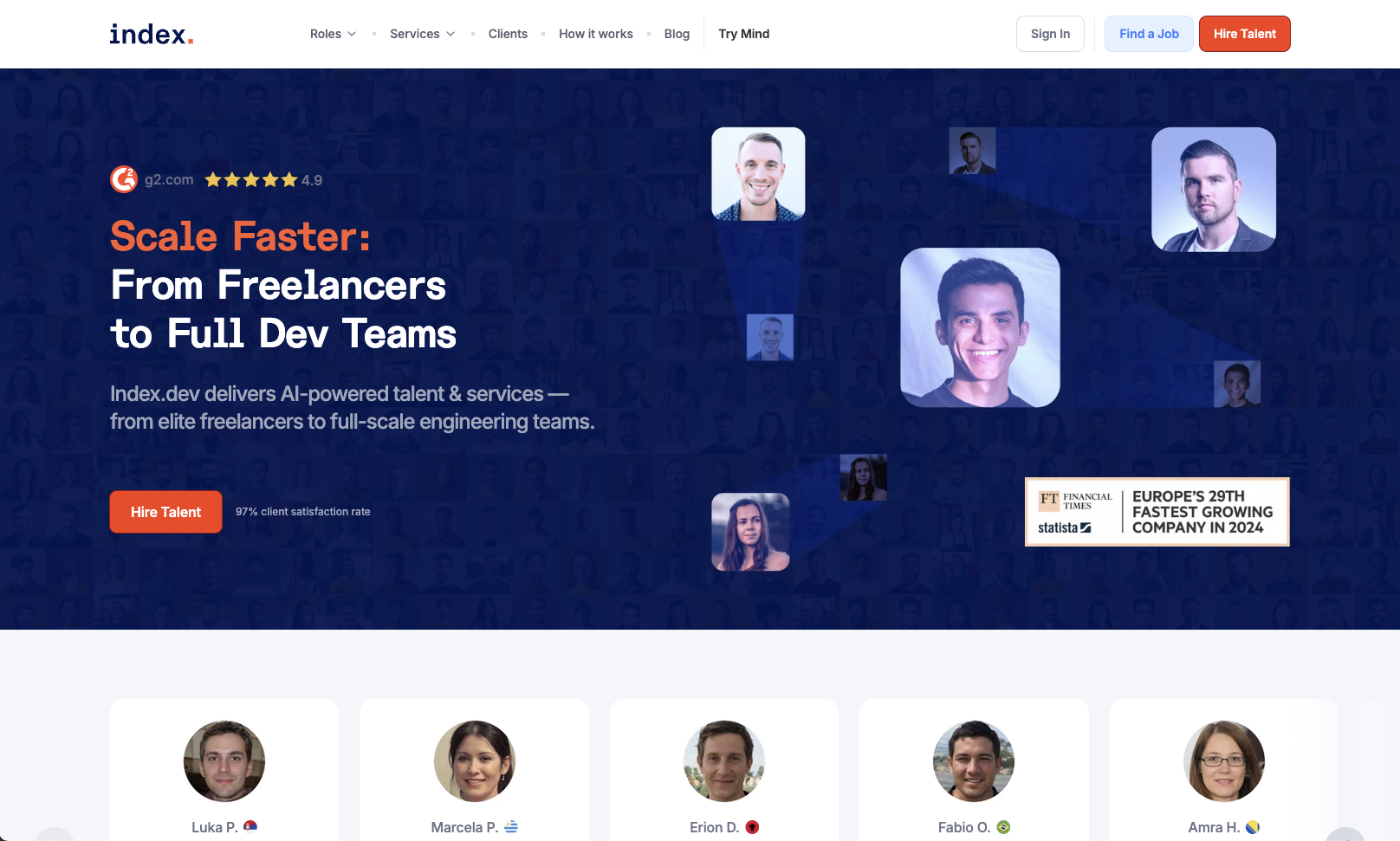
Index.dev isn’t a traditional ATS but a specialized platform for tech roles. It uses AI to match developers with projects and companies in its network. For technical candidates, this matching algorithm ensures they only see jobs that fit their skills, cutting through the noise.
Fast response times
Because it’s built for developers, Index.dev emphasizes rapid connections: candidates often hear back within 48 hours. This speed greatly improves experience, especially compared to slow email processes.
Project-based approach
Many listings on Index.dev describe projects and tasks rather than static job titles. Candidates see exactly what they’ll build, which boosts engagement.
Cost structure
The platform is free for developers. This zero-friction signup enhances the user experience on the candidate side, you just create a profile and start matching.
How to use it
For tech recruiters, having your roles on Index.dev (or a similar niche site) complements your broader strategy. It’s a great way to reach mid-senior developers and software engineers, especially when candidates prefer community-driven platforms.
2. Phenom People
AI-driven personalization
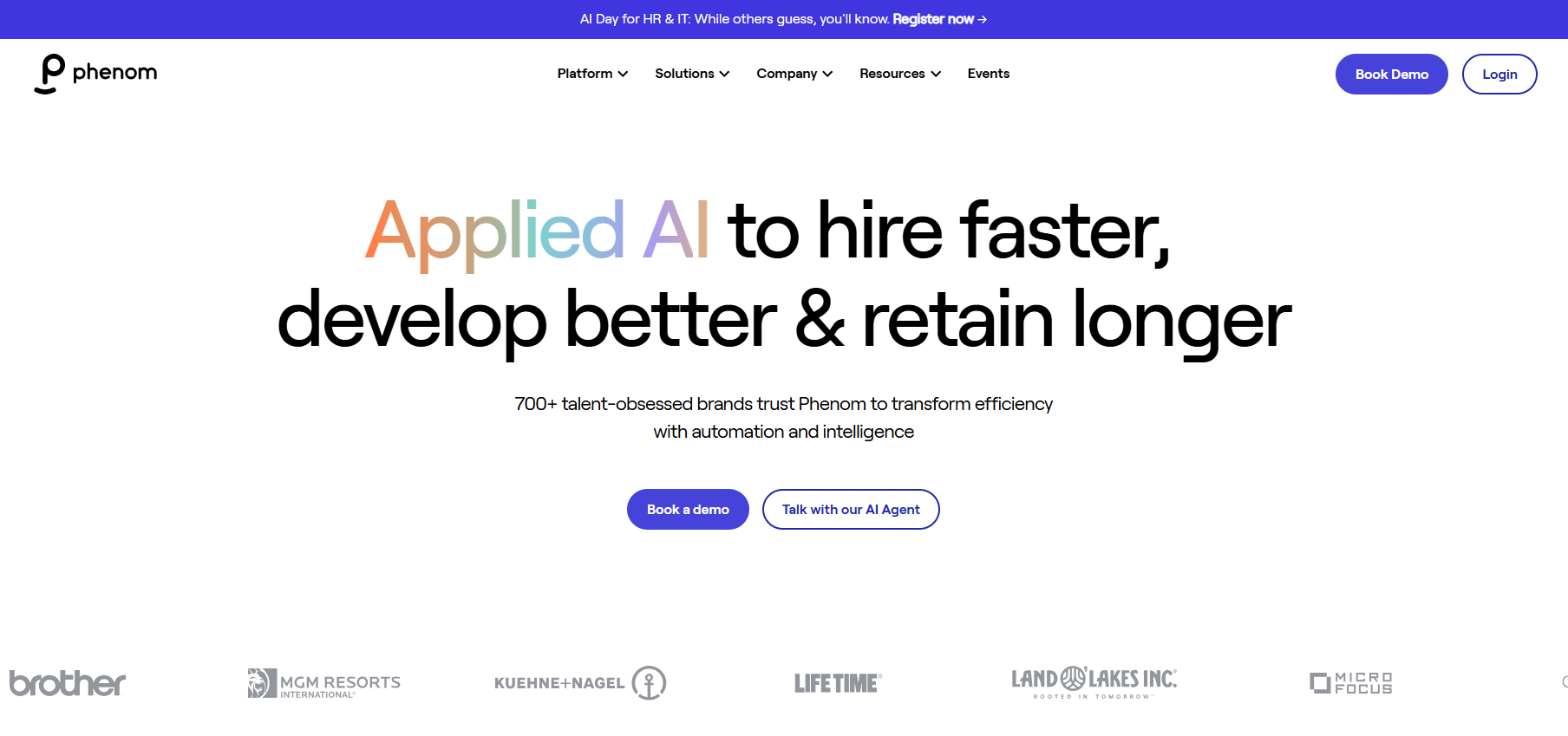
Phenom’s “Intelligent Talent Experience” platform connects people, data, and interactions to create amazing experiences throughout the hiring journey. It uses AI to deliver personalized job recommendations and content to candidates based on skills, location, and experience. This hyper-personalization ensures candidates see relevant opportunities – a critical boost to candidate experience for mid-to-senior roles.
Conversational AI Chatbot
Built-in chatbots on career sites answer FAQs instantly, guide applicants through process steps, and even conduct AI-assisted initial screening.
Comprehensive talent CRM
Phenom includes tools for candidate relationship management and automated talent pipelines, keeping communication consistent. Recruiters can launch targeted nurture campaigns (emails, SMS) that feel personal.
Insights and metrics
Built-in analytics show how candidates interact with your brand and which messages convert best. This data helps continuously improve the process.
Enterprise focus & pricing
Phenom is aimed at medium-to-large companies. Pricing is customized, but reports indicate a base cost of roughly $10,000/month for a multi-module package. Smaller teams may find it pricey, but large employers get robust ROI (e.g. 25% shorter time-to-fill and 50% more efficient recruiting spend, per Phenom’s case studies).
3. Paradox
24/7 AI Chatbot (Olivia)
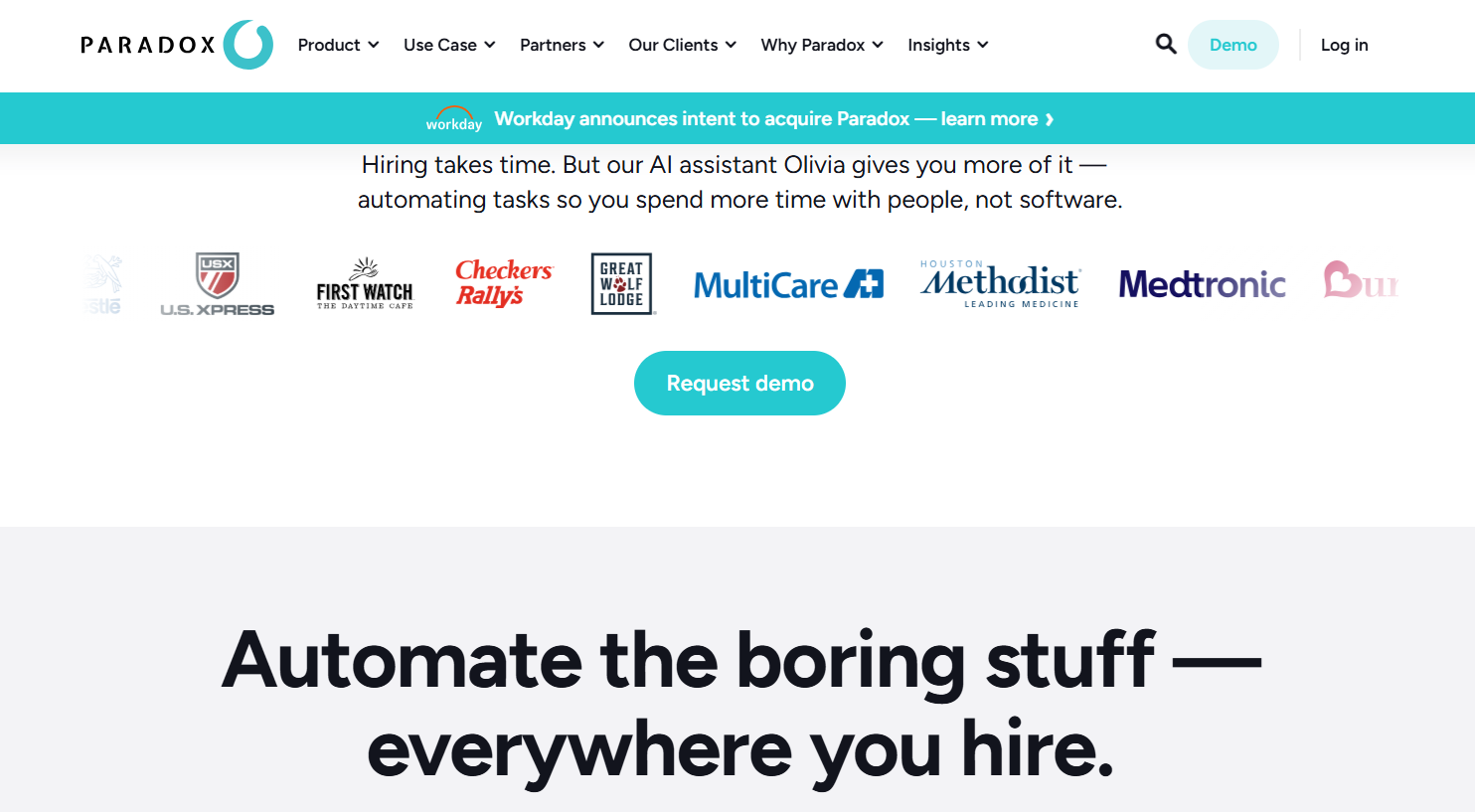
Paradox.ai centers on Olivia, a conversational AI assistant that texts and chats with candidates to automate screening, Q&A, and scheduling. She can ask knockout screening questions and instantly qualify or disqualify applicants – massively speeding up top-of-funnel tasks. For example, companies have cut scheduling time from days to minutes using Olivia.
Automated scheduling & reminders
Olivia integrates with your ATS/HRIS and automatically books, reschedules, and reminds candidates of interviews. This removes the endless email/back-and-forth that frustrates applicants.
Multilingual, accessible design
The platform auto-detects 100+ languages and ensures messages are culturally localized. Paradox emphasizes “accessible candidate experiences” – it even pledges compliance with accessibility standards so all job seekers have equal access.
Ethical AI stance
Paradox publicly commits to transparent, explainable, and fair AI. This helps companies address candidate concerns: Olivia never makes final hiring decisions and only automates repetitive tasks.
Best for high-volume roles
Paradox shines in retail, hospitality, and healthcare verticals where thousands of applicants apply. If you’re hiring frontline or hourly positions at scale, Olivia handles the routine work so your team can build relationships.
Pricing
Official pricing isn’t posted publicly, but surveys peg Paradox at $1.5K–$2.5K/month for smaller installs, with enterprise contracts often $30K–$100K+ per year depending on locations and hires. It’s modular (you can pick chat, scheduling, apply automation, etc.) and scales to very large organizations.
4. candidate.fyi
AI Scheduling Agent
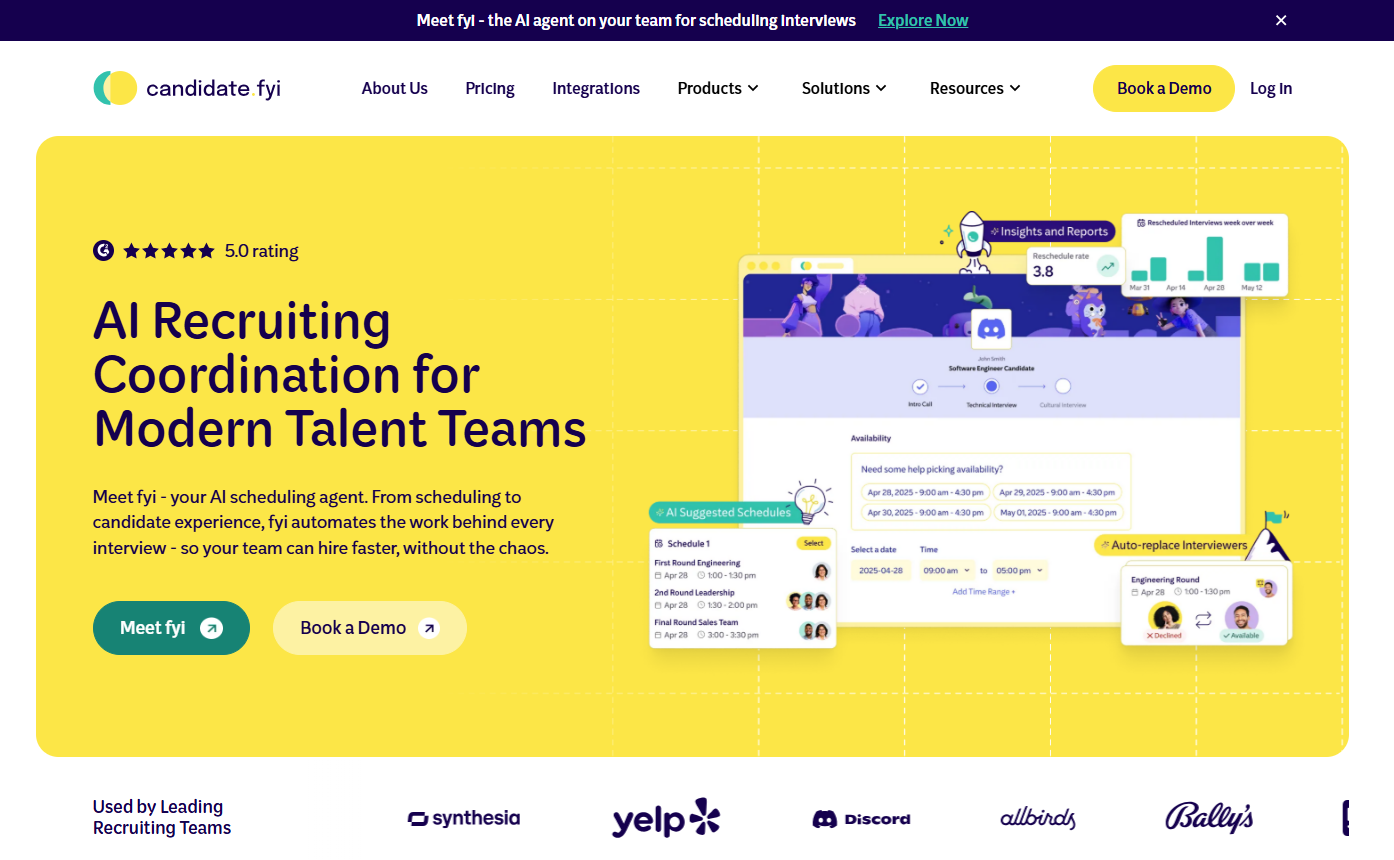
Candidate.fyi calls itself an “AI scheduling agent”. It takes over interview logistics: candidates pick times via text or chatbot, calendar invites auto-sync, and reminders are sent proactively. This ensures smooth scheduling. A top candidate's experience wins.
Automated nurturing and surveys
After each stage, candidate.fyi can automatically follow up for feedback or provide updates so applicants never feel ignored. Pulse surveys are triggered if candidates stall.
Personalized candidate dashboard
Job seekers get a branded portal with status updates and tips, improving transparency.
Tiered plans by company size
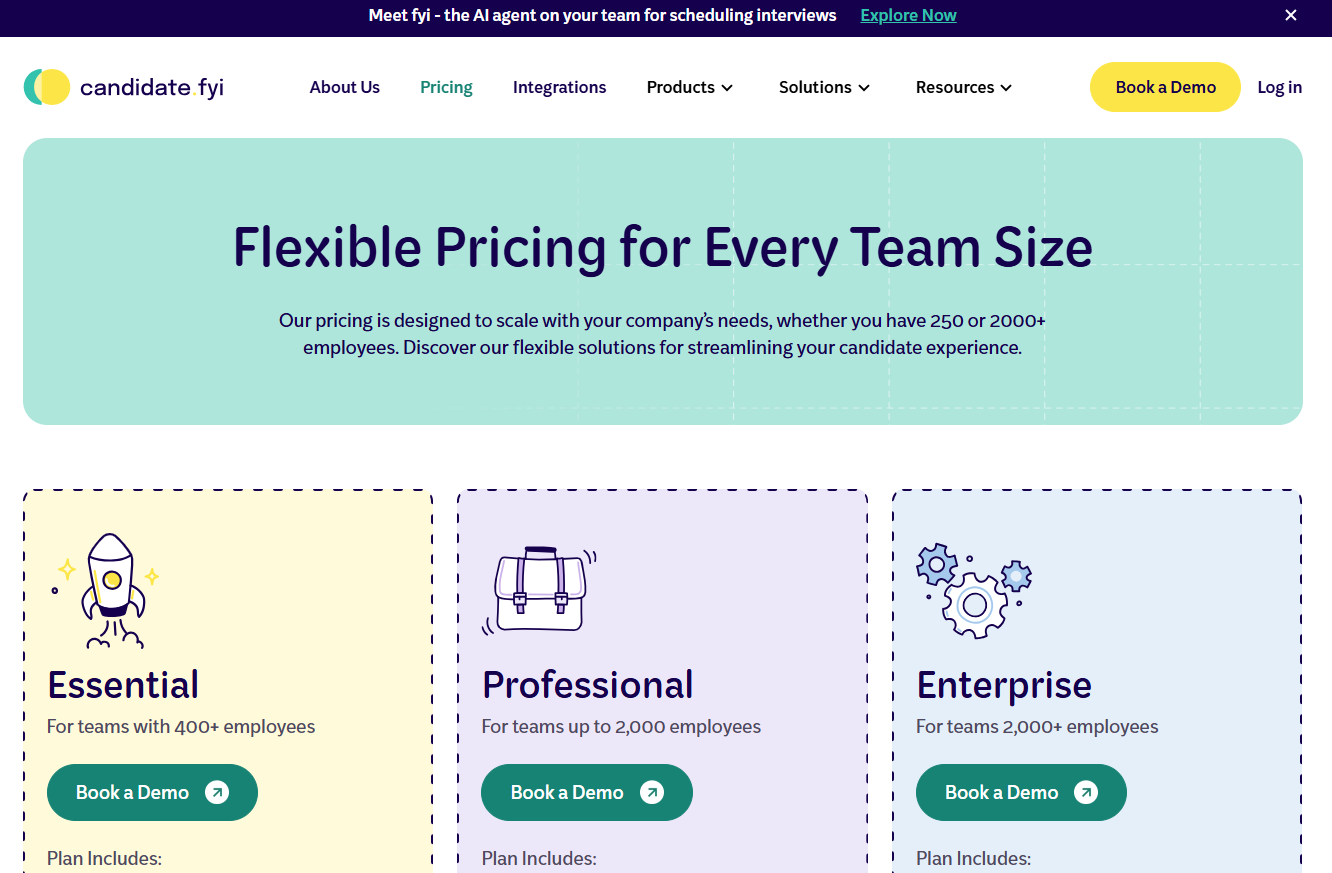
Pricing scales with your hiring volume. For example, their “Essential” plan is aimed at teams with 400+ employees, “Professional” fits up to ~2,000 employees, and “Enterprise” for 2,000+. All plans include core AI features: intelligent communication, campus recruiting assistance, interview training, and engagement analytics. (You must request a demo for exact quotes.)
Ease of use
It integrates with major calendars and ATSs, so your HR team quickly sees confirmed slots. The candidate-friendly interface (SMS and web) reduces no-shows.
Use case
This platform is great for organizations that struggle with manual scheduling or ghosting (a known issue: ~40% of candidates report being ghosted). Automating confirmations and thank-yous keeps candidates engaged, which is especially crucial in industries like tech or professional services where delays can lose talent.
5. iCIMS
Full-featured ATS with AI
iCIMS is a well-known enterprise talent-acquisition suite. Its AI-powered hiring platform is designed to improve efficiency and “build exceptional experiences for candidates and recruiters”.
Smart content & search
The latest iCIMS release (Summer 2025) adds AI tools: natural-language candidate search, SEO-optimized career site content, and instant translation of career pages. In practice, this means easier talent sourcing and truly global, localized candidate portals.
Career sites & CRM
You can launch branded career microsites and AI-driven nurture campaigns. For example, candidates browsing your site may receive AI-suggested jobs or live chat help. Detailed engagement tracking shows which emails/posts attracted each candidate.
Automation & analytics
The platform automates interview scheduling, feedback collection, and pipeline moves. Recruiters get dashboards with 1,000+ metrics – meaning you can quickly spot bottlenecks (e.g. a job with low email-open rates) and iterate.
Broad industry support
iCIMS offers vertical solutions for retail, healthcare, finance, government, and more. For instance, their healthcare solution emphasizes 24/7 candidate communication so nurses get answers immediately. (One healthcare client noted 60% of interviews were scheduled after hours via iCIMS’s AI bot).
Pricing tiers
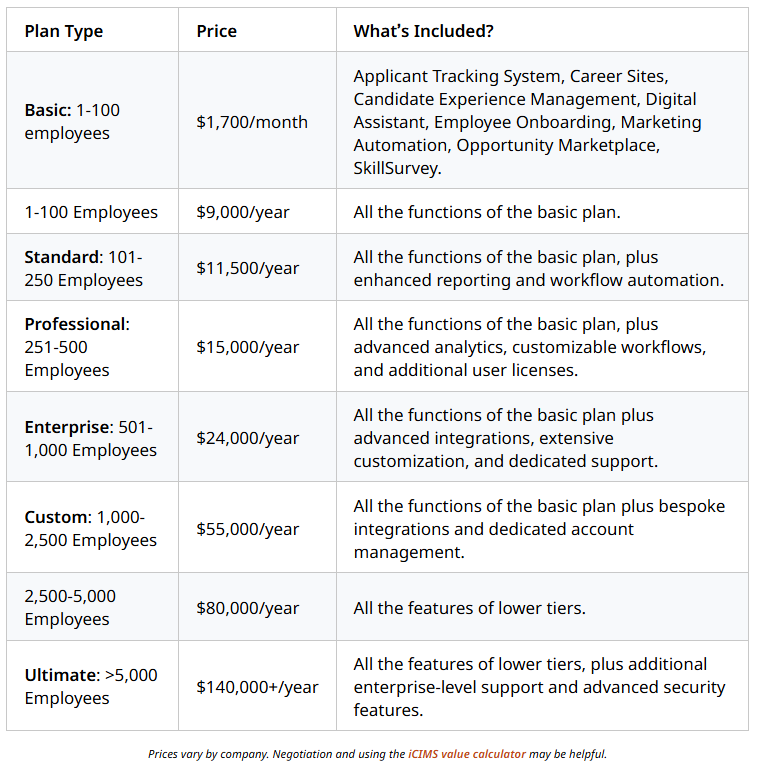
iCIMS pricing is custom, but third-party research suggests a small-company package costs on the order of $9K–$15K per year. In the table above, for example, a 1–100 person firm might pay ~$9K/yr (basic), while 250–500 person companies see ~$15K/yr (professional). Full enterprise bundles (for 1,000+ seats) can be well over $50K+/year, varying by modules. Consider iCIMS if you need a unified platform (ATS, career sites, onboarding, etc.) with AI enhancements.
6. Beamery
AI-driven talent CRM
Beamery focuses on candidate relationship management. It uses AI to match and recommend talent, enriching candidate profiles with social/skills data. This means your recruiters get high-quality lead lists of potential candidates automatically. For candidate experience, Beamery can send tailored emails and content to nurture interested applicants over time.
Engagement automation
You can create event invites, drip campaigns, or retargeting ads personalized at scale. Candidates feel like they’re known, not spammed, because the AI picks the most relevant messages.
Analytics & insights
Beamery reports on which sources and campaigns drive applicants, helping refine your branding. For example, you might learn that software engineers prefer emailed coding challenges, while marketers engage on LinkedIn posts.
Enterprise focus & pricing
Beamery is positioned for large employers. Exact pricing is custom, but industry leaks suggest a starting point around $75 per user per month (depending on features and volume). There’s no free tier. It’s an investment, but Beamery cites studies (Forrester) showing substantial ROI (e.g. 467% ROI) from efficiency gains.
Use case
Ideal if you have ongoing talent pipelines (e.g. tech, finance). For mid-to-senior roles where hiring cycles are longer, Beamery keeps candidates engaged between interviews, reducing drop-offs. It also supports internal mobility, meaning even your own employees see relevant openings.
7. Humanly
AI screening & video
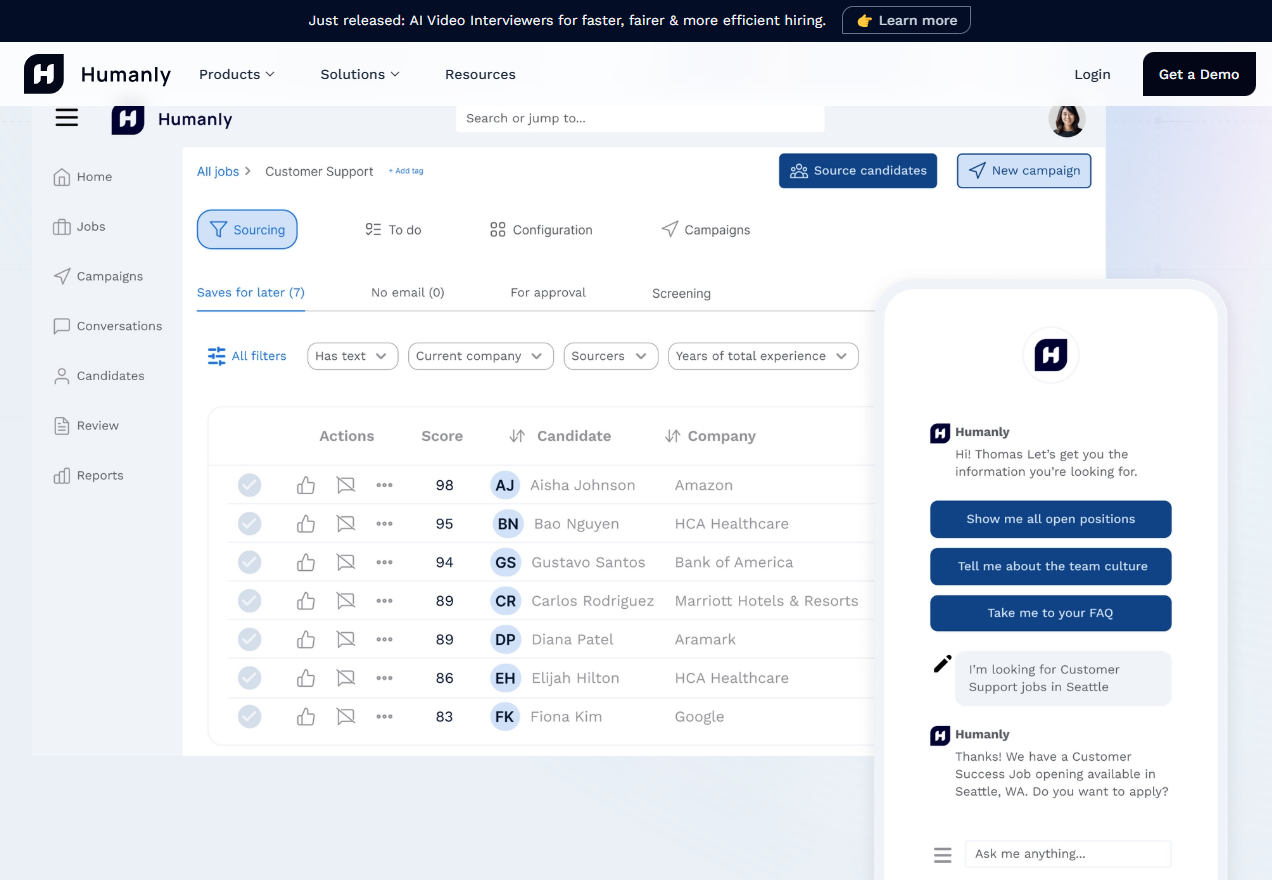
Humanly offers an AI interviewer for first-round screening. It conducts automated video interviews (candidates record answers on their time) or live interviews with AI-generated guides. This uniform process ensures consistency: each candidate hears the same questions in the same way. That reliability reduces bias and improves fairness.
Personalized outreach
The platform lets recruiters send mass but personalized SMS or email campaigns. For example, you can re-engage past applicants with “we miss you” messages or push notifications when new relevant jobs open. Importantly, Humanly’s AI keeps the tone warm, blending automation with human-sounding language.
Interview Scheduling
As with others, scheduling is automated. Candidates pick slots via text, and Humanly syncs calendars. This frees recruiters from back-and-forth emails.
Diversity and fairness
Built-in bias mitigation checks and compliance features help ensure underrepresented candidates aren’t inadvertently filtered out.
Pricing & deployment
Humanly offers demos on request (no public price). It’s best suited for organizations dealing with hundreds of applicants regularly (e.g. retail chains, large call centers). For mid-sized professional firms, it’s also useful to quickly screen many candidates while giving them a unified experience.
8. HireVue
On-demand video interviews
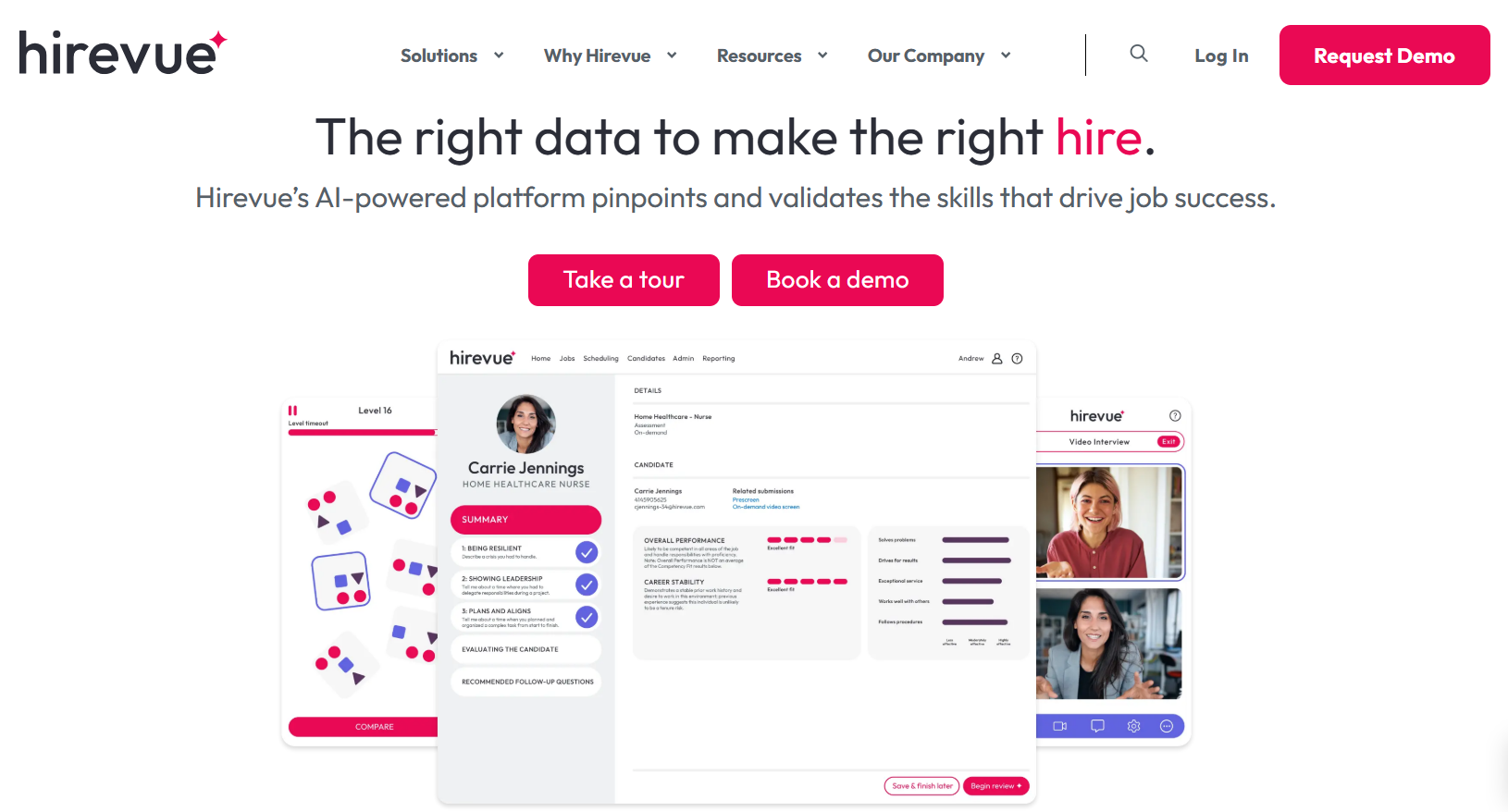
HireVue lets candidates record interviews anytime from home (on-demand one-way video). Candidates report high satisfaction (NPS ~71) because they can interview when convenient. This flexibility itself boosts experience compared to rigid scheduling.
Live video & scheduling
It also supports live video interviewing and automatically schedules both live and one-way interviews. Integrated calendar syncing means candidates immediately see availability, reducing friction.
AI assessments & games
Beyond interviews, HireVue offers AI-driven assessments (cognitive games, coding tests) to evaluate skills. These give immediate insights while providing candidates feedback on their strengths.
Candidate-friendly
HireVue emphasizes that it’s free for candidates and requires no downloads. It also supports accessibility (WCAG-compliant accommodations, multilingual config up to 40+ languages). There’s 24/7 multilingual support if a candidate runs into issues. All this leads to a smooth experience: for example, Foxtel Group reported saving 20 minutes per candidate, accelerating decisions.
Packages
The platform is tiered (Essential, Enterprise, Premium) but hides prices behind demos. Large firms can bundle it into their ATS; smaller teams (e.g. startups) might start with basic video/interview functions. Overall, HireVue is a leader if interviews are a bottleneck – it makes the actual interview process more engaging and less error-prone.
9. Eightfold.ai
Skills-based matching
Eightfold uses deep learning to match candidates based on skills and potential, not just past titles. Its AI “learns” from billions of data points (resumes, job descriptions, career paths). For candidate experience, this means job suggestions are more relevant. A developer, for instance, may be shown roles that fit their exact skill mix rather than a generic “Software Engineer” role.
Enhanced candidate portal
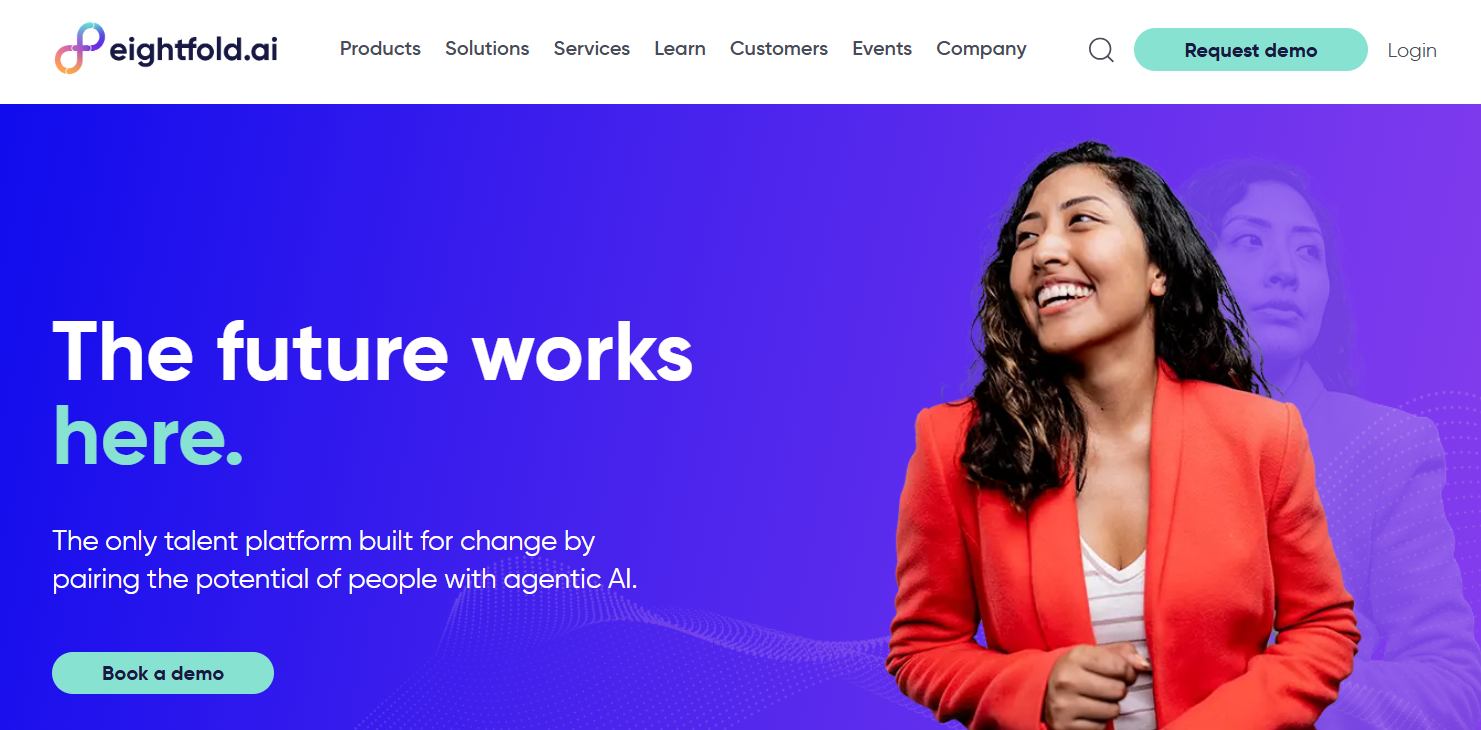
Job seekers on Eightfold-powered platforms often see a modern, user-friendly interface that offers personalized career-path recommendations. The site suggests companies and roles similar to a candidate’s profile, encouraging them to stay in the process.
Diversity & equity
Eightfold’s AI anonymizes personal info to focus on skills. By removing biases, candidates feel they’re being evaluated on fit and potential. This has become a key expectation (35% of recruiters worry AI might exclude unique skills). Eightfold explicitly markets itself for improving diversity and inclusivity.
Internal mobility
After hiring, Eightfold helps place candidates into career development programs. Candidates see this as part of a long-term “talent experience”, not just a one-off application.
Pricing
According to industry sources, Eightfold starts around $650 per month for its basic talent-acquisition modules (higher for full-featured talent intelligence suites). As with others, exact quotes are custom. It tends to be suitable for mid-to-large companies investing in strategic AI.
Explore 7 AI tools to improve large-scale hiring effortlessly.
Candidate Experience Metrics to Track (by KPI)
When implementing AI platforms for candidate experience in recruitment, track these metrics to ensure AI is improving experience, not hurting it:
- Time to first response (aim: <48 hours for initial reply to applicant).
- Offer-acceptance rate (trend up = good).
- Candidate Net Promoter Score (NPS) (post-process survey; HireVue reports NPS ~71 for its users as a benchmark).
- Candidate drop-off rate at each stage (where are candidates leaving?).
- % of interviews scheduled automatically (candidate.fyi reports AI scheduling resolving up to ~82% of sessions in product literature).
Implementation Checklist (Rapid-Deploy, Low Time-to-Value)
1. Pick the right mix
For most mid-to-large companies, combine an ATS (iCIMS/Phenom) + scheduling (candidate.fyi) + conversational bot (Paradox) + niche channels (Index.dev for developers).
2. Integrate, don’t duplicate
Make sure bots, scheduling, and ATS share candidate status to avoid double messages.
3. Be transparent with candidates
Add short blurbs like “We use automated scheduling & screening tools — you’ll always see who reviewed you and next steps.” This reduces confusion and builds trust.
4. Run a fairness & explainability audit
Before rolling out AI screening at scale, validate that your models don’t filter out good candidates. (Document findings.)
5. Collect immediate feedback
Post-interview micro-surveys (1–2 questions) — iterate monthly. Candidate feedback is the control metric for experience improvements.
Short, Prescriptive Recommendation (Boardroom-Ready)
- For mid-to-top tier companies:
- Adopt an ATS with AI candidate-facing enhancements (iCIMS or Phenom) + dedicated scheduling agent (candidate.fyi) + conversational bot for immediate touch (Paradox). For developer hiring, add Index.dev to accelerate technical matches.
- Adopt an ATS with AI candidate-facing enhancements (iCIMS or Phenom) + dedicated scheduling agent (candidate.fyi) + conversational bot for immediate touch (Paradox). For developer hiring, add Index.dev to accelerate technical matches.
- Run a 90-day pilot focused on 2 KPIs:
- Time-to-first-response and candidate NPS. Use these to tune prompts, webhook workflows, and escalation rules.
- Time-to-first-response and candidate NPS. Use these to tune prompts, webhook workflows, and escalation rules.
- Maintain human oversight on decisions:
- Disclose AI usage to candidates to avoid attrition and negative press (per 2025 QRGs).
What's next for AI recruiting
By 2025, 70% of employees will interact with AI-powered tools daily. Recruitment AI will become invisible infrastructure. The winners won't be companies with the most AI, but those using it most thoughtfully.
Focus areas for 2025-2026:
- Predictive quality of hire (beyond just filling roles fast)
- Emotion AI for gauging candidate engagement
- Blockchain credentials for instant verification
- AR/VR for immersive job previews
- Micro-learning during application process
Conclusion
Great candidate experience isn't about having the fanciest AI recruiting tools. It's about removing friction, providing clarity, and respecting people's time. The platforms discussed here excel because they understand this fundamental truth.
Pick solutions that match your actual problems, not your aspirational ones. A small company drowning in manual scheduling needs candidate.fyi more than enterprise-grade Phenom. A retailer hiring thousands needs Paradox's scale more than Beamery's relationship management.
Track what matters: response time, completion rates, candidate satisfaction. Everything else is just expensive noise. When candidates feel respected and informed throughout your process, they'll accept offers, refer friends, and reapply for future roles even if not selected.
That's the real ROI of AI platforms for candidate experience in recruitment — building a reputation that attracts talent rather than repels it.
Transform your hiring with AI-powered candidate experiences. Access top 5% vetted developers and fill roles in 48 hours with Index.dev.