The AI honeymoon is over. You’ve likely seen the headlines about mass adoption, but the view from the boardroom is much grimmer.
An MIT‑led study found that 95% of enterprise AI pilots generate zero measurable P&L impact — 90‑odd billion dollars in investment, spread across thousands of experiments, and just 5% extracting millions in value. At the same time, McKinsey reports that 88% of organizations now use AI in at least one function, yet only about one third have begun to scale it beyond experiments.

That gap between using AI and scaling AI is where billions disappear. This article is about that gap. What's breaking most AI products before they scale, and exactly what the top 5% are doing differently.
Turn your AI pilots into real products with verified AI engineering capacity →
Why Your AI Keeps Failing: The Seven Execution Walls
A pilot is a controlled experiment. Real-world deployment is something else entirely. The moment AI moves from the lab into live operations, a different set of problems shows up, and almost none of them are technical.
The path to production is blocked by these seven consistent blockers:
1. The pilot trap mentality.
AI stays in ‘experiment mode’ with no clear path to productization. Most teams are addicted to Proof of Concepts. They prove the tech works in a vacuum but never build the bridge to the real world. A pilot with no pre-defined path to production is just an expensive hobby.
2. The accountability gap.
Pilots are safe because they have no consequences. Real implementations do. Projects stall because nobody wants to be the one on the hook when an automated decision costs the company money. Scaling requires shifting from experimentation to ownership.
3. Lack of workflow ownership.
You can’t just add intelligence to a messy process. If you don’t redefine who owns the model’s output, who handles the exceptions, and who hits the kill switch when a model drifts, the project will collapse under its own ambiguity.
4. Weak integration into workflows.
AI sits on the sidelines while decisions are still made the old way. Value doesn’t come from a capable model alone; it comes from embedding that model into the actual moments where people choose, approve, or act. If outputs arrive too late, in the wrong format, or disconnected from action, adoption fails, even if the model is accurate.
5. Weak product governance.
Only 29% of organizations have a real AI governance plan. A quarter are still in the process of implementing one. Nearly a third have no AI governance policy at all. Governance that arrives after deployment is damage control. By the time a governance team is called in to assess a live system, accountability gaps have already formed, trust is already compromised, and the cost of fixing it is far higher than if you'd designed it in from the start.
6. Insights that arrive too late, or in the wrong place.
Even Walmart’s AI‑driven forecasting works only because insights reach the right people at the right time, inside existing tools. If your AI surfaces information in a separate dashboard or email, it becomes noise, not leverage. Timing and context matter as much as accuracy.
7. Trust and explainability gaps.
People are expected to act on AI outputs they don’t fully understand or trust. When users can’t see why a model suggested something or how to validate it, they revert to familiar processes. or ignore the AI entirely. Technology that feels like a black box is technology that will be resisted.
⭢ Explore more: The blockers don't stop at the project level. Here's a deeper look at the 6 enterprise AI adoption barriers and what leaders can do to break through them.
What the Best AI Teams Get Right
The best AI teams don't just bolt AI onto their existing business. They rebuild the business around it. McKinsey found that the small group of AI high performers, roughly 6% of companies generating more than 5% of EBIT from AI.
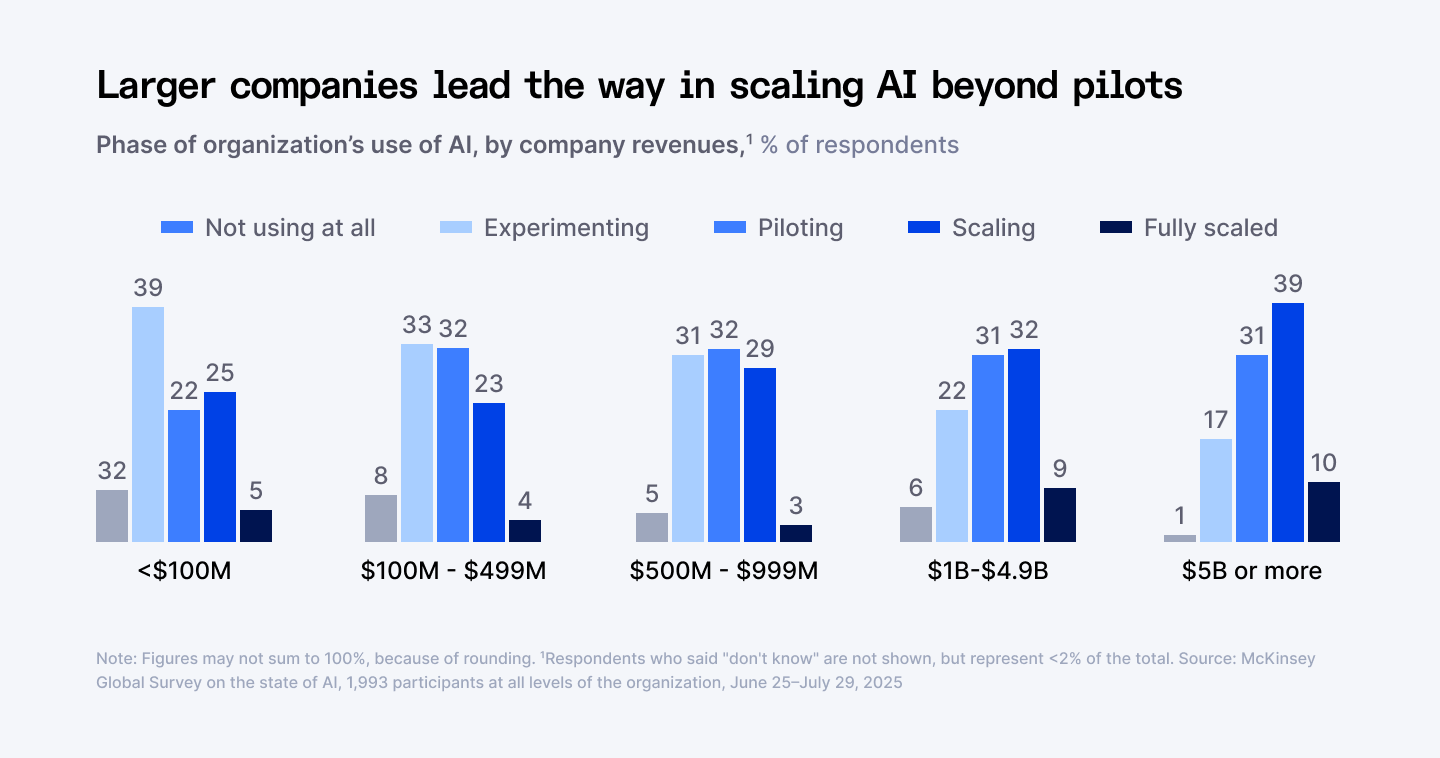
Here's what the top performers are doing differently.
1. Rethink workflows for AI-first work
High performers are nearly three times more likely than others to say their organizations have fundamentally redesigned individual workflows, and this intentional redesign has one of the strongest contributions to meaningful business impact of all the factors tested.
The question they ask isn't "how can AI speed up what we already do?" It's "how should this work be done if AI is a core capability?" That's a different question entirely. And it leads to completely different outcomes.
Amazon's fulfillment network is one of the clearest examples. They didn't automate the old warehouse workflow. They rearchitected how goods move, how orders are prioritized, and how exceptions are handled, with AI embedded at every decision point.
The action: Map your five most critical workflows. For each one, ask not what AI can speed up, but what steps only exist because humans had to do them manually. In practice, this means removing steps, not just automating them.
2. Play to win, don't just play to save
Cost reduction is a legitimate AI goal. It's also a limited one. Cutting overhead is a one-time gain. The companies compounding AI returns are using it to create something new: product capabilities that weren't possible before, personalization at a scale no human team could achieve, faster feedback loops between what users do and what the product does next.
Spotify doesn't use AI just to cut costs. It uses AI to keep you on the platform longer, surface what you didn't know you wanted, and generate product experiences that would take thousands of human curators to replicate. That's the difference between AI as a cost center and AI as a growth engine.
The action: For every AI initiative, name the growth outcome explicitly — not just what you save, but what you can now build or offer that wasn't feasible before. Design AI‑powered features that change what customers can do, not just how fast they do it. Build tight feedback cycles: user actions → signals → model updates → product changes, all tied to clear business metrics.
3. Treat AI as a product, not a side initiative
The best AI initiatives are run like any other core products: a dedicated owner, a roadmap tied to business outcomes, iterative delivery, and real feedback loops from the people using it. High‑performers don’t hand AI off to IT or data science and walk away. They assign product teams, designers, and domain experts to own the AI‑enabled experience end‑to‑end.
When AI is treated as a product, it ships with purpose. When it’s treated as a project, it stalls with politics.
The action: Assign a Product Manager to every AI model. Their job is to manage the model's life, from drift monitoring to feature updates, not just its launch.
4. Keep AI systems ready for constant change
Just 43% of organizations have an AI governance policy in place, and nearly a third have none at all
AI systems don't stay static. They drift. The data changes. The user behavior changes. The business context changes. Governance that was written at launch and reviewed annually is a false sense of security.
High performers treat AI governance the same way they treat any other critical operational system: ongoing monitoring, clear accountability for when something breaks, explicit rules for when human judgment overrides the model, and regular review cycles tied to real performance data.
The action: Define three things for every live AI system: who monitors it, what triggers a human review, and what constitutes a failure worth stopping for. If those answers don't exist, the system isn't governed.
5. Get the builders you need before the wave hits
Gartner’s latest infrastructure forecasts show a massive wave of AI‑optimized infrastructure spending through 2026, with AI‑optimized servers and data centers absorbing tens of billions of dollars.
The infrastructure wave is here. Hyperscalers are building the compute capacity to train and run AI agents at scale. But for most companies, the real constraint isn't servers — it's the engineering capacity to build, deploy, and maintain AI systems reliably and fast enough to stay competitive.
That's why smart leaders are partnering with specialized AI engineering firms rather than trying to hire and staff their way to capacity. Partners like Index.dev give companies access to top-tier AI engineering talent on demand, without the 6-to-12 month hiring cycles that kill momentum on time-sensitive AI initiatives.
The action: Audit your AI engineering capacity honestly. If you can't ship two meaningful AI initiatives in parallel right now, you're under-resourced for what's coming. Either shrink the scope or partner with a vetted AI‑engineering provider so you don’t trade speed today for fragility tomorrow.
6. Bet on the right partnerships
AI is not a solo sport. Projects developed in deep partnership with external AI specialists had a success rate of 67%. Projects built entirely in-house had a success rate of just 33%. The most effective AI leaders are not trying to build everything themselves. They double down on robust, battle‑tested partners across data, infrastructure, and AI platforms, then layer their own differentiated logic on top. Only the leaders with a very clear differentiation strategy should be going custom.
The action: Map your current AI partner stack. For each gap, ask whether you need to build, buy, or partner. Default to partner unless there's a compelling reason not to.
7. Invest in the unglamorous parts
More than half of generative AI budgets are devoted to sales and marketing tools, yet MIT found the biggest ROI in back-office automation — eliminating business process outsourcing, cutting external agency costs, and streamlining operations.
The highest-value AI work isn't always the most visible. Automating contract review, internal helpdesk, report generation, procurement workflows — these aren't headline-grabbing use cases, but they're where successful implementations generate $2–10M annually in measurable cost reductions.
The action: Audit where your AI budget is going. If most of it is in customer-facing or marketing applications, cross-check that against where your measurable returns are coming from.
⭢ Learn more: Knowing why AI fails is step one. Explore the 5 core elements of successful AI adoption and see what leading engineering teams consistently get right.
The Choice: Scale or Stagnate
The gap between the 5% and the 95% is execution. By 2026, trying AI will no longer be an acceptable strategy. You are either re-engineering your workflows to capture value, or you are burning capital on experiments that will never see the light of day.
Success requires three things:
- Radical workflow redesign
- Product-led ownership
- The specialized talent to bridge the gap between a raw model and a production-ready system.
If you’re stuck in a pilot trap because you lack the specialized hands to move faster, this is where we come in.
Build your AI-native workforce with Index.dev
If any of this sounds like where your team is stuck — on data quality, model training, engineering capacity, or getting AI-ready talent without a 9-month hiring cycle — that's exactly what Index.dev is built for.
- Train & refine: Access high-quality SFT data and RLHF expertise from doctors, lawyers, and engineers to ensure your models are accurate and safe.
- Build & deploy: Move beyond the API call. We help build the retrieval pipelines, agentic workflows, and red-teaming guardrails that make AI production-viable.
- Scale with elite talent: From PhDs to deep learning researchers, we provide identity-verified specialists who understand the modern AI stack and hit the ground running.
Don't let a talent gap be the reason you stay in the 95%. Let’s get your AI out of the lab and into production →