Resumes shouldn’t stand between you and your next great hire. Manual screening costs you 23 hours per hire, swells your budget, and allows unconscious bias to filter through—while top talent gets away.
AI resume screening flips this on its head:
It analyzes all formats in minutes, applies your precise criteria, and shows you your ideal fits in an instant.
In this guide, you’ll see how automated screening slashes review time, levels the playing field, and scales on demand, so you land the right candidates faster.
Transform your hiring process instantly with Index.dev’s AI screening technology.
What Is AI Resume Screening?
AI resume screening uses natural language processing (NLP) and machine learning to:
- Extract critical details (names, skills, experience) from any format – PDF, Word, or image.
- Match that information to your exact job requirements.
- Rank candidates so you view your top fits first.
Think of it as a digital recruiting partner that never tires, never judges, and never misses a keyword.
This technology processes resumes faster by 75% than humans ever could and removes personal biases that manage to infiltrate employment decisions.
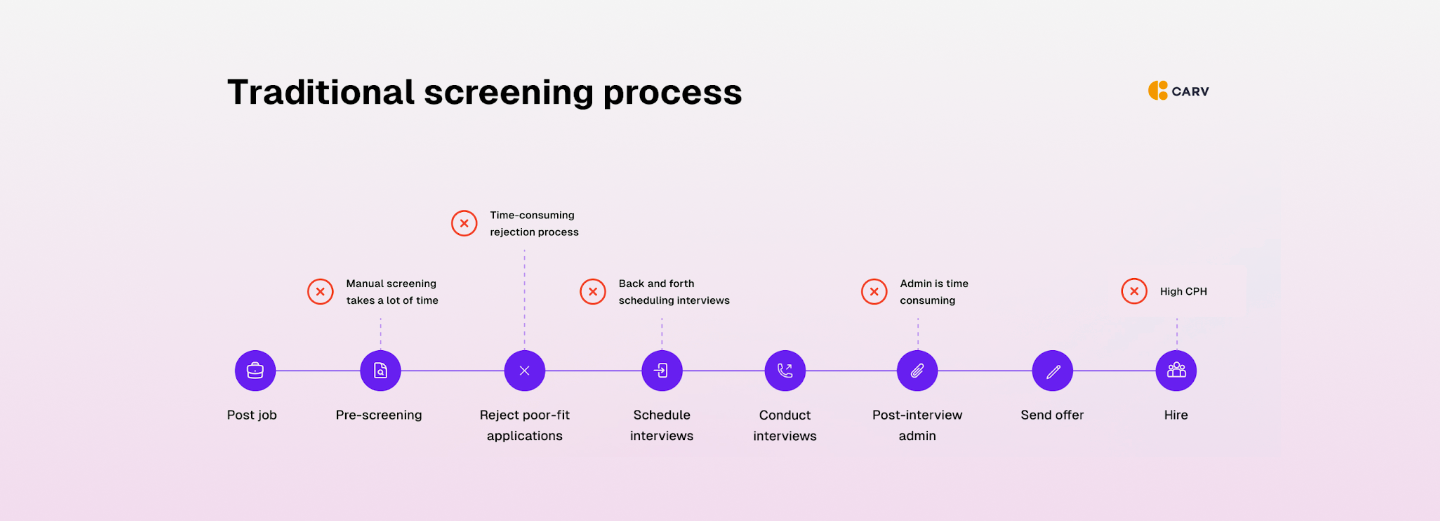
The Problem with Manual Resume Screening
1. Time Drains Your Team
You spend over 23 hours (almost three full workdays!) just reviewing resumes for one role. That means less time for candidate outreach, interviews, and strategic recruiting.
2. Bias Slips In Unnoticed
Your reviewers, however well-intentioned, bring unconscious preferences: top-tier schools, familiar names, or polished formatting. Those biases shape who moves forward—often at the expense of real talent.
3. Standards Vary by Recruiter
One recruiter may value “years of experience,” while another prioritizes “technical chops.” The result? Two equally qualified candidates get very different outcomes, depending on who clicks “Next” first.
4. Fatigue-Induced Shortcuts
When 250 resumes flood in, you and your team burn out. You skim each resume in 7 seconds or less, guaranteeing you miss high-potential profiles buried in the pile.
What This Costs You
- Slower Hires: Extended timelines frustrate hiring managers and candidates alike.
- Higher Expenses: Overtime and process delays inflate your recruitment budget.
- Lost Talent: Top candidates slip away to faster-moving competitors.
- Diversity Gaps: Qualified, diverse talent never has an equal opportunity.
- Reputation Damage: Bad candidate experiences damage your employer reputation.
With AI resume screening, you recover those hours, remove bias, and give every candidate a standard, equal assessment, so you hire wiser and faster.
How AI Resume Screening Technology Actually Works
Imagine a digital recruiter that never tires, never skips a detail, and always applies your unique criteria. That’s AI resume screening in action.
Here’s how it turns hundreds of resumes into your top candidates.
1. Extraction
You feed your resumes (PDFs, Word docs, even images) into the NLP engine. You get structured data (job titles, skills, education, certifications) without any manual lift. No formatting quirks slip through.
2. Matching
You set your must-haves (e.g., “3+ years in digital marketing with Google Ads”). Depending on the AI System, the results look something like this:
- Keyword-Based Systems spot those exact terms, abilities, and credentials that match those in your job description.
- Context-Understanding Systems analyses the resumes' sentence structure and meaning—“led a software team” equals “managed developers.”
- Pattern-Recognition Systems identify growth and achievements (“increased sales by 30%”). They are excellent at finding applicants who have demonstrated progress and measurable achievement.
This layered approach ensures that the AI catches synonyms (“programme coordination” = project management) and hidden signals that humans miss.
3. Ranking
Each resume receives a 0-100 score according to your weighted criteria. You access your dashboard and immediately view the top 10% of applicants. No scrolling, no burnout, just the best candidates first. And you have clear visibility into what led to each high score, so your decision-making is transparent and defendable.
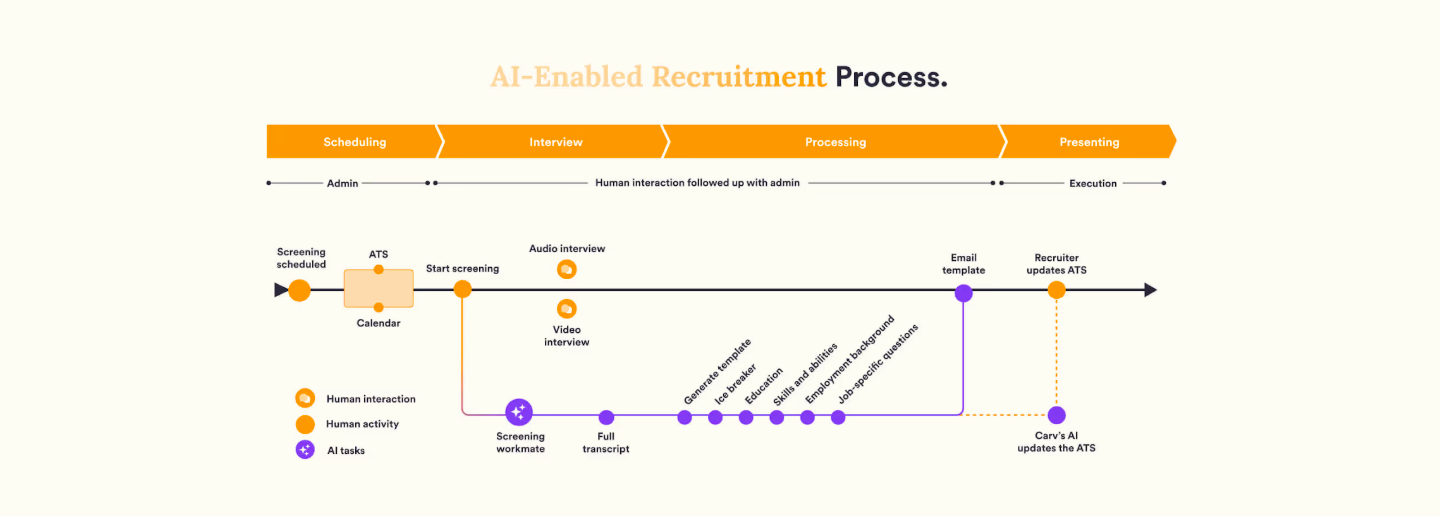
AI for resume screening starts with processing resumes, extracting pertinent information regardless of their format. You provide a conventional layout or an innovative format, the system finds corresponding details every time.
How to use AI to hire developers: what works and what doesn’t.
Key Benefits of Switching to AI-Powered Screening
Drastic Time Reduction
You’ll sort hundreds of resumes in minutes, not days. Recruiting teams can respond to candidates quicker and advance qualified candidates efficiently through pipelines. In short, you reach top talent faster and cut time-to-hire from weeks to days.
Reduced Cost
Factor in recruiter salaries, benefits, and lost opportunities. Impressively, AI technology often pays for itself in a matter of months. Costs are reduced by as much as 75% after the automation of screening processes thereby freeing your budget for strategic work.
Better Matching
AI for resume screening systems analyse large datasets and spots patterns, helping you surface candidates you’d never spot manually. They process and weigh multiple variables simultaneously, something increasingly difficult for humans as application volumes grow.
Reduce Hidden Bias
With the right setup, AI prioritises experience and knowledge over individual characteristics that could unintentionally influence human assessors. Which means that we focus on experience and results, not names, ages, or schools, so you build a stronger, more diverse team.
Boost Candidate Experience
You deliver instant feedback, keeping applicants engaged. Faster screening reduces the probability of candidate desertion and improves your employer's reputation by providing applicants with immediate feedback. Companies using AI report a 40% jump in candidate satisfaction.
Highest level of Scaling
Since AI can process lots of applications without slowing down, it is perfect for high-volume hiring campaigns or one-time hiring spikes that could otherwise cause manual procedures to stall. Whether it’s 10 or 10,000 resumes, you handle any volume effortlessly. No bottlenecks, no burnout.
Difference Between Human Screening vs AI Screening
You’ll cut screening time from days to minutes, slash costs by up to 75%, eliminate hidden biases, and scale instantly—freeing your team to focus on interviews and strategy.
Aspect | Human Screening | AI Screening | Impact |
Speed | Up to 23 hours per hire | Minutes to hours for large volumes | Fill roles in days, not weeks |
Consistency | Variable standards, fatigue effects | The same criteria applied uniformly | Surface high-potential candidates you’d miss |
Bias | Unconscious biases affect decisions | Can be designed bias-free | Broader, more diverse talent pool |
Cost | High labour and time costs | Lower long-term costs | Reallocate budget to strategic initiatives |
Scalability | Limited by human capacity | Unlimited volume handling | Handle hiring spikes without bottlenecks |
Personal Touch | Relationship building possible | Lacks personal engagement | 40%+ boost in candidate satisfaction |
Practical Steps to Implement AI in Your Screening Process
Step 1: Audit & Pick Your Tool
Start by mapping your current process: time spent, volumes, pain-points, team capacity, etc. Then demo 2-3 AI resume-screening solutions, scoring each on ease of use, integration, and cost. You’ll spot the best fit in one afternoon—not weeks. Ask several vendors for demos and make your choice only after that, and test the tools using real job postings.
Step 2: Define & Train
For each job, include detailed job descriptions that include the qualifications required, such as education, training, certifications, experience, and other requirements. Be clear about what qualifications are essential vs. desirable. In place of "marketing experience," provide "3+ years digital marketing experience with Google Ads and social media management."
The more specific your requirements are, the better AI will perform. Upload past hires (and rejects) so your AI learns exactly what success looks like in your organization.
Step 3: Integrate & Test
Hook your chosen AI into your ATS and HRIS to train the AI for resume screening. Run end-to-end tests with live job postings to ensure data flows smoothly, results appear in your dashboards, and recruiters see everything in their familiar workflows. Index.dev specialises in assisting firms configure AI systems with firm-specific information for maximum performance.
Step 4: Pilot & Measure
Launch on one team or department. Track key metrics—screening time saved, candidate quality, hiring-manager feedback—and compare them to your old manual baseline. Test integration extensively with test apps to ensure results and data exchanges are available within regular processes. You’ll know in days if you’re on track.
Step 5: Optimize & Scale
Set monthly check-ins to tweak keyword weights, threshold scores, or integration points based on real-world hiring outcomes. Once you hit your targets, roll out across the business—and keep refining as you grow. Index.dev provides ongoing support to help companies refine their AI systems for better long-term results.
The Future of Resume Screening: Efficiency and Fairness
You’ve seen what AI can do today. Here’s where we’re headed next:
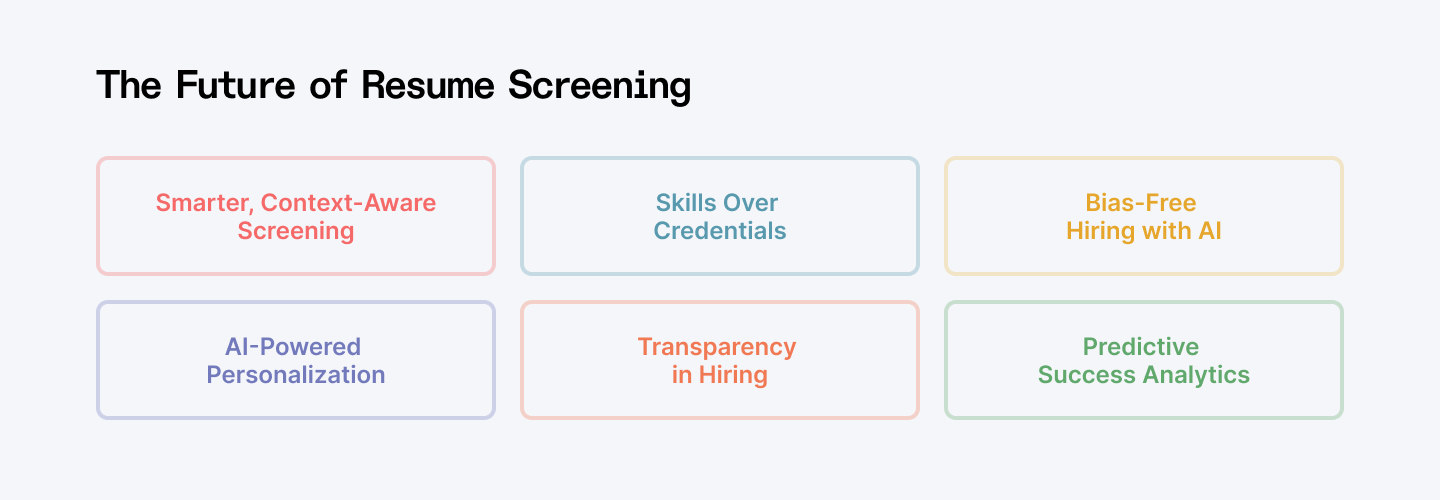
Smarter, Context-Aware Screening:
AI won’t just match keywords. It will read tone, detect intent, and spot hidden gems so that you can uncover potential others miss.
Skills Over Credentials:
Hiring will shift to focus on real skills, not just formal degrees. A self-taught coder could stand equal to a computer science graduate.
Bias-Free Hiring with AI:
Algorithms will spot and reduce hidden biases in the screening process. Fairness will be built into every evaluation step.
AI-Powered Personalisation:
With AI for resume screening, applicants will receive useful, personalized feedback in return like, “Here’s how to strengthen your resume”, boosting your employer brand and keeping candidates engaged.
Transparency in Hiring:
Candidates will know where they stand and why, without the wait. You’ll share clear reasons for every shortlist: “We scored you 85/100 on project leadership and data analysis.” This clarity builds trust and strengthens the employer’s image.
Predictive Success Analytics:
Future artificial intelligence will predict a candidate’s potential based on past patterns and learning ability. Even non-traditional candidates will get a fair shot.
And at Index.dev, we’re building these exact advances into our platform today so you can pilot tomorrow’s technology without waiting.
Explore 5 ways AI cuts time-to-hire without losing quality.
Putting it All Together
AI resume screening slashes your review time, cuts costs by up to 75%, and uncovers hidden talent, all while keeping candidates engaged and freeing your team to focus on strategic conversations, not mundane paperwork.
With real-time analytics and customizable dashboards, you gain full visibility into every stage of your hiring funnel, so you can spot trends, measure ROI, and continually refine your approach.
Ready to eliminate bias and accelerate your hiring? Discover how Index.dev’s AI-powered recruitment solutions can transform your process today.