AI delivers the biggest results in traditional industries when it targets one specific workflow. Specialization turns AI from a speed tool into a competitive edge.
AI Adoption Is Expanding Beyond Tech
Most AI coverage focuses on startups and technology companies. However, some of the largest productivity gains are happening in traditional industries such as law firms, asset management companies, and M&A advisory firms.
These industries have often operated with similar processes for decades, which makes them strong candidates for workflow automation.
Why Specialization Unlocks AI Value
A McKinsey report found that AI could automate up to 70% of business activities across industries. However, automation alone does not create the most value.
The biggest gains appear when AI is trained on domain-specific data and embedded into expert workflows.
This article explains:
- why specialization multiplies AI value
- which workflow types benefit most
- how companies are applying this strategy in practice
Companies such as Sokolove Law, Surplus Network, and Sun Acquisitions illustrate how specialized AI is already transforming workflows in legal services, surplus asset markets, and mergers and acquisitions.
Build specialized AI systems with expert engineers from Index.dev.
Common AI Applications in Traditional Industries
AI Application Type | Industry Fit | Key Benefit | Maturity Level |
| Intake and qualification automation | Legal, insurance, healthcare | Faster screening, less manual review | High |
| Valuation and demand forecasting | Asset management, real estate, retail | Accurate pricing, better revenue recovery | High |
| Predictive deal analytics | M&A, private equity, venture | Earlier risk detection, faster decisions | Growing |
| Document review and classification | Legal, compliance, finance | Reduced review time, consistent output | High |
| Client triage and routing | Professional services, support | Better client experience, lower cost | High |
These applications show where AI is already delivering measurable productivity gains across traditional industries.
Why Generic AI Falls Short in Specialized Industries
General-purpose AI tools are good at broad tasks. They can summarize text, draft emails, and answer common questions. But they struggle with decisions that require years of industry-specific context.
A generic AI tool does not know that a specific clause in a legal contract signals high litigation risk. It does not know which product categories depreciate faster in a surplus market. It cannot flag the financial structure of an acquisition that historically leads to deal failure. These insights come from domain-specific data. And that data lives inside specialized organizations.
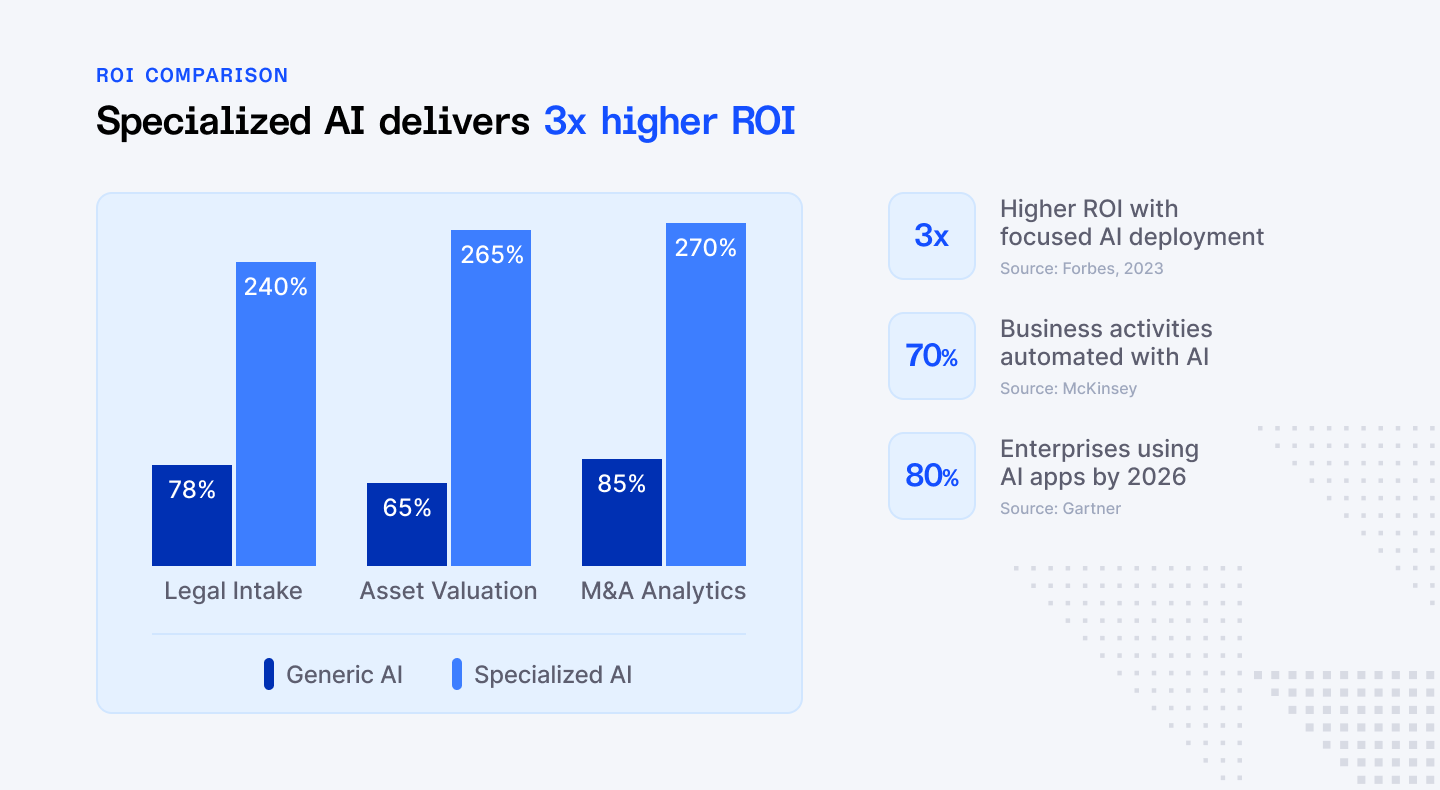
According to Harvard Business Review, companies that fine-tune AI on their own operational data see significantly higher accuracy than those using off-the-shelf models. The model itself is not the differentiator. The data is.
The Specialization Gap
Most companies underestimate how much domain knowledge lives inside their own workflows.
A large amount of domain knowledge lives inside everyday workflows, for example:
- Legal intake teams learn which cases qualify based on years of screening patterns
- Valuation teams understand which buyer segments pay premiums for specific assets
- M&A advisors recognize financial signals that historically predict deal success or failure
Generic AI does not automatically have access to this knowledge. Specialized AI does because it is trained on it.
This difference is known as the specialization gap.
A Forbes analysis found that companies focusing AI on a specific business function report ROI three times higher than those deploying AI broadly. Narrower focus produces stronger results.
⭢ Read next to see how AI-assisted development is evolving from simple autocomplete tools to full agentic workflows.
The Three Workflow Types That Benefit Most
Not every workflow is a good fit for AI. The best candidates share common traits. They are repetitive, data-heavy, and involve consistent decision criteria that can be learned from historical examples. Three workflow types appear across almost every traditional industry that has successfully applied AI.
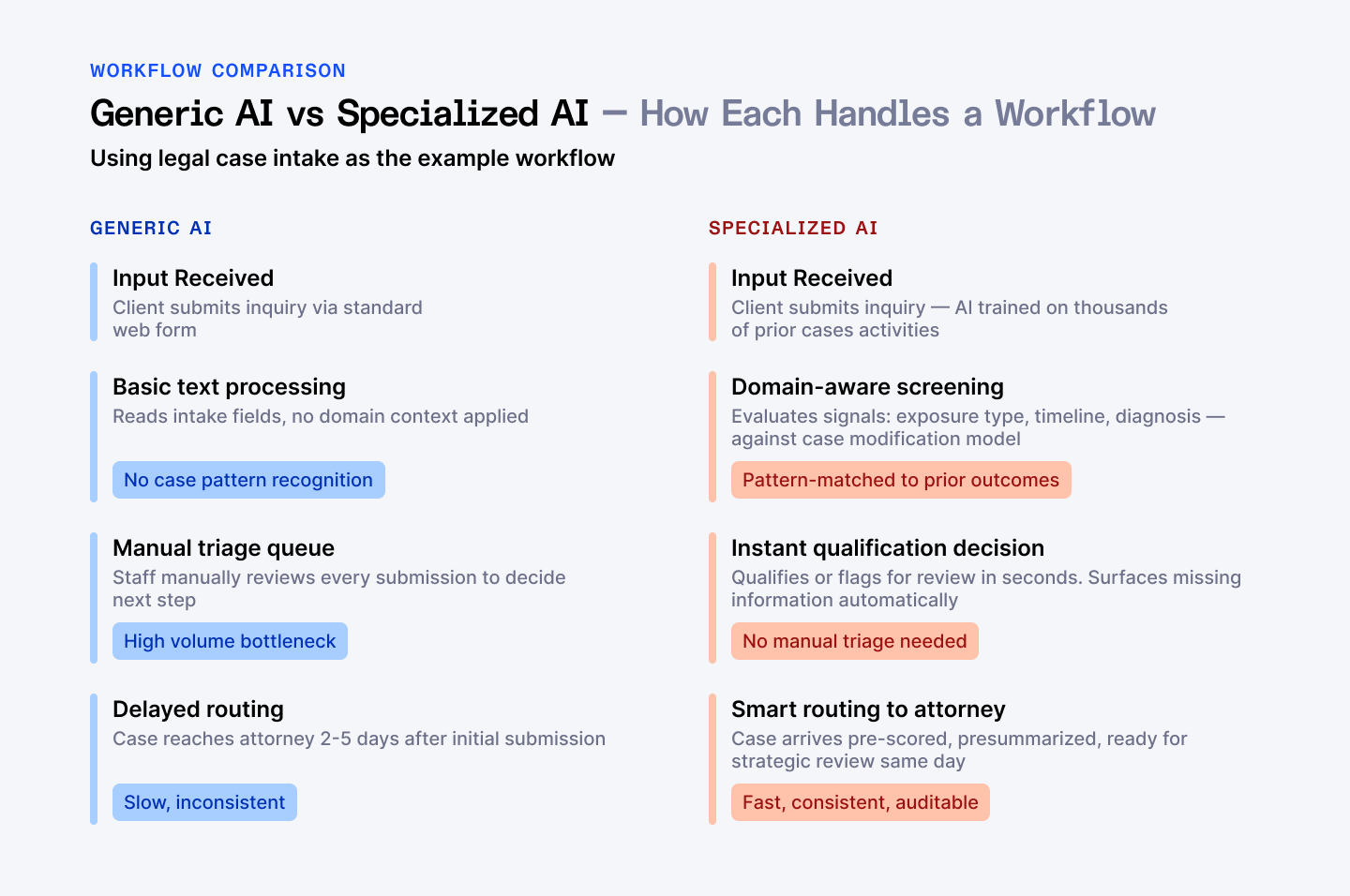
1. Intake and Qualification
Intake is the first step in most professional service workflows. A client submits information. A team reviews it. Someone decides whether to proceed. Done manually at scale, this process is slow and inconsistent.
AI automates the repetitive parts. It evaluates inputs against defined qualification criteria. It catches missing information before the case reaches a reviewer. It routes requests based on type, urgency, and match without waiting for human assignment. Teams move faster and spend more time on work that requires judgment. Additionally, tools like an AI call answering service can automate and analyze customer interactions at scale, improving intake efficiency and ensuring consistent communication across workflows.
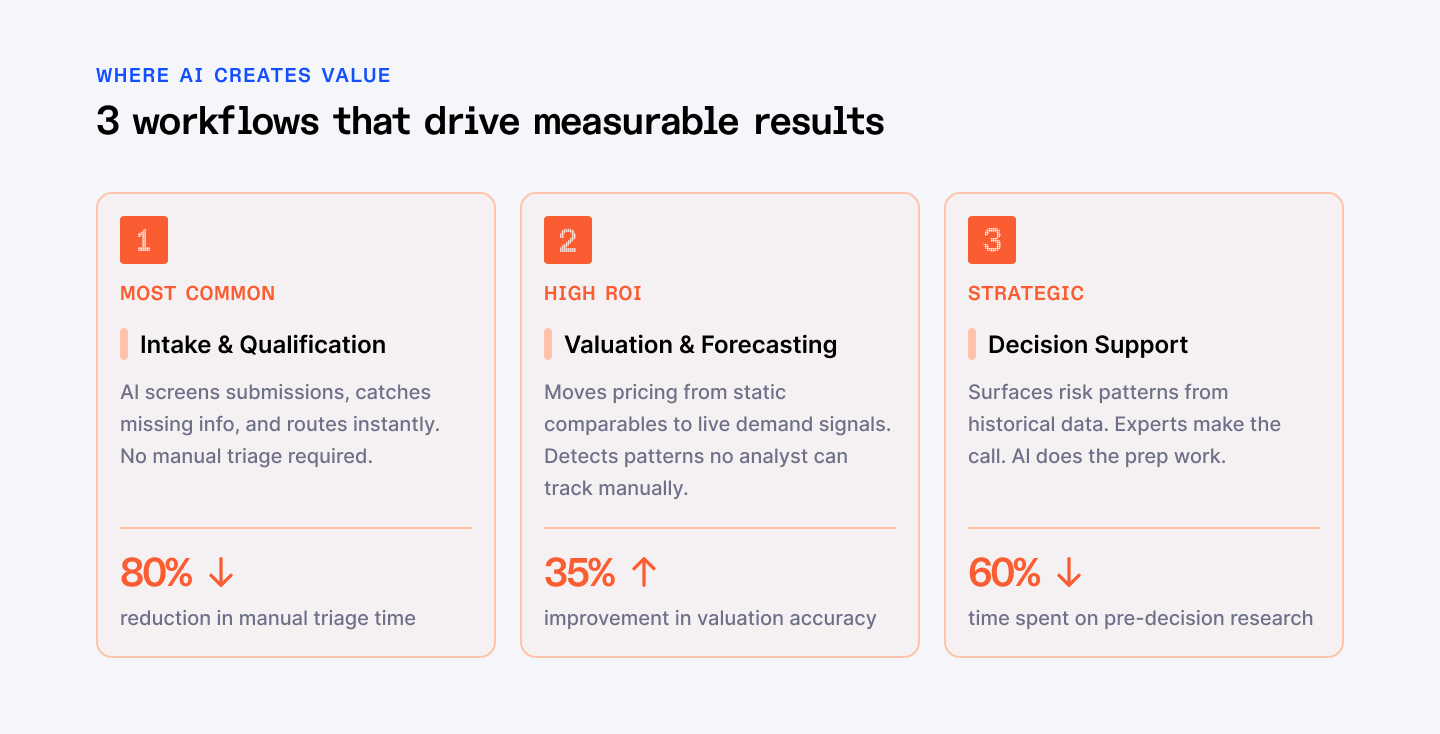
2. Valuation and Demand Forecasting
Pricing and valuation in many industries still rely on manual comparables and judgment. This approach works but it is slow. It misses signals that are not visible in standard pricing references. And it requires senior expertise to execute well every time.
AI shifts valuation from reactive to predictive. It processes more data than any analyst can review manually. It detects demand patterns, seasonal trends, and depreciation curves that change faster than manual models can track. The result is more accurate valuations in less time, with less dependence on individual expertise.
3. Decision Support for High-Stakes Transactions
M&A deals, legal strategy, and major financial transactions require expert judgment. AI does not replace that judgment. It prepares experts with better information before they make decisions.
AI scans large datasets faster than humans can. It surfaces risk signals from historical transactions. It flags patterns that correlate with deal failure or litigation exposure. Advisors spend less time gathering information and more time analyzing it. Decisions are better and faster because the prep work is stronger.
What Makes Specialized AI Hard to Copy
One of the most important properties of specialized AI is that it gets harder to replicate over time. A company that trains AI on three years of internal case data has an advantage that a new entrant cannot easily close. The data compound. The model improves. The gap widens.
This is the moat that AI creates in traditional industries. It is not technology. Any company can buy access to the same foundation models. The moat is the proprietary data and the workflow integration built around it.
Gartner forecasts that by 2027, organizations combining proprietary data with foundation models will outperform competitors using generic AI by a factor of three in accuracy and cost efficiency. Building that data advantage now creates a durable competitive position.
Humans Remain Central
Specialized AI does not remove the need for expert professionals. It removes the parts of their job that are repetitive and data-heavy. This frees them to do more of what requires real expertise. In safety-critical domains such as aviation software development, this distinction is even more pronounced, since engineers must still own certification, validation, and system safety regardless of any tooling support.
An attorney still makes the legal judgment. A valuation specialist still reviews the final pricing recommendation. An M&A advisor still structures the deal and advises the client. AI accelerates the preparation. Humans own the decision.
This is not just a safety consideration. It is a practical one. Clients in high-stakes situations want to know that an expert is responsible for the outcome. AI-supported workflows maintain that accountability while reducing the time and cost of delivering expert judgment.
How to Build a Specialized AI Capability
Building a specialized AI capability does not require a large team or a major budget to start. The companies showing the strongest results began with a single workflow, measured the impact, and expanded from there. The same approach works regardless of industry or company size.
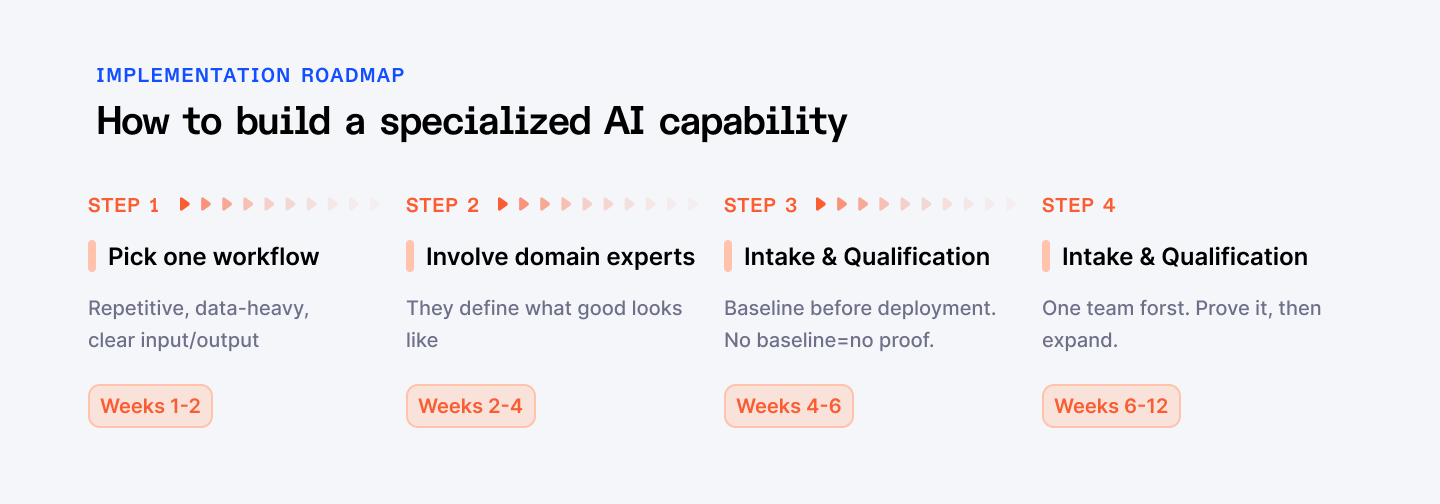
Step 1: Identify One High-Impact Workflow
Look for a process that is repetitive, data-heavy, and has a clear input and output. Intake, qualification, pricing, and risk assessment are strong starting points. A clear workflow makes it easier to train the model and easier to measure whether it is improving the process.
Avoid the temptation to automate everything at once. One well-executed deployment creates more value than five half-built ones. It also builds internal confidence and teaches the team how to work effectively with AI tools.
Step 2: Involve Domain Experts in Training
The people who know the workflow best should define what good looks like. This means involving your legal team, pricing specialists, or deal analysts before you write a line of code. They know which inputs matter. They know what signals to look for. Their input shapes the training data and makes the model more accurate.
A common mistake is to build AI tools in isolation and hand them to domain experts after the fact. This produces tools that are technically functional but miss the nuances that make outputs useful. Domain experts and technical builders need to work together from the start.
Step 3: Set Metrics Before Deployment
Define two or three metrics that matter for the workflow before deploying AI. For intake, this might be time-to-qualification or case acceptance rate. For valuation, it might be pricing accuracy against final transaction price. For deal analysis, it might be risk flag accuracy or time saved per deal.
Set a baseline before deployment. This gives you a real number to compare against once the tool is running. Without a baseline, it is hard to know whether the AI is helping or just adding complexity.
Step 4: Pilot, Measure, Optimize, Scale
Run a pilot with one team or one use case. Measure results against your baseline. Identify what is working and what needs adjustment. Optimize the model and the workflow before expanding. This approach reduces risk and builds trust with the people using the tool every day.
An MIT Technology Review study found that companies using a pilot-first approach are 2.5 times more likely to scale AI successfully than those deploying broadly from day one. Start small. Prove the value. Then expand.
Real-World Companies Applying Specialized AI
AI isn't a future bet anymore. It's already running inside law firms, retail giants, and M&A advisory desks.
The following examples illustrate how specialized AI is already improving workflows in legal services, surplus asset markets, and mergers and acquisitions.
Sokolove Law: Streamlined Intake with Intelligent Lead Screening
When someone calls a law firm after a serious injury or diagnosis, the intake process needs to be fast, clear, and supportive. Firms like Sokolove Law have focused on making that first interaction as smooth as possible.
- Their website features an automated chatbot that likely helps capture basic information and guides visitors through initial questions.
- Tools like this are usually used to capture data such as injury type, location, exposure history, and contact information before a human specialist steps in.
- Behind the scenes, large legal firms often rely on digital intake systems that organize information and route potential cases to the appropriate legal team.
Technology helps filter and organize incoming requests so attorneys can focus on evaluating cases and helping individuals understand their legal options. For example, people exploring asbestos-related claims will likely be routed to a specialized mesothelioma lawyer at a firm like Sokolove Law.
Surplus Network: Bringing Pricing Clarity with AI-Powered Market Valuation to a Guesswork Market
Surplus Network asset liquidation has always rewarded the party with better market information. AI is changing who that is.
- Surplus Network's AI-powered valuation engine analyzes real-time market data, industry trends, and comparable asset sales to generate accurate fair market value assessments, replacing pricing instinct with evidence.
- Sellers choose between bulk purchase for immediate capital recovery or continuous liquidation for higher returns, with Surplus Network handling negotiations, logistics, and compliance throughout.
- The platform serves industries from manufacturing and energy to pharmaceuticals, anywhere surplus inventory has historically been undervalued due to market opacity.
In a space where information asymmetry used to favor buyers, AI-based valuation shifts that leverage back toward the seller.
Sun Acquisitions: Sharper Deal Intelligence for Mid-Market M&A
In mergers and acquisitions, a missed signal during due diligence doesn't show up immediately. It compounds quietly after the deal closes.
- Sun Acquisitions uses data-driven analysis tools to continuously monitor the market for potential targets, applying predictive analytics to identify companies poised for growth or facing challenges that could make them attractive candidates.
- On the due diligence side, machine learning helps assess the likelihood of deal success, flag potential integration challenges, and forecast post-merger performance. Sun Acquisitions is compressing timelines that once took weeks of manual modeling.
- The firm's position is that technology must be balanced with human expertise and judgment. Sun Acquisitions Certified M&A advisors remain central to every transaction; AI surfaces the patterns, practitioners decide what to do with them.
Across all three companies, the pattern is consistent: AI handles volume, speed, and pattern recognition. Humans handle judgment, relationships, and accountability. That division of labor isn't a compromise. It's the point.
Common Patterns Across Successful Deployments
Looking across legal, asset management, and financial advisory, a consistent set of patterns appears in the companies that get the most value from AI. These are not industry-specific. They apply across any traditional sector applying AI to a specialized workflow.
Pattern | What It Looks Like in Practice | Why It Matters |
| One workflow first | Pick intake, valuation, or risk review. Not all three. | Easier to measure. Easier to improve. |
| Domain data drives the model | Train on internal case, pricing, or deal data | Generic models cannot match proprietary accuracy |
| Experts define success criteria | Legal, pricing, or advisory teams set what good looks like | Outputs stay relevant to real decisions |
| Humans own final decisions | AI prepares. Professionals decide. | Accountability and trust stay intact |
| Metrics set before deployment | Baseline measured before AI goes live | ROI is visible and defensible |
| Pilot before scale | One team, one process, measured results first | Reduces risk. Builds internal confidence. |
A Statista survey of AI adoption in professional services found that organizations following a structured deployment approach are significantly more likely to report positive ROI within the first year. The pattern matters as much as the technology.
⭢ Explore the biggest AI tech trends shaping 2026 and what they mean for companies, developers, and the future of software.
Frequently Asked Questions About Specialized AI
What is AI specialization?
AI specialization means applying AI to one specific industry workflow using domain-specific training data. It improves accuracy and relevance compared to general-purpose AI tools because it learns the patterns and signals that matter in that field.
How does specialized AI differ from generic AI?
Generic AI is trained on broad public data. It performs well on common tasks but misses industry-specific nuance. Specialized AI is trained on proprietary data from one domain. It understands the language, risk signals, and decision criteria that matter in that specific context.
Which industries benefit most from specialized AI?
Legal services, asset management, financial advisory, healthcare, and logistics show the highest gains. These are fields where decisions are complex, data is abundant, and the cost of errors is high. AI trained on domain data performs well in all of them.
Does AI replace professionals in specialized roles?
No. AI handles the data-heavy, repetitive parts of a workflow. Professionals keep control of decisions that require judgment, context, and accountability. The strongest deployments use AI to prepare experts, not replace them.
How long does it take to build a specialized AI workflow?
A focused pilot on one workflow can be running in 8 to 12 weeks with the right team. The timeline depends on data availability, workflow complexity, and how clearly success metrics are defined before work starts. Simpler workflows with clean historical data move fastest.
Final Words
AI is not a replacement for industry knowledge. It is an amplifier. The companies showing the strongest results are not deploying AI broadly. They are targeting one workflow, training on their own data, and measuring the impact carefully.
The strategic value comes from the combination. Human expertise sets the context. AI handles the data work at scale. The result is faster decisions, more consistent outputs, and a competitive position that gets stronger over time as the model improves.
Traditional industries that build this capability now will have an advantage that is hard to replicate. The technology is accessible. The differentiator is the domain data and the expertise to apply it well. Companies that move first build a moat. Companies that wait start behind.
➡︎ Applying AI to your industry means nothing without specialists who understand your workflows. Index.dev connects you with vetted ML engineers, AI solution architects, and domain-trained data scientists who know how to build AI that actually performs in production.