AI-powered video interview software has become a popular subject among talent acquisition executives and hiring managers, particularly in technology recruiting, where speed and quality of evaluation are critical. While some platforms offer extraordinary speed and intelligence, others raise major questions about fairness, prejudice, and pseudoscience.
This article is intended for decision-makers who are interested in technologies such as AI video interviews and asynchronous video interviews, but want to know whether these advances offer actual value or just noise.
You'll get a comprehensive, evidence-based assessment of what AI video analysis can really achieve (like improving structured screening) and where it falls short (like inferring personality from facial clues). We will also give a reasonable strategy for employing these tools while maintaining candidate experience and fairness.
If you're thinking about incorporating video interview software into your employment process, or rethinking what you currently have, this guide will help you make better, more ethical choices.
Stop relying on AI guesswork to judge candidates. Access Index.dev's elite 5% of pre-vetted developers through proven assessments, 48-hour matching, and 30-day free trial.
The Growth of Video Interview Software in Tech Hiring
Video interview software are digital platforms that allow companies to evaluate candidates remotely using recorded or live video replies. These technologies can be driven by AI or utilized for organized, time-shifted interviews.
There are two main formats:
- One-way video interviews:
- Include candidates answering pre-recorded questions without a human interviewer. This approach is commonly used to assess technical or communicative abilities. For example, a frontend developer may record asynchronous responses to JavaScript inquiries.
- Include candidates answering pre-recorded questions without a human interviewer. This approach is commonly used to assess technical or communicative abilities. For example, a frontend developer may record asynchronous responses to JavaScript inquiries.
- Asynchronous video interviews:
- A wide phrase that encompasses one-way forms in which applicants conduct interviews on their schedule. These technologies frequently provide schedule flexibility and replay for unbiased assessment.
- A wide phrase that encompasses one-way forms in which applicants conduct interviews on their schedule. These technologies frequently provide schedule flexibility and replay for unbiased assessment.
Video interviews gained popularity during the COVID-19 epidemic and have since been an essential component of remote employment methods.
According to a 2022 LinkedIn study, 81% of hiring professionals expect virtual recruiting to continue after the pandemic, with AI solutions becoming vital in their tech stacks.
The key participants in this space are:
- HireVue: Known for using AI facial and tone analysis.
- Modern Hire: Offers predictive recruiting algorithms.
- Spark Hire is popular for its user-friendly one-way video interviews.
- myInterview, VidCruiter, and Talview: Emerging rivals with unique capabilities
The transition to video-based assessments underscores the IT industry's desire for speed, flexibility, and global reach, particularly for tasks that require scaled, early-stage screening. It also corresponds with an increasing drive for organized evaluations and using standardized forms to reduce interviewer bias.
However, as acceptance increases, so does scrutiny, particularly when AI is involved. While AI-enhanced platforms promise to assess communication, emotion, and even potential, detractors believe that such features might introduce algorithmic bias or pseudoscientific conclusions, which we'll examine in the next sections.
Understanding the potential and limitations of video interview software is critical for any tech hiring manager seeking to create a fair and successful recruitment process.
Need better tech hiring? Explore 17 AI recruiting tools that make finding software engineers easier.
The Promises: What AI Video Interview Tools Claim to Do
AI-enhanced video interview software is advertised as a significant advancement in applicant screening, particularly for high-volume technical recruiting.
These platforms offer to do more than simply record interviews; they claim to do in-depth analysis of applicant behavior.
Assess Tone, Confidence, and Communication Clarity
HireVue and other platforms promise their capacity to evaluate a candidate's intonation, speaking tempo, and clarity to draw judgments about confidence and communication abilities. According to the website, AI models are "trained to identify verbal indicators of candidate potential" (HireVue AI Hiring).
Facial Expressions and Emotion Recognition
Some AI video interview technologies go even further, assessing facial expressions to determine involvement, honesty, and passion. Vendors believe that microexpressions, such as a fleeting grin or wrinkled brow, might indicate emotional intelligence or personality qualities. Modern Hire, for example, offers "science-based predictive analytics" to assist recruiting teams in forecasting future performance.
Soft Skills and Personality Inferences
Several systems claim to be able to discover soft talents like empathy, curiosity, and leadership by evaluating verbal and visual clues. While the approach isn't always clear, the inference is that AI may assist in anticipating "cultural fit" or behavioral patterns.
Efficiency, Fairness, and Scale
Vendors usually claim that AI removes human bias, saves recruiters time, and assures consistency. My Interview reports that "AI-powered video interviews create a level playing field by standardizing how candidates are evaluated."
These promises are especially enticing to IT hiring managers who are under pressure to analyze hundreds of candidates fast while maintaining high quality. The potential to automate early screening, identify top performers, and decrease scheduling complexity makes asynchronous video interviews appealing.
However, as promising as these aspects appear, they must be thoroughly scrutinized.
- Are facial expressions trustworthy indicators of performance?
- Can tone analysis accurately identify confidence from anxiousness across cultures?
The next section delves into what independent research suggests and whether AI video interviews can genuinely deliver on these promises.
Reality: What Research and Experience Say
Despite the big promises made by many video interview software companies, independent research raises fundamental questions regarding the accuracy, ethics, and fairness of AI-powered assessments.
1. Bias in Facial Recognition
Facial analysis algorithms frequently misidentify expressions across racial, gender, and age categories. A 2019 research by the Algorithmic Justice League discovered mistake rates of up to 34.7% for darker-skinned women, compared to less than 1% for lighter-skinned males (AJL Report).
This raises red flags when vendors use face recognition to predict emotions or interests, especially in high-stakes recruiting.
2. Misinterpretations of Tone and Language
AI models trained in standard English frequently struggle with non-native speakers, accents, and regional dialects. According to an IEEE paper on bias in NLP systems, models may wrongly rank a candidate lower based on variations in speech patterns rather than real communication competence.
In one case, a Harvard Business Review research found that applicants with foreign accents were commonly scored worse in AI-assessed interviews despite having similar or greater qualifications.
3. Pseudoscience of Personality Detection
Many experts see AI personality inference as scientifically unjustified. Psychology Today and other peer-reviewed research warn that using facial expressions or tone to assess personality is based on pseudoscience rather than evidence. The European Commission identified such actions as "unacceptable risks" in its draft AI Act (EU AI Act Overview).
4. Legal & Regulatory Pushback
In the United States, the Illinois Biometric Information Privacy Act (BIPA) requires authorization for any biometric data use, including face analysis in employment. Companies like HireVue have been sued for breaking these requirements.
The EU AI Act, which is slated to take effect in 2026, may restrict or prohibit emotion-detection techniques in recruiting entirely, alleging human rights abuses and algorithmic prejudice.
While AI video interview technologies have the potential to streamline recruiting, many of its most futuristic claims, such as reading emotions or recognizing soft skills, lack the scientific support and legal clarity to be utilized responsibly today. Without proper monitoring, they risk perpetuating rather than eliminating prejudice.
Where It Works Well
While most of the discussion about AI video interview software focuses on its shortcomings, there are use cases where these technologies, when used properly, may offer significant value to the recruiting process, particularly in high-volume technical positions.
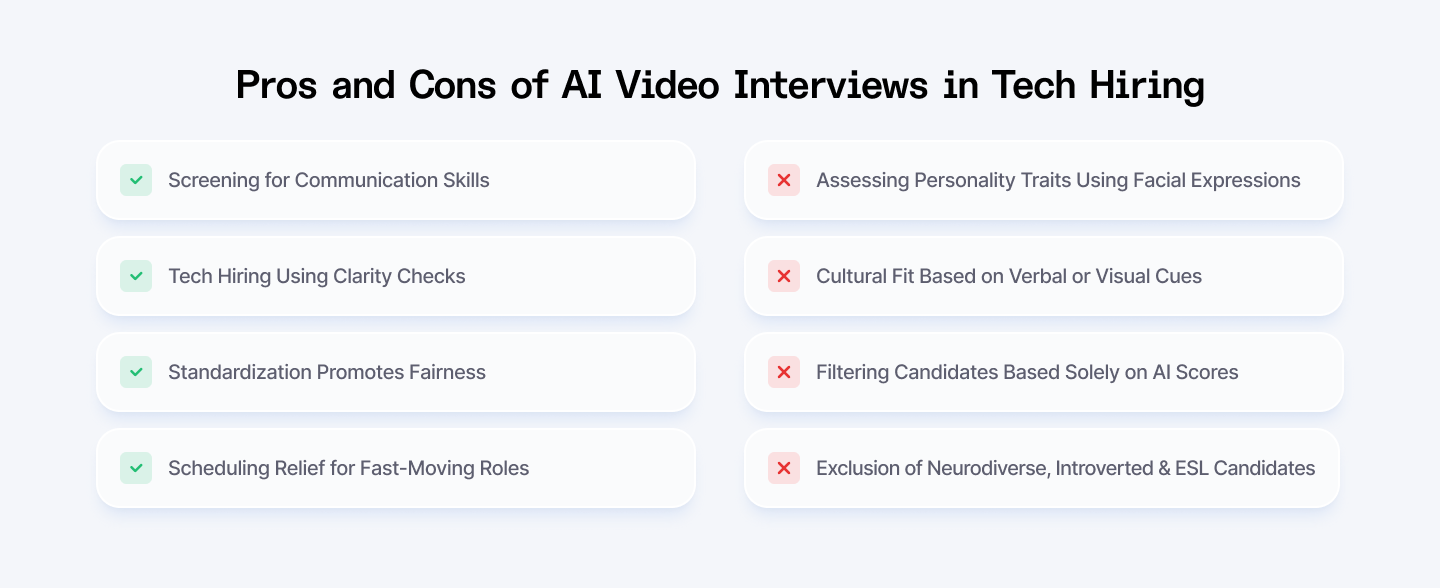
Screening for Communication Skills
Clear communication skills are vital in customer-facing professions such as technical assistance, presales engineering, and client success. One-way video interviews allow candidates to exhibit their talents right away. An organized answer to a frequent customer circumstance, for example, might send a stronger signal than a resume.
A TA leader on LinkedIn stated that "video interviews help surface strong communicators in early rounds, especially when hiring for hybrid support roles where client interaction is key" (LinkedIn Discussion).
Tech Hiring Using Clarity Checks
In asynchronous technical interviews, applicants may be asked to explain a line of code or tackle a system design task vocally. While not a replacement for technical testing, these comments assist recruiters in assessing conceptual clarity and communication, both of which are vital in remote teams.
Asynchronous video interviews can alleviate scheduling strain and allow numerous stakeholders to assess them at different times, resulting in higher decision quality.
Standardization Promotes Fairness
When each applicant is asked the same set of questions under the same conditions (time limit, prompt), interviewer variability and potential bias are reduced. Recorded replies can be replayed and analyzed by numerous reviewers, which improves evaluation consistency.
According to a SHRM whitepaper published in 2023, organized, pre-recorded interviews are more likely to result in fair recruiting decisions than unstructured live interviews.
Scheduling Relief for Fast-Moving Roles
Asynchronous forms allow applicants to record replies when it is convenient for them, reducing the back-and-forth of live scheduling, especially beneficial in early-stage tech screening or recruiting across time zones.
Video interview software may help a fair and efficient employment process by providing standards, scalability, and communication screening. The key is openness, ethical design, and considering AI ratings as an input rather than the final judgment.
Where It's Risky and Should Be Avoided
Despite the benefits of AI video interview tools, there are significant concerns when they are used to draw subjective inferences from limited, unvalidated data, especially in technical recruiting, where the stakes are high.
1. Assessing Personality Traits Using Facial Expressions
Many programs promise to determine characteristics such as "leadership" or "openness" by examining a candidate's microexpressions. This method is fundamentally incorrect. According to a 2021 MIT Technology Review article, these algorithms "lack the scientific basis to back up their personality claims" and might severely mislead employment choices.
Using such analysis may erroneously punish candidates based on facial tics, cultural variances in nonverbal cues, or camera quality.
2. Cultural Fit Based on Verbal or Visual Cues
Trying to determine "culture fit" from how someone seems or sounds in a one-way interview is inherently skewed. It frequently reinforces hiring decisions based on familiarity or likeness rather than skill or diversity. Worse, it is not a measured or repeatable quality.
Candidates from underrepresented origins or with varying societal standards may be unjustly excluded. Reddit discussions commonly emphasize this problem, with applicants describing AI interviews as "demeaning" or "unpredictable" in their assessments.
3. Filtering Candidates Based Solely on AI Scores
The use of AI-generated scores as the principal filtering method raises serious concerns. While appealing for high-volume recruiting, this method frequently conceals opaque algorithms that punish candidates without explanation.
According to Cornell Tech researchers, these ratings lack transparency and rarely provide accountability or appeal processes for rejected individuals.
4. Exclusion of Neurodiverse, Introverted, and ESL Candidates
Introverts, non-native English speakers, and those on the autistic spectrum may experience difficulties expressing themselves on video. The lack of real interaction might increase fear and lower performance, unjustly skewing ratings.
A Quora user wrote,
"As someone on the spectrum, video interviews feel like a trap, I know I'm being judged for not smiling or making enough eye contact".
AI video interviews should not be used to forecast personality, determine cultural fit, or replace human judgment. These methods can establish systematic prejudice, harm the employer brand, and undermine applicant confidence.
Framework: Use Video Interview Software Ethically and Effectively
To use video interview software ethically in technical recruiting, organizations must use AI technologies with prudence, openness, and human oversight.
- Transparent Communication
- Always let applicants know when AI is employed, what it assesses, and how the results are used. This transparency promotes confidence and conforms with standards such as GDPR and BIPA (IAPP Guide to AI Transparency).
- Always let applicants know when AI is employed, what it assesses, and how the results are used. This transparency promotes confidence and conforms with standards such as GDPR and BIPA (IAPP Guide to AI Transparency).
- AI: Assistive, Not Decisive
- AI video interview ratings should be used as one input, not the ultimate judgment. These techniques can help to identify trends or minimize burden, but final evaluations must require human judgment.
- AI video interview ratings should be used as one input, not the ultimate judgment. These techniques can help to identify trends or minimize burden, but final evaluations must require human judgment.
- Human-in-Loop Review
- Ensure that each candidate's performance is reviewed by experienced specialists. This reduces algorithmic bias and provides critical context that AI lacks.
- Ensure that each candidate's performance is reviewed by experienced specialists. This reduces algorithmic bias and provides critical context that AI lacks.
- Avoid Emotional/Face-Based Scoring
- Avoid platforms that rely on facial expressions, emotion identification, or tone analysis. These techniques lack scientific confirmation and may pose legal and ethical risks.
- Avoid platforms that rely on facial expressions, emotion identification, or tone analysis. These techniques lack scientific confirmation and may pose legal and ethical risks.
- Audit Your Tools
- Ask suppliers to explain how their AI models are developed, what data is utilized, and if they have been independently evaluated for fairness and bias mitigation.
Checklist for conducting ethical AI video interviews
- Disclose AI usage to applicants.
- Do not filter primarily on AI scores.
- Prioritize organized and skill-based questions.
- Use human review for every evaluation.
- Choose techniques that avoid emotion and face analysis.
- Regularly assess tools for compliance and fairness.
Following this approach enables TA leaders to employ asynchronous video interview software in a fair, effective, and future-proof manner.
Explore 5 best AI tools for product analysis and research.
Our Point of View: A Responsible Approach to Asynchronous Video Interviews
At Index.dev, we believe that video interview software should empower applicants, not evaluate them harshly.
Our platform focuses on asynchronous video interviews that are structured, consistent, and accessible. Candidates can record their replies at a time that is convenient for them, enhancing their experience and reducing stress. Every candidate is provided with the same questions and reaction time, which helps to avoid accidental bias.
Importantly, we do not employ face analysis or tone-based rating. We feel that these features cause more difficulties than they solve. Instead, our platform is designed to standardize the screening process, allow for many reviewers, and ensure fair judgments.
Whether you're recruiting engineers, support experts, or product managers, our methodology keeps the process inclusive, transparent, and fast.
Final Thoughts
AI video interviews offer a significant shift in how we assess applicants, but the line between innovation and excess is tight.
When utilized properly, video interview software may assist in scaling recruiting, add structure to assessments, and enable improved decision-making. However, when used to infer personality, sentiment, or "fit," it may swiftly devolve into unethical behavior.
What's the important takeaway?
Use AI technologies to improve, not replace, human judgment.
Hiring managers and TA leaders should carefully consider the claims of any AI video interview tool, use ethical frameworks, and select platforms that value fairness, openness, and accountability.
Take the next step: Evaluate your existing interview process using the framework provided above, and select tools that respect your applicants and your brand.
Cut through the AI hiring hype. Hire smarter with Index.dev: vetted developers, structured interviews, and ethical AI screening built in. Try it free for 30 days.