
Cloud computing has become a cornerstone for modern businesses, enabling scalability, flexibility, and cost efficiency. As organizations increasingly migrate to the cloud, two platforms dominate the market: Amazon Web Services (AWS) and Microsoft Azure. According to recent data, AWS holds a 31% market share, while Azure follows closely with 24%, showcasing their pivotal roles in cloud services.
AWS is popular because of its services, the solidity of offered facilities, and the vast list of services. However, one of its biggest advantages lies in incompatibilities with other Microsoft products and in providing a smooth solution for businesses already using Microsoft’s products.
This blog’s objective is to make a comparison of AWS and Azure based on performance, pricing and services. The comparison of these platforms provides useful insights by offering businesses specialized options suitable for their specific goals. Awareness of both the benefits and drawbacks of each can help organizations use cloud technology optimally in their activities.
Hire senior cloud developers with expertise in AWS or Azure on the Index.dev platform in just 48 hours. Start hiring today!
Market Overview
The cloud computing market is quickly growing and maturing around AWS and Microsoft Azure at the moment. Both AWS and Azure combined, account for the wide majority of the market share, still defining the evolution of the social and technical aspects of cloud computing services.
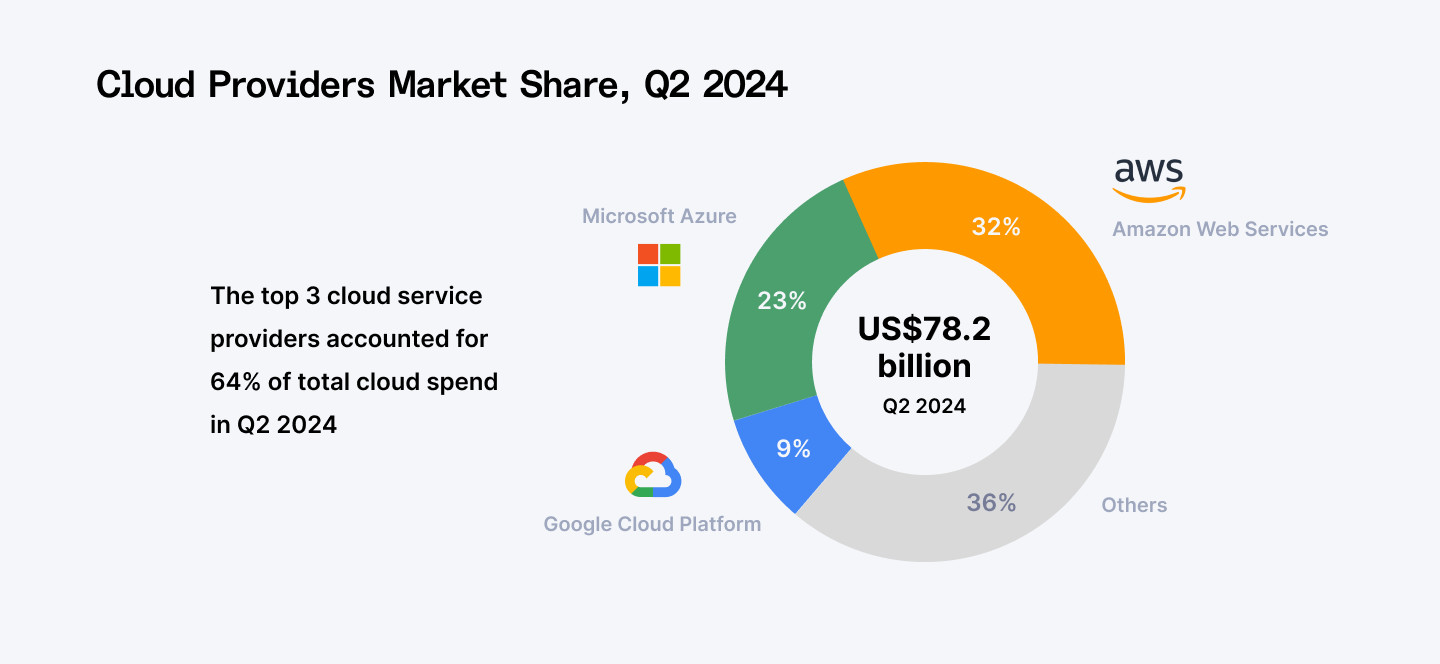
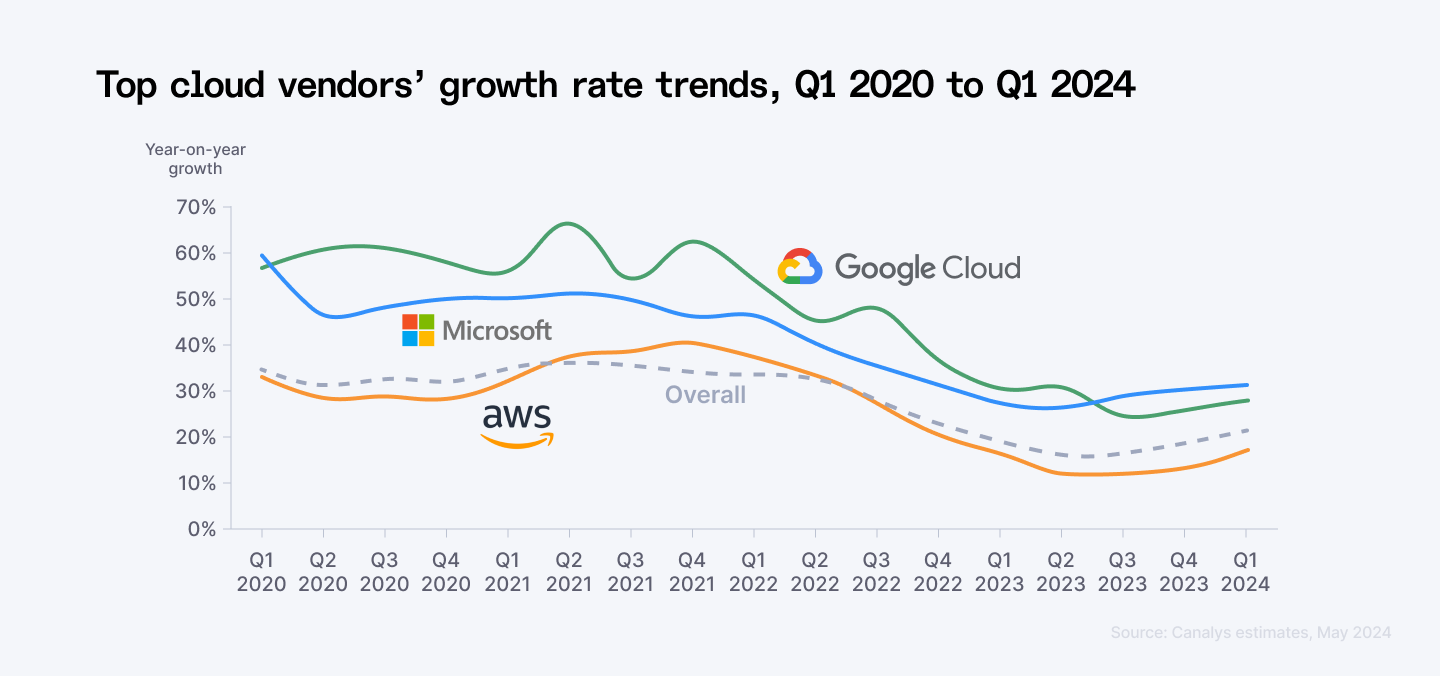
Based on the forecast for the fiscal year ending in 2024, both platforms will still experience a further rise. AWS was forecasted to sustain roughly 31% of the total market share whereas Azure was estimated to increase to about 25% in the Q1 of 2024. This growth is mainly going to be driven by the growing adoption and investment by different enterprises in the AI technologies which is, in turn, requiring scalable cloud services. IDC’s data shows that cloud spending across the world is expected to reach as high as $300 billion by 2024 on an annualized end-point basis, which constitutes an increased yearly growth rate of around 21%.
While these trends and statistics are factors operating in the background, as various businesses adapt to this environment, they will have value in informing organizational strategy and decisions regarding the cloud.
Core Services Comparison
Compute Services
AWS provides a web service called Elastic Compute Cloud (EC2), which offers high-quality compute capacity on demand. Azure responds with its virtual machines that are offered in different models suitable for certain job types. Data from Cockroach Labs show that AWS particularly shines in single-core performance which is perfect for applications that involve a lot of computing.
Storage Solutions
Except for the case, presented later in this article, where AWS S3 (Simple Storage Service) is compared to Azure Blob Storage, both perform well when measured for scalability and durability. However, AWS S3 often provides better response times in terms of average retrieval than Azure, with less than 100 ms as opposed to Azure’s longer latencies. A comparison of pricing strategies shows that while AWS bills clients per GB stored and transferred, Azure has relatively low prices for the same services.
Database Services
When it comes to database services, Amazon RDS and Microsoft Azure SQL are very reliable services. AWS RDS can handle up to 64 TB of storage – this is where it beats Azure SQL Database in terms of scalability while Azure SQL Database offers superior performance with additions to IQP. Each platform has its distinct advantages making it useful to different business models.
Explore More: The Ultimate Checklist for Releasing Your Full-Stack Web Application
Networking Capabilities
When comparing AWS's Virtual Private Cloud (VPC) and Azure's Virtual Network (VNet), both platforms offer robust networking features tailored to different use cases.
AWS VPC is the service that enables users to build isolated networks with full control over IP addressing resources like the range of IP addresses, subnets and routing tables. This flexibility is well suited for customer-facing applications where the servers need to support highly tuned security and VPN for on-premise connectivity, and it can be further enhanced when paired with modern cloud VPN services that simplify secure multi-site tunneling.
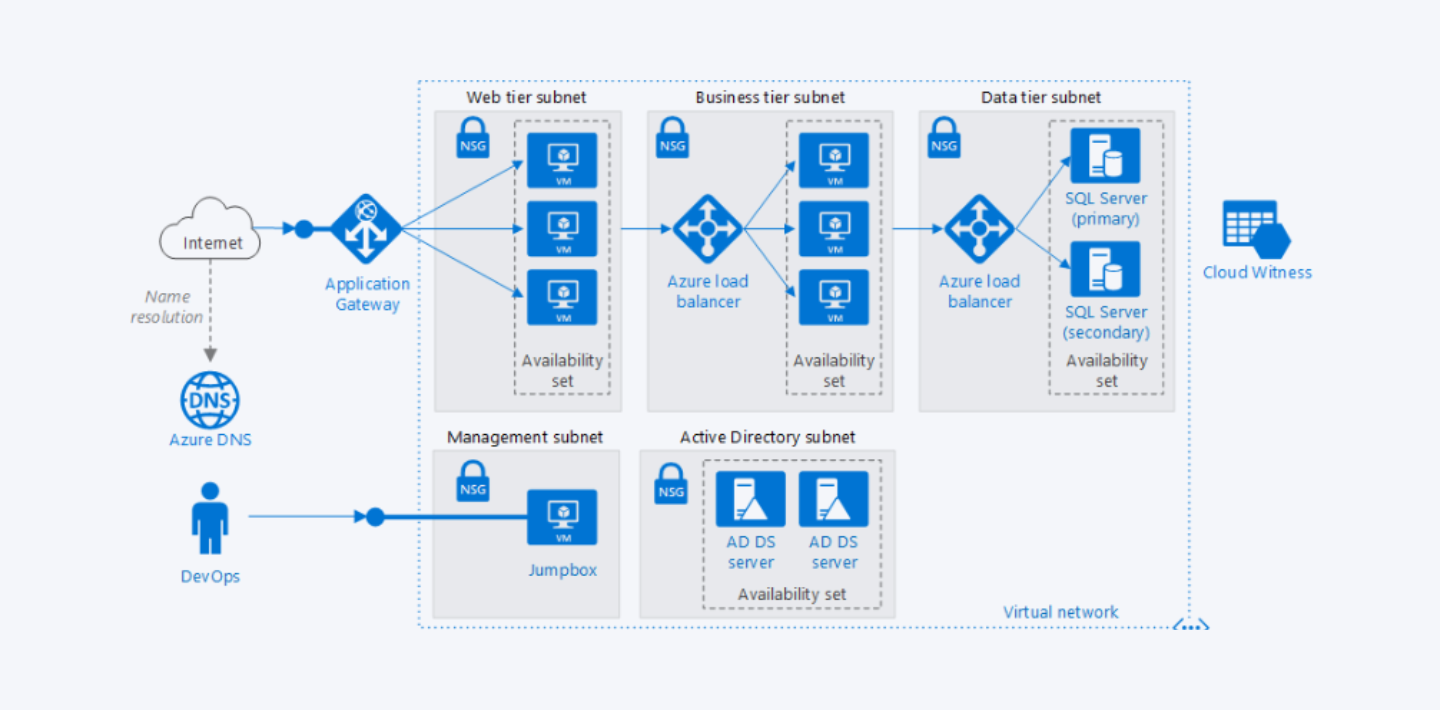
Typical Azure Virtual Network (VNet) architecture, showcasing various components and their relationships.
On the other hand, Azure VNet emphasizes seamless integration with Azure services and simplifies network management through features like VNet peering and user-defined routing. It supports both IPv4 and IPv6, enhancing connectivity options for IoT devices.
Regarding load balancing AWS provides Elastic Load Balancing for the distribution of incoming application traffic to multiple targets and Azure provides public as well as private load balancers for efficient VM traffic within a VNet.
For cross-premises connectivity, AWS offers Transit Gateway and Direct Connect for this, while Azure uses ExpressRoute for dedicated private connections. Combined, these capabilities provide AWS and Azure the strength to compete in the cloud networking market, serving unique Enterprise needs.
Performance Metrics
When examining compute, storage, and database services between AWS and Azure, several metrics demonstrate the disparity in latency,throughput, and, most importantly, scalability.
Compute Services
Speaking of benchmarks, it is worth stating that AWS is a more computing-oriented platform than Azure and performs much better in this aspect. For example, a benchmark conducted by Principled Technologies revealed that AWS’s EC2 instances provided 1.79 times greater client concurrency and 1.9 times less average response time compared to Azure’s analogous configurations for SQL Server-based applications.
Storage Solutions
In the storage section, AWS has shown better performance with a higher write rate of almost 1 Gbps or more and Azure’s disk write speed is slightly lower than AWS. Through the measure of latency, it is clear that AWS has a superior access time throughout the end-user workload hence suitable for high-performance workloads.
Database Services
When considering the database services of AWS RDS there are evident benefits about scalability and performance. It is optimized for read/write operations for bigger datasets, while Azure SQL Database is great at query optimization but can be slower in terms of throughput.
Summing up, these measures demonstrate that although these platforms provide rather powerful features, AWS has a higher level of service performance, especially for computing and storage services.
Security and Compliance
AWS and Azure being cloud service providers in cloud security management have their benefits, which when combined yield different advantages than when used individually. The majority of AWS compliance certifications cover more than 143 security standards across the spectrum such as SOC 1 & SOC 2, PCI DSS and HIPAA/HITECH. This large compliance map is most useful for industries that have to adhere to strict rules such as the health sector and the financial industry. AWS runs through endless third-party assessments and has customers transitioning to strong security features well-suited for compliance with specific requirements such as GDPR or FedRAMP.
On the other hand, Azure is somewhat focused on security, especially for enterprise applications. It provides additional security solutions like Azure Security Center and Azure Sentinel used for comprehensive threat protection and detection. Azure also proves very useful to organizations which are already using Microsoft products to guarantee compatibility with the existing security measures.
Both of them are very strong in terms of compliance features and options for the industry the company belongs to.
Hybrid Cloud Capabilities
When it comes to usability, Azure is rather homogeneous with other solutions for Microsoft products in the context of the modern hybrid cloud systems. This integration helps the organizations that are already a part of the Microsoft environment to transition smoothly and conveniently where the on-premises Active Directory can be aligned with Azure Active Directory. Using products such as Azure Logic Apps and over 600 connector apps already included in Azure, it becomes easy to integrate applications from one environment with another, making Azure even more attractive to large companies that want their workflows to be seamless.
On the other hand, AWS has reliable hybrid solutions in AWS Outposts and AWS Direct Connect through which organizations can use their internal infrastructure as a cloud foundation. Hybrid foundations in AWS are mainly concerned with an optimum functional modality across settings, thereby enabling enterprises to handle workloads scientifically.
One cannot underestimate the role of hybrid cloud solutions in the contemporary IT landscape. They allow organizations to keep some important workloads in-house for compliance or performance purposes while at the same time being able to use scalable features of cloud services. Besides improving the manoeuvrability in operations, it also preferably brings the issue of cost efficiency to the table, thus earmarking this approach as a vital necessity among those organizations that are keen on excelling in the present-day, highly-valued digital environment.
Explore More: 10 Best Cross Platform Mobile App Development Frameworks in 2024
Choosing the Right Cloud Platform
When choosing between AWS and Azure, it ultimately depends on your business needs. AWS is ideal for flexibility, a broad range of services, and global reach, while Azure integrates well with Microsoft products and offers strong hybrid cloud solutions. Evaluate your specific requirements, budget, and existing infrastructure to make the best decision.
For Clients: Find senior cloud developers with expertise in AWS or Azure on the Index.dev platform. Focus on your core business while shortening your hiring time to 48 hours!
For Cloud Engineers: Grow your remote career in cloud computing! Join Index.dev to land high-paying remote roles on innovative cloud projects across the US, UK & Canada. Apply today!


