Traditional team structures frequently struggle with misalignment, silos, and handoffs in fast-paced product settings. As organizations seek faster delivery and greater accountability, the agile pod team structure is developing as a high-performance option.
Unlike hierarchical structures, pod teams are small, cross-functional, and autonomous. They aim to deliver results rather than tasks. These development pod teams have built-in agility, allowing for quick iteration and seamless communication.
In this article, we will break down what an agile pod team structure is, cover critical pod team responsibilities, help you through successful management tactics, and present real-world use cases from leaders such as Spotify.
Hire elite developers in 48 hours. Build agile pod teams with Index.dev’s vetted global talent. Fast, flexible, and risk-free.
What Is an Agile Pod Team Structure?
An agile pod team structure is a modular approach to arranging teams that facilitates expedited product delivery, strengthens accountability, and reduces friction. Each development pod team has 4–8 cross-functional individuals, often including a product manager, developers, a technical lead, QA testers, and designers, who are responsible for a given business outcome from inception to completion.
Influenced by Spotify's squad concept, pod teams operate as miniature startups within an enterprise. In contrast to conventional teams that depend on departmental transitions, pods function autonomously and closely correspond with product objectives. They are not constrained by inflexible procedures such as those employed by Scrum teams; rather, they modify agile practices to align with their objectives.
Important characteristics of agile pod teams:
- Cross-functional: All critical responsibilities consolidated inside a single unit.
- Autonomous: Execute judgments independently of external influences.
- Objective-aligned: Each pod is associated with an OKR or customer journey.
- Iterative: Engage in brief cycles accompanied by ongoing feedback.
- Scalable: Numerous pods can function concurrently towards a common objective.
This framework is optimal for businesses requiring rapidity without compromising quality or oversight. It facilitates enhanced communication, expedited decision-making, and reinforced ownership among teams.
Explore why Big Tech companies are hiring more contractors.
Core Pod Team Roles and Responsibilities
Designing a high-performing development pod team starts with the correct set of responsibilities – clearly defined, connected to results, and integrated into a common goal. Agile Pod teams alleviate the inefficiencies of segmented departments by combining all important functions into a single autonomous unit.
Within pod teams, jobs are often divided into two categories:
- Core members, who carry out daily tasks
- Supporting roles, who give strategic input and continuity
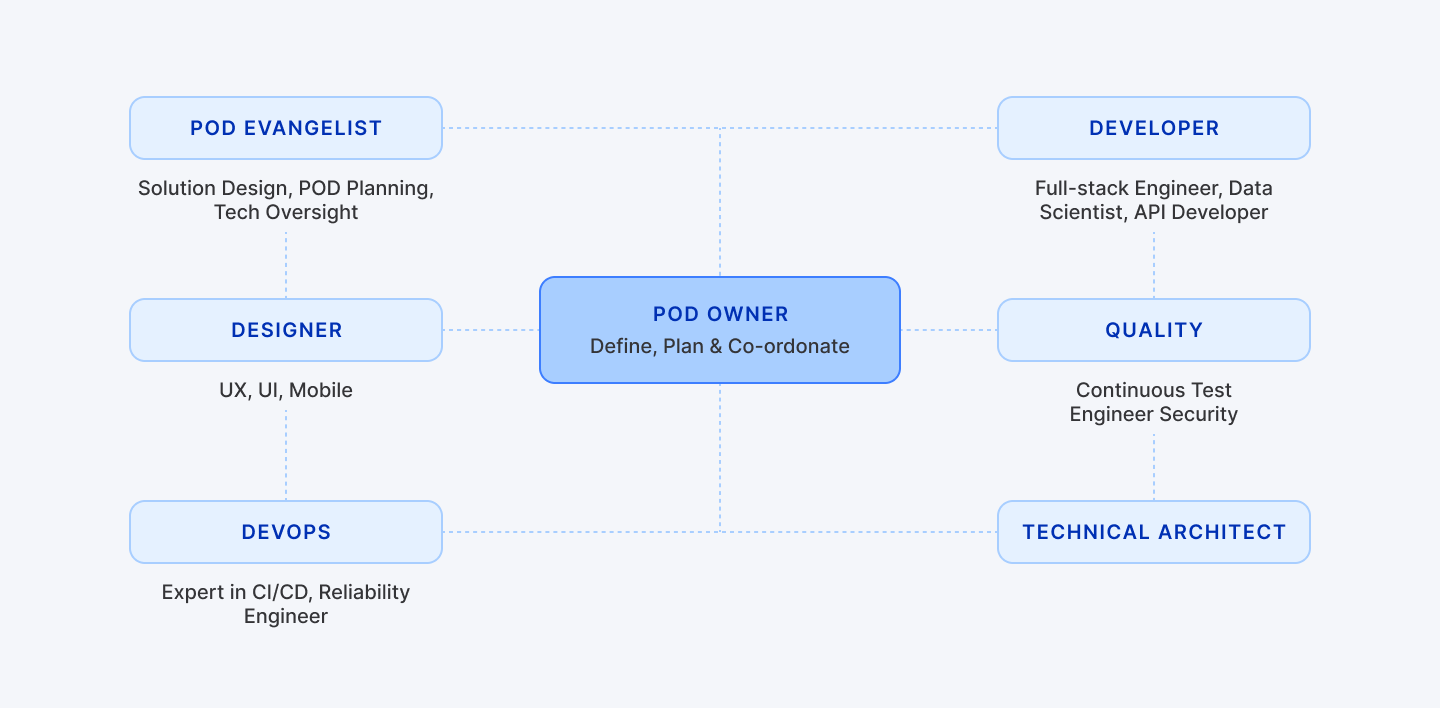
The Core Pod Team Roles
1. Product Manager/Product Owner
The product vision is owned by the PM, who ensures that business goals and development priorities are aligned. They manage the backlog, develop user stories, and establish sprint objectives. Their leadership keeps the team focused on what's most important: customer value and company impact.
2. Technical / Engineering Lead
Responsible for technical direction, architectural choices, and developer mentorship. The technical lead assures scalability, code quality, and compliance with the organization's engineering standards.
3. Developers
They bring the thing to life. Developers in pod teams do more than simply write code; they work closely with project managers and quality assurance to deliver products from start to finish. Their work is fast-paced, iterative, and tightly connected with corporate objectives.
4. QA / testers
Quality assurance in pods is incorporated rather than outsourced. QA testers collaborate with developers to detect issues early, automate tests, and ensure stability across versions.
5. UX/UI Designers
Designers ensure that products are usable, accessible, and visually consistent. In customer-facing pods, they are essential for wireframing, prototyping, and validating user processes.
Supportive Pod Team Roles
1. Data Analyst/BI Specialist
Analyzes use information, monitors KPIs, and generates dashboards to help decision-makers. Their findings enable pods to fine-tune features and validate theories.
2. Agile Coach/Scrum Master
Facilitates agile rituals (standups, retrospectives, sprint planning), assists the team in continual improvement, and removes roadblocks. They emphasize team wellness and process excellence.
3. Business Stakeholders
These might include marketing, financial, or leadership representatives. They guarantee that the pod's output is consistent with the business strategy and offer regular input.
Organizations that clearly define pod team duties generate focused, empowered teams that can act quickly without relying on external approvals or resources. This structure boosts ownership, eliminates friction, and paves the way for continuous delivery.
How to Design Your Agile Pod Team?
An efficient agile pod team structure is not a result of chance. It necessitates meticulous design that harmonizes autonomy with alignment, and competencies with results. Presented above are optimal strategies for structuring pod teams to achieve success.
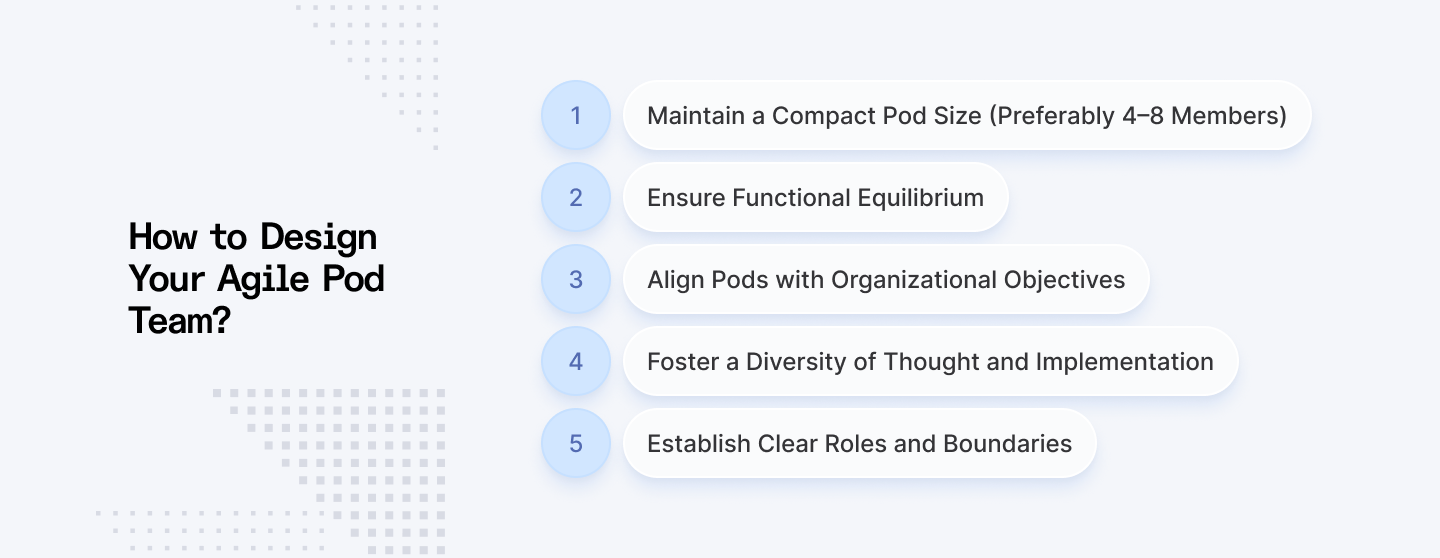
1. Maintain a Compact Pod Size (Preferably 4–8 Members)
Compact teams exhibit enhanced agility and superior communication. A streamlined development pod team facilitates expedited decision-making, enhanced collaboration, and increased responsibility. When a pod surpasses 8 individuals, consider dividing it into two.
2. Ensure Functional Equilibrium
Each pod must be autonomous. This entails incorporating all essential competencies:
- Product Management Strategy
- Technical Implementation (Developers and Technical Lead)
- Quality Assurance (QA)
- User Experience (Designer, if necessary)
This mitigates reliance on external departments and facilitates uninterrupted supply.
3. Align Pods with Organizational Objectives
Pods are most effective when linked to a specific OKR or customer journey, rather than a general feature set. For instance, one pod may be responsible for "user onboarding," while another oversees "checkout optimization." This results-oriented design enhances concentration and efficacy.
4. Foster a Diversity of Thought and Implementation
Each pod should include diverse viewpoints — product, design, technology, and data — to stimulate creativity and mitigate prejudice. This also enhances problem-solving capabilities and improves product-market alignment.
5. Establish Clear Roles and Boundaries
Lucidity mitigates conflict. Utilize onboarding checklists and a straightforward RACI matrix to delineate ownership within the pod. Promote overlap just in instances where collaboration is essential, avoiding situations that may lead to misinterpretation.
Intentional design of agile pod teams allows them to operate as autonomous delivery engines. They can construct, evaluate, and deploy features with fewer dependencies, hence providing value more swiftly and reliably.
Managing and Leading Pod Teams Effectively
Leading a development pod team necessitates a transformation in mindset, from hierarchical control to empowerment, alignment, and trust. In a pod model, the responsibility of the pods management team is to facilitate teams in autonomously owning results rather than micromanaging implementation.
Servant Leadership Over Command and Control
Effective pod leadership emphasizes the elimination of obstacles, the facilitation of cooperation, and the cultivation of a culture of responsibility. Servant leaders provide assistance rather than exert control. They enable team members to make decisions, engage in experimentation, and take ownership of the product.
Fundamental Agile Practices for Harmony and Flexibility
Pod teams have to adhere to streamlined yet efficacious agile methodologies:
- Daily standups: Brief updates to align progress and identify concerns
- Sprint planning: Prioritize tasks associated with OKRs and business objectives.
- Retrospectives: Contemplate, modify, and perpetually enhance
These rituals sustain rhythm and enhance transparency within the pods management team. An AI meeting note taker can strengthen these rituals further — automatically capturing decisions, action items, and key discussion points from standups and retrospectives so the team stays focused on the conversation rather than on manual documentation.
Synchronizing OKRs at the Pod Level
Every pod must establish its own Objectives and Key Results (OKRs) that are linked with overarching organizational objectives. A pod may be tasked with the objective: “Enhance checkout conversion by 15%.” Linking work to OKRs enhances concentration and quantifiable outcomes.
Tool Stack for Pod Collaboration
A cohesive, clear toolset diminishes friction and promotes clarity:
- Jira – Sprint organization and backlog administration
- Slack — Quick communication
- Notion – Collaborative documentation and decision records
- Amplitude – Monitoring product use and experimental analysis
Index.dev uses this specific stack to operate globally distributed pods. Each development pod team at Index.dev is allocated OKRs, provided with toolkits, and overseen through asynchronous check-ins and dashboards, facilitating autonomy at scale.
Promoting Psychological Safety
Google's Project Aristotle identified psychological safety as the primary determinant of high-performing teams. Promote transparent communication, regard setbacks as educational opportunities, and eschew a culture of blaming.
At Index.dev, psychological safety is established through transparent goal-setting, inclusive retrospectives, and asynchronous voice notes, ensuring that all voices are acknowledged, irrespective of time zone.
Effectively managing agile pods involves facilitating results via clarity, support, and trust rather than merely supervising tasks.
Real-World Use Cases: DevPod Implementation Examples
Adopting the agile pod team structure is more than just a theory; it is producing value at scale in some of the most prestigious technology organizations. The following real-world examples demonstrate how businesses employ development pod teams to move quickly, coordinate more effectively, and innovate continually.
Example 1: Index.dev, Global DevPods with Embedded Autonomy
Index.dev employs development pods to create high-performing, dispersed tech teams for clients all around the world.
- Each development pod team is onboarded with certain OKRs.
- Uses a lightweight agile framework: async standups, sprint reviews, and retros using Loom and Slack.
- Jira, Notion, and Amplitude are tools that provide transparency and visibility.
- Clients claim up to 30% quicker feature delivery and increased retention of top IT personnel.
Example 2: Spotify: Squads, Tribes, Chapters, and Guilds
Spotify pioneered the agile pod team structure with their "squad" approach.
- Squads are pod teams focusing on certain product functions.
- Tribes = A group of squads having a common purpose.
- Chapters and Guilds are communities of practice that ensure coherence.
- This methodology enabled Spotify to expand agile among hundreds of engineers while avoiding central bottlenecks.
Example 3: Atlassian: Modular Pods for Core Products
Atlassian runs pods throughout its products, including Jira, Trello, and Confluence.
- Each pod owns a component (such as Jira's permission engine).
- Deep integration between designers, project managers, and engineers.
- Agile techniques include specific OKRs linked to quarterly targets.
- Output: Increased concentration, fewer cross-team roadblocks, and quantifiable product improvements.
These use cases demonstrate that pod-based models are not experimental; they are operational, scalable, and now generating enterprise-grade outcomes.
Challenges in Pod Team Structures and How to Solve Them
While the agile pod team structure promotes speed and alignment, it is not without obstacles. As businesses grow pods, similar concerns may arise, but each can be solved with conscious practices and the correct assistance from the pods management team.
1. Misaligned goals amongst pods
Without well-defined OKRs, separate pods may tug in opposite directions. This results in redundant work, ambiguous priorities, and wasted cycles.
- Solution: Align all development pod teams with company-wide objectives. OKRs should be implemented at the pod level and reviewed during cross-pod syncs to guarantee cohesiveness.
2. Skill silos and inconsistent collaboration
Even within pods, separated skills (e.g., developers vs design vs QA) can generate micro-silos that stymie development.
- Solution: Implement common rituals like cross-functional retrospectives, internal demos, and paired work sessions to reduce barriers.
3. Inconsistent tooling and workflows
Various pods employing various tools or documentation formats lead to confusion, slow onboarding, and reduced visibility.
- Solution: Standardize the tool stack across pods, using Jira for sprints, Notion for documentation, Slack for communication, and Amplitude for insights. Maintain a unified knowledge base for easier onboarding and reuse.
4. Lack of Cross-Pod Coordination
Miscommunication can occur when pods expand in the absence of a central sync point.
- Solution: Use a "Scrum of Scrums" method, with leaders from each pod meeting periodically to coordinate on blocks and schedules. To facilitate large-scale planning while keeping autonomy, arrange pods into "Tribes" according to the Scaled Agile Framework (SAFe).
Effective pod management teams continually monitor these difficulties and adapt their structures to preserve alignment, agility, and momentum.
Read More: Best Practices for Hiring Top Talent Remotely
Conclusion
The agile pod team structure is more than just a layout; it represents a mentality shift. When pod teams are purposefully created and managed, they enable quicker, more responsible, and collaborative product development.
Organizations may achieve actual, quantifiable results by establishing the appropriate pod team responsibilities, implementing agile rituals, and aligning each pod to outcomes. The trick is to start small, experiment, and grow with purpose.
For Clients:
Build high-performance pods fast. Hire elite, pod-ready developers from Index.dev’s top 5% talent pool, matched in 48 hours with a 30-day free trial.
For Developers:
Build great things with global teams. Join Index.dev and get matched with agile pods where your skills make a real impact.