
ChatGPT has a massive user base, with estimates in late 2025 and early 2026 pointing to over 800 million weekly active users (WAU), while some projections estimate Monthly Active Users (MAU) to be between 1.2 to 1.5 billion by early 2026, with significant growth driven by its viral adoption and features like image generation, even reaching hundreds of millions of mobile app users alone.
But user counts don't tell you how people actually use it. In May 2025, OpenAI published the biggest study ever on AI usage. They analyzed 1.5 million conversations and found that 49% of usage is people asking questions, 40% is getting work done like writing or coding, and 11% is just exploring ideas.
Key User Metrics & Growth
- Weekly Active Users (WAU): Over 800 million as of late 2025/early 2026, doubling its base in just months.
- Monthly Active Users (MAU): Estimates suggest 355 million in 2025, with projections for 2026 reaching 1.2-1.5 billion.
- Mobile App Users: 557 million monthly active users on mobile by August 2025.
- Website Visits: 775.6 million visits in October 2025 alone, with total visits to web properties exceeding 5.8 billion.
User Demographics & Behavior
- Gender: Approximately 64.3% male and 35.7% female users.
- US Usage: Around 77.2 million monthly active users in the U.S. and significant teen usage, with high awareness and varied opinions on its use for schoolwork.
Factors Driving Growth
- Viral Features: New features, like image generation (Ghibli mode), have spurred rapid adoption.
- Accessibility: The introduction of a toll-free number (1-800-CHATGPT) for phone calls in the US/Canada further expanded access.
Here’s the exponential search demand growth in the last 3 years, according to Google Trends:

This guide covers ChatGPT user numbers, how people use it, traffic patterns, work vs. personal usage, and why 79% of developers rely on it. All data comes from OpenAI's official reports, Semrush traffic analysis, AI search visibility and Pew Research surveys.
Hire AI-ready developers in 48 hours. Tap into Index.dev’s elite 5% talent pool with a 30-day risk-free trial.
ChatGPT in 2026
User Scale (2026 data)
- ~800M weekly active users globally in early 2026 (still strong user base)
- Monthly visits reach ~5.8 B (traffic measure)
- Over 2.5 B daily queries/prompts processed worldwide
How People Use It
- Usage patterns still show mix of asking, doing, expressing (from long‑form studies)
- Work‑related tasks include writing, coding, planning, research - and, in academic contexts, using tools alongside
essay service options for outlining. - Personal/creative use remains a large share of interactions
Work vs. Personal
- A significant portion of use is still work‑related (writing, productivity, coding)
- Developers remain a major professional user segment (e.g., ~82% report using ChatGPT in tech work in some surveys)
Top Rankings / Market Position
- ChatGPT continues as one of the most popular AI apps globally with huge web traffic and usage footprint
- It holds a leading share in the generative AI market, though competitors like Google Gemini are growing share
Company & Usage Stats
- ChatGPT Plus paid subscribers are around 10M+ in 2026 estimates
- Annual revenue projections still high ( ~$10 B+ range) based on market estimates
- Embedded and API usage across productivity and enterprise workflows is substantial
ChatGPT user demographics
How widely is ChatGPT used around the world?
ChatGPT hit 800 million to 1 billion weekly active users in early 2026 (still strong user base). Sam Altman announced this at TED, saying roughly 10% of the world now uses ChatGPT systems.
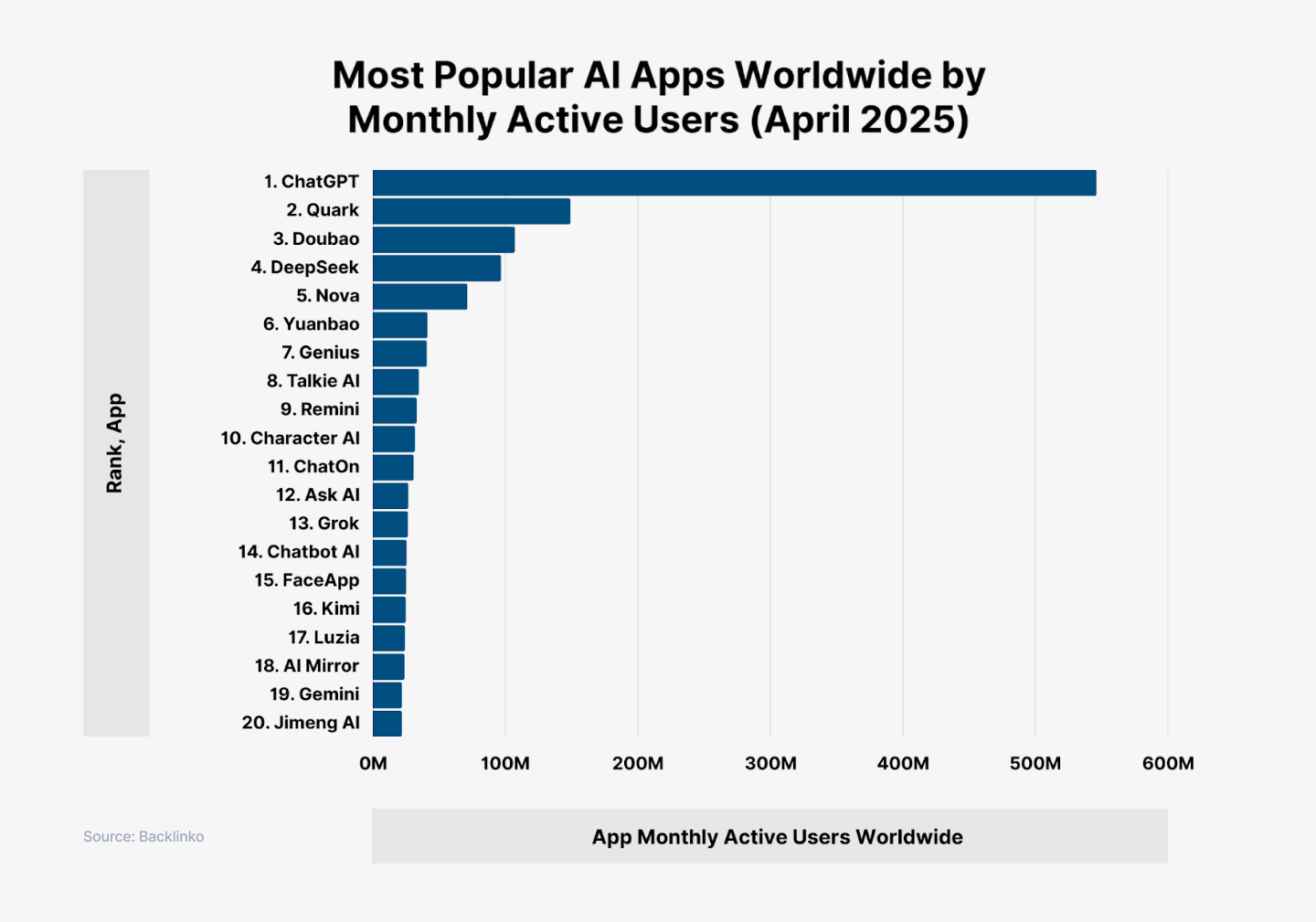
Source: Backlinko
The 800M-1B number includes ChatGPT embedded in third-party apps and API integrations. For core platform users, ChatGPT had 400 million monthly active users in February 2025 and 250 million weekly active users who consistently return.
Daily active users average 122 million, processing over 1 billion queries every day. That's 8-10x growth from 100 million weekly users in November 2023.
Here's the growth timeline:
- November 2023: 100M weekly users
- December 2024: 300M weekly users
- February 2025: 400M monthly users
- March 2025: 800M-1B weekly users
This clearly places ChatGPT at the forefront of AI tools worldwide, ahead of all competitors. Its reach and influence are not limited to the U.S. or tech-savvy users; it’s a mainstream tool impacting work, study, and life globally.
Which country has the most ChatGPT users?
According to Semrush data insights, the U.S. leads with 745.87 million ChatGPT users, followed by India with 401.38 million users and Brazil with 243.64 million users.
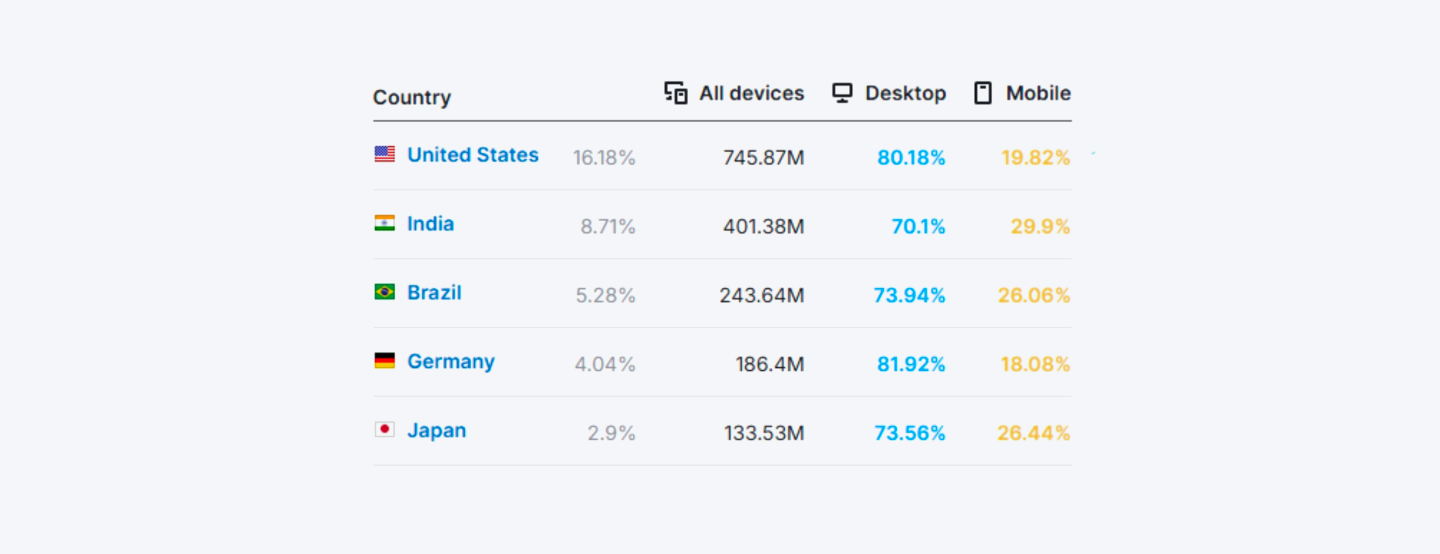
The U.S. and India are ChatGPT’s largest user bases, demonstrating strong adoption in both developed and emerging markets. These figures reflect significant market penetration and widespread utility across industries and demographics.
How many users does ChatGPT have each week?
ChatGPT currently has 800M-1B weekly users weekly active users. The company is converting free users to paid products at a rate of 5-6%.
A weekly base of 800 million users points to consistent and repeated usage, not just trial or curiosity. It suggests deep integration into user routines, especially for tasks like coding, writing, and research.
Compare DeepSeek and ChatGPT's performance, cost, and user experience to see which will dominate in 2025.
How People Actually Use ChatGPT: OpenAI's 2025 Study
OpenAI published the biggest study on AI usage in May 2025. They analyzed 1.5 million ChatGPT conversations from 700 million weekly users. Here's what they found.
The Three Types of Usage:
Asking (49% of all usage):
- People seeking information and factual answers
- Getting advice on decisions
- Consulting ChatGPT like an advisor
- Most valued category according to user ratings
Examples: "What are the pros and cons of React vs. Vue?" or "How should I approach this salary negotiation?" With half of ChatGPT usage being people asking for recommendations and advice, brands naturally want to know if they show up in these conversations. One easy way to do this is by using an AEO tool that shows what people are asking, whether your brand appears in ChatGPT answers, and how it's presented.
Doing (40% of all usage):
- Writing emails, reports, code, and content
- Planning projects and organizing info
- Task-oriented work where ChatGPT generates outputs
- About one-third of "Doing" is explicitly for work
Examples: Drafting documents, debugging code, creating presentations
Expressing (11% of all usage):
- Personal reflection and exploration
- Creative experiments and play
- Conversations without specific goals
- Just chatting and exploring ideas
Work vs. Personal Split:
30% of ChatGPT usage is work-related. That includes:
- Writing (top work task: emails, reports, documentation)
- Coding and debugging
- Research and fact-checking
- Data analysis
70% is personal/non-work usage. That includes:
- Learning new skills (26% of US adults)
- Entertainment and exploration (23% of US adults)
- Personal decisions and advice
- Creative hobbies
For Developers Specifically:
79% of developers use ChatGPT for work. That's higher than any other profession.
What developers do with it:
- Code generation and boilerplate (38% of full-stack devs)
- Debugging and error messages (57% of junior devs)
- Documentation writing
- Learning new languages and frameworks
- Code review and optimization
A Harvard/MIT study found that consultants using GPT-4 completed tasks 12.2% faster and produced 40% higher quality work than those without AI.
Who Uses ChatGPT:
The gender gap closed in 2025. In January 2024, only 37% of identifiable users were women. By mid-2025, usage matches the general adult population.
Age breakdown:
- 18-29 years: 43% have used ChatGPT (highest)
- 30-49 years: 30% adoption
- 50-64 years: 20% adoption
- 65+: 6% adoption
Education level:
- Postgraduate degree: 52% have used it
- Bachelor's degree: 51%
- Some college: 33%
- High school or less: 18%
Low and middle-income countries are growing 4x faster than high-income countries. ChatGPT is available in 195 countries but banned in 15 (China, Russia, Iran, Cuba, North Korea, Syria, and others).
ChatGPT Traffic Analysis: Where Users Come From
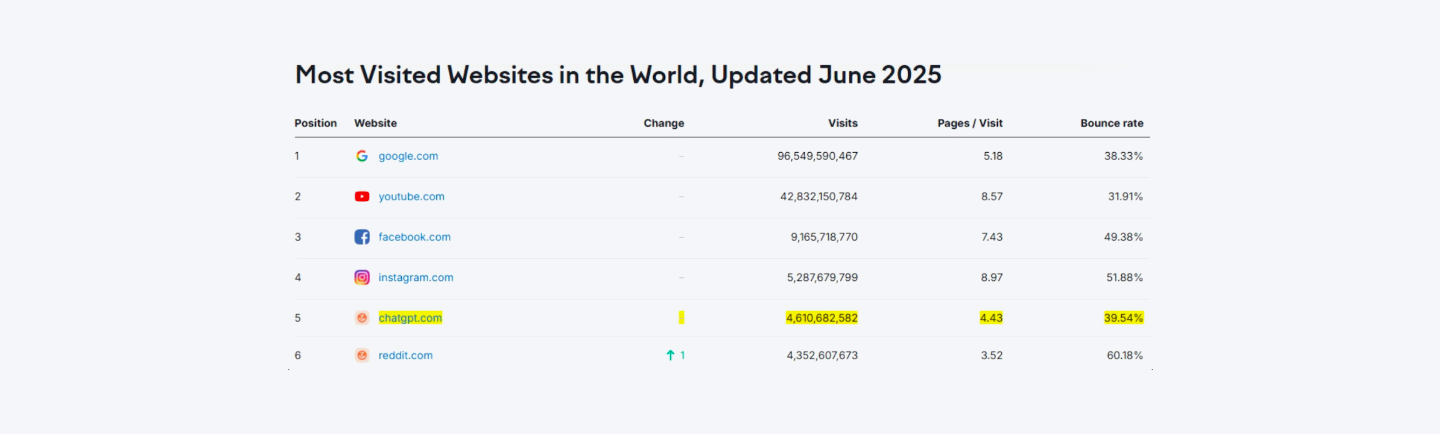
ChatGPT gets 5.8 billion monthly visits as of September 2025. That's up 7.6% from 5.39 billion in August. Daily visits average 193 million.
Website Ranking:
ChatGPT is the #6 most visited website globally (July 2025). Only Google, YouTube, Facebook, Wikipedia, and Amazon rank higher.
Traffic Sources:
79.77% of traffic is direct. That means people type chatgpt.com directly or have it bookmarked. This is unusually high and shows ChatGPT is a daily habit for most users, not something they discover through search.
The breakdown:
- Direct visits: 79.77%
- OpenAI.com referrals: 5.79%
- Google organic search: 5.10%
- Social media and other: 9.34%
Desktop vs. Mobile:
76.22% of traffic comes from desktop, 23.78% from mobile. Desktop dominance makes sense for a productivity tool. Most coding and writing happens on computers.
Mobile usage varies by region. In Sub-Saharan Africa, mobile makes up 57% of sessions. In the US, Europe, and Japan, it's 70%+ desktop.
Top Countries by Traffic:
- United States: 17.2% (70-77M monthly users)
- India: 8.27%
- Brazil: 5.73%
- Japan: 3.7%
- Germany: 3.39%
- United Kingdom: 3.2%
- South Korea: 2.8%
- France: 2.5%
- Canada: 2.3%
- Mexico: 2.1%
Session Length: Average session lasts 14 minutes 36 seconds. That's longer than Amazon (8-10 min), BBC News (5-7 min), and most social media. Shows people are doing actual work, not just quick lookups.
Pages Per Visit: Users average 4.4 pages per visit. This means they navigate through multiple conversations and threads, not just one-and-done searches.
When People Use It:
Peak hours (US timezone):
- Morning: 9 AM - 11 AM (work queries spike)
- Lunch: 12 PM - 2 PM (mixed work and personal)
- Evening: 7 PM - 10 PM (learning and personal projects)
Weekday usage is 60% higher than weekends. Monday through Thursday are peak days. Sunday is the lowest usage day.
ChatGPT usage by profession
Which profession uses ChatGPT the most?
Software developers top the chart with 79% ChatGPT adoption.
Developers have integrated ChatGPT into their workflows for coding, testing, and debugging. This high usage signals strong trust in its capabilities.
What about financial advisors?
Only 12% of financial advisors use ChatGPT at work; the total adoption rate is 34%.
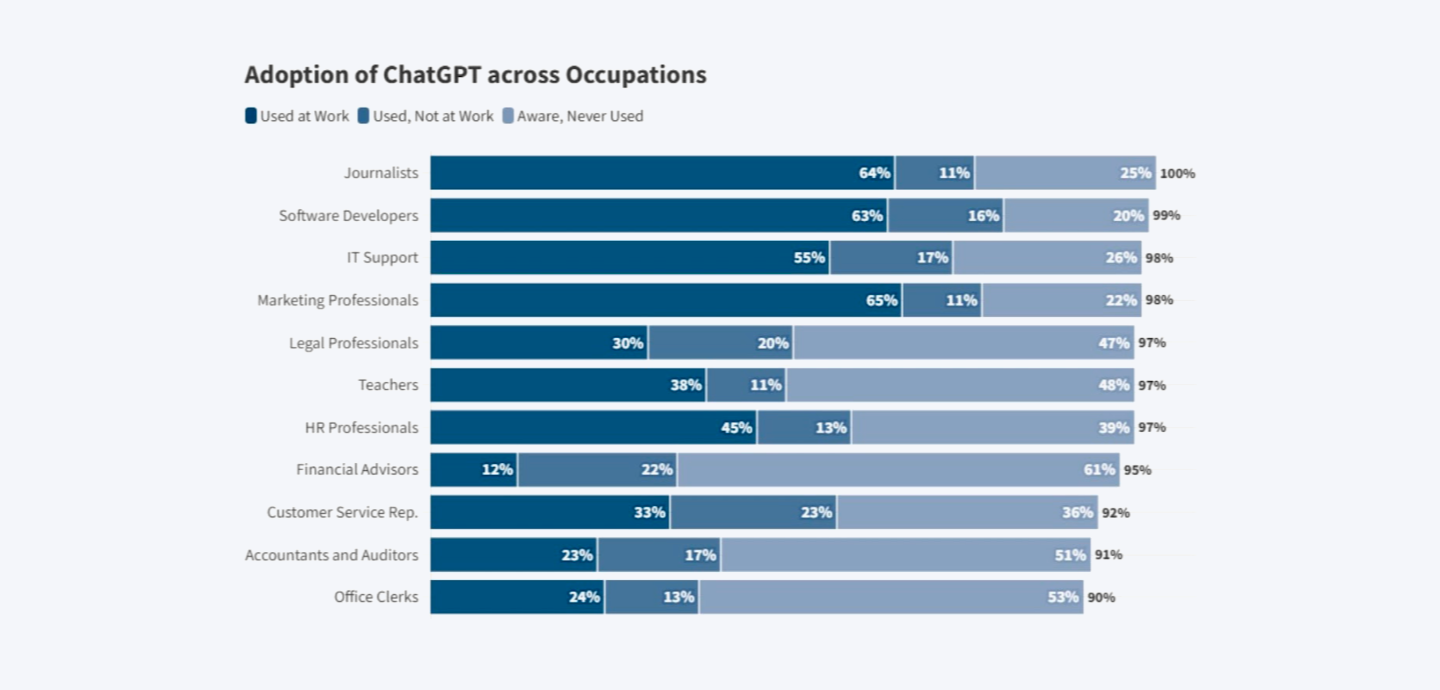
Financial professionals remain cautious about AI, possibly due to compliance concerns. But with 1 in 3 already using it, this industry may see more adoption soon.
How many U.S. employed adults use ChatGPT?
28% of employed U.S. adults use ChatGPT at work, up from 8% in 2023.
This 3.5x growth in work-related use over just two years shows how rapidly ChatGPT has entered the modern workplace.
ChatGPT demographics
Who uses ChatGPT more: men or women?
Women are 20% less likely to use ChatGPT than men in the same job.
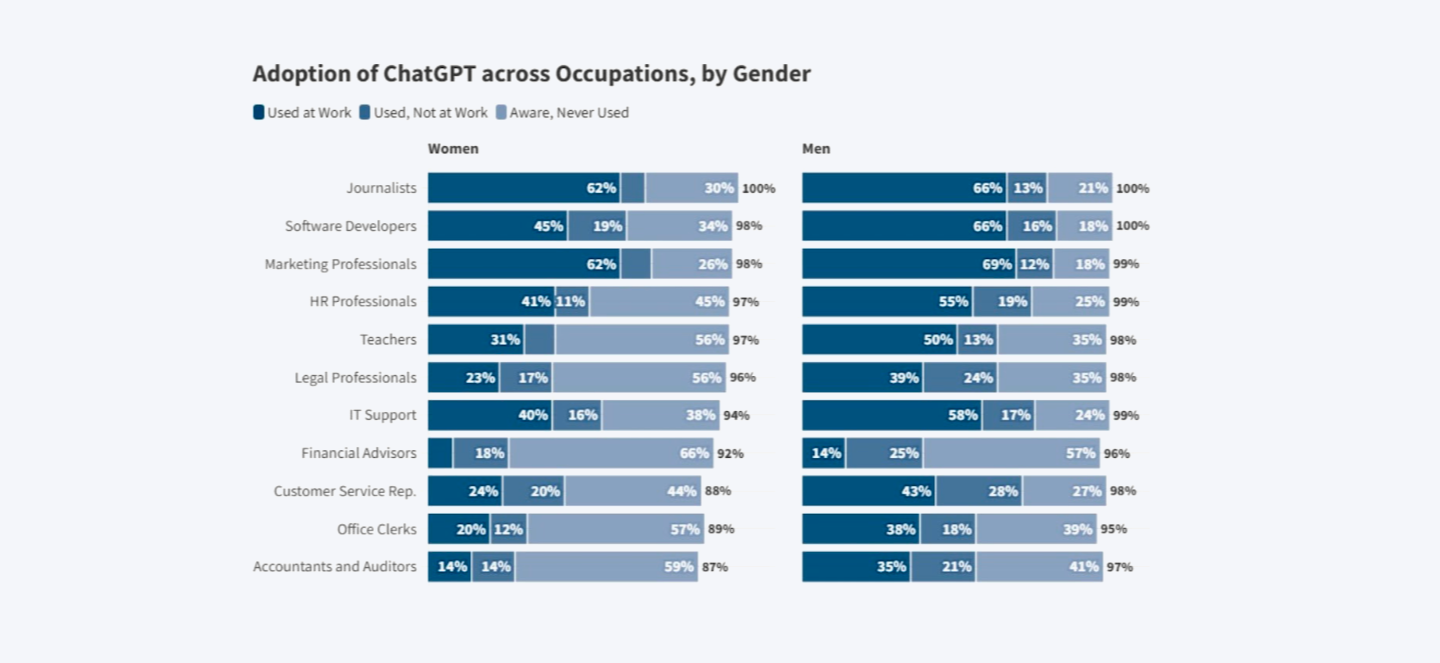
Overall adoption has become gender-balanced, but in professional settings, women remain underrepresented. This reflects broader tech industry dynamics.
What age group uses ChatGPT the most?
Among 18–24-year-olds, 56% have used ChatGPT at least once, and 16% of people above 55 years of age have used it..
Gen Z is the most AI-friendly generation so far. Their early and enthusiastic adoption may shape future job markets and education systems.
How is ChatGPT used in education?
About one-third of U.S. college-aged adults use ChatGPT, with roughly 25% of their messages related to school work.
ChatGPT is quickly becoming a digital study partner. Students rely on it for explanations, assignments, and writing help.
ChatGPT recognition and growth
How quickly did ChatGPT gain traction after its launch?
ChatGPT gained one million users just five days after its November 2022 launch.
This record-breaking growth showed immense public interest and demand for AI-powered assistance. It helped set a precedent for ChatGPT’s explosive user base.
What is the global recognition rate of ChatGPT?
ChatGPT is the most recognized and used generative AI tool across Argentina, Denmark, France, Japan, the UK, and the USA. It is 2-3x times more popular than Google Gemini and Microsoft Copilot.
ChatGPT’s dominance spans continents. It is not just a regional tool; it holds global mindshare, even in tech-savvy and AI-conscious markets.
How many people interact with ChatGPT daily?
Over 1 billion user messages are sent on ChatGPT every day.
This message volume reflects not just usage but reliance. It reveals ChatGPT’s integration into millions of daily workflows and personal routines.
ChatGPT Revenue and Business Performance
What’s the revenue forecast for OpenAI?
OpenAI reportedly generated $3.7 billion in revenue in 2024 and expects $29.4 billion by 2026. This massive projected jump shows growing monetization through consumer, enterprise, and API channels, reflecting ChatGPT’s shift from a novelty to a core business tool.
How much has OpenAI raised in funding?
OpenAI has raised $57.9 billion over 11 rounds, including a $40B Series F in March 2025 led by SoftBank.
OpenAI's capital-raising success positions it as a dominant player in AI innovation. Massive backing also signals investor belief in long-term profitability.
What portion of OpenAI’s B2C sales comes from ChatGPT Pro?
ChatGPT Pro makes up nearly 5.8% of OpenAI’s B2C sales. Though a small slice of the overall pie, Pro subscriptions represent loyal power users. These users drive consistent revenue and serve as use-case champions.
How dominant is ChatGPT in the paid AI tool space?
In November 2024, ChatGPT captured 62.5% of the market share of B2C AI subscription tools. No other paid AI tool even comes close. ChatGPT’s brand trust, functionality, and ease of use make it the clear market leader.
How much of OpenAI’s business is consumer-driven?
Roughly 75% of OpenAI’s business revenue comes from consumer subscriptions.
The company’s foundation rests on individuals using ChatGPT. This reinforces the need to keep improving usability and consumer features.
ChatGPT Language and Feature Access
How many languages does ChatGPT support?
ChatGPT presently supports 59 languages. Multilingual support allows ChatGPT to reach broader user bases and better serve global enterprises, educational institutions, and governments.
In how many countries is ChatGPT available?
ChatGPT is accessible in 188 countries and regions. ChatGPT is one of the most globally available tech platforms with a presence in nearly every country, ready for both personal and professional use.
ChatGPT in Enterprise Use Cases
Which Fortune 500 brands use ChatGPT?
Major brands like PwC, Canva, Zapier, Klarna, Carlyle, Estée Lauder, and Block are ChatGPT adopters. These early adopters validate the real-world business value of ChatGPT, from internal communication and customer support to software development.
What tools does ChatGPT Enterprise offer for admins?
ChatGPT Enterprise provides Single Sign-On (SSO), domain verification, a centralized admin console, and an analytics dashboard. These features make ChatGPT scalable for large organizations, helping IT teams manage usage, compliance, and productivity across departments.
It guarantees that customer data is never used to train models, ensuring full data segregation for enterprise clients. This assurance increases trust and paves the way for regulated industry adoption.
What’s the ROI for companies using ChatGPT Enterprise?
Klarna improved employee performance and scaled support to millions of users using ChatGPT. This shows how deploying ChatGPT Enterprise isn’t just about experimentation; it creates tangible productivity and support gains.
ChatGPT’s Market Share and Visibility
How much market share does ChatGPT have in AI chatbots?
ChatGPT owns 79.76% of the AI chatbot market as of June 2025. Its wide use, frequent updates, and brand strength make it difficult for competitors to catch up.
What is ChatGPT’s Authority Score online?
ChatGPT holds an authority score of 94. This high SEO score signifies credibility, widespread backlinks, and strong user engagement. It cements ChatGPT’s leadership in organic search visibility.
How many referring domains mention ChatGPT?
ChatGPT now has 158,640 referring domains, a 7.27% increase. More websites across industries are linking to ChatGPT, indicating growing brand reach, relevance, and content usage in thought leadership.
How does ChatGPT rank in organic vs. paid traffic?
ChatGPT saw 71.56M organic visits (+4.12%) and 18.01M paid visits (+23.56%) in June 2025. It means organic traffic still dominates the industry, but ChatGPT is increasingly investing in paid campaigns, possibly to target new sectors or geographies.
ChatGPT in the Workforce
How many workers say ChatGPT boosts their productivity?
Workers estimate that ChatGPT can cut the time spent on one-third of their job tasks by half. They say using ChatGPT is a time-saver. That perception alone justifies its place in day-to-day work for efficiency and output.
How many workers have been affected by GPTs?
Around 80% of U.S. workers could have at least 10% of their tasks affected, while 19% may see over half of their tasks impacted. Generative AI isn’t just an assistant; it’s reshaping how jobs are done. Entire workflows may be redesigned as GPTs gain more traction.
How does education level affect ChatGPT usage?
45% of postgraduates use ChatGPT for work vs. 36% (bachelor’s), 25% (some college), and 17% (high school or less).
Higher-educated professionals are early adopters of ChatGPT, likely due to comfort with new tools and the nature of their work, benefiting from AI augmentation.
Developer Engagement and Mobile Reach
How many developers in the U.S. have built on OpenAI?
1.3 million U.S. developers have created projects on OpenAI’s platform. This developer base contributes to rapid experimentation and the rise of AI-enhanced apps, services, and plugins.
How many total weekly active users does ChatGPT have now?
ChatGPT currently has 800M-1B weekly active users. Compared to earlier numbers, this represents a rise, suggesting ChatGPT’s stickiness and growing user demand on a weekly cycle.
How many iOS and Android devices have ChatGPT installed?
ChatGPT reached 52 million iOS and Android installs, up 12% since March and 38% since January.
Strong month-over-month ChatGPT installation growth indicates surging mobile usage and brand penetration into mainstream mobile habits.
ChatGPT and AI-Generated Content
Can users identify if content was AI-generated?
In a survey of 1,900 Americans, 53% couldn’t identify AI-written content, rising to 63.5% with GPT-4.
AI content has become incredibly realistic. GPT-4’s output is often indistinguishable from human writing, raising new challenges for content detection and attribution, especially as users increasingly rely on tools to humanize AI writing for professional and creative use.
How much better is GPT-4 than GPT-3.5 at sounding human?
GPT-4 is 16.5% more convincing than GPT-3.5 in making users believe the content was human-written. The jump in believability demonstrates rapid improvements in language quality, tone, and coherence from one generation to the next.
What are the top use cases for ChatGPT?
ChatGPT is mainly used for media creation (28%) and information search (24%).
Users generate content like emails, stories, essays, and ask factual questions on ChatGPT. This confirms the platform’s creative edge over being just a search alternative.
According to Statista, 20% of the adults use ChatGPT for work, 17% to learn something new, and 17% for entertainment.
How is media creation divided?
Media creation by ChatGPT includes writing text (Email (9%), essays (8%), creative writing (7%)), image generation (9%), coding (5%), video generation (4%), audio generation (3%), and casual experimentation (11%).
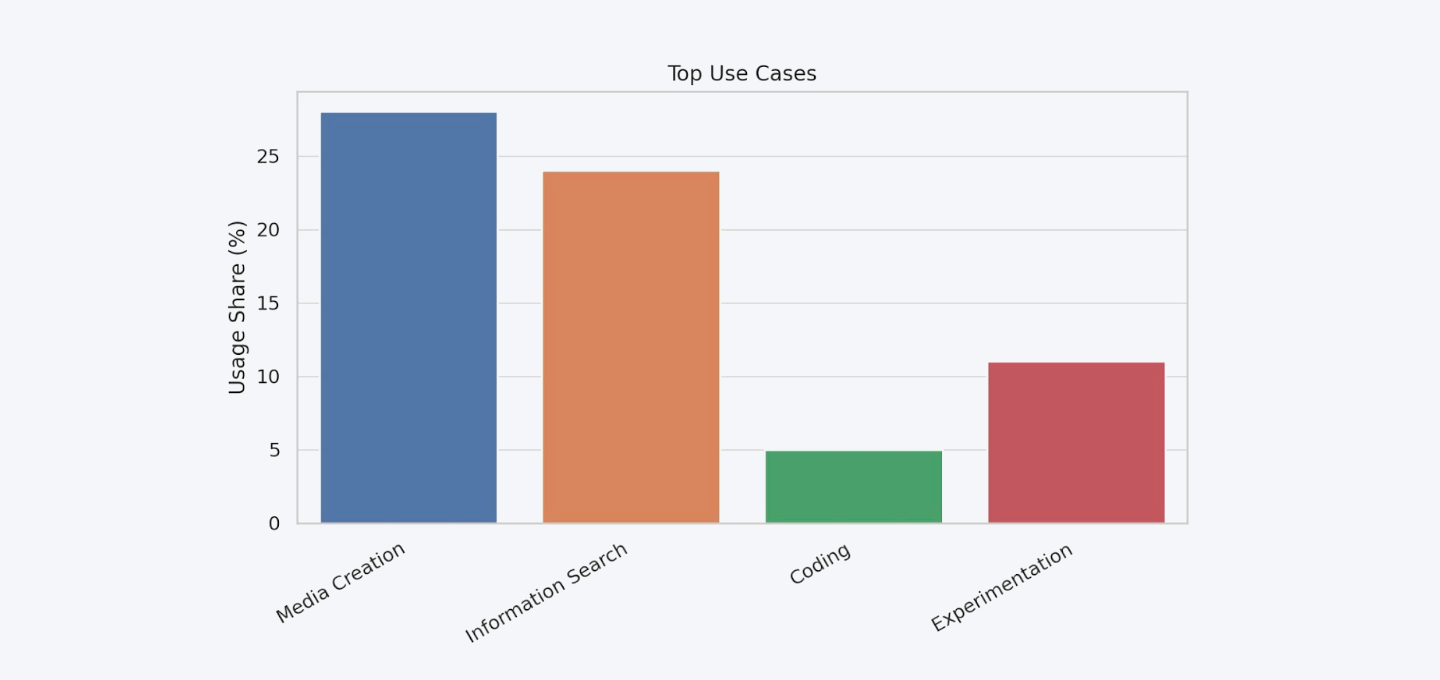
ChatGPT serves many creator personas. Whether you’re writing, coding, or just playing with ideas, it meets a wide variety of creative demands.
How many people worldwide use ChatGPT systems?
Sam Altman said around 10% of the world now uses ChatGPT systems, nearly 800 million people.
This estimate showcases ChatGPT’s reach beyond active app users. It hints at broader adoption through integrations, API usage, and third-party apps.
Conclusion
ChatGPT went from 100 million weekly users in late 2023 to 800 million-1 billion in March 2025. The May 2025 OpenAI study shows people don't just use it occasionally. They integrate it into daily work, spending 30% of time on work tasks and averaging 14.5-minute sessions.
For developers at Index.dev, ChatGPT's 79% adoption rate among developers and proven productivity gains (12.2% faster tasks in Harvard/MIT studies) make it standard equipment. We use it for code generation, debugging, and documentation.
The numbers show ChatGPT isn't just the most popular AI tool. It's changing how people work, with 92% of Fortune 500 companies using it and 28% of US employed adults relying on it for work tasks. The usage split (49% asking, 40% doing, 11% expressing) proves it's useful for more than just quick answers.
ChatGPT isn't going anywhere. If you're building a development team in 2025, ChatGPT fluency is table stakes. At Index.dev, all our vetted developers use it daily.
Ready to hire developers who already know ChatGPT? Get 3 interview-ready candidates in 48 hours. Schedule a consultation with Index.dev team.
ChatGPT vs Perplexity: Which AI Assistant Is Better for Coding?


