DeepSeek vs Claude — which AI model should you use in 2025?
The short answer: Claude excels at creative writing, reliable code generation, and conversational tasks, while DeepSeek offers superior cost-efficiency, stronger math reasoning, and open-source flexibility.
For coding specifically, Claude produces more maintainable, production-ready code, but DeepSeek Coder wins on benchmarks and supports 338 programming languages at a fraction of the cost. This comprehensive comparison breaks down DeepSeek (V3, R1, Coder) vs Claude (3.7 Sonnet, Opus) across benchmarks, real-world tests, pricing, and specific use cases to help you choose the right AI for your needs.
Join Index.dev to work on cutting-edge AI projects with global companies. Get matched with top opportunities today!
DeepSeek vs Claude: Quick Comparison Table
Feature | DeepSeek | Claude |
|---|---|---|
Best For | Coding benchmarks, math, cost-sensitive apps | Creative writing, reliable code, enterprise use |
Coding Score | 91% HumanEval, excels at competitive programming | 64% agentic eval, better maintainable code |
Math (MATH-500) | 90.2% | 88% |
Context Window | 128K tokens | 200K tokens |
Pricing (API) | ~$0.14-0.55/M tokens (15x cheaper) | $3-15/M tokens |
Open Source | Yes (can self-host) | No |
Web Search | Built-in | No native search |
Image Generation | Via code only | SVG, charts, React components |
Best Model | DeepSeek-R1 (reasoning), Coder V2 | Claude 3.7 Sonnet |
Bottom line: Choose DeepSeek for budget-conscious development, algorithmic challenges, and math-heavy tasks. Choose Claude for production code quality, creative content, and enterprise reliability.
Explore More: For a broader look at Chinese AI developments, see our guide to top Chinese AI models like DeepSeek.
Background of DeepSeek and Claude
What Is DeepSeek?
DeepSeek AI is an advanced large language model (LLM) created by a Chinese AI startup founded by Liang Wenfeng in May 2023. The company specializes in developing efficient and cost-effective AI models, particularly for enterprise applications.
DeepSeek's models, including DeepSeek-V3 and DeepSeek-R1, leverage cutting-edge machine learning techniques such as the Mixture-of-Experts (MoE) architecture.
This method optimizes computing resources by activating only the necessary parts of the model, enabling high performance at a lower cost. As a result, DeepSeek has emerged as a strong competitor in the AI landscape.
What Is Claude?
Claude AI is an advanced artificial intelligence chatbot and large language model (LLM) developed by Anthropic, an AI startup founded in 2021 by former OpenAI employees, including Dario Amodei and Daniela Amodei. It was launched in March 2023 and has undergone several iterations, with Claude 3.7 being the latest version.
Claude AI specializes in generating human-like text responses, handling tasks like summarization, Q&A, decision-making, coding, and multilingual translation. It operates on transformer architecture and uses "Constitutional AI," a training method emphasizing ethical principles to ensure safety and reliability. Anthropic aims to create AI systems that are helpful, harmless, and honest.
To understand how these large language models work under the hood, check out our explainer on what LLMs are and how they function.
DeepSeek vs Claude for Coding: Which Is Better?
Coding is where these two AI models show the sharpest contrast. Here's how they compare across different programming scenarios:
Benchmark Performance:
Benchmark | DeepSeek | Claude |
|---|---|---|
HumanEval | 91% | 64% (Sonnet) |
Codeforces Rating | 2,029 Elo (96.3 percentile) | Not specialized |
SWE-bench Verified | 55% (V3) | 72.5% (Opus) |
Languages Supported | 338 | ~50+ |
Debugging Accuracy | 90% | 75% |
Real-World Coding Tests:
In practical tests (building games, web apps, debugging), the results are more nuanced:
- Claude wins for: Maintainable code, clear documentation, multi-step agentic tasks, full-stack applications, and code that "just works" without debugging
- DeepSeek wins for: Algorithmic challenges, competitive programming, mathematical code, and cost-sensitive batch processing
Developer Feedback (Reddit):
- "Sonnet is the best... if you want to get stuff DONE and not have to fix errors" — wuu73
- "DeepSeek excels as a coding architect" — multiple users on AI IDEs
- "Better for me, especially for recall in a large codebase" — khromov on Claude
Recommendation: For most production development work, Claude produces more reliable, deployment-ready code. For competitive programming, algorithm optimization, or when budget is critical, DeepSeek Coder delivers excellent results at 15x lower cost.
DeepSeek Coder vs Claude: Head-to-Head
DeepSeek Coder is a specialized model optimized specifically for programming tasks. Here's how it stacks up against Claude for coding:
DeepSeek Coder V2 Strengths:
- Support for 338 programming languages (vs ~50 for Claude)
- Mixture-of-Experts architecture for efficient code generation
- Open-source — can run locally for privacy-sensitive projects
- 128K context window for entire codebase understanding
- Integrates with VS Code, PyCharm, and other IDEs
Claude Code Strengths:
- Deep IDE integration (VS Code extension, GitHub Copilot)
- Multi-hour agent runs with checkpoints
- Better at explaining code and writing documentation
- More reliable for production-ready, maintainable code
- Superior at multi-file refactoring and architectural decisions
When to Use Each:
Use Case | Better Choice |
|---|---|
Competitive programming | DeepSeek Coder |
Production web apps | Claude |
Algorithm optimization | DeepSeek Coder |
Code reviews & documentation | Claude |
Self-hosted/private deployment | DeepSeek Coder |
Enterprise team collaboration | Claude |
Budget-constrained projects | DeepSeek Coder |
Complex debugging sessions | Claude |
User Interface of AI models
DeepSeek

The DeepSeek interface is organized with a general message box, where users can input text and interact with the AI. Alongside it, there is a Deep Thinking Mode toggle button, which enhances response quality, and a Web Search option for retrieving real-time information.
Then, an upload button, allowing users to upload files for analysis. Users can upload up to 50 files, with each file having a maximum size of 100 MB. This streamlined design ensures an efficient and user-friendly experience.
Claude
In the Claude interface, with the message section, the Upload button offers three options for adding content. Users can upload files, allowing them to share documents or images for analysis. The Take a Screenshot option enables users to capture and upload screenshots directly within the interface.

Additionally, the Add GitHub feature allows users to link and analyze code from a GitHub repository. Alongside these options, there is also a Writing Style button, which lets users customize the tone and format of responses to better suit their needs.
Observations: Both interfaces are user-friendly. DeepSeek is streamlined with deep thinking web search, while Claude offers more options like screenshots and GitHub integration. Claude's interface might be preferable for users needing direct content uploads and modifications.
Exlpore: Flowise vs LangGraph vs n8n: Agent Framework Comparison
DeepSeek vs Claude Pricing (2025)
Pricing is where DeepSeek's value proposition becomes undeniable:
DeepSeek API Pricing:
- Input tokens: $0.14/M (cache hit) to $0.55/M (cache miss)
- Output tokens: $2.19/M
- DeepSeek is free to use on their website
- Models can be downloaded and self-hosted at no cost

Claude API Pricing:
- Claude 3.7 Sonnet: $3/M input, $15/M output
- Claude Opus: $15/M input, $75/M output
- Prompt caching: Up to 90% savings
- Batch API: 50% discount

Cost Comparison Example:
For 1 million input + 1 million output tokens:
- DeepSeek: ~$2.75
- Claude Sonnet: ~$18
- Claude Opus: ~$90
Verdict: DeepSeek is approximately 6-15x cheaper than Claude depending on the model tier. For high-volume applications, batch processing, or startups on tight budgets, DeepSeek's pricing is a game-changer.
AI Models
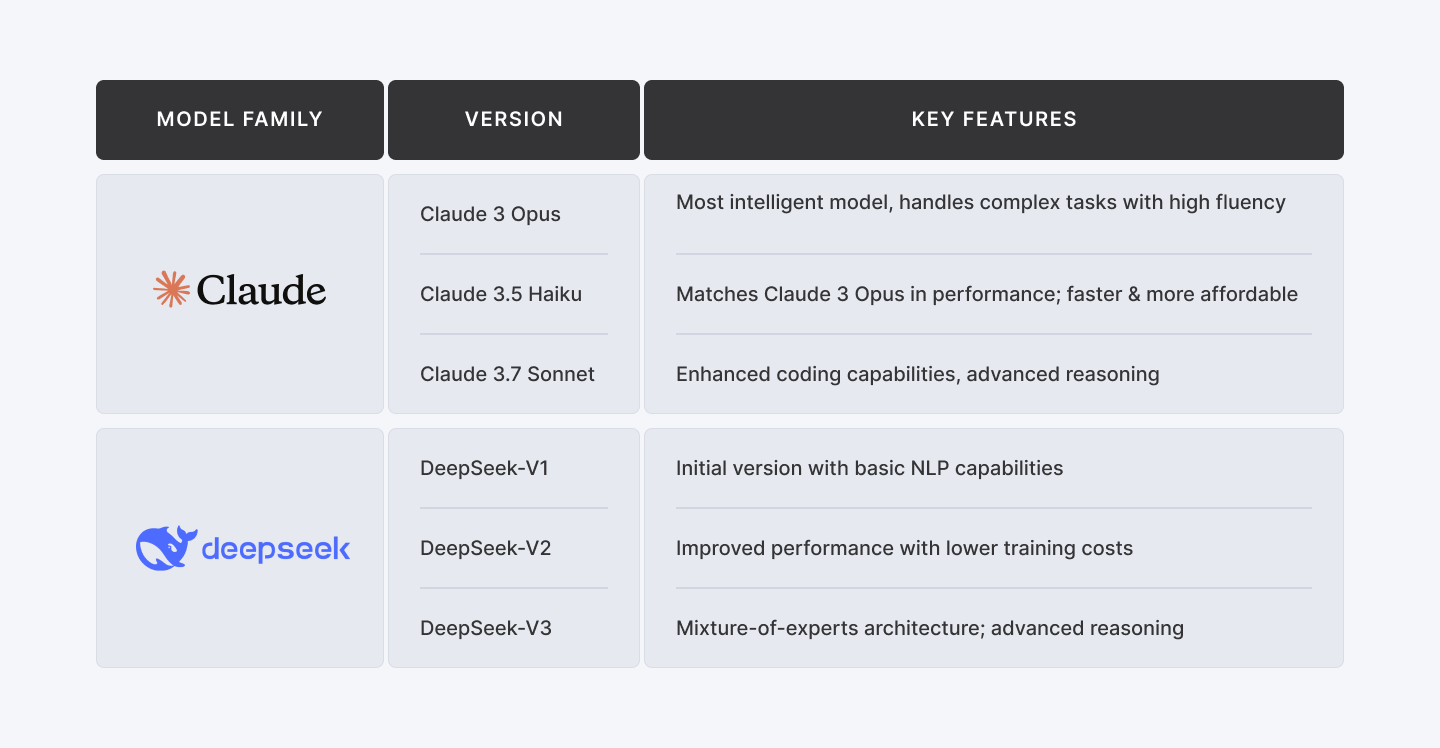
Observations: Claude offers models tailored for fluency, speed, and reasoning. DeepSeek focuses on open-source coding models. Claude has a more diversified model, offering different strengths.
Efficiency of DeepSeek and Claude
Comparing the efficiency of DeepSeek and Claude AI involves analyzing their architecture, performance, cost-effectiveness, and specific strengths in various applications. Here is a detailed comparison:
Architectural Efficiency
- DeepSeek: Utilizes a Mixture-of-Experts (MoE) architecture, activating only 37 billion out of 671 billion parameters per query. This design optimizes computational efficiency while maintaining high performance, especially in coding and mathematical reasoning tasks.
- Claude: Focuses on ethical AI design and reasoning capabilities, with models like Claude 3.7 Sonnet excelling in complex problem-solving and natural language communication. It also benefits from a larger token limit (200,000 tokens), enabling efficient handling of extensive context.
Performance Benchmarks
- Quantitative Reasoning: DeepSeek achieves an 86% accuracy on MATH-500 benchmarks, slightly behind Claude's 88%.
- Coding: DeepSeek excels with a 91% score on HumanEval coding tasks but struggles with advanced challenges like game development, where Claude performs better.
- Multimodal Understanding: Claude leads in multimodal tasks like image analysis and explanation, while DeepSeek lacks multimodal capabilities.
Observations: DeepSeek's MoE architecture optimizes resources. Claude excels in complex problem-solving with a larger token limit. DeepSeek may be more efficient for specific coding and math tasks, while Claude handles extensive context very well.
If you're looking to hire developers skilled in AI-powered tools, see our guide to hiring AI developers.
Data Analysis with DeepSeek and Claude
For experimental purposes, we used both DeepSeek and Claude to analyze one set of GDP data. Then asked to share key insights from the datasets and create a visualization of this data.
Data Insights by DeepSeek:
DeepSeek provided detailed analysis using the given data as below.

Deepseek was not able to generate any visuals, though it used Python programming language to create a line chart code to represent the data.

Data Insights by Claude:
Claude shared this detailed data analysis for the same:

Additionally, Claude created a graphical representation for this data.

Observations: Claude provides visualizations directly, while DeepSeek offers code for generating them. Claude wins for immediate insights; DeepSeek provides code for customizable visuals if the user runs the code separately.
Content Creation
We created the same content from Deepseek and Claude using the same prompt. Both articles, generated by Claude and DeepSeek, show clear differences that highlight the strengths of each AI model.
Content Creation Using DeepSeek:
DeepSeek, known for its technical expertise, creates content that is rich in detail and precision. It dives deep into AI technologies, using specific examples and metrics to support its points. Its language focuses on efficiency and performance, often with more creative phrasing. Since DeepSeek has a deep thinking feature and access to open-source, users can customize it, leading to more unique and technically advanced articles.

Content Generation Using Claude:
On the other hand, Claude prioritizes clarity and structure, making its content easy to read and logically organized. It places a strong emphasis on ethical considerations and real-world context, ensuring that its articles are both informative and responsible.

Claude maintains a consistent tone and carefully follows guidelines, producing well-organized and relevant content. Its strength in long-form writing helps present complex topics in a way that is easy to understand. It also offers an option to modify AI-generated responses using the “improve” feature as required by the user.
Observations: While DeepSeek offers deeper technical insights and more creative variety, Claude excels at clear communication and ethical awareness. This makes Claude a strong choice for producing polished and informative content.
Visual Creation
Visual Creation in DeepSeek:
In terms of image generation, DeepSeek is not yet able to create any kind of visuals. DeepSeek is capable of generating images indirectly by providing you with the necessary code to create visuals, rather than creating the images directly.
For example, if you need to generate charts, graphs, or other visual content, DeepSeek can supply you with Python code (using libraries like Matplotlib, Plotly, etc.) that you can run in environments like Google Colab, Jupyter Notebook, or a local Python setup.

By running this code, you can produce the desired visual content, such as data visualizations, interactive charts, and diagrams, based on your specifications. While DeepSeek itself cannot render images directly, it offers a practical solution for users who are comfortable running code to create their own visualizations.

Visual Creation Using Claude:
Claude can generate a wide range of visual content, primarily using SVG (Scalable Vector Graphics) for static images. These include simple landscapes with elements like skies, clouds, trees, and lakes, as well as charts and graphs such as bar charts, line charts, and pie charts.

Claude also excels at creating diagrams like flowcharts, sequence diagrams, and technical illustrations. Additionally, it can generate more complex diagrams like entity-relationship diagrams, Gantt charts, and user journey maps.
For interactive visuals, Claude can produce React components and HTML/CSS-based layouts, making it suitable for both static and dynamic web content.
Logical Reasoning
To compare their logical ability, we asked the same number sequence question to both AI models.
Claude provided a single, well-structured logical answer, demonstrating a clear and direct reasoning process.

In contrast, DeepSeek took a more comprehensive approach, offering two different methods to solve the problem.

Observations: While both models arrived at the correct response, their distinct problem-solving strategies highlight the variations in their reasoning and approach to logic.
Real-time Information Access
Web Search In DeepSeek:
DeepSeek offers an advanced web search feature that allows you to access real-time information by scanning the web and fetching suitable pages. This allows DeepSeek to provide you with the latest trends, news, or updates based on current events or topics of interest.
For example, if you're looking for the latest image trends about Studio Ghibli, DeepSeek will search the web and deliver relevant results as below to keep you in the know.

Limited Real-Time Data in Claude:
Claude, on the other hand, does not have the ability to browse the web or provide live updates. Claude’s knowledge is based on pre-existing data up until its training cutoff in October 2024.
While it can't fetch real-time information, it can offer in-depth insights and advice based on the extensive knowledge it has. If you're looking for real-time trends or up-to-date details, you'll need to turn to Deepseek or search engines like Google or Bing.
Observations: DeepSeek offers real-time web search, which Claude lacks. DeepSeek is better for up-to-date info; Claude for insights based on existing knowledge.
Popularity
Based on Google Analytics data for the past 30 days, DeepSeek has shown a significant lead in popularity, with nearly three times the user engagement compared to Claude.

This sharp difference in traffic and interaction suggests that DeepSeek’s standout features—such as real-time web search capabilities, deep thinking algorithms, and intelligent insights—are playing a key role in driving user demand.
These features, which allow users to access the latest information and receive thoughtful, complex responses, likely contribute to DeepSeek’s rapid rise in popularity.
Coding Assistant
We used a basic prompt to generate a loan calculator, and both DeepSeek and Claude performed exceptionally well. Both platforms wrote the necessary code using HTML, CSS, and JavaScript to calculate monthly payments, interest rates, and loan terms, while also incorporating a clean and user-friendly interface for easy interaction.
While we used a basic prompt, both platforms are capable of adjusting to more specific or detailed inputs. You can customize your prompt according to your needs, and both DeepSeek and Claude will provide accurate and effective solutions, ensuring the result is tailored to your requirements.
DeepSeek Generated Interface:


Claude Generated Interface:

Observations: Both perform well, with similar interfaces. The choice depends on user preference and specific prompt details.
Features that DeepSeek Has but Claude Doesn’t
DeepSeek offers several distinctive features that set it apart from Claude. One key difference is its integrated internet search capability, allowing it to access real-time information from the web while providing responses. This feature enables DeepSeek to deliver up-to-date content, a significant advantage over systems like Claude that lack this web-connected search functionality.
Additionally, DeepSeek's "DeepThink" mode enhances transparency by displaying its reasoning process as it formulates answers. This feature gives users insight into the AI's thought process, which is not typically available in the free version.
Another notable advantage is DeepSeek's approach to model development. AI has been designed to use innovative techniques that reduce the need for human intervention, lowering computational costs while still delivering powerful and efficient AI models. These features contribute to DeepSeek's ability to perform deep thinking combined with real-time web search, providing a more dynamic and informed experience compared to Claude.
Features that Claude Has but DeepSeek Doesn’t
Claude AI offers a unique combination of features that set it apart from other models like DeepSeek R1. One of its standout features is the Artifacts capability. This feature allows users to generate fully formatted outputs, such as web pages or documents, and view them side-by-side with their conversation in real time.
Users can edit or tweak these outputs directly within the interface, streamlining workflows without needing to switch between applications. This capability enhances productivity and efficiency by keeping all relevant information in one place.
In fact you can add GitHub directly to your Claude account and do further analysis.

DeepSeek vs Claude: Who Is the Winner?
Determining a clear "winner" between DeepSeek and Claude is complex as each AI model presents different strengths serving different user needs.
DeepSeek shines with its real-time web search and "DeepThink" mode, offering up-to-date information and transparent reasoning. Its efficient architecture and cost-effective API, particularly for coding, make it ideal for developers, researchers, and anyone needing current data or detailed technical insights.
DeepSeek provides robust coding assistance, capable of generating functional code based on user prompts. This AI is perfectly suited for those who prioritize practical applications, coding assistance, and staying informed with the latest web information.
Claude, on the other hand, excels in ethical content generation, multimodal understanding (especially image analysis), and its unique "Artifacts" feature for real-time output editing. Its strength in clear communication and complex problem-solving makes it highly suitable for content creators, writers, and professionals who value clarity, ethical considerations, and seamless workflow integration.
Claude also offers strong coding capabilities, including direct GitHub integration for code analysis and generation, catering to development-focused users.
Claude is perfect for individuals and teams looking for an AI that can handle intricate tasks while maintaining a strong focus on ethical and polished outputs, with capable coding support.
Final Words
The DeepSeek vs Claude debate ultimately comes down to your priorities:
Choose DeepSeek if you need:
- Maximum cost efficiency (15x cheaper than Claude)
- Strong math and algorithmic reasoning
- Open-source flexibility and self-hosting
- Competitive programming and benchmark performance
- Built-in web search capability
Choose Claude if you need:
- Reliable, production-ready code quality
- Creative writing and human-like conversation
- Enterprise-grade safety and compliance
- Superior documentation and code explanations
- Multi-step agentic workflows and IDE integration
For development teams: Many organizations now use both — DeepSeek for development, testing, and cost-sensitive batch processing, while reserving Claude for production customer-facing applications where reliability matters most.
Building AI-powered applications? Hire pre-vetted AI developers through Index.dev to integrate DeepSeek, Claude, or both into your product.
For Developers: Ready to build AI-powered solutions? Join Index.dev's talent network and get matched with companies seeking AI expertise like yours.
For Clients: Need developers who understand cutting-edge AI like DeepSeek and Claude? Access the top 5% of vetted developers through Index.dev's 48-hour matching.