A good DevOps Team Lead does more than write scripts and manage pipelines. They build systems, guide teams, and keep things running smoothly under pressure. That’s why hiring for this role takes more than a standard tech interview. The role requires a mix of hands-on experience, problem-solving ability, and strong communication.
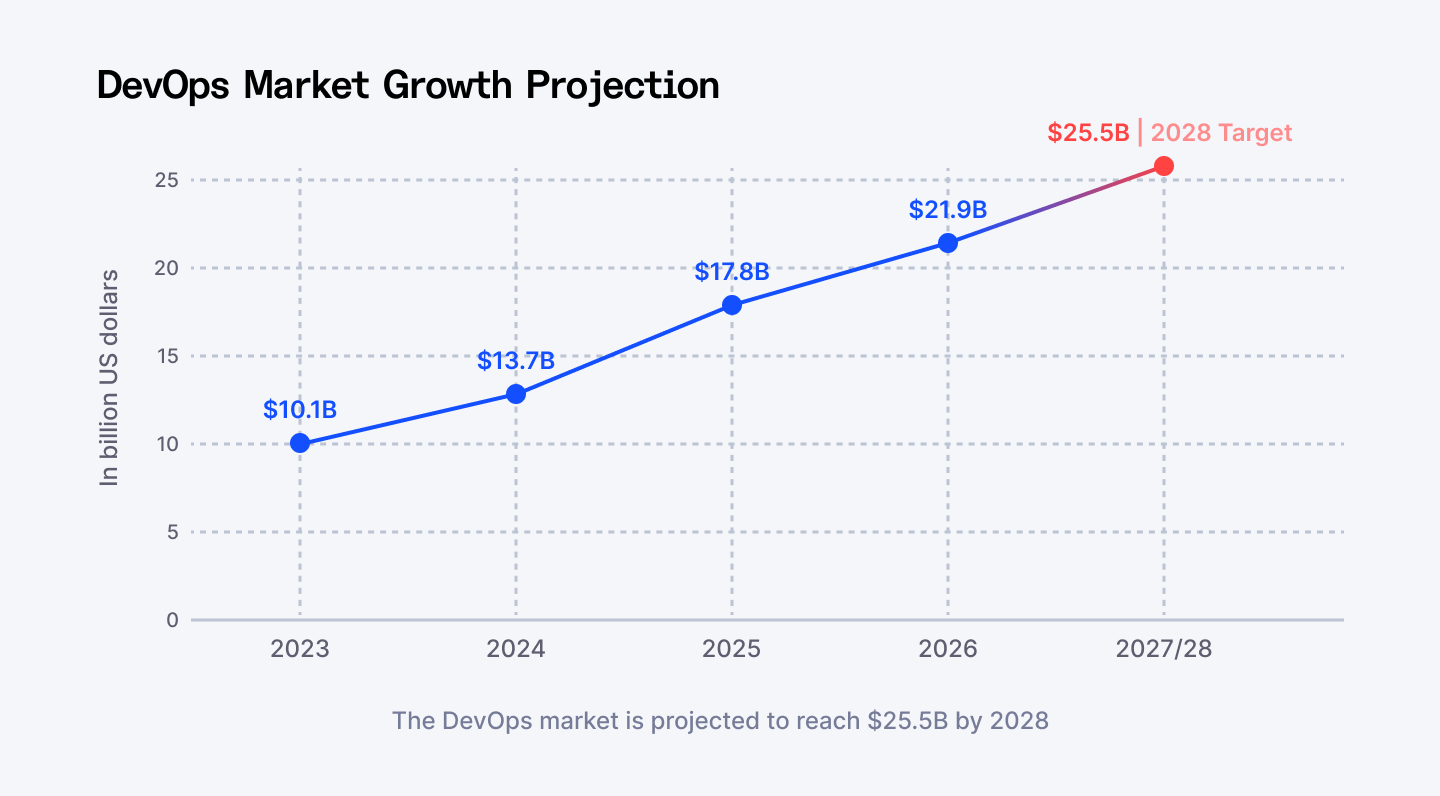
It’s important to adopt a hiring framework that simultaneously evaluates a candidate’s technical expertise as well as their leadership capabilities. Especially since industry reports state that the DevOps market is projected to hit $25.5 billion by 2028 and a striking 86% of professionals advocating DevOps culture for faster software delivery.
Hire Top 5% DevOps Leaders! Access vetted experts, match in 48 hours, and get a 30-day free trial.
Understanding the Role of a DevOps Team Lead
DevOps team leads work at a unique crossroads. Unlike pure engineering roles, they need multidimensional skills:
- Technical Mastery: They should know CI/CD pipelines inside and out, speak fluently about infrastructure automation, and navigate monitoring systems with confidence. Book knowledge falls short—hands-on experience matters most.
- Leadership & Communication: The role exists specifically to bridge divides between development and operations teams. This means translating concerns across department lines, resolving conflicts before they derail projects, and developing strategic roadmaps everyone can follow.
- Strategic Vision: DevOps leads worth their salt can see beyond the current sprint and recognize which innovations actually solve real problems your team faces day-to-day. They notice when a new tool might solve that persistent deployment bottleneck, or when machine learning could help predict system failures before they happen.
Whether staffing in-house or exploring outsourcing options, these core abilities separate exceptional candidates from the merely competent.
Explore More: Cloud Engineer vs DevOps Engineer: What’s the Difference?
Essential DevOps Team Lead Interview Questions
Here are 10 essential questions with insights and answer snippets to guide your interviews. Use these as conversation starters rather than rigid scripts—they're designed to help you get a sense of the depth and insight you should expect during interviews.
1. Could you walk us through a specific CI/CD implementation that changed how your team delivered software?
Rationale:
Continuous delivery pipelines fundamentally change development workflows. You need someone who's personally built and optimized these systems, not just used pre-configured ones.
Sample Answer:
“In my previous role, deployments were bimonthly headaches until I implemented Jenkins pipelines with our GitLab repos. The security team needed convincing that automation wouldn't compromise quality, so we started with the payment module that had solid test coverage. After adding SonarQube for code quality and configuring automated rollbacks, deployment time dropped from 3 days to 4 hours. Developers loved getting immediate feedback instead of waiting for QA bottlenecks.”
This response signals operational efficiency to hiring companies and demonstrates practical tool experience for development professionals.
2. How do you handle conflicts within teams while ensuring productivity and fostering professional development?
Rationale:
Conflict resolution paired with team management directly impacts productivity and requires careful team nurturing. This question probes soft skills, leadership approach, and collaborative mindset.
Sample Answer:
“When our frontend and backend teams clashed over API changes, I organized a workshop where each side documented their pain points. The frontend felt blindsided by schema changes, while backend was frustrated by shifting requirements. We implemented an RFC process for API modifications and established twice-weekly interface meetings. Within three sprints, complaints dropped significantly. I also paired a junior frontend developer interested in backend architecture with a senior engineer for mentoring. He's now our most effective cross-team bridge and recently earned a promotion partly based on this expertise.”
This answer demonstrates that the candidate can balance interpersonal challenges with operational efficiency—a quality valued by HR and essential for any developer stepping into leadership.
3. Tell us about a time when you implemented Infrastructure as Code principles. What specific challenges did you overcome?
Rationale:
Manual infrastructure management creates inconsistency and deployment headaches. Strong candidates have transformed traditional processes through automation tools like Terraform or CloudFormation.
Sample Answer:
“Last year, I spearheaded our migration to Terraform despite initial resistance. We took an incremental approach, beginning with non-critical environments to demonstrate early wins. The migration cut provisioning time from four days to under 48 hours while ensuring consistency across all environments. Everything lived in version control, giving us transparency and painless rollbacks when things went sideways.”
Companies can see cost savings and operational consistency here while developers recognize technical depth in automation practices.
4. Which specific metrics do you measure whether your DevOps approach is actually delivering results?
Rationale:
Effective DevOps leadership requires thoughtful measurement beyond standard vanity metrics. This question helps identify candidates who can distinguish between meaningful performance indicators and less consequential data points that don't drive improvement.
Sample Answer:
“I spearheaded a DevSecOps initiative and the KPIs solidify that my decisions were correct—deployment frequency, mean time to recovery (MTTR), system uptime, and error rates provide the clearest picture. Using Grafana dashboards for real-time visibility helped our team spot bottlenecks before they affected users, ultimately boosting system reliability by 30%.”
This answer appeals to both HR (by showing a structured approach) and technical candidates (by demonstrating practical use of monitoring tools).
5. Describe a situation where you successfully implemented a DevSecOps initiative.
Rationale:
This question reveals whether candidates treat security as an afterthought or a core practice. It’s important to spot those who've actually integrated security tools into development workflows versus those who just talk about it.
Sample Answer:
“Security vulnerabilities were causing headaches until our team spearheaded the integration of Snyk directly into our CI/CD pipeline. When we did this, the automated scanning at each development stage cut security incidents by 50% without sacrificing delivery speed. Our team finally stopped being seen as the 'department of no' and became valued partners in the development process.”
The candidate’s response to this question highlights their risk management capabilities and underlines their expertise in merging security with DevOps practices.
6. How do you get development and operations teams to actually work together instead of blaming each other?
Rationale:
Most DevOps initiatives fail because teams keep working in their separate bubbles. This question helps to differentiate DevOps Team Leads who can break down those invisible walls and get people working together without constant friction.
Sample Answer:
“I implemented daily stand-ups and weekly cross-functional workshops to align previously siloed teams. Slack channels were also set up, dedicated to specific services and Microsoft Teams, for broader collaboration meant both groups shared accountability for outcomes. Projects that once dragged on for months finished 20% faster after these changes took hold.”
The candidate's perspective on this will expose their true inner workings and strategic mindsets. Their answer should appeal to companies seeking improved internal dynamics and for developers who want to work in a harmonious, agile environment.
7. What's the biggest scaling challenge you've faced implementing DevOps practices? How did you tackle it?
Rationale:
When systems grow, yesterday's solutions often break down. This question uncovers how candidates adapt when their carefully designed processes start creaking under pressure.
Sample Answer:
“During the BlackFriday launch, traffic spiked beyond expectations and systems buckled under pressure. Rushed implementation of auto-scaling groups and strategic load balancer placement stabilized everything within hours. The experience taught us to stress-test more aggressively. This strategy improved system resilience and maintained uptime even under heavy load.”
This response helps companies to gauge the candidate’s crisis management capabilities while developers appreciate the technical approach to scaling challenges.
8. How do you approach prioritization during complex technical migrations while keeping your team engaged?
Rationale:
Change management is a critical leadership skill. This question assesses the candidate’s experience in guiding teams through significant technological or process shifts. Candidates should illustrate clear prioritization methodologies.
Sample Answer:
“During our monolith-to-microservices migration at TechPayments, I broke down the overwhelming project into phases after mapping dependencies. We started with non-critical services running parallel to the legacy system. I ran targeted training on our API Gateway since that was our biggest knowledge gap. For prioritization, we used MoSCoW (Must have, Should have, Could have, Won’t have) during planning, but added a twist—each developer could flag one interesting task per sprint. This kept motivation high even during tedious middleware work. Our Kanban board became the team's focal point, with stand-ups addressing blockers, not status updates. The team's energy shifted dramatically after our first successful microservice deployment, and we finished subsequent phases ahead of schedule.”
For HR professionals, this response demonstrates the candidate’s priority for organizational structure while developers appreciate practical workflow management techniques.
9. How important is monitoring in your DevOps approach? What tools have you found most valuable?
Rationale:
Proactive system monitoring is essential for preventing downtime. This question explores how candidates leverage observability tools for maintaining system health.
Sample Answer:
“I set up comprehensive dashboards built on Prometheus and Grafana track application performance in real-time. When unusual patterns emerged, the automated alerts ensured that the right people were notified before users faced any problems. This proactive stance slashed incident response times by 35% and virtually eliminated the midnight emergency calls that plagued the team previously.”
This answer highlights the candidate’s operational reliability to companies and developers who can recognize value in proactive, tool-driven approaches.
10. Describe a project where you had to innovate using AI/ML in a DevOps context.
Rationale:
Innovation separates market leaders from followers. This question assesses how candidates integrate cutting-edge technologies to optimize operations.
Sample Answer:
“The operations team struggled with unpredictable system failures. I led a project that implemented AI-driven analytics to predict system failures. By processing historical performance data, the system predicted potential failures days before they happened. Maintenance was scheduled instead of being reactive, improving uptime by 20% while reducing operations costs. This approach helped us to position our company as forward-thinking in client presentations.”
Forward-looking companies value innovation mindset and the candidate’s answer to this question offers a peek at their unconventional creativity.
Real-World Case Studies
Real-world examples help illustrate the impact of strong leadership and innovative practices in DevOps. Here are a few case studies that provide practical insights:
Netflix – Chaos Engineering for Resilience
Netflix deliberately crashes its own systems through chaos engineering experiments, which has helped them keep services running smoothly (nearly 100% uptime) even during major outages. This strategy is detailed on the Netflix Tech Blog.
Relevance: Ask candidates about their experience with controlled failure testing—thus quickly separating those who've built truly resilient systems from those who just respond to emergencies.
Etsy – Continuous Integration Success
Etsy revolutionized its deployment process by adopting a continuous integration framework that significantly increased deployment frequency. You can read more about Etsy’s journey here.
Relevance: Their case demonstrates how solid CI/CD practices, as discussed in our questions, lead to operational excellence.
Amazon – Two-Pizza Teams
Amazon’s Two-Pizza Team concept—small enough that two pizzas can feed everyone—cut through bureaucracy and put decision-making power where it belongs. This approach speeds up delivery by trusting small groups to solve problems their way. More details are available on About Amazon.
Relevance: This model exemplifies how decentralization and clear task prioritization are crucial traits evaluated during DevOps team lead interview questions.
Spotify – Squad Model for Agile Delivery
Spotify’s squad model encourages cross-functional teamwork and agile practices, accelerating product delivery cycles. Insights on this model can be found on Spotify Engineering or you can read more here.
Relevance: Their model reinforces the need for effective communication and collaboration, as highlighted in our interview questions.
Facebook – Real-Time Deployment Mastery
Facebook handles billions of interactions through continuous deployment systems using rigorous monitoring and automated rollouts. Facebook Engineering provides deeper insights.
Relevance: Their approach offers benchmarks for advanced scalability and performance questions during leadership interviews.
Learn More: Top 5 Programming Languages DevOps Automations
Conclusion
Selecting DevOps leadership directly impacts technological agility and market competitiveness. The interview questions above uncover candidates who blend technical depth with leadership acumen and communication skills. Whether outsourcing staff or preparing for leadership roles yourself, these questions provide solid evaluation frameworks.
As you prepare upcoming interviews, incorporate insights from industry pioneers like Netflix, Etsy, and Amazon. However, finding and hiring top DevOps talent requires more than just best practices—it demands access to a trusted network of skilled professionals.
Partnering with Index.dev gives you:
- Access pre-vetted talent with proven technical and problem-solving skills.
- Hire the right talent in just 48 hours without the overhead of traditional hiring.
- Get expert guidance on remote talent integration, onboarding, compliance, and payments.
Start your free trial with Index.dev today!