According to the State of CI/CD Report, a whopping 83% of developers perform DevOps activities. To stay relevant, a DevOps Engineer must understand a specialized collection of programming languages for automation and DevOps. These languages have significance not just for scripting and automating repetitive operations, but also for managing large infrastructures, optimizing CI/CD pipelines, and ensuring that your systems are scalable, safe, and stable.
With a growing emphasis on cloud-native solutions, containerization, and infrastructure as code (IaC), the right programming languages will help you transform development and operations and streamline workflows.
In this blog, we will discuss the best programming languages for automation and DevOps in 2025. Let’s dive in.
Explore high-paying remote jobs with Index.dev and work on innovative DevOps projects in the US, UK, and EU!
1. Python
Python offers versatility and accessibility, making it an ideal choice for DevOps operations. It gives DevOps professionals the ability to design, test, deploy, visualize, and monitor the DevOps lifecycle using upgraded, simple, yet complex custom utilities.
Automation is the ultimate aim of DevOps, making it the most important Python implementation in DevOps operations. Python makes it simple to create scripts that can automate critical operations in DevOps workflows.
Some of these tasks are:
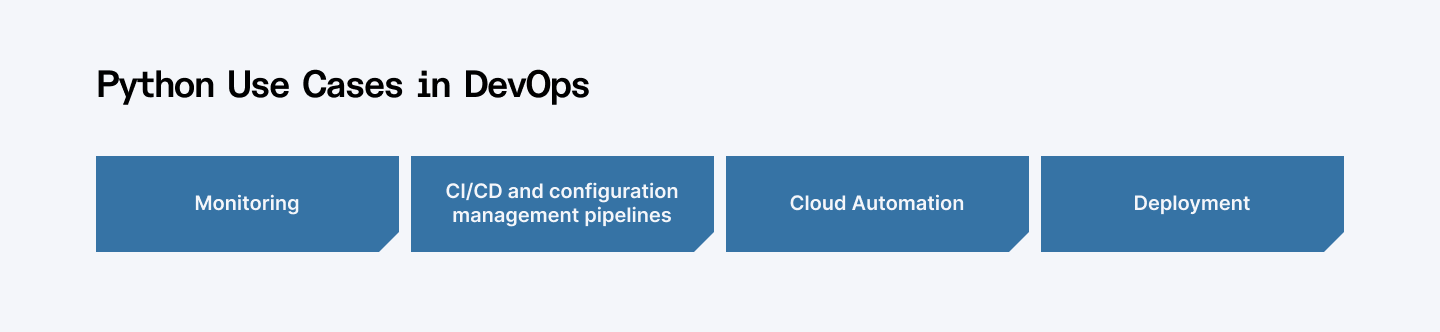
Monitoring
Python allows you to develop scripts that can be used to automate routine day-to-day monitoring chores as well as send messages and alerts when there is a problem with the system. Use Python libraries such as psutils, a cross-platform lib for process and system monitoring, plus one of the many network traffic monitoring libraries produced by the Python community (for example, Scapy), and you'll have a monitoring system that you can design from scratch and tailor to your exact requirements.
CI/CD and Configuration Management Pipelines
Another application of Python is to automate continuous integration and deployment. Python makes it straightforward to develop scripts that automate the CI/CD workflow, making it more efficient and error-free. Remember that the most important and well-known DevOps tools are built in Python; examples include Ansible and SaltStack.
Cloud Automation
You can additionally employ Python to create infrastructure-specific scripts that automate the development, setup, and administration of DevOps applications' environments using cloud platform interfaces. Boto and Google Cloud Storage are Python SDK modules for AWS and Google Cloud Platform, respectively. Other generic libraries, such as Apache Libcloud, are frequently used by infrastructure teams and DevOps suppliers to manage infrastructure with simplicity and trust.
Deployment
Fabric and Cuisine are famous Python modules used in DevOps deployments. Python is also used to automate application deployment, setup, and administration, from development to testing and production.
Explore More: Cloud Engineer vs DevOps Engineer: What’s the Difference?
2. JavaScript
JavaScript has become one of the most popular web development languages due to its versatility, simplicity of use, and quantity of frameworks and tools. Using JavaScript in your DevOps process enables you to automate activities, write custom scripts, and interface with a variety of tools and technologies. Furthermore, many current online apps are fully written in JavaScript, making it an ideal fit for DevOps in web development.
If you implement Javascript for automation and DevOps, you should keep the following in mind:
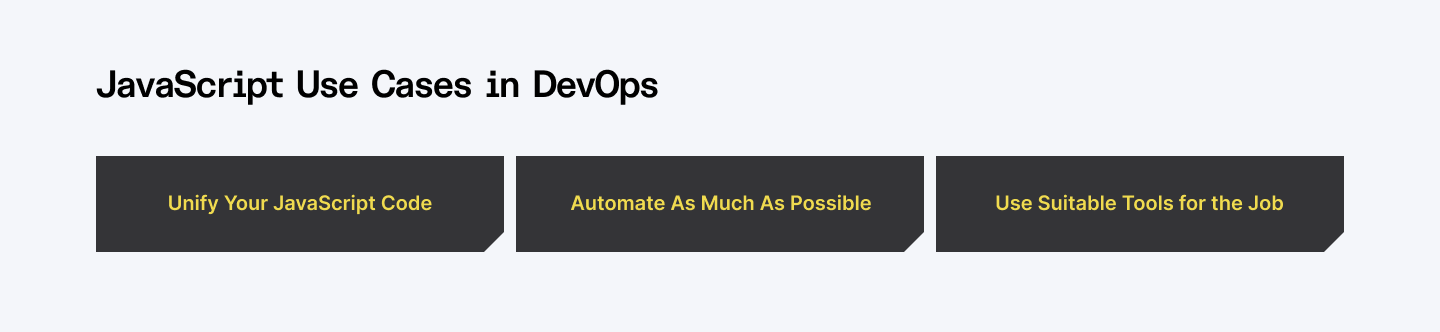
Unify Your JavaScript Code
Standardising your JavaScript code may help you manage, debug, and test your apps more efficiently. Using tools such as JSLint or ESLint may assist in ensuring that your code adheres to best practices and is consistent across your application.
Automate As Much As Possible
Automation is an essential aspect of DevOps, and it may assist in speeding up your development process while lowering the chance of error. To maximise efficiency, look for ways to automate operations such as testing, deployment, and server configuration.
Use Suitable Tools for the Job
There are several tools and technologies available for DevOps in web development, so make sure to select ones that are appropriate for your individual requirements. Tools like Grunt, Gulp, and Webpack can help automate processes and manage dependencies in JavaScript applications.
3. Go/Golang
Golang is one of the most popular languages among DevOps workers, owing to its unique properties. Golang is an open-source programming language created by Google to make software development simple, efficient, and dependable. Go is intended to make writing more user-friendly by including built-in garbage collection, rapid compilation, and great performance, even when developing large-scale projects or complicated applications.
The features of Go/Golang include:
- Garbage Collection: This functionality reduces memory allocations in your software by locating and removing any unnecessary files. It can handle both efficient and concurrent memory.
- Multi-platform: With this feature of the Go programming language, you don't have to start writing from scratch when you switch platforms.
- Security: Unlike certain elements of DevOps, where speed and security do not go hand in hand, Go does. Go has a minimal vulnerability to attacks while maintaining speed, and the compiler always detects problems.
- Ease by Compilation: You can use this capability in Go to filter errors and build a binary or executable file before running the program.
Key GoLang use cases in DevOps include:

Developing Infrastructure Tools
Golang is a good language to create infrastructure tools. Golang is used to create tools such as Terraform and Packer. Terraform is widely used in the industry for Infrastructure as Code, as well as Packer for machine image distribution across many environments. Golang's properties, such as concurrency and ease of use, make it ideal for these kinds of tools.
Automation Scripts
Golang is also used to automate certain DevOps processes. The Kubernetes operator, or Helm, is also written in Golang. The Kubernetes Operator manages application deployment, whereas Helm manages packages and the Kubernetes application lifecycle.
Cloud Infrastructure
Because of technologies like CloudFoundry and OpenStack, Golang is now the most popular language for developing cloud infrastructure. These technologies are used to manage cloud resources, resulting in a more scalable and secure architecture.
Monitoring and Logging
Because of its high concurrency and scalability, Golang has emerged as a popular language for developing monitoring and logging solutions. Using Golang simplifies the handling of massive volumes of data while also scaling. This has resulted in the development of a plethora of monitoring and logging tools, including popular ones like InfluxDB and Grafana.
4. Ruby
Ruby is primarily employed for web development, data science, DevOps and automation, web scraping, and creating static websites. Ruby testing frameworks offer a range of capabilities to assist developers in writing realistic tests for their Ruby-based applications, including support for behaviour-driven development, mocking and stubbing, and test suite management. Ruby is a programming language that is well-suited for web automation.
Heroku is a prominent web app deployment platform that uses Ruby. Heroku is used to ease the deployment process, making it easier for developers without DevOps knowledge. Vagrant, a popular utility, was also created in Ruby. Vagrant is used to manage virtual machines on any operating system. For example, one can develop code for Linux systems on Windows or Mac while still ensuring its compatibility with other operating systems.
Ruby can be used to create Common Gateway Interface (CGI) scripts that are easily embedded into Hypertext Markup Language (HTML). Its syntax is similar to that of languages such as C++ and Perl, making it accessible to developers who are familiar with them. One of Ruby's most notable advantages is its scalability, which allows even large-scale projects to be managed and maintained. Ruby is also suitable for creating Internet and intranet applications because it works in a range of contexts, including Windows and POSIX.
It supports a variety of graphical user interface (GUI) tools, including Tcl/Tk, GTK, and OpenGL, and can easily connect to databases such as DB2, MySQL, Oracle, and Sybase. Furthermore, Ruby has a large library of built-in functions that may be simply included in scripts, simplifying development and increasing productivity.
Key applications of Ruby in DevOps include:
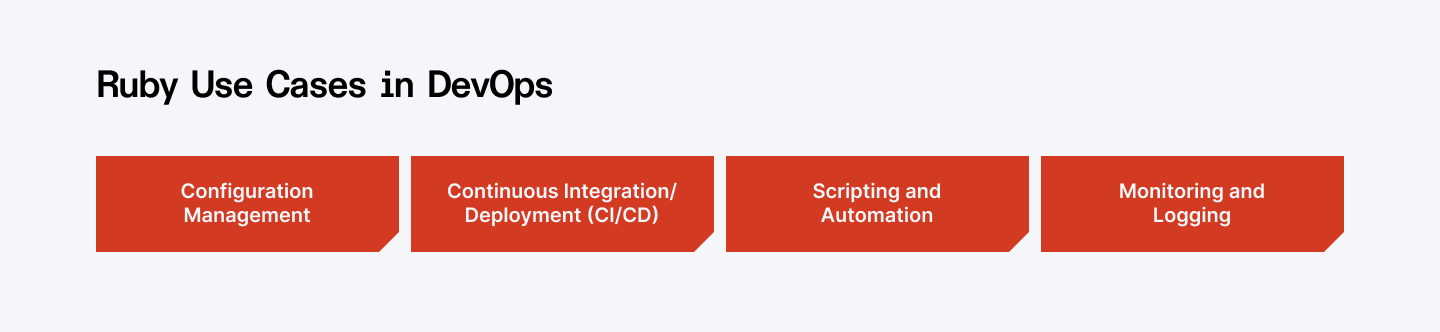
Configuration Management
Ruby powers tools like Chef and Puppet, which automate configuration management for consistent server setups. This enables teams to define infrastructure as code, making deployments and updates more reliable.
Continuous Integration/Continuous Deployment (CI/CD)
Ruby is used in CI/CD pipelines to automate testing and deployment, often with tools like Jenkins and CircleCI. This helps teams deploy updates quickly and consistently.
Scripting and Automation
DevOps teams can write scripts for various tasks like server monitoring, log management, and data migration. Ruby scripts automate repetitive tasks, reducing human error.
Monitoring and Logging
Tools like Fluentd, written in Ruby, help DevOps teams collect and manage log data from different sources. This centralized logging makes troubleshooting faster and helps maintain system health across large infrastructures.
5. Bash
Bash also goes by the name the "Bourne Again Shell." The shell's implementation enables us to efficiently accomplish a variety of activities. We can easily use Bash to conduct operations on numerous files from the command line. Bash, like Python, allows developers to build and execute scripts that can be run on a variety of operating systems.
Using Bash at a terminal is an effective approach to interface with computers, GUIs, and command lines. Bash is complimentary; knowing both allows us to considerably increase the number of jobs we can perform on our computer.
Bash, like other CLIs, is employed by computer applications that require precision while managing large amounts of files and data. Data must be searched, sorted, processed, or in some other way.
Typical applications for Bash include:
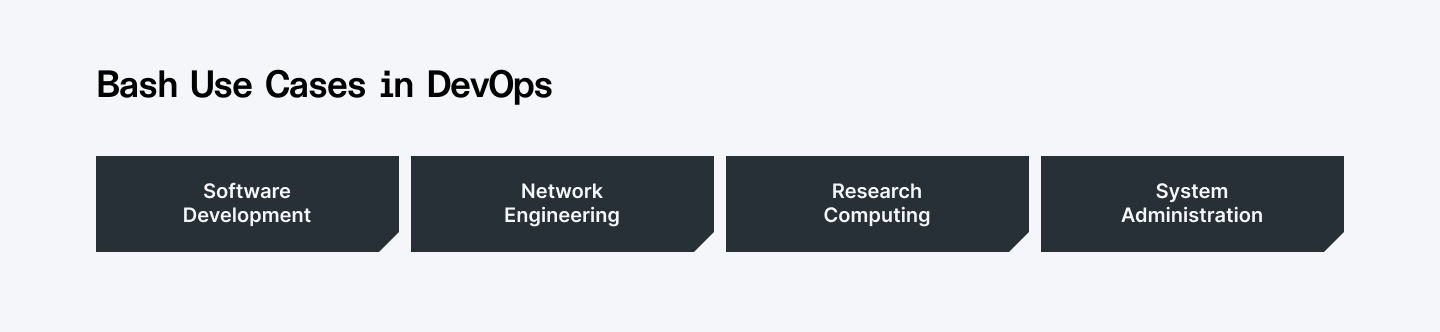
Software Development
Bash is widely used by developers to automate a range of processes during the development process, including code compilation, debugging, and version control. It simplifies repetitive operations like software testing and change management, increasing efficiency in the software development cycle.
Network Engineering
Network engineers use Bash to set up, test, and monitor network performance, automating configuration and troubleshooting activities to ensure smooth operations.
Research Computing
In academic and scientific environments, computer scientists use Bash to manage large-scale research workflows, automate sophisticated data processing, and administrate research infrastructure.
System Administration
System administrators use Bash to manage and maintain systems in a scientific and systematic manner, resulting in maximum performance. It gives administrators access to system settings and internet connectivity, allowing for more effective troubleshooting when systems experience problems.
Explore More: Kubernetes vs Docker: Which Containerization Tool Should You Choose
Conclusion
Python, JavaScript, Go, Ruby, and Bash each have distinct strengths that address certain elements of program development and operations. Mastering these languages will increase your capacity to enhance operations, collaborate more effectively, and boost productivity in an increasingly automated environment. Using these technologies will advance your career and position you as a valued asset in the constantly evolving field of DevOps.
Are you a DevOps Engineer looking for a long-term remote opportunity? Join Index.dev to access high-paying remote careers with top companies in the US, UK, and EU. Sign up today and take your career to the next level!
Struggling to find a professional DevOps Engineer? Sign up to Index.dev and tap into a global network of senior pre-vetted DevOps engineers. Receive 3 to 5 top candidates within 48 hours and benefit from a 3x higher retention rate compared to the industry average. Hire swiftly, scale effortlessly!