
The short answer? It depends on what you're building and how fast you need it done.
If you're maintaining a core product that requires deep institutional knowledge and long-term ownership, employees are usually your best bet. Need specialized skills for a three-month project or want to scale your team quickly without the overhead? Independent contractors make more sense.
The right choice depends on what you’re building and how fast you must ship. You must match the role to outcome: tight budgets, niche skills, discrete pilots, or short-term projects often favor contractors, while core, mission-critical work, long-term continuity and full integration tend to favor employees.
Below we list key considerations, supported by data and expert analysis, to help decision-makers in software development pick the best approach.
Scale your team with independent contractors worldwide. Index.dev takes care of legal, payroll, and compliance so you can focus on scaling.
TL;DR
- For continuity and culture: choose employees.
- For flexibility, cost control, and specialist bursts: choose independent contractors.
- Best practice for most companies: keep a small core of employees and supplement with contractors as needed.
The Numbers Speak
The 2025 Stack Overflow Developer Survey shows the developer population is overwhelmingly professional (about 76% of respondents are professional developers), which implies most developers remain in traditional employment relationships rather than purely freelance arrangements. At the same time, Upwork’s Future Workforce Index (2025) finds that 28% of skilled knowledge workers now operate as freelancers or independent professionals, and 48% of CEOs plan to increase freelance hiring in the coming year — a clear signal that companies are treating contracting as strategic capacity.
Industry trackers also report that a large majority of firms consider outsourced/contract workers part of their workforce, demonstrating why contracting is increasingly baked into workforce planning. Finally, Upwork/Axios commentary in 2025 highlights that AI-related freelance earnings are rising year-over-year, reinforcing demand for skilled, flexible talent.
Discover why big tech companies are turning to contractors.
Hire Full-time Employees When
- You're building something that'll need maintenance for years.
- Your core product infrastructure, user authentication systems, data pipelines – these need someone who'll still understand the codebase in 18 months.
- Your core product infrastructure, user authentication systems, data pipelines – these need someone who'll still understand the codebase in 18 months.
- Company culture matters.
- Employees attend your all-hands meetings, understand your company's priorities, and (hopefully) care about your customers beyond just completing their assigned tasks.
- Employees attend your all-hands meetings, understand your company's priorities, and (hopefully) care about your customers beyond just completing their assigned tasks.
- You have consistent, ongoing work.
- If you know you'll need backend development work every month for the next two years, an employee makes financial sense.
Pros
- Long-term ownership & institutional knowledge. Employees live in your codebase and product domain; they retain context and handle maintenance without repeated ramp-up.
- Strong cultural fit & alignment. Employees are more likely to adopt company processes, security practices, and long-term goals.
- Lower legal ambiguity for core roles. Hiring an employee for core functions reduces the risk of misclassification challenges.
- Easier internal promotion and career paths. This helps retention and builds loyalty over time.
Cons
- Higher fixed costs. Salary + benefits + payroll taxes + equipment + office costs raise total cost of headcount.
- Slower to scale up/down. Hiring takes weeks–months; layoffs are disruptive and costly.
- Longer time to productivity. Recruiting and onboarding extend time before full contribution.
- Skill inflexibility. Employees may take time to learn new specialisms outside their remit.
Hire Independent Contractors When
- You need speed.
- Hiring contractors vs employees is like the difference between ordering takeout and growing your own vegetables. Sometimes you just need to eat tonight. Contractors are a strong fit for well-scoped, specialist projects where flexibility is essential; however you must weigh integration and security trade-offs (data protection, code access) and address them contractually.
- Hiring contractors vs employees is like the difference between ordering takeout and growing your own vegetables. Sometimes you just need to eat tonight. Contractors are a strong fit for well-scoped, specialist projects where flexibility is essential; however you must weigh integration and security trade-offs (data protection, code access) and address them contractually.
- Your project has clear boundaries.
- Contractors excel when you can say "build this feature, integrate with that API, deliver by this date." They're not great for "help us figure out our long-term product strategy."
- Contractors excel when you can say "build this feature, integrate with that API, deliver by this date." They're not great for "help us figure out our long-term product strategy."
- You're experimenting.
- Want to test if blockchain makes sense for your supply chain software? Hire a blockchain contractor for two months instead of committing to a full-time hire you might not need.
Pros
- Speed & scalability. Bring on specialists fast for a sprint, pilot, or urgent fix; scale down once the work ends.
- Access to niche/global talent. Contractors let you tap language- or framework-specific experts worldwide.
- Lower ongoing overhead. No employer-paid benefits or long-term commitments for the contract term.
- Focused, deliverable-driven work. Contractors often target specific outcomes and can be highly productive on short projects.
Cons
- Knowledge continuity risk. Institutional knowledge can leave with the contractor unless handovers are enforced.
- Potential legal/compliance risk. Misclassification or local labor law differences can trigger fines or retroactive liabilities.
- Cultural fit & integration. Contractors may not be embedded in team rituals or long-term product vision.
- Variable cost visibility. Hourly or scope creep can increase spend if scope isn’t tightly managed.
The Real Cost Breakdown
Here's where things get interesting. Everyone talks about contractors being "cheaper" because you don't pay benefits, but let's look at actual numbers:
Full-time Senior Developer:
- Avg Salary: $120,000
- Benefits (30%): $36,000
- Equipment, office space: $8,000
- Avg Total: $164,000/year
Contract Developer (Equivalent Skills):
- Avg Rate: $85/hour
- 2,000 billable hours: $170,000
- No benefits, equipment, or office costs
- Avg Total: $170,000/year
These numbers are illustrative; actual costs vary by geography, roles specifics, and benefits. Use a cost model tailored to your region.
Wait, the contractor costs more? Yes, but here's what you're really paying for: FLEXIBILITY. That contractor can be scaling other projects while your employee is in meetings. You can bring them on for three months, not twelve.
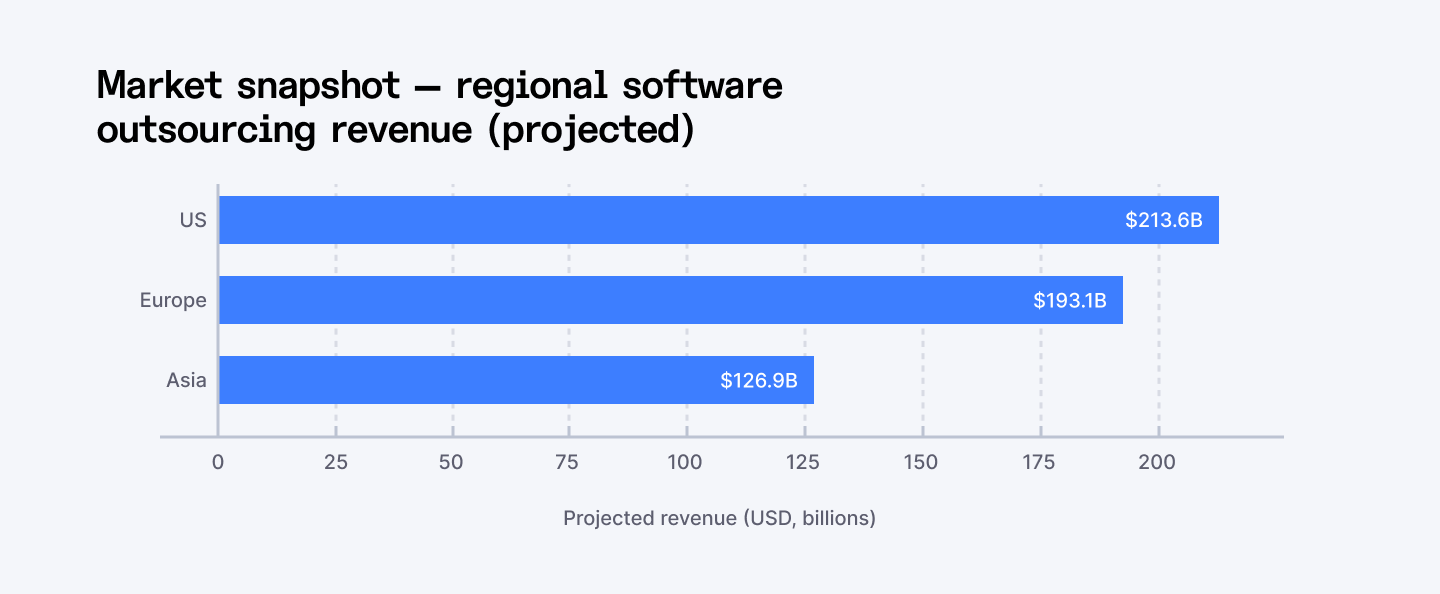
Many businesses save money on payroll by hiring contract engineers without paying benefits or pensions. You can read more about this here.
The real savings come from not having idle time. Employees get paid whether they're coding or sitting in status meetings. Contractors typically bill only for productive work.
Access to Talent: The Global Advantage
Remember when hiring meant "who lives within 50 miles of our office"? Those days are over. Independent contractor developers give you access to talent anywhere. Need a developer who's worked with Estonia's e-Residency APIs? There's probably someone in Tallinn who can start next week. Looking for someone who's built fintech apps that comply with European banking regulations? You'll find them faster in the global contractor pool than in your local job market.
We've seen companies in expensive markets like San Francisco hire excellent contractors from places like Poland, Argentina, and Ukraine – getting top-tier talent at rates that actually work with their budgets.
The catch? Time zones and communication. But honestly, if you're already doing remote work (and most software teams are), this becomes manageable pretty quickly.
1. Quality Control
Here's the thing nobody talks about:
Bad contractors can sink your project faster than bad employees. At least bad employees take a while to do damage.
Vetting is everything. Platforms like Index.dev focus on the top 5% of global tech talent – they pre-screen for both technical skills and communication abilities. You're not scrolling through hundreds of random profiles hoping someone knows React.
Some red flags we've learned to watch for:
- Contractors who can't explain their previous projects clearly
- Anyone who promises unrealistic timelines
- Developers who don't ask questions about your requirements
- People who want payment upfront for anything more than a small deposit
Green flags that indicate quality:
- Asks detailed questions about your tech stack and requirements
- Provides realistic time estimates with built-in buffers
- Can walk you through their problem-solving process on previous projects
- Has worked with companies similar to yours in size or industry
- Offers to start with a small test project
Pro tip: Start every contractor relationship with a well-defined, one-week project. See how they communicate, how they handle unexpected issues, whether their code quality matches their claims. Much better to discover problems after one week than one month.
2. Flexibility and Scalability
Contractors offer instant scale-up/down. In software projects, demand often spikes for new features or fixes. Contractors allow rapid response: teams can expand or shrink without severance or lengthy layoffs. Big tech companies like Google exploit this.
Their contractor workforce now nearly matches their full-time headcount. When they need to ramp up for a product launch, they bring in contractors. When the project wraps up, those contractors move on to other clients. No layoffs, no awkward "restructuring" announcements.
Keep a small core team of full-timers for ongoing maintenance and critical knowledge. Use contractors for extra modules. For example, Netflix, for example, has publicly discussed expanding its AI capabilities and recruiting specialists, though public reporting does not always specify whether those specialists are hired as employees or contractors.
We've seen this work brilliantly for project-based work. Building a new mobile app? Bring in iOS and Android contractors for six months. Migrating your database? Hire a database specialist for the migration, then they're done. Your core team handles maintenance.
The alternative – hiring full-time people for temporary needs – means you either have idle developers (expensive) or you have to let people go later (expensive and demoralizing). Hiring takes months and often overshoots short-term needs, while layoffs cost morale and money.
3. Speed of Hiring and Onboarding
Contractors get to work faster. Traditional hiring? That's posting jobs, screening resumes, doing technical interviews, negotiating offers... easily 8-12 weeks. Contractors can skip much of this. Agencies and platforms pre-vet candidates, so companies can often see qualified developers within days.
- Trial periods.
- Many contractor platforms offer risk-free trials (e.g. 30 days) before committing. Index.dev offers a 48-hour replacement policy if a match isn’t right. This means teams waste little time if a contractor isn’t fitting in.
- Many contractor platforms offer risk-free trials (e.g. 30 days) before committing. Index.dev offers a 48-hour replacement policy if a match isn’t right. This means teams waste little time if a contractor isn’t fitting in.
- Immediate skills.
- Contractors typically come with their development environment ready, they're used to diving into unfamiliar codebases quickly, and they're motivated to prove themselves fast (since their reputation depends on quick wins). A contractor expert in Kubernetes can start working on your cloud architecture much sooner than hiring and upskilling a new employee in that niche.
In short projects or emergency fixes, the speed advantage of contractors is a major benefit. A full-time hire simply cannot start contributing from day one, but a contractor often can.
4. Access to Talent and Expertise
Quick question: how many Rust developers live within 50 miles of your office? How about someone who's built healthcare apps that comply with HIPAA regulations? Or a developer who's worked with Estonia's X-Road digital infrastructure?
This is where contractors shine. You're not limited by geography or visa restrictions. Need someone who understands European GDPR compliance? There are contractors in Berlin who've implemented it dozens of times. Looking for blockchain expertise? You'll find more qualified contractors globally than local employees.
McKinsey found that only 16% of executives feel they're fully staffed with tech talent. Contractors fill those gaps without requiring anyone to relocate or navigate complex immigration processes.
For example, UK or Canadian firms may hire Eastern European or Asian developers as contractors to meet budgets. (One report notes Canadian tech firms increased international contractor hires by 34% in 2024 to fill local gaps.)
By contrast, relying only on full-time local hires can leave teams understaffed. Global outsourcing allows firms to continue projects without halting work due to a hiring gap.
5. Employee Loyalty vs. Contractor Focus
A full-time engineer is invested in your product long-term. They learn the codebase deeply and may be more motivated by the company’s mission.
However, a contractor often brings focused energy: they’re usually billing by deliverable, so they tend to work efficiently on agreed tasks. Firms report that contractors often bill only productive hours, whereas full-timers include breaks and non-working hours in their schedule.
Vetting is key. Both models can yield high quality if talent is vetted. One risk of contractors is potential loss of knowledge. But strategies can mitigate this: some companies overlap contractor assignments with employees so skills transfer naturally.
Studies suggest creative problem-solving can actually increase with external input. The Index.dev blog notes contractors bring outside perspective, often sparking innovative solutions that in-house teams missed. In practice, engineering managers should ensure code reviews and documentation to keep quality high regardless of staffing model.
6. Team Integration and Culture
Full-time employees have advantages contractors don't: they're in every standup, they understand your company culture, they know why you made certain architectural decisions six months ago.
Contractors miss the hallway conversations where important decisions get made. They don't know that the CEO has strong opinions about user interface design, or that the marketing team promised a feature would work a certain way.
But this isn't insurmountable.
The best teams we've worked with treat contractor onboarding like employee onboarding.
Clear documentation, immediate access to communication channels, introduction calls with key stakeholders.
Some teams even assign a "contractor buddy" – a full-time team member who can provide context and answer "why did we build it this way" questions.
The fresh perspective bonus: contractors often spot problems your internal team has become blind to. They'll ask "why do you do it this way?" about processes everyone else just accepts. Sometimes that's annoying. Sometimes it leads to breakthrough improvements.
7. Legal and Compliance Considerations
Misclassifying workers can be expensive. California's AB-5 law, similar regulations in other states, and new rules across Europe mean you can't just call someone a contractor and hope for the best.
The basic test everywhere comes down to control. If you're telling someone when to work, how to work, what tools to use, and requiring them to attend your daily standups – they're probably an employee, not a contractor.
Safe approach:
- Contractors work on projects with clear deliverables
- They use their own equipment when possible
- You're buying an outcome, not their time
- They can work for other clients simultaneously
Risky approach:
- Requiring contractors to work specific hours
- Making them attend all your team meetings
- Providing company equipment and email addresses
- Treating them like employees but paying them like contractors
Here are the legal reclassification and retroactive liabilities as per country variations:
- United States — “ABC”/AB-5 style tests:
- In many U.S. states, tests similar to California’s AB-5 examine whether a contractor is truly independent (control, outside the company’s ordinary business, independent trade). Misclassification can lead to payroll tax liability and penalties.
- In many U.S. states, tests similar to California’s AB-5 examine whether a contractor is truly independent (control, outside the company’s ordinary business, independent trade). Misclassification can lead to payroll tax liability and penalties.
- Germany — schedule/location autonomy matters:
- German case law often emphasizes whether a contractor can genuinely set their own schedule and location; being tightly scheduled by the client risks employee classification.
- German case law often emphasizes whether a contractor can genuinely set their own schedule and location; being tightly scheduled by the client risks employee classification.
- Canada — equipment & training indicators:
- The Canada Revenue Agency’s (CRA) assessments pay attention to whether a worker uses company equipment or receives company-paid training — two indicators of an employment relationship.
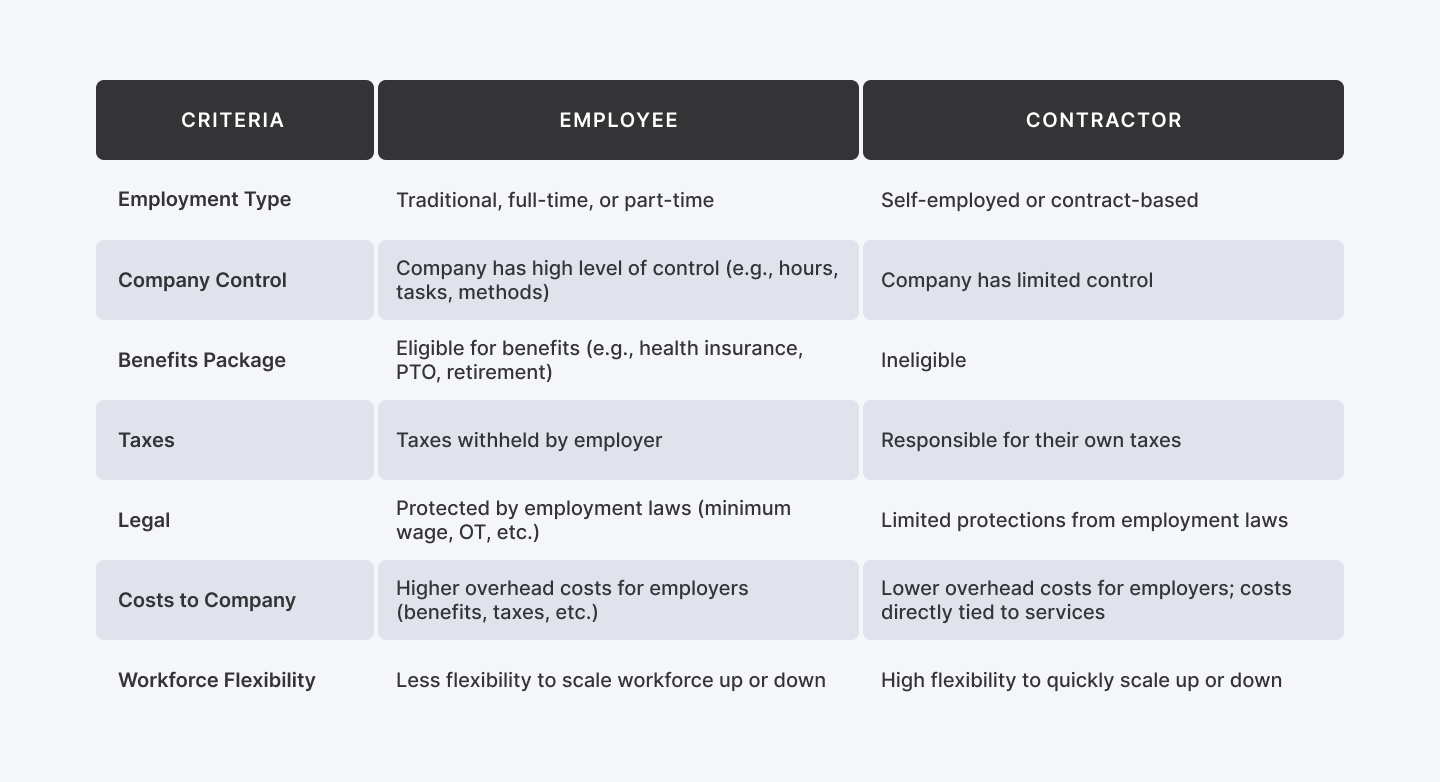
Legal risk doesn’t automatically make one option better, but it does add overhead. Some companies avoid ambiguity by choosing employees for core roles, and using contractors only in truly independent, project-based situations. So choose wisely.
Learn the key components of an independent contractor agreement template, or explore customizable legal agreement templates on Lawdistrict to ensure your contractor relationships are properly documented.
Smart Strategies: Getting the Best of Both
The most successful software teams we've worked with use hybrid models. Here are three approaches that actually work:
The Core + Surge Model
Keep 3-5 full-time developers who know your product inside and out. When you need to build new features or handle spikes in work, bring in contractors who work alongside your core team.
The Platform Play
Build your core platform with employees. Use contractors for integrations, mobile apps, and specialized features that connect to your main product.
The Innovation Track
Use employees for maintaining and improving existing products. Use contractors for exploring new technologies, building prototypes, and testing market opportunities.
Making the Decision: A Practical Framework
Ask yourself these questions:
Timeline:
- Do you need someone productive within days? → Contractor
- Can you wait 2-3 months for full productivity? → Employee
Scope:
- Can you write a clear statement of work? → Contractor
- Is this "figure it out as we go" territory? → Employee
Duration:
- Project ends in under a year? → Contractor
- Ongoing work for multiple years? → Employee
Knowledge:
- Will someone need to maintain this code in three years? → Employee
- Is this a one-time build? → Contractor
By planning ahead, companies can treat contracting as a tool, not a band-aid. For instance, use analytics (for example, from an HR dashboard) to forecast peak development needs and decide which roles should go to contractors vs. FTEs. Then on-board contractors just as carefully as employees, with clear goals and integration checkpoints.
Global Hiring Compliance Checklist

- Draft SOWs that define deliverables, not daily methods.
- Require contractors to use their own tools/equipment where possible.
- Include IP assignment and confidentiality clauses, and define jurisdiction for disputes.
- Confirm local tax withholding rules; consider using an EOR or agency for complex jurisdictions.
- Limit mandated work hours; prefer outcome-based milestones where practical.
Conclusion: Tailor to Your Needs
There's no universal "better" choice between independent contractors vs employees for software development. The best companies use both strategically.
Start with these principles:
- Use employees for your core product and long-term platform work
- Use contractors for new initiatives, specialized projects, and capacity surges
- Always prioritize clear communication and defined outcomes, regardless of employment type
- Plan for knowledge transfer and documentation with both models
The advantages of contracting software engineers are real, but so are the benefits of having committed, long-term team members.
Your goal should be building a team structure that lets you move fast when you need to, while maintaining the institutional knowledge and cultural continuity that keeps your product reliable.
Ready to explore contract developers for your next project?
The key is finding pre-vetted talent who can integrate seamlessly with your existing team. Many companies are discovering that big tech companies hire contractors for good reasons – flexibility and access to specialized skills without long-term overhead and Index.dev enables you to work with the elite 5% talent.
The future of software development teams isn't employee vs contractor – it's employee and contractor, used strategically based on what you're building and when you need it done.

