Artificial intelligence has become one of the most rapidly growing technologies from the idea of future science fiction to the medium for change in numerous industries. Almost every industry is undergoing a shift towards the utilization of artificial intelligence solutions to improve operations, customer relations, and to introduce new innovations in areas such as; healthcare, finance, retail, and manufacturing. This tremendous increase has propelled the embarkation of several AI development projects, which is why AI is crucial for companies of all sizes.
However, starting an AI development process is not an easy task to do. As for the key problems, one of the major ones is the inability of organizations to estimate the costs at which corresponding benefits can be achieved. AI projects are different from projects that develop regular software and involve aspects such as data quality and algorithmic complexity, hardware requirements, and talent acquisition. These variables make it really very cumbersome to foresee the final prices at least before reaching the final stage.
This blog is designed to provide some information about the factors affecting the costs of AI development. We will discuss many cost aspects, review methods of cost calculations, and give tips on how to effectively manage your AI costs. To manage AI costs efficiently and make the right decisions regarding spending on this technology, you should consider the factors discussed above to control expenses and improve the ROI from your AI projects.
Need expert developers to build your AI application? Hire senior AI engineers through Index.dev to save 60% on your AI development costs.
AI Development Cost
AI development cost is a concept that defines the overall expense required to design an artificial intelligence application or system. This includes personnel costs, costs of the hardware and software used, data and also the supporting infrastructure.
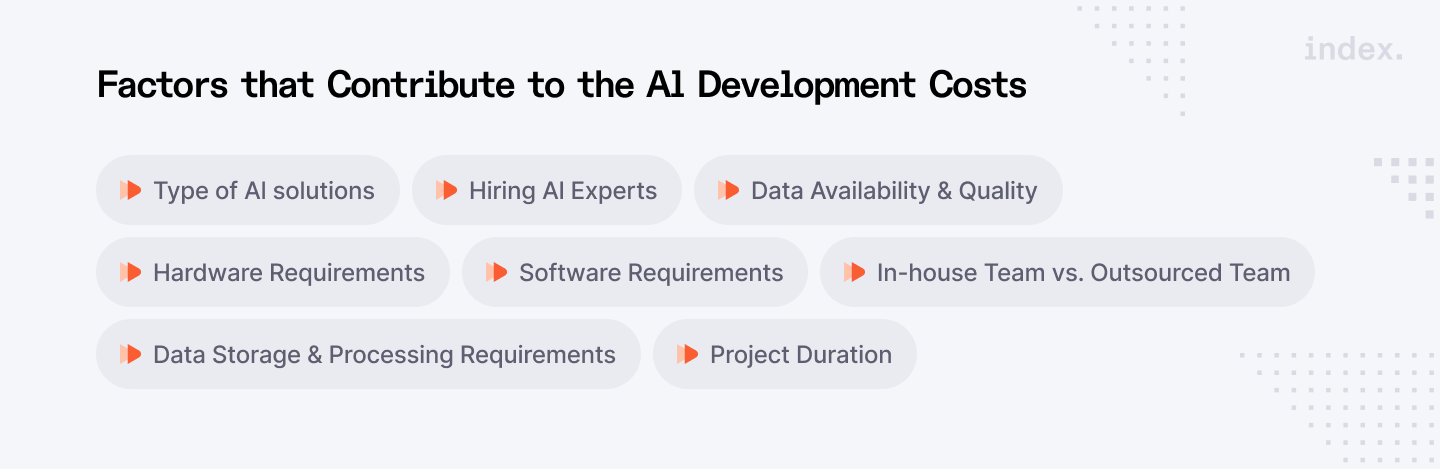
Several factors significantly impact the cost of AI development:
- Project Complexity: First of all, the complexity of the AI model, the number of features to be included, and the required accuracy determine the time and resources needed to implement such solutions, thus impacting costs.
- Data Volume and Quality: Accuracy, comprehensiveness, and volume of data used to train AI models are also high-level indicators that require focus. In data contamination, data acquisition, data cleaning and data preparing usually takes time and is costly.
- Team Size and Expertise: When the number and skill set of the development team are fixed, then project duration and cost is also defined. Recruiting data scientists, machine learning engineers, as well as AI specialists of a higher level usually costs a lot of money.
Technology Stack: The selection of workAI AI frameworks, libraries, and workAI tools should be made bearing in mind that it has an influence on the development costs. Some technologies may be canonical and may need extra hardware or extra software licences.
The cost of AI development varies widely depending on the project scope. Here are some examples of AI applications and their approximate cost ranges:
- Chatbots: The basic versions of the chatbots cost between $10,000 and $50,000, although the AI-powered portions with a number of functions may cost more than $100,000.
- Image Recognition: The cost depends on the complexity of the proposed image recognition design, it can reach $50,000 for a simple problem or it may cost several hundred thousand dollars to develop the systems that have to recognize images with very good accuracy.
- Predictive Analytics: Custom predictive models that focus on business applications cost between $50,000 and $200,000, depending on how varied the input data are and how complex the model needs to be.
- Autonomous Vehicles: The process of creating self-driving cars is a complicated and expensive process which can cost as low as several millions of dollars to tens and hundreds of billions of dollars.
It's essential to note that these are rough estimates, and actual costs can vary significantly based on specific project requirements and market conditions.
Read also: How to Select the Best AI Model for Your Project in 2024
AI App Development Cost
Creating a mobile or web application that incorporates AI is not similar to cost analysis to traditional apps. In addition to common application development costs, the inclusion of AI features entails other costs in data, algorithms, and AI personnel.
Platform-Specific Costs
The platform chosen for your AI app significantly impacts development costs:
- iOS: While Apple has one of the most restrictive app store policies and slightly more expensive devices, developing for iOS tends to start with a bigger outlay. However, on average the Apple ecosystem usually has a higher average revenue per user (ARPU).
- Android: The development costs are generally lower because the platform is open, and there is a range of device capabilities; however, getting revenue is steep because of tight competition.
- Web: Creating a web-based AI app will have the benefit of being usable through a variety of devices and via different browsers, but may take more effort to fine-tune the interface for all these platforms.
Impact of Features and Functionalities
The complexity and sophistication of your AI app's features directly influence development costs:
- Basic AI Features: For simple tasks, such as chatbots which provide only a set of responses or those which recognize objects on a picture, the costs of development could be lower.
- Advanced AI Features: The use of complex equations or natural language processing, or real time ML integration adds materially to timescales and cost.
- Data Requirements: The high volumes and quality of data required to feed your AI model are critical factors that affect your expenses. As seen, the processes of acquiring, cleaning, and preparing data involve time and can be costly.
- Third-Party Integrations: The use of third-party AI services, OpenAI software solutions or APIs may increase the costs of developing applications depending on the used solution and its pricing policy.
Examples Cost Breakdown:
While exact costs vary widely, here's a general estimate for a medium-complexity AI app:
- UI/UX design: $10,000 - $30,000
- Front-end development: $15,000 - $50,000
- Back-end development: $20,000 - $80,000
- AI development (including data, algorithms, model training): $30,000 - $150,000
- Testing and quality assurance: $5,000 - $15,000
- Deployment and maintenance: Ongoing costs
It's crucial to note that these are ballpark figures, and actual costs can fluctuate based on factors like geographic location, team expertise, and project scope.
Read also: 6 AI Model Optimization Techniques You Should Know
AI Software Development Cost
Creating enterprise-level AI software can be quite expensive, and this means that a lot of capital and manpower needs to be channelled towards this kind of software. Whereas, AI projects differ from conventional software development projects in terms of more complexity and risk.
Cost Implications of Different AI Software Types
The cost of developing AI software varies significantly based on the type of AI employed:
Machine Learning:
Overall, the costs of machine learning projects are usually lower than deep learning ones, but they are still costly because of the need to collect and prepare data, as well as create a model. Some organizational expenses may be more than $100,000 and others may be but $10,000 to $15,000.
Deep Learning:
Deep learning models require lots of data and computer power to train and work effectively and efficiently. This leads to increased expenditure on the hardware, software as well as human resources in the organization. Development can vary from several hundred thousand dollars to millions of dollars.
Natural Language Processing (NLP):
There is flexibility in human language which makes the NLP projects complicated. The costs depend on the language, availability of the data, and the type of the model used. Anticipate costs to be in the same ballpark as other ML initiatives.
The Role of Software Licensing and Maintenance Costs
Beyond development, ongoing costs associated with AI software include:
- Software Licenses: To note, the majority of the existing AI frameworks and tools applied to the development of AISs are available with licensing charges. The fees are relatively low and range from a few hundred dollars to a few thousand dollars per annum.
- Hardware Costs: AI models, especially the learning algorithms require sophisticated calculations and therefore calls for sophisticated processing units. The logic behind this is that costs of servers, GPUs, as well as other equipment that is needed can be relatively high.
- Data Storage: When it is a matter of storing thousands and thousands of samples for training and model development, there is a cost associated with storage.
- Maintenance and Updates: In order to make the AI models run effectively, they have to be assessed, coached, and modified on a frequent basis.This means that there has to be a constant investment in human resources and computations.
It's essential to consider these additional expenses when estimating the total cost of ownership for AI software.
Cost Components of AI Development
Developing an AI application involves a complex interplay of various cost components. Understanding these costs is crucial for effective budgeting and project planning.
Cost Components
1. Personnel:
- Data Scientists: These professionals are very important when it comes to data analysis, model and algorithm creation.
- Machine Learning Engineers: They make discoveries from the research deployed for creating ready-to-implement systems.
- AI Developers: They develop and support the AI application.
- Project Managers: Coordinating the project and resources involved in it.
- Domain Experts: The specific industry or the problem domain should be understood very well.
Hire expertly-vetted AI, ML, Data Science & Project Management professionals to develop your AI solutions efficiently and cost-effectively. Connect with the best now!
2. Hardware:
- High-performance computing (HPC) systems: For training complex models.
- GPUs: Accelerate computations for deep learning tasks.
- Servers and storage: For data storage and model deployment.
3. Software:
- AI frameworks and libraries: TensorFlow, PyTorch, Scikit-learn, etc.
- Data management tools: For data cleaning, integration, and storage.
- Cloud computing platforms: For infrastructure and scalability.
- Software licenses: For commercial AI software or tools.
4. Data:
- Data acquisition: Collecting relevant data can be expensive, especially for proprietary datasets.
- Data cleaning and preparation: This process is time-consuming and requires skilled personnel.
- Data labeling: For supervised learning tasks, data labeling can be a significant cost.
5. Infrastructure:
- IT infrastructure: Network, servers, storage, and security.
- Cloud infrastructure: For scalability and flexibility.
- Deployment and maintenance: Costs associated with deploying and maintaining the AI application.
Potential for Cost Overruns
AI projects are often subject to cost overruns due to various factors:
- Data challenges: Fluctuations in the quality, absence, or quantity of data used in the timeline and cost prediction will also change any of those estimates.
- Algorithm complexity: The advantage of using complex models may be that it takes time and/or is more expensive to build.
- Hardware limitations: Lower computational ability in this environment is indicative of slower throughput and increased cost.
- Team challenges: Lack of human capital and skilled manpower, poor communication, and such issues as people dropping out of the project can lead to time enhancement as well as enhanced costs.
- Scope creep: The scope of a project’s work does not always mean that it is healthy to expand; if not done meticulously it results in cost.
Mitigating Cost Overruns
To minimize cost overruns:
- Undertake comprehensive prior research and prepare precise blueprints of the project.
- Define project goals and objectives, and the anticipated work to be performed.
- Combining the best approaches to build a skilled and experienced team.
- Always seek to follow proper data management procedures.
- Invest in cloud computing to enable flexibility and economies of scale.
- Ensure effective and close supervision while carrying out the projects.
- One should use the pretrained models or transfer learning concepts so that the model development time is less in comparison to the traditional machine learning model.
- Ensure that projects are aligned based on priority and make changes accordingly.
Controlling these cost factors and adopting the right strategies will help organizations reduce the chances of going over the budget on AI projects.
Read also: Top 5 Programming Languages For AI Development in 2024
How Much Does AI Cost to Develop?
Pricing happens to be among the most frequently asked questions concerning the development of AI. Regrettably, it is almost impossible to provide a set price since there are multiple aspects that need to be taken into consideration and each project is distinct. The costs of such projects highly depend on numerous factors, including the complexity of the project, the availability of data, expertise of the team, as well as potential outcomes.
The Challenge of Cost Estimation
- Project Scope: A simple instance can be a conversational interface chatbot which is in the range of tens of thousands of dollars and a complex one can be an autonomous vehicle which is in millions or let's say billions of dollars.
- Data Requirements: Labeled and quality data is one of the ways to get data to feed the machine learning models. Data acquisition and data cleansing along with data preparation activities are sometimes costly and time-consuming.
- Team Expertise: Expert data scientists, machine learning engineers as well as AI developers are well paid with outstanding packages.
- Hardware and Infrastructure: The initial investment required for the hardware infrastructure and peripheral for AI development, for instance, GPUs, and cloud, is relatively expensive.
- Iterative Process: AI development might need to be tested several times to get the best results every time round and this will always be costly.
Cost Estimation Frameworks
While providing a precise figure is challenging, some frameworks can help estimate AI development costs:
- Bottom-up Approach: Subdivide the various subdivisions of the overall project and give out an approximate expenditure of each of them. This means that this method can at times prove to be cumbersome but the result is an analysis done in detail.
- Top-down Approach: It is recommended to begin with a rough number derived on the values of similar projects in order to make relevant amendments.
- Parameter Estimation: Determine contingency factors that affect cost and based on it develop cost factors: for example data size, model sophistication etc.
Additional Considerations
- Time-to-Market: Faster development sometimes implies a higher cost as resources are utilized at a faster rate.
- Minimum Viable Product (MVP): As for the second activity, the creation of an MVP can also serve as a way to determine the viability of the project and the associated expenses during the development of a plan to build a complete product.
- Outsourcing vs. In-house: Learn the advantages and disadvantages of developing an AI team within an organization and in case of outsourcing.
AI development is something that requires investment, and this is why it is necessary to recall the information presented above. Costs should be reduced, but the excessive emphasis on this can lead to the receipt of fairly low-quality services. Thus, One can suggest that focusing on quality, data, and talent can bring value in the long term and higher ROI.
Build successful AI applications with experienced developers from Index.dev. Our senior professionals specialize in creating robust AI solutions and optimizing costs. Connect with the best talent today!
The Bottom Line
Creating an AI application is a challenging process that involves a multitude of factors and, consequently, corresponds to a high level of costs. Starting from personal and IT hardware, software, data and structures, all these elements make up the project cost. The cost depends on many factors ranging from project requirements, quality of data, skills of the team, and selected technology setup.
It is quite difficult to get the right cost estimates when it comes to development of AI applications because project uncertainty is inherent. But arriving at an objective cost of the project through frameworks and methodologies can be useful to organizations. Minimizing costs, therefore, becomes a key factor of consideration through proper planning, use of resources, and implementation of efficient cost strategies, where the objective is to maximize the ROI.
The costs related to the future AI development can be expected to change in the following manner. Cost factors that may be predicted include pre-existing developed models and automations due to the AI technology. However, savings in costs could be reduced by high demand for qualified AI specialists and the growth of AI’s multifunctional uses. Indeed, as AI evolves, organizations have to remain prepared to adapt to the fluctuations in the cost structure so as to remain viable.
Analyzing the key drivers of costs, using the most efficient approaches to costs’ management and having an understanding of tendencies of the modern world, companies can successfully implement AI development.
Index.dev can help by providing comprehensive solutions for AI development, including cost-effective strategies and expert guidance to ensure that your AI project is delivered efficiently and effectively. With Index.dev’s expertise in AI development, the platform can help you build a strong AI development team, navigate the complexities and uncertainties involved in AI project costs, ensuring that your organization achieves the desired ROI. Connect with the elite 5% of AI developers today!