
The wait’s over. OpenAI just dropped GPT-5, and it’s the biggest jump we’ve seen since ChatGPT became part of our daily workflow.
If GPT-4 was smart, GPT-5 feels sharper, faster, and way better at following complex instructions without getting lost in the weeds. Think of it as going from an old grainy iPhone screen to Retina display, that’s how Sam Altman described it. “It’s the first time it really feels like talking to an expert in any topic… like a PhD-level expert,” he said.
And this time, it’s not just a chatbot that answers your questions. It gets things done. Michelle Pokrass, one of OpenAI’s post-training leads, put it simply: “It executes long chains of actions, follows detailed instructions, and explains its thinking upfront.” Translation: you can throw entire coding projects at it and it won’t just give you fragments, it will plan, build, and ship in one go.
Join Index.dev, get matched with global companies, and start building amazing projects with GPT-5.
What Is GPT-5 and How’s It Different?
At its core, GPT-5 is OpenAI’s first unified model, meaning it blends the deep reasoning smarts of the o-series with the speed and responsiveness of the GPT series. You don’t have to pick a “fast” model or a “smart” model anymore. GPT-5 decides in real-time whether your prompt needs instant output or deeper thinking.
Here’s what stands out:
Smarter problem-solving.
Better across disciplines.
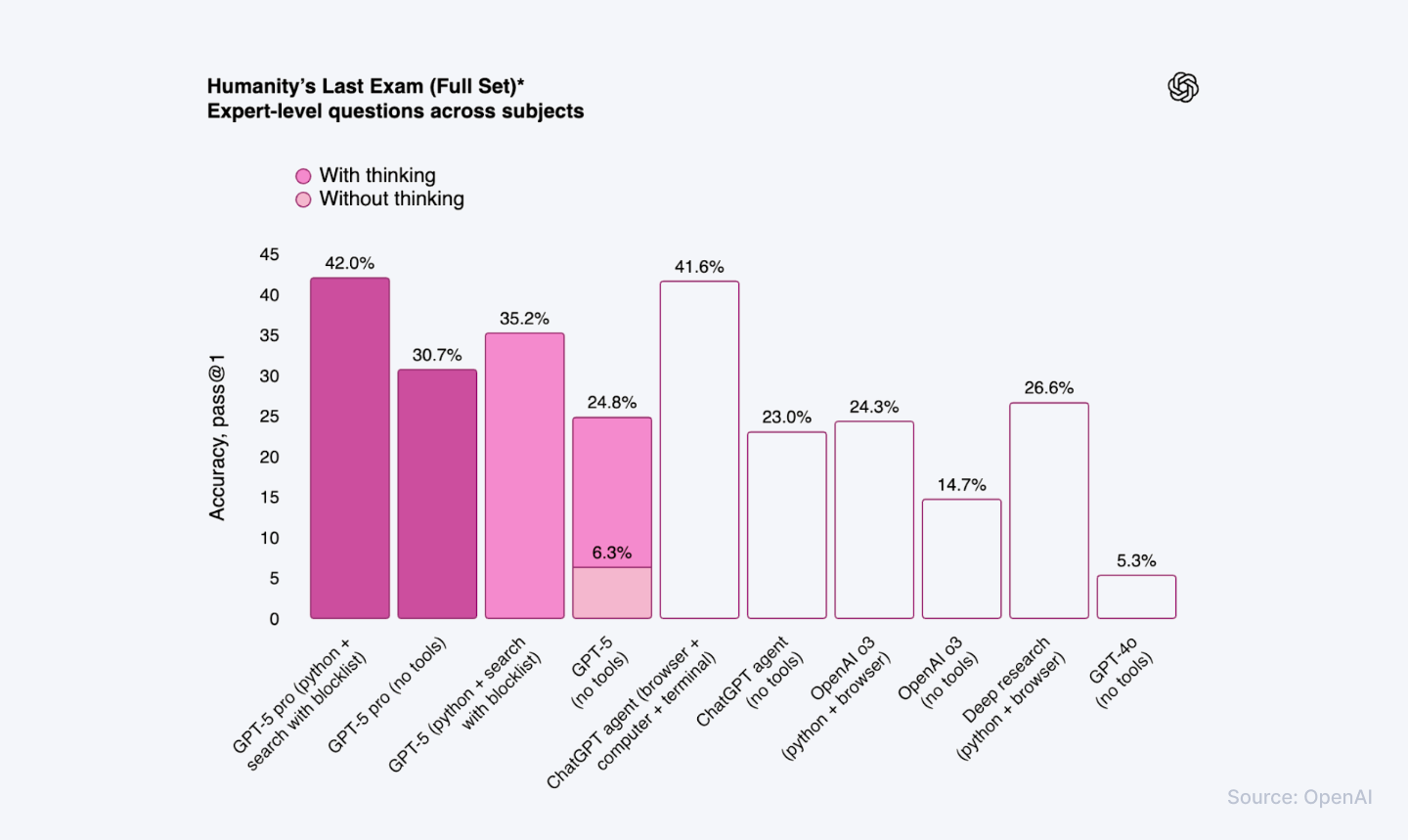
- On Humanity’s Last Exam, a brutal test that measures AI across math, humanities, and natural sciences, GPT-5 Pro (with extended reasoning) scored 42% using tools. That’s just shy of Grok 4 Heavy’s 44.4% and well above most other models.
- On Humanity’s Last Exam, a brutal test that measures AI across math, humanities, and natural sciences, GPT-5 Pro (with extended reasoning) scored 42% using tools. That’s just shy of Grok 4 Heavy’s 44.4% and well above most other models.
Source: OpenAI
Faster everything.
- Standard queries are 30–50% quicker. Code generation that used to take 45–60 seconds is now 15–20 seconds.
- Standard queries are 30–50% quicker. Code generation that used to take 45–60 seconds is now 15–20 seconds.
Cleaner output.
- 45% fewer factual errors than GPT-4o. If it can’t do something, it says so — no more “confidently wrong” answers.
- 45% fewer factual errors than GPT-4o. If it can’t do something, it says so — no more “confidently wrong” answers.
Real “vibe coding”.
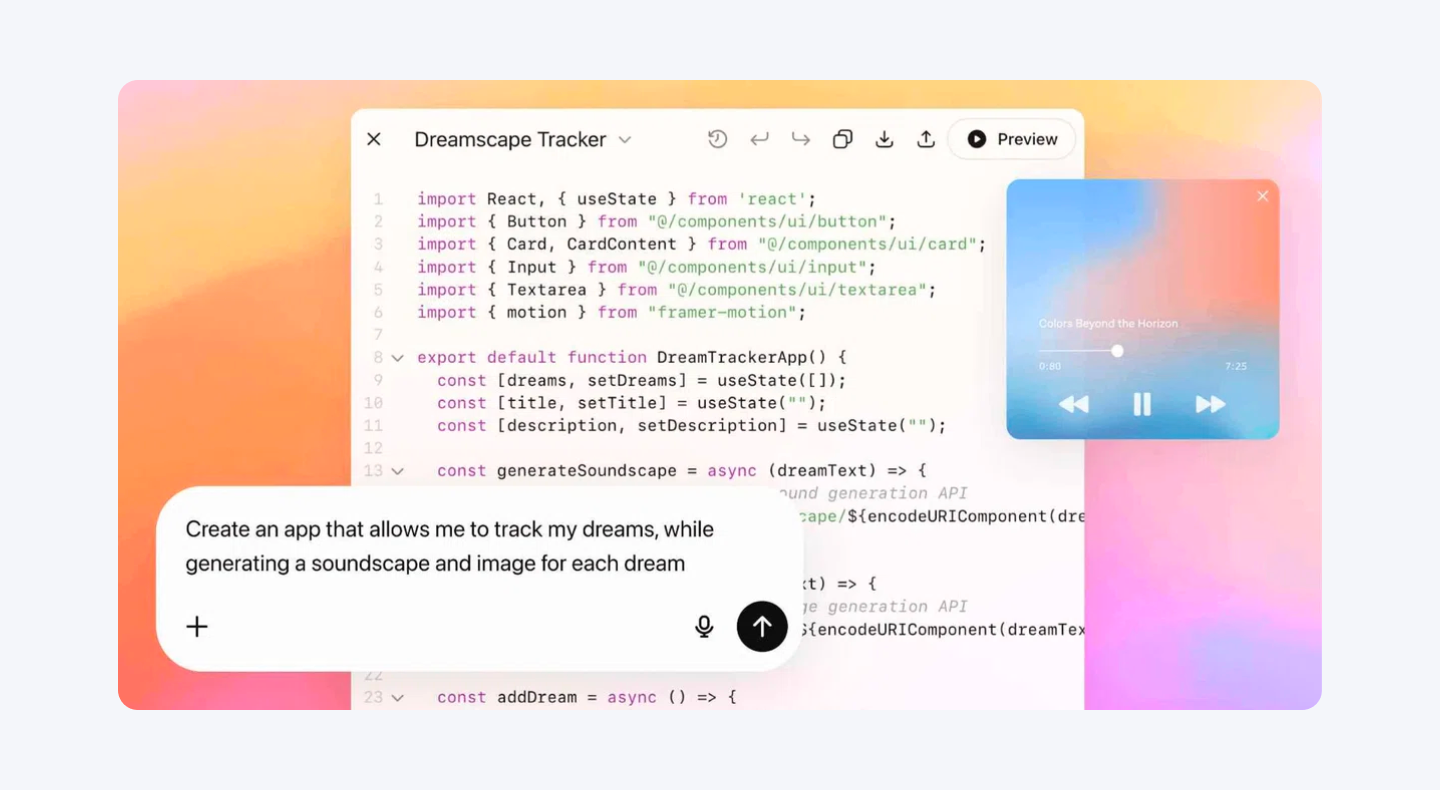
- Feed it a single prompt and it can spin up an entire working app. Responsive layout, API calls, styling, and all.
- Feed it a single prompt and it can spin up an entire working app. Responsive layout, API calls, styling, and all.
Better at following you.
- Complex, multi-step instructions are handled in one pass instead of breaking halfway through.
- Complex, multi-step instructions are handled in one pass instead of breaking halfway through.
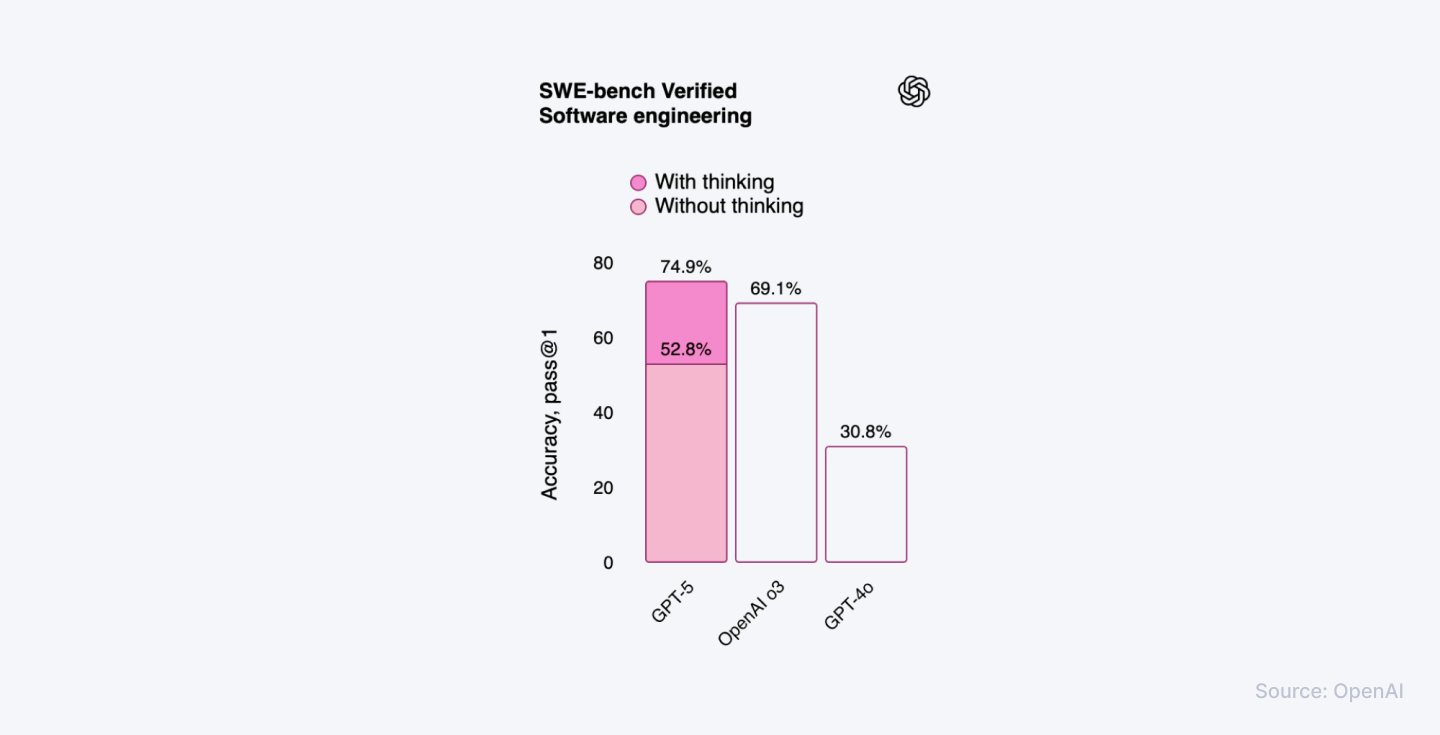
For devs, GPT-5 is a genuine coding collaborator. On the API side, it’s available in three flavors (gpt-5, gpt-5-mini, and gpt-5-nano), so you can trade off cost vs. reasoning time.
And yes, the pricing is surprisingly good:
- $1.25 / million input tokens (~750k words)
- $10 / million output tokens
This isn’t just for paid users. GPT-5 is rolling out to all ChatGPT accounts, free tier included (with usage limits).
Discover 40+ ChatGPT statistics that show why it still has a stronghold on the industry.
Source: OpenAI
What GPT-5 Means for Developers
Okay, enough theory. Let's talk about what this means for you, depending on what kind of code you write every day.
1. Backend Developers
If you write backend code, you know the pain: endless boilerplate, repetitive API endpoints, debugging that eats your entire afternoon. GPT-5 is basically here to steal that pain from you.
Here’s why it’s different this time:
- It doesn’t just code, it architects.
- You can ask GPT-5 to design the entire backend for a service, and it will map out the database schema, the API routes, and the authentication flow without skipping steps.
- You can ask GPT-5 to design the entire backend for a service, and it will map out the database schema, the API routes, and the authentication flow without skipping steps.
- It understands dependencies better.
- Instead of giving you snippets that don’t connect, it now delivers cohesive, production-ready code that respects your tech stack.
- Instead of giving you snippets that don’t connect, it now delivers cohesive, production-ready code that respects your tech stack.
- It can read your existing codebase.
- Paste in a chunk of your project and ask for changes, it will edit directly without breaking unrelated parts.
- Paste in a chunk of your project and ask for changes, it will edit directly without breaking unrelated parts.
Real-world use case
You’re building a booking system for a SaaS product. Instead of manually setting up user accounts, permissions, payment processing, and email notifications, you feed GPT-5 a single prompt:
“Create a backend in Node.js for a booking system with Stripe payments, user authentication, role-based access, and email confirmations. Use PostgreSQL. Make sure it’s secure and scalable.”
In under a minute, it hands you:
- A ready-to-run API with endpoints for booking creation, payment handling, and cancellations.
- SQL migrations for your database.
- Middleware for authentication and input validation.
- A basic test suite so you can deploy with confidence.
The big shift
With GPT-4, you still had to “babysit” it: check every endpoint, rewrite half the queries, fix the imports. GPT-5’s improved reasoning and context awareness means it now nails 80–90% of backend tasks on the first go. You still need to review and test (please don’t skip that), but the heavy lifting? That’s gone.
2. Frontend Developers
Frontend work can be a weird mix. One day you’re deep in React state management, the next you’re arguing with CSS about why your button has moved three pixels to the left. GPT-5 won’t stop designers from changing their minds every five minutes, but it will make everything else way faster.
Here’s what’s new for you:
- Figma-to-code that works.
- You can now paste a Figma export or even a screenshot and GPT-5 will give you responsive, production-ready components.
- You can now paste a Figma export or even a screenshot and GPT-5 will give you responsive, production-ready components.
- Smarter state management help.
- Tell it “Convert this messy React code into clean Redux Toolkit slices” and it will restructure your logic without breaking the app.
- Tell it “Convert this messy React code into clean Redux Toolkit slices” and it will restructure your logic without breaking the app.
- Real understanding of design systems.
- If you’re using Material UI, Tailwind, or Chakra, GPT-5 will stick to your chosen system and generate components that feel native.
- If you’re using Material UI, Tailwind, or Chakra, GPT-5 will stick to your chosen system and generate components that feel native.
- Built-in accessibility awareness.
- It now flags missing ARIA labels, poor color contrast, and keyboard navigation gaps.
- It now flags missing ARIA labels, poor color contrast, and keyboard navigation gaps.
Real-world use case
Your designer hands you a Figma file for a marketing dashboard. Instead of spending a whole day slicing it into components, you drop the design specs into GPT-5 and say:
“Build this in React with Tailwind CSS, mobile-first, and integrate Chart.js for the analytics section. Make sure it’s accessible and follows our color palette.”
You get back:
- A fully functional dashboard with responsive breakpoints.
- Styled, reusable components.
- Pre-wired charts with placeholder data.
- Accessibility notes and suggestions baked into the code comments.
The big shift
With GPT-4, frontend help was “meh,” it could spit out JSX, but you’d spend just as much time cleaning it up. GPT-5’s better context handling means it understands how components fit together and keeps everything consistent. It’s not just generating code, it’s building out a UI in a way that feels like you wrote it yourself.
3. QA Engineers
QA work is often about patience: reproducing a bug that “only happens sometimes,” running the same tests across five environments, and writing test cases that developers swear they’ll read. GPT-5 is like having a hyper-focused testing assistant who never gets bored.
Here’s what’s different for you now:
- Instant test script generation.
- Give GPT-5 a feature description or user story, and it’ll generate Selenium, Cypress, or Playwright tests that match the acceptance criteria.
- Give GPT-5 a feature description or user story, and it’ll generate Selenium, Cypress, or Playwright tests that match the acceptance criteria.
- Smarter bug reproduction.
- Paste in logs, screenshots, and error traces, and GPT-5 will walk you through likely causes and exact reproduction steps.
- Paste in logs, screenshots, and error traces, and GPT-5 will walk you through likely causes and exact reproduction steps.
- Multi-environment awareness.
- It can now adapt tests for different browsers, devices, and staging environments in one go.
- It can now adapt tests for different browsers, devices, and staging environments in one go.
- Better edge-case spotting.
- If you feed it the main happy-path tests, it will suggest edge cases you might have missed.
- If you feed it the main happy-path tests, it will suggest edge cases you might have missed.
Real-world use case
You’re testing a checkout flow, and a customer reports that their payment failed, but only on Safari iOS. You drop the logs, device info, and the feature description into GPT-5 and say:
“Write automated tests for this checkout flow, including scenarios for Safari iOS where payment might fail. Suggest likely causes for the bug.”
You get:
- A tailored Playwright test suite covering multiple browsers.
- A probable cause: a misconfigured Apple Pay API call.
- Step-by-step manual reproduction instructions so you can confirm it’s fixed before closing the ticket.
The big shift
With GPT-4, test generation was hit-or-miss, and debugging advice often sounded like “turn it off and on again.” GPT-5 links logs, symptoms, and code changes, so you can zero in on the root cause without wasting hours. It’s about making you the fastest QA in the room.
4. AI/ML Developers
If you work in AI or ML, you’ve probably been juggling half a dozen tools: Jupyter for notebooks, pandas for cleaning, scikit-learn for quick models, Hugging Face for bigger ones. GPT-5 isn’t here to replace those, but it is here to sit in the middle and glue everything together like a super-smart lab assistant.
Here’s what’s new for you:
- Faster prototyping.
- You can describe your dataset, your problem, and your goal, and GPT-5 will set up preprocessing, feature engineering, and a baseline model.
- You can describe your dataset, your problem, and your goal, and GPT-5 will set up preprocessing, feature engineering, and a baseline model.
- Smarter data cleaning.
- It now understands data quality issues at a deeper level. Give it a messy CSV, and it will flag anomalies, missing values, and potential label leaks.
- It now understands data quality issues at a deeper level. Give it a messy CSV, and it will flag anomalies, missing values, and potential label leaks.
- Integrated tool usage.
- GPT-5 can orchestrate calls to APIs like Hugging Face, TensorFlow Hub, or even AutoML platforms without you having to hand-hold every step.
- GPT-5 can orchestrate calls to APIs like Hugging Face, TensorFlow Hub, or even AutoML platforms without you having to hand-hold every step.
- Better prompt engineering.
- When building with LLMs, it can design, test, and optimize prompts automatically, then explain why certain structures work better.
- When building with LLMs, it can design, test, and optimize prompts automatically, then explain why certain structures work better.
Real-world use case
You’re building a sentiment analysis tool for customer reviews. You say:
“Given this dataset of 50k reviews, clean it, remove duplicates, handle missing data, and train a BERT-based classifier for sentiment analysis. Optimize for accuracy over speed. Use PyTorch.”
GPT-5 returns:
- A cleaned, preprocessed dataset with clear documentation of what was changed.
- A ready-to-run training script using Hugging Face Transformers.
- Hyperparameter tuning suggestions and a few quick experiments.
- An evaluation report with accuracy, F1-score, and potential improvements.
The big shift
With GPT-4, you could get “toy” models and half-working code, great for a demo, not so much for production. GPT-5’s improved reasoning means it now maintains context across the whole pipeline, from data cleaning to model evaluation. That means you can go from “idea” to “MVP” in a single sitting.
5. Data Engineers
If you’re a data engineer, you live in the world of ETL jobs, schema migrations, and the occasional “why is this table 300 GB bigger than yesterday?” mystery. GPT-5 can’t stop bad data from showing up, but it can help you catch it earlier, fix it faster, and build cleaner pipelines from the start.
Here’s what’s new for you:
- End-to-end pipeline building.
- You can describe your data sources, formats, and destinations, and GPT-5 will produce a full ETL/ELT script – Spark, Airflow, dbt, whatever you use – wired up and ready.
- You can describe your data sources, formats, and destinations, and GPT-5 will produce a full ETL/ELT script – Spark, Airflow, dbt, whatever you use – wired up and ready.
- Smarter schema handling.
- It can map mismatched schemas across different systems and generate transformations to align them without losing data integrity.
- It can map mismatched schemas across different systems and generate transformations to align them without losing data integrity.
- Proactive data quality checks.
- Give it a sample dataset, and it will propose automated validation rules to catch bad data before it poison downstream tables.
- Give it a sample dataset, and it will propose automated validation rules to catch bad data before it poison downstream tables.
- Context-aware optimizations.
- It can suggest more efficient partitioning, indexing, or join strategies based on your existing pipeline logic.
- It can suggest more efficient partitioning, indexing, or join strategies based on your existing pipeline logic.
Real-world use case
You’re tasked with moving data from multiple APIs into a Snowflake warehouse every hour. You tell GPT-5:
“Write an Airflow DAG that pulls data from these three APIs, cleans it, unifies the schema, and loads it into Snowflake. Include validation steps to catch null IDs and inconsistent timestamps.”
GPT-5 returns:
- A working DAG with all the necessary tasks, retries, and dependencies.
- Python operators for schema transformation.
- Built-in data validation functions.
- Notes on how to scale the job if volume spikes.
The big shift
With GPT-4, you could get the “skeleton” of a pipeline, but you’d still spend hours filling in the gaps and fixing data mismatches. GPT-5 understands workflow context better, it knows that cleaning and validation need to happen before loading, and it respects your scheduling and dependency logic.
6. Cloud Engineer
If you’re a cloud engineer, you’ve probably got Terraform scripts older than your coffee mug and a to-do list that includes “just a quick change” that takes three hours. GPT-5 isn’t going to stop people from asking for impossible uptime SLAs, but it will make spinning up and maintaining infrastructure a whole lot smoother.
Here’s what’s new for you:
- Full-stack IaC generation.
- Describe your infrastructure needs in plain English, and GPT-5 will write Terraform, Pulumi, or CloudFormation templates that actually deploy without 40 rounds of fixes.
- Describe your infrastructure needs in plain English, and GPT-5 will write Terraform, Pulumi, or CloudFormation templates that actually deploy without 40 rounds of fixes.
- Multi-cloud awareness.
- Need AWS for computation, GCP for data, and Azure for a specific service? GPT-5 can orchestrate resources across providers without you having to mentally juggle every API.
- Need AWS for computation, GCP for data, and Azure for a specific service? GPT-5 can orchestrate resources across providers without you having to mentally juggle every API.
- Smarter CI/CD automation.
- It can set up pipelines that handle testing, security scans, and zero-downtime deployments in one flow.
- It can set up pipelines that handle testing, security scans, and zero-downtime deployments in one flow.
- Built-in cost awareness.
- You can now ask it to optimize for budget, and it will suggest cheaper instance types, storage tiers, or scaling policies.
- You can now ask it to optimize for budget, and it will suggest cheaper instance types, storage tiers, or scaling policies.
Real-world use case
You get a request to launch a staging environment for a new microservice. Instead of manually setting up EC2 instances, networking, IAM policies, and monitoring, you tell GPT-5:
“Write Terraform to deploy a staging environment for a Node.js microservice on AWS with autoscaling, CloudWatch monitoring, and an S3 bucket for file storage. Optimize for cost and make it easy to tear down.”
You get:
- Complete Terraform scripts for compute, networking, and storage.
- Pre-configured IAM roles with least-privilege access.
- Autoscaling groups with sensible CPU/memory thresholds.
- Inline cost optimization notes so you know where you’re saving money.
The big shift
With GPT-4, you’d get IaC that looked fine but broke halfway through deployment because of a missing permission or misnamed resource. GPT-5’s deeper reasoning keeps track of dependencies, naming conventions, and security rules, so you can go from “idea” to “running environment” in one pass.
7. DevOps Engineers
DevOps often means living in a constant loop of “fix, deploy, monitor, repeat.” GPT-5 won’t stop people from deploying, but it will make incident prevention and recovery far faster.
Here’s what’s changing:
- Automated incident triage.
- Paste in a log dump, and GPT-5 can pinpoint the most likely cause, suggest fixes, and even generate the patch or config change.
- Paste in a log dump, and GPT-5 can pinpoint the most likely cause, suggest fixes, and even generate the patch or config change.
- Smarter monitoring setup.
- It can configure Prometheus, Grafana, or Datadog with relevant alerts based on your architecture and SLA requirements.
- It can configure Prometheus, Grafana, or Datadog with relevant alerts based on your architecture and SLA requirements.
- Seamless CI/CD pipelines.
- Instead of manually wiring Jenkins, GitHub Actions, or GitLab CI, GPT-5 creates end-to-end pipelines – tests, builds, deploys, and rollbacks – that work across multiple environments.
- Instead of manually wiring Jenkins, GitHub Actions, or GitLab CI, GPT-5 creates end-to-end pipelines – tests, builds, deploys, and rollbacks – that work across multiple environments.
- Proactive reliability checks.
- You can ask it to “stress test the current pipeline” and get automated simulations that reveal scaling or security weaknesses.
- You can ask it to “stress test the current pipeline” and get automated simulations that reveal scaling or security weaknesses.
Real-world use case
PagerDuty goes off. Your Kubernetes cluster in production is throwing 500 errors. With GPT-5, you drop in a snippet of the failing pod logs and say:
“Find the root cause of these errors and write a patch for the deployment YAML to fix it. Include a rollout plan with no downtime.”
You get:
- Root cause analysis (“misconfigured environment variable in production deployment”).
- Fixed YAML file with correct variables and scaling settings.
- Step-by-step rollout commands for kubectl or Helm.
The big shift
GPT-4 could explain logs. GPT-5 can explain and fix them, in a way that’s tailored to your actual infrastructure, with minimal babysitting.
8. Product Managers
GPT-5 won’t replace stakeholder meetings (sorry), but it will turn product planning, research, and communication into a faster, sharper process.
Here’s what’s new:
- Rapid market analysis.
- Drop in raw research, user feedback, or competitor data, and GPT-5 will summarize trends, identify gaps, and suggest high-impact features.
- Drop in raw research, user feedback, or competitor data, and GPT-5 will summarize trends, identify gaps, and suggest high-impact features.
- Auto-generated user stories.
- Based on your product vision, it can create clear, prioritized Jira tickets with acceptance criteria that engineers actually understand.
- Based on your product vision, it can create clear, prioritized Jira tickets with acceptance criteria that engineers actually understand.
- Data-informed roadmaps.
- Integrate analytics dashboards, and GPT-5 will highlight features that drive the most retention or revenue.
- Integrate analytics dashboards, and GPT-5 will highlight features that drive the most retention or revenue.
- Meeting-free alignment.
- You can feed in engineering capacity, dependencies, and deadlines, and GPT-5 will propose realistic, dependency-aware roadmaps.
- You can feed in engineering capacity, dependencies, and deadlines, and GPT-5 will propose realistic, dependency-aware roadmaps.
Real-world use case
Your CEO says: “We need an AI-powered search in the next quarter, figure it out.” With GPT-5, you can say:
“Based on our current roadmap, engineering bandwidth, and user analytics, propose a delivery plan for AI search. Include feature scope, dependencies, and risk mitigation.”
You get:
- A 3-phase roadmap with MVP → Beta → Full release timelines.
- Clear Jira epics and stories for each phase.
- Risks identified (e.g., latency issues, data privacy).
- Suggestions for incremental rollout to minimize impact.
The big shift
GPT-4 could help you write tickets. GPT-5 can design a product strategy, connect it to real capacity, and make sure everyone from engineering to marketing knows what’s coming, without ten Slack threads.
Compare which AI model is better for coding: Gemini and ChatGPT.
What You Can Build with ChatGPT-5
GPT-5 is basically a coding partner. You throw an idea at it, and instead of just giving you a snippet of code, it can build the whole thing. End-to-end.
Source: OpenAI
Here are three project ideas that show just how much power this thing has:
1. AI-Powered Resume Screener for Recruiters
Imagine building a tool that scans through hundreds of resumes, ranks candidates based on skills, and even flags the ones who are a perfect fit. GPT-5 can handle the parsing, the logic, the scoring, plus generate neat candidate summaries.
Why it’s cool for you
No need to wire up a dozen APIs or hand-write every data filter. GPT-5 can spin up the backend, integrate an interface, and even build the dashboard.
2. Smart Personal Finance Dashboard
Think of a web app that connects to your bank, tracks your spending, predicts cash flow, and suggests where you could save money. GPT-5 can set up the data pipelines, calculate trends, and make the UI fun to use (yes, even for budgeting).
Why it’s cool for you
It’s like having a data engineer, frontend dev, and UI designer in one. You just point GPT-5 in the right direction and refine the result.
3. On-Demand API for Niche Data
Say you want to build an API that serves real-time surf conditions, indie game release dates, or any super-specific dataset. GPT-5 can create the scraping scripts, set up the database, wrap it in an API, and even document the endpoints.
Why it’s cool for you
Normally this would take days of setup. GPT-5 makes it a one-afternoon job, leaving you more time to ship it or monetize it.
Final Thoughts
The launch of GPT-5 is the moment AI starts to feel less like a tool you use and more like a partner you work with.
Michelle Pokrass from OpenAI summed it up well:
“It’s a great coding collaborator, and also excels at agentic tasks.”
It’s not just answering questions, it’s taking action, handling complexity, and explaining its moves along the way.
We’ve seen this shift coming for a while. GPT-4 was smart. GPT-4o was fast. But GPT-5 is smart and fast, and that’s the combination that matters. It can reason through a multi-step coding problem, fetch the data it needs, build you a working app, and have it deployed quickly.
Does that mean we’ve hit AGI?
No. But we have hit a point where your workflow as a developer can look completely different. No more bouncing between ten tools, waiting for pipelines to run, or spending days debugging setup scripts. You can now have one conversation, in plain language, and see it translated into running, functional software.
Is it perfect?
Of course not. The Humanity’s Last Exam results prove that it’s still not the top dog in every category, and, like every model, it can still get things wrong. But when you can go from “idea” to “prototype” in hours, the trade-off is worth it.
In the end, GPT-5 isn’t just about faster answers. It’s about shorter paths from problem to solution. And if you’re a developer in 2025, that’s the edge you want, because the ones who learn how to work with GPT-5, will be the ones who set the pace for everyone else.
Ready to use your new GPT-5 skills on global projects? Join Index.dev to get matched with top tech companies and build a great remote career.


