
Hiring skilled back-end developers is a common pain point for startups and enterprises alike. The demand for backend talent outpaces supply: US software developer roles are projected to grow 15% from 2024–34. In response, many companies turn to curated platforms.
In reality, almost half of CEOs intend to increase freelance employment, and 78% indicate that best freelancers provide greater value than their in-house counterparts. Such trends indicate that utilization of specialist hiring platforms can provide you with access to a higher, broader talent pool in a short period.
The following platforms are the best ones to hire backend developers in the USA in 2025. Each is evaluated for vetting rigor, tools offered, success rates, pros/cons and ideal use cases.
We rank Index.dev first as the fastest, most reliable source of pre-vetted talent. You’ll also see Toptal, Gun.io, Turing, plus broader job boards. By the end, you’ll know which platform best fits your hiring needs and how to act.
Hire pre-vetted back-end engineers in 48 hours, with a 30-day risk-free trial and full US compatibility.
1. Use Index.dev to Hire Pre-Vetted Talent Fast

Index.dev is our own curated network of remote developers vetted for both technical skill and cultural fit. You can get matched with top back-end devs in 48 hours and start a 30-day risk-free trial. Index.dev focuses exclusively on high-caliber engineers with 5+ years of experience.
The hiring process: submit your backend project requirements, and Index.dev’s talent matcher handpicks 2–3 candidates in 1–2 days. You interview only these hand-selected profiles – no sifting through hundreds of resumes. If you hire, the first 30 days are free until you’re completely satisfied. The platform guarantees a 97% conversion from trial to placement, showing that matches usually work out.
- Key features:
- Senior US-compatible devs, risk-free trial, dedicated account manager, direct hiring or contracting.
- Senior US-compatible devs, risk-free trial, dedicated account manager, direct hiring or contracting.
- Vetting:
- All candidates pass technical tests and live interviews. They must prove expertise in major backend stacks (e.g. Node.js, Python, Go, Java) and excellent remote collaboration skills.
- All candidates pass technical tests and live interviews. They must prove expertise in major backend stacks (e.g. Node.js, Python, Go, Java) and excellent remote collaboration skills.
- Tools:
- Platform to match candidates, AI recommender, integrated billing and compliance handling, and Slack/Discord ready channels. They even handle all contracts and tax compliance.
- Platform to match candidates, AI recommender, integrated billing and compliance handling, and Slack/Discord ready channels. They even handle all contracts and tax compliance.
- Success metrics:
- Clients (from startups to Fortune 100s) report fast hires and high retention; Index.dev notes average engagements last 14+ months.
- Clients (from startups to Fortune 100s) report fast hires and high retention; Index.dev notes average engagements last 14+ months.
Pros: Speed (fast matching), high quality (only senior devs), risk-free trial, US-matched talent (overlaps in time zone).
Cons: Premium pricing vs generic boards, longer lead time than job ads (but still <1 week).
Checklist: Before choosing Index.dev, confirm your scope and budget. Ensure you have specific backend requirements to share (languages, frameworks, project duration). Ask about timezone overlap, trial terms, and replacement guarantees (we offer 48-hr replacement).
Learn more about Index.dev’s newly launched U.S. Hub – your gateway to remote tech talent.
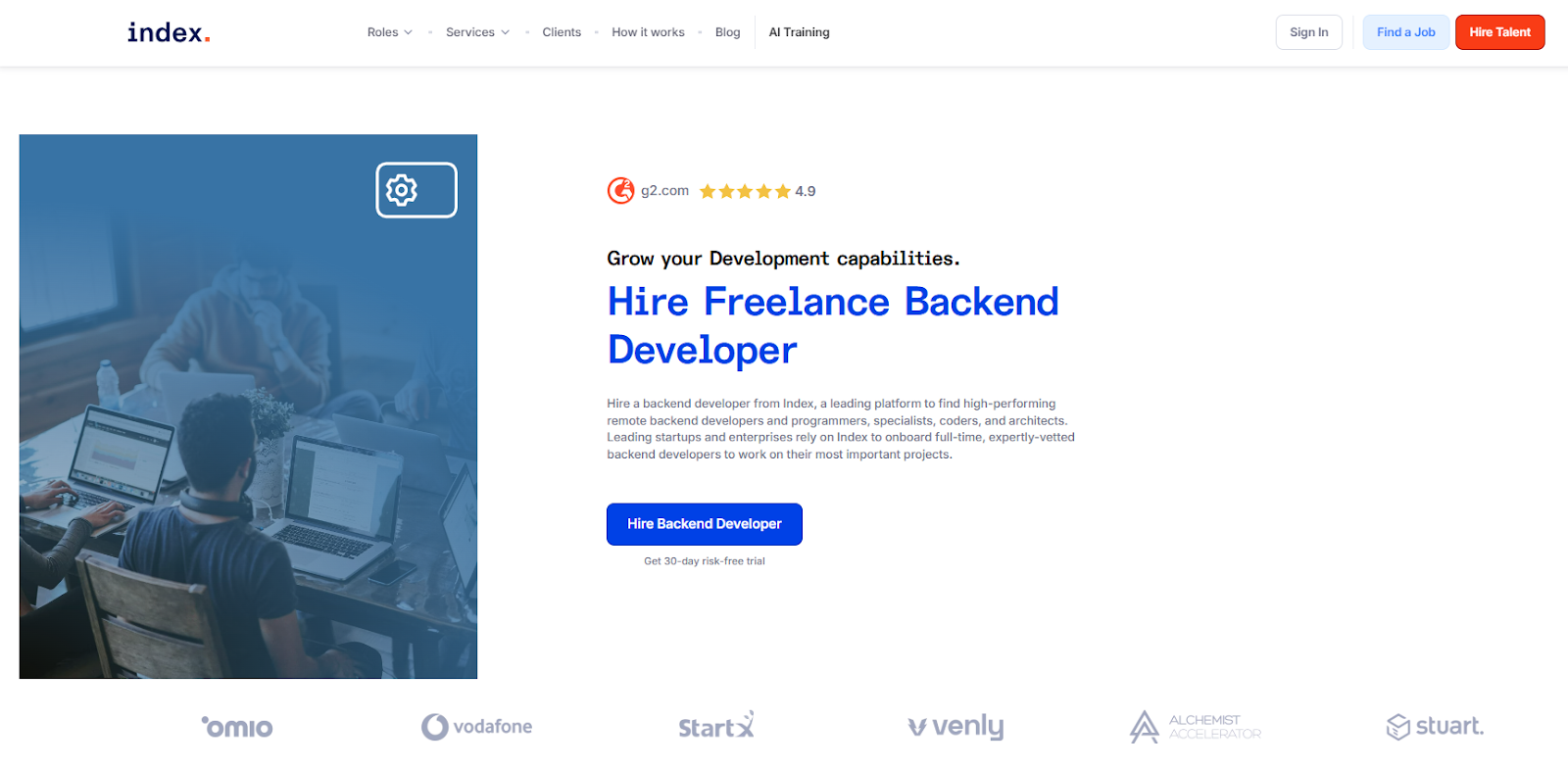
Index.dev’s platform is built for speed and trust. If you want qualified backend developers ready to start immediately and eliminate hiring risk, give Index.dev a try.
2. Use Toptal to Access the Top 3% of Developers

Toptal is a well-known premium network of freelance software engineers (and other specialists). It prides itself on only accepting the top 3% of applicants, after multiple screening stages. Toptal’s talent pool includes engineers with experience at tech leaders like Shopify and Motorola. For backend development, you’ll find experts in Java, Python, Node.js, Ruby, and more. Toptal clients benefit from:
- Tough Vetting:
- All developers are interviewed, algorithm tested, and given a live coding challenge. They must have stellar English communication. Toptal claims a 98% trial-to-hire success rate because of this vetting.
- All developers are interviewed, algorithm tested, and given a live coding challenge. They must have stellar English communication. Toptal claims a 98% trial-to-hire success rate because of this vetting.
- Fast matching:
- Once you sign up, Toptal pairs you with an “engineering lead” who conducts a consultation. You get candidate matches typically in 24–48 hours. You go through a shortlist, interview candidates, and then hire on a risk-free trial basis (pay only if satisfied).
- Once you sign up, Toptal pairs you with an “engineering lead” who conducts a consultation. You get candidate matches typically in 24–48 hours. You go through a shortlist, interview candidates, and then hire on a risk-free trial basis (pay only if satisfied).
- Dedicated Service:
- Toptal provides 24/7 support and handles all paperwork. You can flexibly scale the engagement (hourly, part-time, or full-time) with no long-term commitment.
- Toptal provides 24/7 support and handles all paperwork. You can flexibly scale the engagement (hourly, part-time, or full-time) with no long-term commitment.
Pros: World-class talent, proven at large companies, fast matching, risk-free trial, easy escalation from one-off to team.
Cons: Very high cost. Talents often bill $80–$150+ per hour (freelancer rate), which means Toptal charges clients roughly 50–60% above the freelancer’s rate. This makes them one of the priciest options. Also, Toptal primarily offers remote talent.
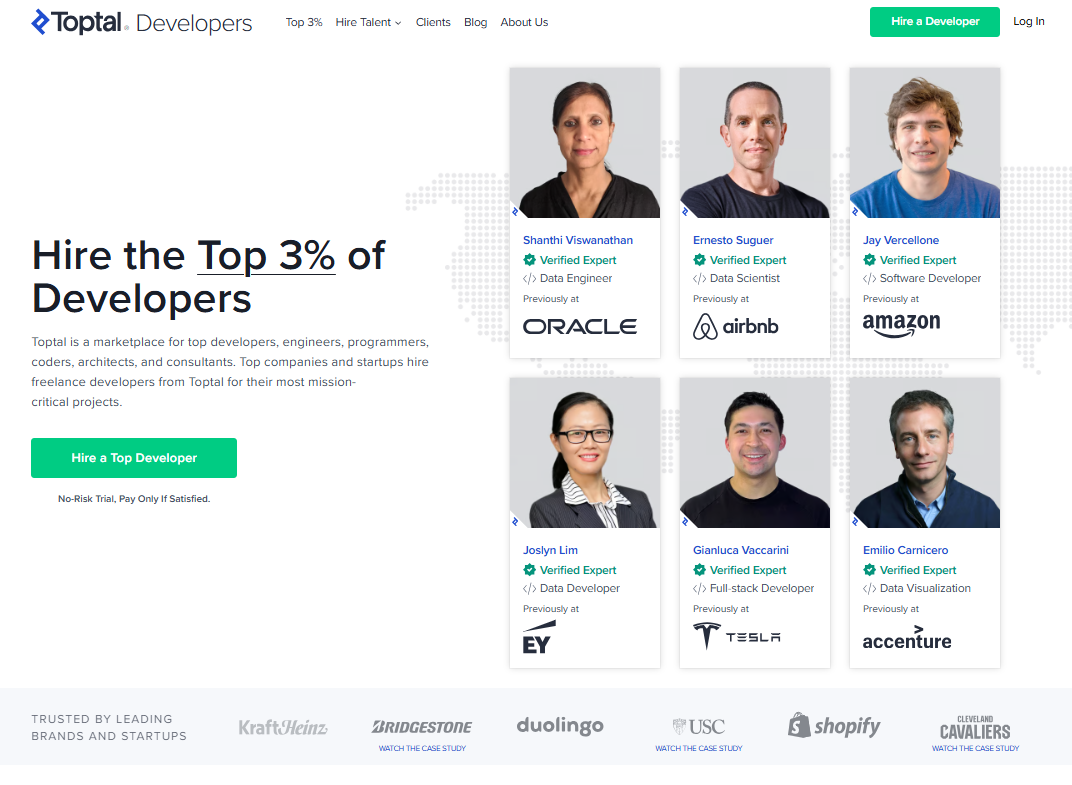
Their model is right for firms that cannot sacrifice technical quality and require nearly-instant deliverables. If your project requires best-in-class backend engineers and you have a high budget, Toptal is a good option. As one CEO noted, “Toptal’s screening ensures quality matches”. But be sure your ROI justifies the premium fees.
Don’t miss: Toptal vs Turing vs Arc.dev vs BairesDev vs Index.dev — see which platform works best for your hiring needs.
3. Use Gun.io to Source Elite Developers Quickly

Gun.io is a boutique developer staffing platform known for speed and Silicon Valley–caliber talent. They source and manage engineers freelance or full-time, handling payroll and compliance.
- Vetting & Matching:
- Gun.io vets all applicants (technical tests + live interviews) and keeps a database of around 5,000 full-stack engineers. When you submit a job, their AI-driven system plus recruiter team present verified candidates in as fast as 3–5 days. Gun.io emphasizes “outcomes-based matching,” focusing on your specific needs.
- Gun.io vets all applicants (technical tests + live interviews) and keeps a database of around 5,000 full-stack engineers. When you submit a job, their AI-driven system plus recruiter team present verified candidates in as fast as 3–5 days. Gun.io emphasizes “outcomes-based matching,” focusing on your specific needs.
- Tools & Support:
- You get a dashboard (“Missions”) to track applicants, shortlist hires, and schedule interviews. Gun.io assigns a dedicated customer success manager to guide you. Once you hire, they handle contracts, timesheets, and even monthly payroll, so your engineering team can focus on coding.
- You get a dashboard (“Missions”) to track applicants, shortlist hires, and schedule interviews. Gun.io assigns a dedicated customer success manager to guide you. Once you hire, they handle contracts, timesheets, and even monthly payroll, so your engineering team can focus on coding.
- Performance Tracking:
- Every developer is rated on performance metrics (quality, communication, hours) on the Gun.io platform. You can view these reports anytime to ensure deliverables stay on track.
- Every developer is rated on performance metrics (quality, communication, hours) on the Gun.io platform. You can view these reports anytime to ensure deliverables stay on track.
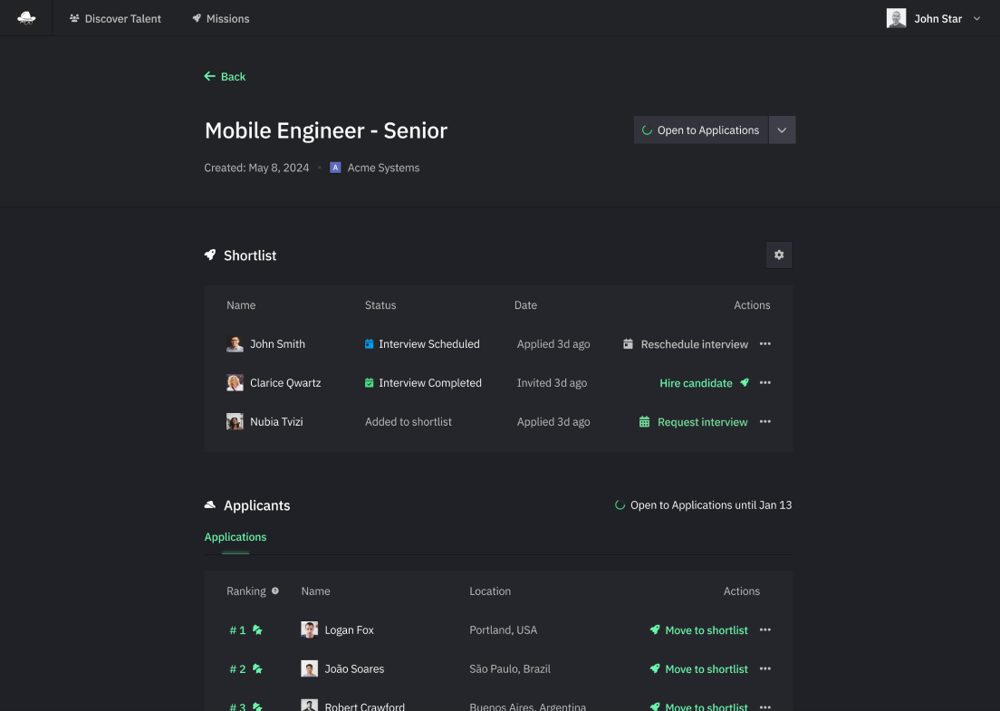
Example: A hiring manager’s view on Gun.io showing applicant shortlist and controls.
Pros: Very fast turnaround (Gun.io reports average fill time ~13 days from request to onboard), no hidden fees (only pay the quoted rate), and ongoing support. They also cover global hires with EOR (employer of record) services. Their clients include Cisco, Amazon, Tesla, etc., reflecting strong trust in quality.
Cons: Rates are high-end. Gun.io engineers typically start around $60/hr and can exceed $150/hr for specialists. There’s also a 20% project fee on full-time placements, so budget accordingly. Lastly, Gun.io is lean on junior devs – they focus on mid/senior talent, so less suited for basic work.
Use Gun.io when you need a vetted full-stack engineer fast. It’s a good bridge between mass marketplaces and top-tier firms: you’ll avoid low-quality applicants but pay more than a standard job board. (Gun.io claims zero extra fees beyond the developer’s rate, and offers free replacements if things go wrong.)
4. Use Turing for AI-Vetted Remote Back-End Experts

Turing.com is an AI-driven platform for hiring remote software engineers, with a heavy focus on rigorous screening. Its tagline is “Hire Back-End Developers in 4 Days” – and they often deliver on speed.
- AI-Powered Vetting:
- Turing uses machine learning to parse millions of data points on developers. They test candidates on coding, algorithms, and domain-specific skills (e.g. back-end frameworks). Turing advertises access to the top 1% of global developers, all of whom have passed its assessments.
- Turing uses machine learning to parse millions of data points on developers. They test candidates on coding, algorithms, and domain-specific skills (e.g. back-end frameworks). Turing advertises access to the top 1% of global developers, all of whom have passed its assessments.
- Rapid Matching:
- After you submit a job description, Turing’s system presents qualified candidates in about 4 days on average. You can view video intros and detailed profiles of each match. They need a minimum of 4-hour time-zone overlap for true real-time work.
- After you submit a job description, Turing’s system presents qualified candidates in about 4 days on average. You can view video intros and detailed profiles of each match. They need a minimum of 4-hour time-zone overlap for true real-time work.
- Managed Oversight:
- After you onboard, Turing has inbuilt tracking: time logs, virtual stand-ups, and performance reviews. In a way, it is both recruiter and light project manager.
- After you onboard, Turing has inbuilt tracking: time logs, virtual stand-ups, and performance reviews. In a way, it is both recruiter and light project manager.
Pros: Phenomenally quick turnaround (roughly 4-day matching), global talent base (plenty of high-end Indian and Eastern European engineers), and built-in remote work tools. Inclusive pricing: expect mid/senior devs at $100–$200/hr (client-side composite rate). Customers pay a flat monthly rate, which pays for salary and platform charges (Turing takes ~50–60% of it). If you desire a virtual-outsourced experience (i.e. contract foreign talent with zero headache), Turing does much of the heavy lifting.
Cons: You lose some direct control, since Turing staff handles many logistics. The pricing is comparable to Toptal at the high end (e.g. a full-time remote senior might cost $17k–$35k/month). And like Toptal, it’s primarily remote talent – so you must manage time-zone and cultural differences.
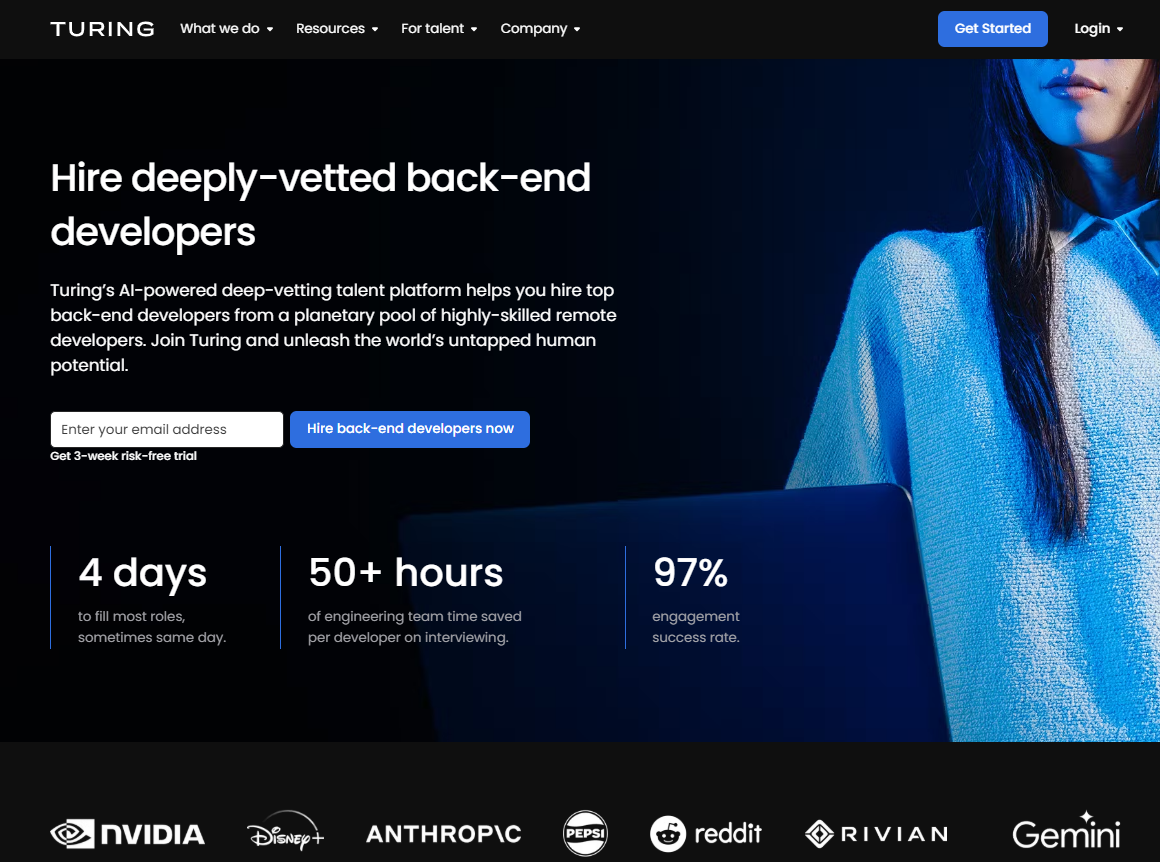
Turing shines when you need vetted backend experts very fast and don’t mind managing a remote team. For example, a US startup that can’t find local Rails or Node.js seniors might post a role on Turing and get a shortlist in days. As one analyst noted, Turing’s technology “scans candidates with 20,000+ signals” to ensure fit.
5. Use LinkedIn and Tech Job Boards for Wide Talent Pools

For completeness, don’t overlook traditional job platforms. LinkedIn, Stack Overflow Jobs, and niche tech boards (e.g. Dice, Wellfound - formerly AngelList) offer massive reach. These are not curated networks, but they have broad usage: LinkedIn has millions of developer profiles, and 45% of US engineers work fully remotely. Here’s how to leverage them:
- Wide Audience:
- Posting on LinkedIn or Indeed instantly exposes your opening to thousands of active candidates. These platforms allow filtering by skills, location, and keywords. Many devs update their LinkedIn to be “Open to work”, and tech job-seekers frequent these sites daily.
- Posting on LinkedIn or Indeed instantly exposes your opening to thousands of active candidates. These platforms allow filtering by skills, location, and keywords. Many devs update their LinkedIn to be “Open to work”, and tech job-seekers frequent these sites daily.
- Tools:
- Paid recruiting products (LinkedIn Recruiter, StackOverflow Talent) include AI matching and messaging. You can search profiles and even invite candidates to apply. On StackOverflow’s network, engineers often highlight their specialized skills (e.g. “backend, Node.js, AWS”), making targeted search possible.
- Paid recruiting products (LinkedIn Recruiter, StackOverflow Talent) include AI matching and messaging. You can search profiles and even invite candidates to apply. On StackOverflow’s network, engineers often highlight their specialized skills (e.g. “backend, Node.js, AWS”), making targeted search possible.
- Cost & Process:
- This route typically costs less up-front (job postings or subscriptions) than premium networks. However, you’ll get far more applicants with mixed quality. Be prepared for heavy screening: sifting through 100+ resumes for a good hire is common.
- This route typically costs less up-front (job postings or subscriptions) than premium networks. However, you’ll get far more applicants with mixed quality. Be prepared for heavy screening: sifting through 100+ resumes for a good hire is common.
Pros: Low barrier to entry, huge candidate volume, easy to advertise multiple openings. It’s especially useful if you have multiple roles or need local hires. Also, LinkedIn’s referral network means your opening can get shared internally.
Cons: Little vetting – you must do all screening yourself. Spam and recruiters’ cold messages are common, which can dilute the candidate pool. It’s time-consuming to post jobs on several boards. For backend specifically, note that many frontend/ full-stack devs will also apply, so define roles clearly.
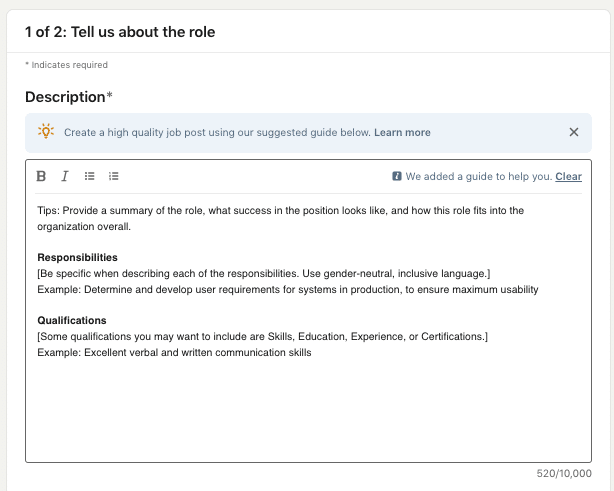
For action, try to write a clear backend role description with required tech stack (e.g. “Java Spring Boot” or “Python Django”). Use checklists or automated assessments to pre-filter (e.g. coding quiz in job posts). Accept that the hire process will take longer: after initial screening, budget several rounds of interviews to truly verify skills.
Still, for teams building a broad pipeline or hiring at scale, these platforms remain essential in 2025.
Next, read our guide on the best 7 platforms to hire top freelance software developers.
Compare Platforms at a Glance
Platform | Typical match time | Vetting rigor | Pricing range (USD) | Ideal use case | Trial / Guarantee | Pros | Cons |
| Index.dev | ~48 hours to shortlist | High — live interviews, technical tests, product-fit checks | Premium (enterprise rates) — consult for quote | Fast, low-risk hires of senior US-aligned backend engineers | 30-day risk-free trial; replacement guarantees | Fast matching; US-aligned talent; trial converts to hire; account manager & compliance handled | Higher cost than generic boards; premium positioning |
| Toptal | 24–48 hours to shortlist | Very high — multi-stage screening; top ~3% accepted | High — typical client rates $80–$150+/hr (client markup applies) | When absolute top-tier technical depth is required and budget is available | Risk-free trial / satisfaction window | Elite engineers; enterprise-grade vetting; fast matching | Very expensive; mainly remote talent; premium fee structure |
| Gun.io | 3–5 days to present candidates; avg fill ~13 days | High — tests + live interviews; recruiter + AI match | Mid–high — $60–$150+/hr (specialists higher) | Rapid hiring of mid/senior engineers with outcomes focus | Replacement and support policies (varies by engagement) | Boutique sourcing; recruiter-led matching; payroll/EOR support | Higher hourly rates; fewer junior options; placement/project fees |
| Turing | ~4 days to shortlist | High — AI + tests; claims top 1% global pool | Mid–high — blended client rates $100–$200/hr (monthly all-in) | Fast global scale hiring when remote collaboration is acceptable | Platform-managed contracts; replacement options | AI-driven scale; built-in remote-work tooling; fast turnaround | Less direct control over logistics; platform margin can be substantial |
| LinkedIn / Tech Job Boards (LinkedIn, Stack Overflow, Dice, Wellfound) | Immediate posting; pipeline builds over weeks | Low–variable — depends on internal screening | Low–mid — job post or subscription costs; hiring team time cost | Building broad pipelines, local hires, multiple simultaneous openings | No trial — standard hiring lifecycle | Massive reach; good for volume and referrals; low up-front cost | High screening overhead; variable candidate quality; time-consuming to vet |
Choosing the Right Platform for Your Business Size
- Speed vs Process
- Startups: prioritize speed and outcome. Use curated marketplaces (Index.dev, Gun.io) or an AI-matching platform to validate a developer in a 30-day sprint. Focus on a one-page brief with 30-day deliverables.
- Enterprises: prioritize process and governance. Use premium networks (Toptal, internal RPO + job boards) that offer SLAs, compliance, and multi-stakeholder vetting.
- Startups: prioritize speed and outcome. Use curated marketplaces (Index.dev, Gun.io) or an AI-matching platform to validate a developer in a 30-day sprint. Focus on a one-page brief with 30-day deliverables.
- Budget vs ROI
- Startups: optimize for time-to-product over hourly rate. Pay a premium for fast, senior hires when it cuts months of product risk. Run short paid trials to validate ROI before long commitments.
- Enterprises: optimize for total cost of ownership. Negotiate volume discounts, long-term contracts, and vendor SLAs. Use job boards and internal hiring pipelines to build sustainable capacity.
- Startups: optimize for time-to-product over hourly rate. Pay a premium for fast, senior hires when it cuts months of product risk. Run short paid trials to validate ROI before long commitments.
- Control vs Scale
- Startups: prefer direct control—short contracts, close onboarding, frequent check-ins. Use curated platforms that let engineering leads hire, replace, or extend quickly.
- Enterprises: need scale, reporting, and vendor management. Use a combination of retained vendors, global platforms (Turing) for scale, and internal sourcing to balance speed with governance.
- Startups: prefer direct control—short contracts, close onboarding, frequent check-ins. Use curated platforms that let engineering leads hire, replace, or extend quickly.
Quick decision rule: if immediate delivery and low hiring risk matter most, run a curated trial (Index.dev) + open a job-board pipeline in parallel. If scale, compliance, and predictable budgeting are primary, prioritize enterprise-grade vendors and build internal hiring funnels.
Read next: Top 7 websites to hire web developers — get actionable tips for sourcing skilled developers quickly and effectively.
Conclusion
Hiring backend developers is a strategic investment. The right platform can save you weeks of work and ensure you onboard an engineer who actually delivers.
This article compared five practical paths: curated networks (Index.dev), elite freelance marketplaces (Toptal, Gun.io), AI-driven remote platforms (Turing), and broad job boards (LinkedIn & tech sites). Each path trades speed, cost, and control differently. That trade-off is the central decision for any hiring team.
When speed and low risk matter most, choose curated matchmaking. When absolute top-tier technical chops are the priority and budget is ample, choose elite marketplaces. When scale and reach matter, use job boards and screening funnels. When time-to-hire and global talent access are the driver, consider AI-vetted remote platforms. In our view, Index.dev offers the best combination of curation and convenience for both startups and enterprises.
Hiring success depends on the process, not just the platform. Use a one-page role brief: tech stack, 30-day deliverables, and objective success criteria. Run a short paid trial where possible. Score trials on deliverables shipped, PR/code review quality, and team communication. Replace or extend only after objective scoring.
For most startups and hiring managers in 2025, a two-track approach works best: run a curated trial (fast validation) while opening a job board pipeline (longer-term backlog). That preserves velocity now and builds depth later.
➡ ️Ready to hire senior backend developers without the hiring risk?
If you need a backend developer, visit Index.dev’s hiring page or schedule a quick call. Our talent team will assess your needs and connect you with candidates on demand. With proven vetting and dedicated support, Index.dev helps you hire with confidence. Don’t waste another hiring cycle on generic job posts, let us match you with a high-performing backend developer today.
➡ Want to dive deeper into developer hiring strategies?
Explore more guides on Index.dev, including top platforms to hire web developers, tools for large-scale hiring, best freelance platforms, AI developer recruiting tips for early-stage startups, and top platforms for hiring European developers. Learn practical tips, compare platforms, and strengthen your hiring process.


