Finding the right development talent at competitive rates remains a critical challenge for businesses of all sizes. The debate over whether to outsource software development from Eastern Europe has intensified.
In this article, we’ll dive into the depth of the topic, analyze trends, and present compelling statistics to help you decide if hiring software talent from the Eastern Europe region is the right step for your business.
The Talent Landscape in Eastern Europe
The tech ecosystem across Eastern Europe has undergone remarkable transformation over the past decade. Countries like Poland, Ukraine, Romania, and the Baltic states have invested heavily in STEM education, creating a robust pipeline of skilled developers who combine technical proficiency with creative problem-solving approaches.
The Numbers Behind the Talent Pool
Eastern Europe now boasts over 1.3 million professional developers, with significant concentrations in:
- Poland: 295,000+ developers
- Ukraine: 240,000+ developers
- Romania: 116,000+ developers
- Czech Republic: 95,000+ developers
This robust ecosystem means that when you’re considering hiring devs from the Eastern Europe region, you’re looking at a market where innovation, technical expertise, and a commitment to quality are at the forefront. As technology continues to evolve, Eastern Europe’s role in driving advancements in artificial intelligence, machine learning, and emerging tech further strengthens its position in the global arena.
What makes this region particularly attractive is not just the quantity of talent but the quality. According to various reports, developers from Romania, Poland, and Ukraine consistently rank in the top 10 globally for problem-solving efficiency and code quality. This concentration of talent stems from several key factors:
- Strong mathematical and engineering fundamentals in education systems
- Early exposure to programming in school curricula
- Growing number of specialized tech universities and bootcamps
- Thriving startup ecosystems that foster innovation
According to Eurostat’s data on education and innovation (more details available at Eurostat), a significant percentage of graduates from these countries pursue careers in tech, making the region a veritable gold mine for mid- and senior-level developers.
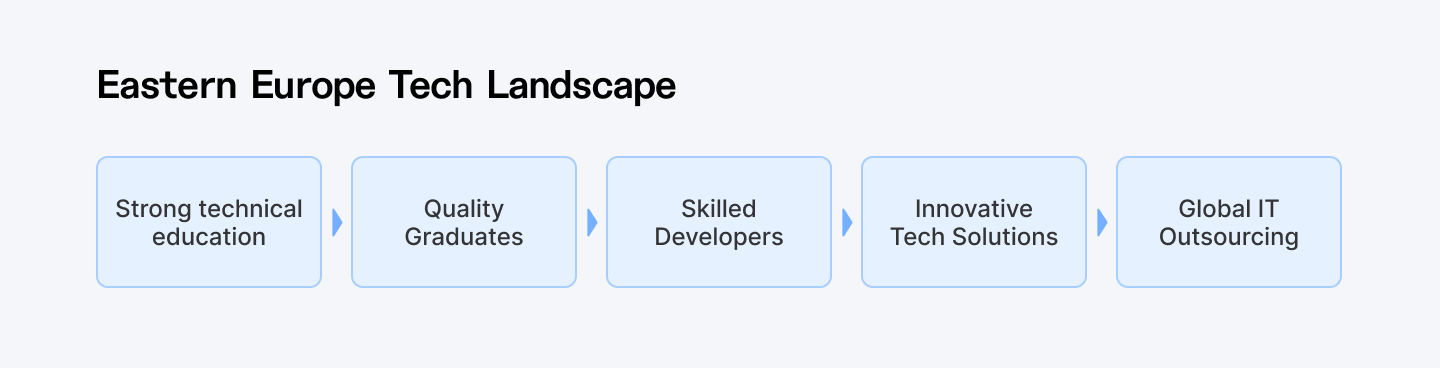
This flowchart illustrates how robust education in Eastern Europe funnels into a rich talent pool, ultimately benefiting companies looking to innovate and expand their tech capabilities.
Learn More: IT Staff Augmentation in Poland: Top Tech Talent Solutions 2025
Key Advantages of Hiring from Eastern Europe
Highly Skilled Workforce
Eastern European developers are renowned for their deep technical expertise. With rigorous training and a strong foundation this translates into versatility across various technology stacks, with particular expertise in:
- Back-end development (Java, Python, .NET)
- Mobile development (Flutter, React Native)
- Data science and machine learning
- DevOps and cloud architecture
According to the HackerRank Country Rankings, developers from Poland, Hungary, and Ukraine place consistently in the top 15 globally across algorithmic challenges and problem-solving competitions.
Their consistent performance in global programming competitions is a testament to their abilities. This factor alone makes hiring devs from the Eastern Europe region a strategic move that will reflect well on your business’ future.
Cultural Compatibility and Communication
One significant advantage when working with Eastern European talent is the high level of English proficiency, particularly among younger developers. The EF English Proficiency Index ranks Poland, Romania, and Croatia among the top 30 countries globally for English skills. This proficiency facilitates seamless communication and reduces cultural barriers that often complicate offshore collaboration.
As our experience at Index.dev has shown, this alignment extends beyond language. There's a strong work ethic and project ownership mentality that aligns well with Western business expectations. One of our clients, a San Francisco-based SaaS company, reported that their Polish development team regularly proposed architectural improvements that their in-house team hadn't considered.
Cost Efficiency
The economic advantage remains compelling. While rates vary by country, experience level, and specialization, the typical cost structure provides significant savings compared to North American or Western European markets. For example, while the hourly rates in the US and Western Europe can exceed $100, rates in Eastern Europe often range between $30 and $60 per hour, depending on the developer’s expertise. Here’s a more precise comparison:
Cost Comparison Chart
Region | Junior Developer (Hourly) | Mid-level Developer (Hourly) | Senior Developer (Hourly) |
USA/Canada | $70-110 | $100-170 | $150-250+ |
Western Europe | $60-90 | $90-140 | $130-200 |
Eastern Europe | $25-40 | $40-70 | $70-120 |
These rates reflect all-inclusive costs when hiring through established agencies or platforms like Index.dev, where we handle legal, administrative, and operational aspects of international hiring.
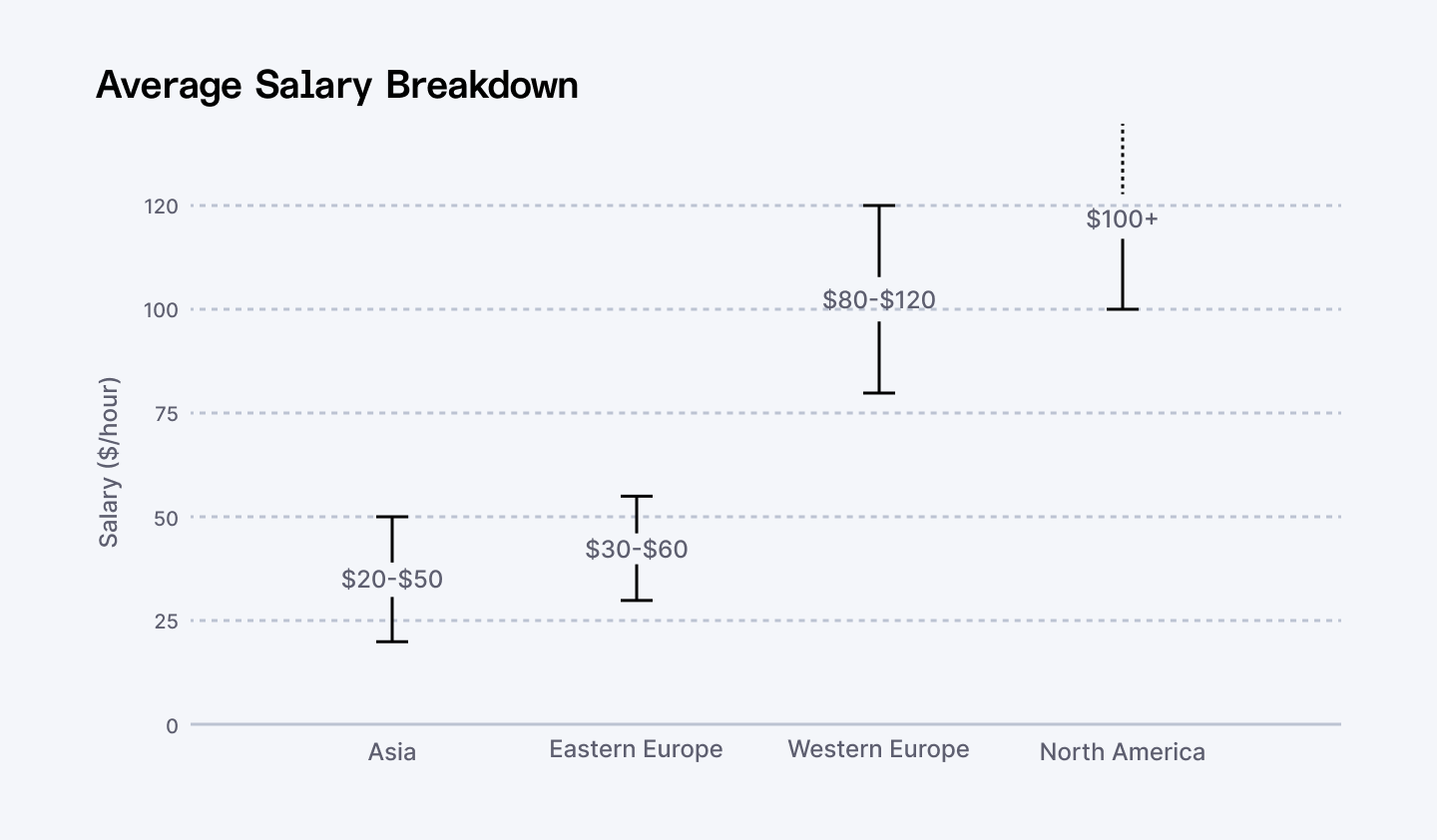
Figure: The bar chart comparison from a cost perspective of hourly rates shows why hiring devs from the Eastern Europe region is worth considering.
This economic benefit means you can invest more resources in innovation and quality assurance rather than just covering high salary costs. This cost efficiency in turn allows you to allocate more resources toward innovation and quality assurance, making hiring devs from the Eastern Europe region worth considering and not only a smart move but a financially savvy one. Moreover, many companies have reported not only saving on direct salary expenses but also enjoying reduced overhead costs related to recruitment and management.
Geographical Proximity and Time Zone Alignment
The strategic location of Eastern Europe also plays a critical role. Hiring developers within a particular time-zone can often make or break your project deliverables. Its time zone alignment with both the US and Western Europe facilitates real-time collaboration and agile development. The Eastern European time zones (UTC+1 to UTC+3) create convenient overlap with both North American and Asian business hours:
- 3-7 hours of overlap with US East Coast
- Full workday overlap with Western Europe
- Afternoon overlap with Asian markets
This positioning enables real-time collaboration without requiring either side to work extensively outside normal business hours. For agile development processes that benefit from synchronous communication, this geographical advantage proves invaluable.
Here’s an anecdote that you may find relatable - during a project kickoff, our client in Eastern Europe and our in-house team managed to resolve a critical issue in a single meeting, thanks to overlapping hours. It was a reminder that even a one-hour difference can foster real-time innovation.
By maintaining synchronous communication with your teams, you ensure project milestones are met without the usual delays associated with distant outsourcing.
Also Check Out: Top 5 Countries In Eastern Europe To Outsource Software Development
Navigating Challenges in Outsourcing
While the advantages are significant, companies considering Eastern European developers should be aware of several important factors:
Legal and Contractual Issues
Each country maintains distinct legal requirements regarding employment, intellectual property, and data protection. We recommend:
- Engaging legal experts familiar with local regulations
- Establishing clear IP assignment protocols upfront
- Understanding data residency requirements, particularly for EU-based operations
- Considering partnership models (B2B contracting vs. employment)
Remote Team Management
Managing a remote team across different time zones requires reliable communication tools and a well-defined project management process. Tools like Slack, Trello, and Zoom can bridge the gap and streamline operations. Successful companies also implement various protocols such as:
- Structured onboarding processes with cultural integration components
- Regular face-to-face meetings when possible (quarterly or bi-annually)
- Transparent documentation and knowledge-sharing practices
- Focus on results rather than activity monitoring
Cultural Integration
Although Eastern European developers generally exhibit strong cultural alignment, regular team-building activities and virtual meetups can enhance collaboration even further by strengthening the bond between your in-house and outsourced teams.
Political and Economic Stability
Despite significant progress, some Eastern European countries still face geopolitical tensions. The region has experienced varying levels of political and economic volatility. However, EU member states like Poland, Romania, and the Baltics offer greater stability, while Ukraine has demonstrated remarkable resilience in its tech sector despite challenging circumstances. Companies can mitigate risks by:
- Diversifying teams across multiple countries within the region
- Working with established agencies that have contingency plans
- Maintaining distributed repositories and deployment processes
- Setting clear communication protocols for potential disruptions
- Conducting thorough risk assessments before establishing long-term partnerships
Talent Retention
The competitive job market in the region sometimes results in higher turnover rates. To mitigate this, companies should focus on offering career development opportunities and fostering engaging, inclusive work environments.
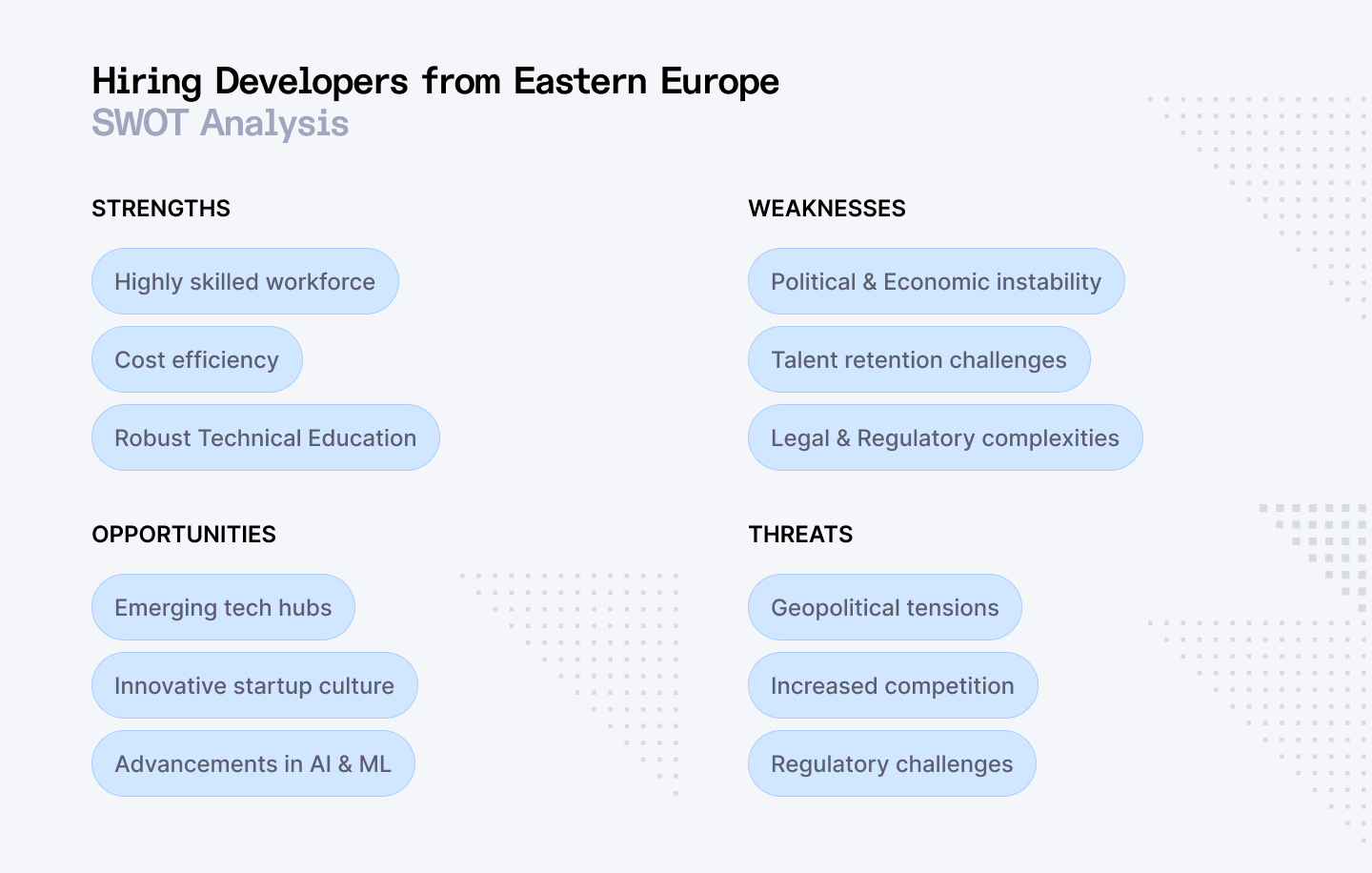
This SWOT analysis attempts to shed some light on the various challenges and strengths of hiring from Eastern Europe.
By planning strategically and using robust communication channels, many companies have successfully managed these challenges, reinforcing that hiring devs from the Eastern Europe region is worth considering despite the obstacles and is not only viable but a strong option for forward-thinking businesses.
Success Stories and Industry Case Studies
There are numerous success stories that illustrate the tangible benefits of tapping into Eastern Europe’s tech talent. Many companies have scaled rapidly and enhanced their innovation capabilities by integrating remote teams from the region.
Take Index.dev, for instance, where our firsthand experience shows that Eastern European developers not only enhance efficiency but also spark creative solutions. Talent acquisition here isn’t just about cutting costs. It’s about finding quality, compatibility, and partners who truly drive growth. One memorable example comes from a client who shared how a senior developer from Poland identified a potential flaw in their code that ultimately saved weeks of rework.
Here are several other documented cases that illustrate the potential:
Case Study 1: Fintech Scale-Up Accelerates Development
A London-based fintech company partnered with a team of 15 developers from Poland to accelerate their payment processing platform. Within 18 months, they:
- Reduced development cycles by 40%
- Successfully processed over $2 billion in transactions
- Expanded their feature set at twice the projected pace
- Maintained PCI DSS compliance throughout
The CTO attributed their success to "...the rare combination of financial domain knowledge, security expertise, and development speed" found in their Polish team members.
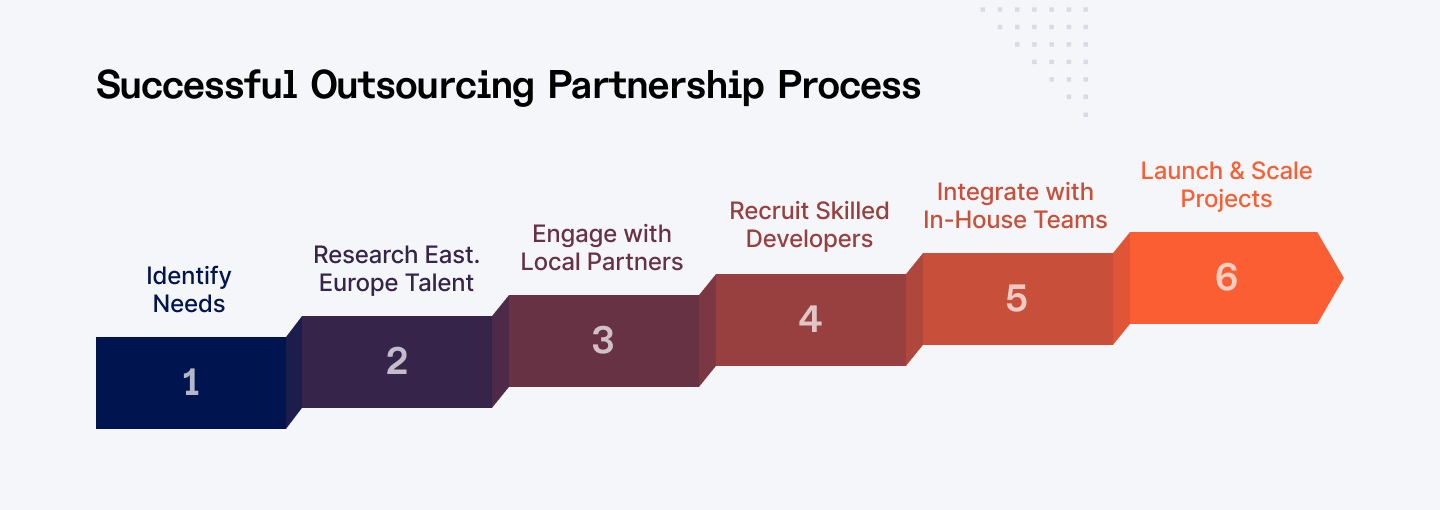
This process diagram outlines the streamlined approach many companies take to ensure that their outsourcing partnerships yield long-term success.
Case Study 2: Healthcare Startup Extends Engineering Capabilities
A Boston-based healthcare analytics company built a distributed team across Romania and Ukraine to develop their AI-powered diagnostic platform:
- Expanded development capacity by 300% within budget constraints
- Accelerated FDA approval timeline by 8 months
- Successfully integrated with 12 major EHR systems
- Maintained HIPAA compliance across all development processes
Their VP of Engineering noted, "What began as a cost-saving measure evolved into a competitive advantage. Our off-shore team brings perspectives we simply couldn't access locally."
Case Study 3: E-commerce Platform Enhances Performance
An e-commerce company assembled a specialized performance team from the Baltics focused on site optimization:
- Reduced page load times by 67%
- Improved conversion rates by 23%
- Implemented advanced caching strategies
- Optimized for mobile performance across 40+ countries
According to their Head of Digital: "The ROI has been extraordinary. Beyond the obvious savings in development costs, the performance improvements directly impacted our bottom line through higher conversion rates."
Additionally, many tech startups have accelerated their product development by forming dedicated remote teams in places like Ukraine and Poland. These success stories underscore the importance of strategic planning and open communication whenever you ask yourself, “Is hiring devs from the Eastern Europe region worth considering?” The answer to that - is a resounding yes.
Read more about how we've helped clients build high-performing tech teams globally.
Data-Driven Insights and Future Outlook
Data and success stories further back this approach. Research from the World Bank and Statista indicates that Eastern Europe’s IT sector is experiencing rapid growth, with annual increases in tech talent and innovation. This growth indicates that, as remote work becomes the norm, choosing Eastern European developers is both practical and visionary.
Moreover, surveys from industry surveys suggest that companies working with Eastern European teams enjoy faster project turnaround and higher technical expertise. This evidence reinforces that the decision to outsource can lead to improved product quality and faster market delivery. Let’s take a quick look at the factors influencing this:
1. Expanding Beyond Major Tech Hubs
Eastern Europe isn’t limited to well-known tech centers like Kyiv, Warsaw, and Bucharest. Emerging cities such as Lviv, Cluj-Napoca, and Tbilisi are rapidly developing into vibrant tech ecosystems. According to recent studies by the European Bank for Reconstruction and Development (EBRD) these cities have experienced roughly 25% growth in tech employment over the past three years, all while keeping costs low. These cities not only offer access to a talented workforce but also maintain robust connectivity and a steadfast commitment to quality.
2. Evolution of Engagement Models
The traditional outsourcing paradigm is giving way to more sophisticated partnership models:
- Dedicated development centers operated as extensions of core teams
- Build-operate-transfer arrangements for long-term projects
- Joint R&D initiatives combining local and distributed expertise
- Outcome-based engagements focused on business metrics rather than time
3. Tech Incubator Programs and Startup Culture
Innovative programs like Poland’s “Start in Poland” are nurturing local talent and fueling entrepreneurship. These initiatives help to elevate developer’s technical skills and foster an environment where creativity and innovation thrive. Data from the European Startup Initiative shows that regions with active incubator programs have experienced up to a 20% increase in early-stage funding and startup activity over recent years. For businesses evaluating whether “hiring devs from Eastern Europe region - worth considering?” this vibrant startup culture translates into a dynamic pool of developers who are fluent in the latest technologies and agile methodologies.
4. A Driving Force in the AI Revolution
Eastern Europe is fast emerging as a key player in the global AI landscape. Reports from IDC in 2024 reveal a 35% uptick in AI-related projects in the region since 2022, with many developers diving into AI-driven solutions. Moreover, a survey by Deloitte found that nearly 60% of tech companies in Eastern Europe are actively investing in artificial intelligence and machine learning initiatives. For companies looking to leverage innovative, data-driven solutions, recruiting developers with a strong grounding in AI could provide the competitive edge needed in today’s market.
5. Specialization in Emerging Technologies
We're seeing increasing specialization in high-demand areas:
- Artificial Intelligence and Machine Learning: Poland and Ukraine are developing particularly strong clusters around AI research and application
- Blockchain Development: Romania and the Baltic states have fostered significant expertise in distributed ledger technologies
- Extended Reality (AR/VR): Growing communities in Poland and the Czech Republic are pioneering immersive experiences
Together, these factors make a strong case. These evolving approaches reflect the maturing relationship between Eastern European developers and global companies, moving beyond transactional outsourcing to strategic partnership. Hiring developers from Eastern Europe is not just viable, but also strategically advantageous.
Read More: How to Avoid Remote Work Pitfalls | 11 Tips
Final Thoughts
So, is hiring devs from the Eastern Europe region worth considering? The evidence speaks for itself. Hiring developers from Eastern Europe represents a strategic opportunity that goes beyond simple cost savings. The region offers a compelling combination of technical excellence, growing specialization in emerging technologies, favorable time zone alignment, and cultural compatibility.
While challenges exist - as they do in any distributed operation - companies that approach the relationship thoughtfully can gain significant competitive advantages. The success stories highlighted demonstrate that Eastern European development talent can deliver transformative outcomes across industries and technical domains.
We hope this article has shed light on why hiring devs from the Eastern Europe region is worth considering. This isn’t just a trend - it’s a strategic decision for a sustainable, innovative future.
Hire Elite Developers from Eastern Europe with Index.dev
At Index.dev, we’ve helped hundreds of companies build high-performing distributed teams that drive innovation and growth. We connect top startups and enterprises with exceptional developers from Eastern Europe, Latin America, and Asia.
Whether you’re looking to optimize costs, access specialized skills, or scale your engineering team, Index.dev provides a proven path to success. Our rigorous vetting process, seamless onboarding, and ongoing support ensure you get top-tier talent that delivers real business impact.
🚀 Get matched in 48 hours and start your risk-free 30-day trial today!