Hiring JavaScript developers remains essential for companies building everything from interactive websites to complex web applications and mobile solutions. As we progress through 2026, understanding regional cost variations helps businesses allocate resources effectively and make strategic hiring decisions.
JavaScript developer rates span a surprisingly wide range – influenced by experience level, framework specialization, project complexity, and geographic location. Senior React developers command premium rates while junior Vue specialists might come at a fraction of the cost.
This guide cuts through recruitment platitudes to show what companies are really paying in 2026. We've analysed thousands of job placements to reveal actual rate ranges, not just advertised figures. Whether hiring talent or positioning yourself in the market, these benchmarks will help you make informed decisions.
Hire elite JavaScript developers in 48 hours. Access the top 5% vetted talent with Index.dev, backed by a 30-day free trial.
Key Factors Shaping JavaScript Developer Hourly Rates
Several critical factors influence JavaScript developer hourly rates:
- Experience and Expertise:
- Junior developers may charge lower rates while mid-level and senior developers demand premium wages due to their proven track record and expertise with complex frameworks (e.g., React.js, Angular, Vue.js).
- Geographic Location:
- Rates are significantly influenced by local costs of living and market demand. For instance, developers in high-cost regions like the United States and Western Europe typically command higher wages compared to talent from Eastern Europe or Asia.
- Technology Stack and Specialization:
- In-depth knowledge of server-side JavaScript (Node.js) or mobile frameworks (React Native) may elevate rates because of their specialized use in modern web and app development.
- Company Size and Project Complexity:
- Larger enterprises often offer competitive hourly rates as compared to startups, which may have more limited budgets.
- Outsourcing Versus In-House Employment:
- Outsourcing to regions with competitive labor markets can be a cost-effective alternative without sacrificing quality.
Regional Breakdown of JavaScript Developer Rates
1. North America (U.S.)
Average Hourly Rates
In the United States, JavaScript developer rates reflect a mature tech market and higher living costs:
- Junior Developers (1-2 years): Approximately $46-$55/hour
- Mid-Level Developers (3-4 years): Approximately $55-$65/hour
- Senior Developers (5+ years): Approximately $65-$72+/hour
These figures are supported by Glassdoor and Talent.com salary data.
Talent Availability by State/City
Talent density in the U.S. varies considerably by region:
- California:
- San Francisco and San Jose form the largest concentrations with an estimated 150,000+ software developers; a significant portion have JavaScript expertise.
- New York:
- New York City is reported to have around 100,000 JavaScript professionals, driven by fintech and media industries.
- Texas:
- Austin and Dallas together are estimated to offer around 80,000 JavaScript developers, fueled by a burgeoning tech ecosystem.
- Massachusetts:
- Boston, with approximately 60,000 developers, is known for its strong academic and startup support.
- Washington:
- Seattle has an estimated 50,000 developers, supported by major corporate headquarters.
Note: Derived from aggregated data from LinkedIn, Stack Overflow Developer Survey, and regional job market studies.
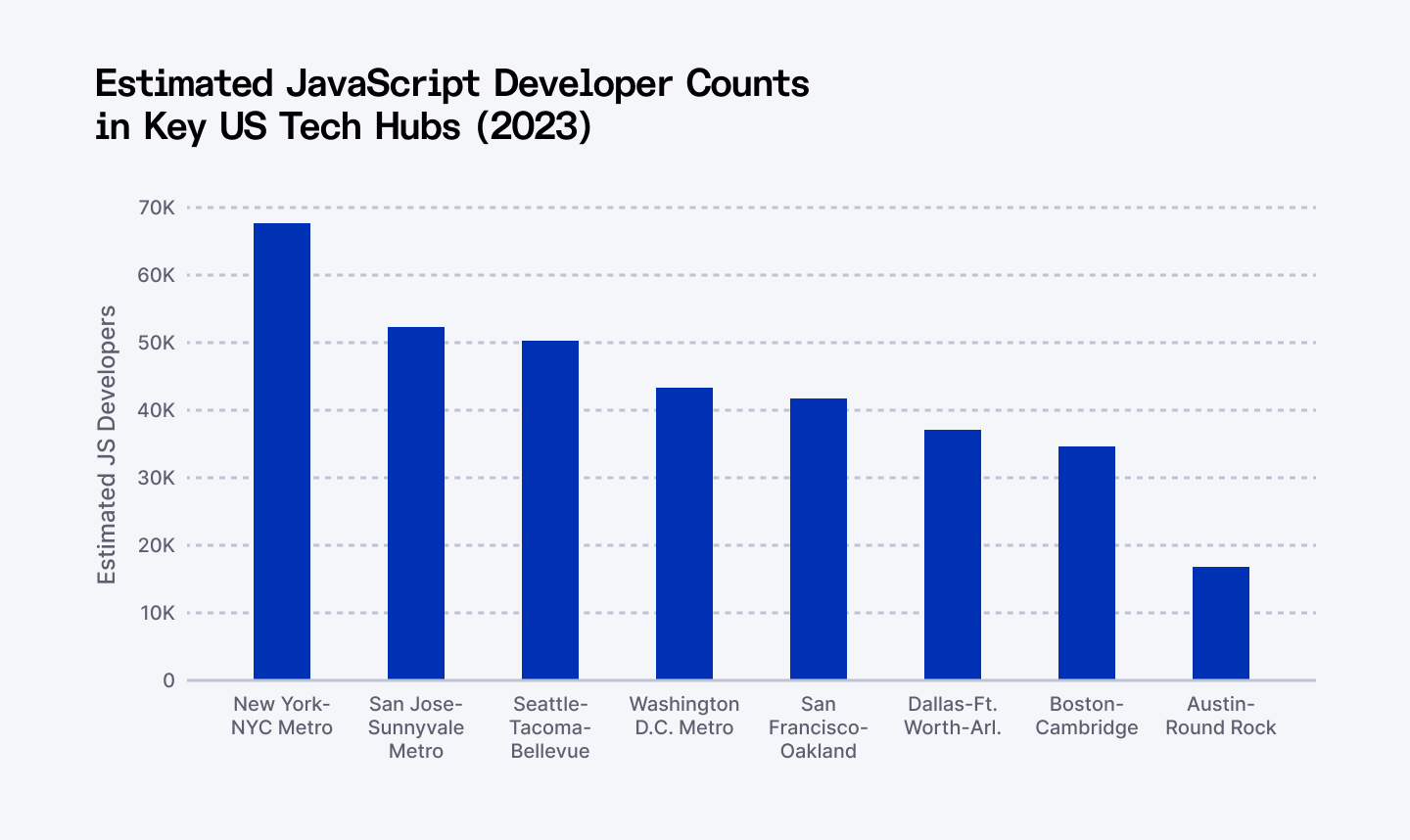
This multi-bar chart shows estimated numbers of JavaScript developers in key U.S. tech hubs.
Tech Stack Expertise
U.S. developers display varied specializations by tech stack:
- JavaScript + React:
- Widely adopted in startups and enterprise projects. Estimates suggest that over 100,000 developers in the U.S. specialize in React—focusing on rich UI and single‑page applications.
- JavaScript + Angular/Vue.js:
- Approximately 50,000-70,000 developers have expertise in these frameworks, often preferred in corporate and legacy projects.
- Node.js Experts:
- Critical for server‑side development; an estimated 70,000 U.S. developers have strong Node.js proficiency.
- Full‑Stack JavaScript Developers:
- Combining both front-end and back-end skills, around 80,000 professionals work as full‑stack developers.
- Emerging Skills:
- Specialized knowledge in TypeScript, GraphQL, and microservices architecture is increasingly common, particularly among mid-to‑senior developers.
2. Western Europe
Western European markets offer competitive rates influenced by robust economies and higher living costs in metropolitan areas push rates slightly upward.
Average Hourly Rates
- General Range: Approximately $30 to $45/hour
- United Kingdom: Approximately $35-$45/hour
- Germany: Approximately $30-$40/hour
- France: Approximately $32-$42/hour
- Netherlands: Approximately $30-$40/hour
- Seniority Level Rate Breakdown:
- Junior (1-2 years): Approximately $30 -$35/hour
- Mid-Level Developers (3-4 years): Approximately $35-$40/hour
- Senior Developers (5+ years): Approximately $40-$45+/hour
- Tech Lead/Architect: Approximately $45-$55+/hour
These numbers align with salary information from Glassdoor (e.g., Germany’s average annual salary around €55,000, translating to roughly $30-$40 per hour after conversion).
Talent Availability by Country/City
Western Europe boasts well-established tech communities:
- United Kingdom:
- London: Estimated to host around 50,000 JavaScript developers. Other emerging tech cities include Manchester and Edinburgh.
- Germany:
- Berlin: The hub of Germany’s tech scene with approximately 40,000 specialists. Other significant centers include Munich and Frankfurt.
- France:
- Paris: An estimated 30,000 JavaScript developers work in Paris, supported by a growing startup ecosystem.
- Netherlands:
- Amsterdam: Known to have a thriving community of around 25,000 JavaScript professionals.
Note: Figures are extrapolated from local labor market surveys and industry reports (e.g., UK Tech Nation, German IT Market analyses).
Tech Stack Expertise
Western European developers demonstrate depth in specialized areas:
- JavaScript + React/Angular/Vue.js:
- Popular among digital agencies and fintech firms; a considerable portion in London, Berlin, and Paris.
- Node.js & Full‑Stack Development:
- Increasingly adopted by enterprise companies requiring scalable back‑end solutions.
- Emerging Specializations:
- Expertise in TypeScript, GraphQL, and progressive web apps (PWAs) is rising, driven by technology firms in these regions.
3. Eastern Europe
Eastern Europe is known for its cost-effective, technically strong JavaScript talent, making it an attractive outsourcing destination.
Average Hourly Rates
- Junior (1-2 years): $25-$35/hour
- Mid-Level (3-4 years): $40-$55/hour
- Senior (5+ years): $60-$80/hour
- Tech Lead/Architect: Could range between $80-$120/hour
Talent Availability by Country
- Ukraine: Approximately 12,000 JavaScript developers
- Poland: The largest pool with around 25,000 developers
- Romania: Strong presence with about 15,000 developers
- Czech Republic: Growing community with roughly 8,000 developers
- Bulgaria: Emerging market with around 6,000 developers
Also Check Out: Hiring Developers from Eastern Europe | Is It Worth Considering?
Tech Stack Expertise
Premium rates apply for developers skilled in:
- JavaScript + Node.js
- JavaScript + React/Angular/Vue.js
- JavaScript with cloud integrations (AWS, Azure)
Market-Specific Advantages
- Cost-Effectiveness: Lower rates compared to Western markets
- Strong Technical Education: Large numbers of CS graduates
- Cultural Affinity: Similar work cultures for European partners
Note: Data from industry studies such as those by Wild.Codes provide similar ranges for Eastern European developers.
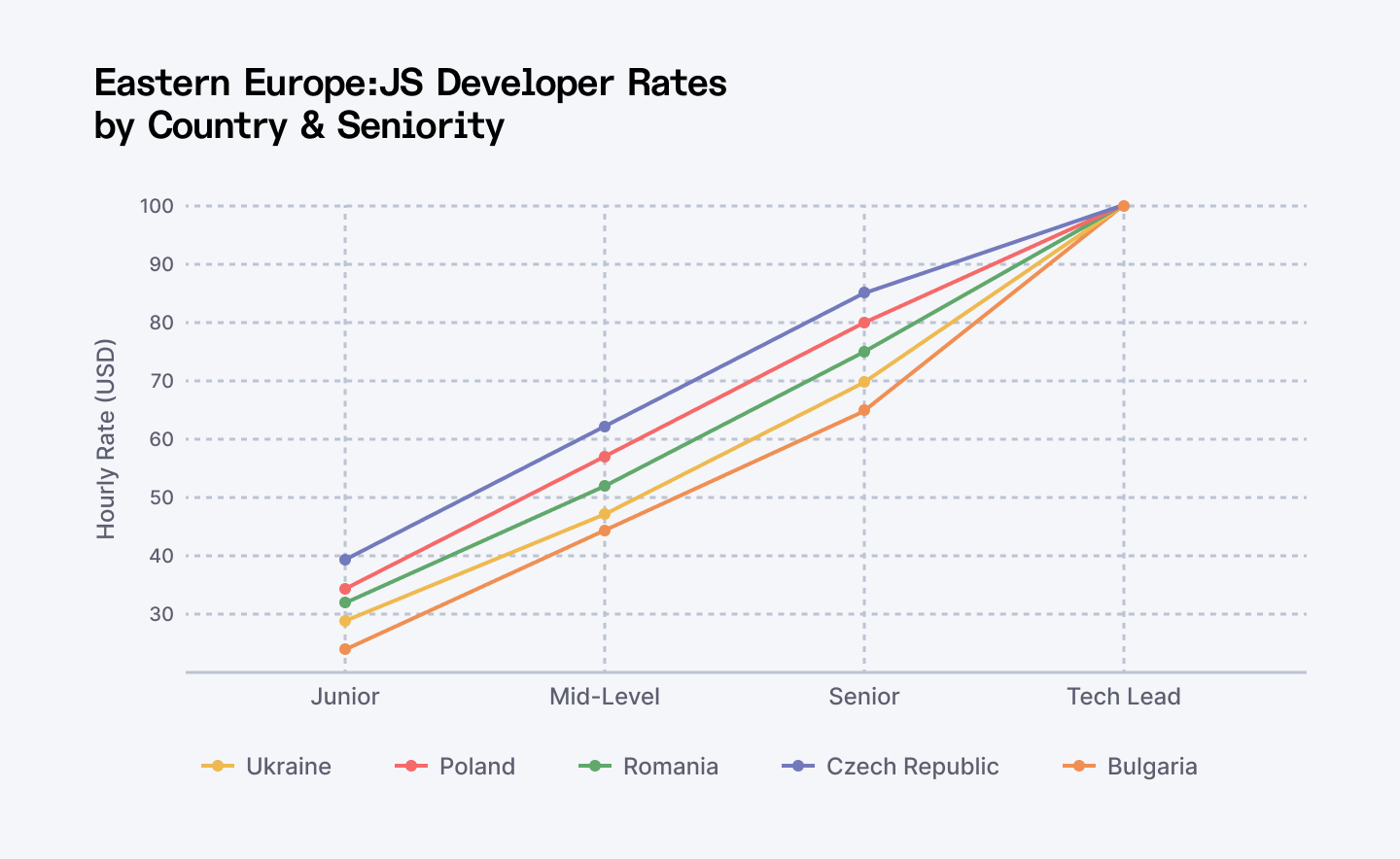
This multi-line graph shows rates by Eastern European countries and experience level.
4. Latin America (LATAM)
Latin America has emerged as a dynamic hub for JavaScript development, particularly attractive for North American companies due to timezone alignment and cultural affinity.
Average Hourly Rate
- Brazil: $40-$95 per hour
- Argentina: $35-$85 per hour
- Mexico: $40-$90 per hour
- Colombia: $35-$75 per hour
- Chile: $45-$100 per hour
Seniority Level Rate Breakdown
- Junior (1-2 years): $30-$45/hour
- Mid-Level (3-4 years): $45-$70/hour
- Senior (5+ years): $70-$100/hour
- Tech Lead/Architect: $100-$155/hour
Talent Availability by Country
- Brazil: Dominant market with ~30,000 JavaScript developers
- Mexico: Rapidly growing with ~18,000 developers
- Argentina: Strong base with ~15,000 developers
- Colombia: Emerging market with ~10,000 developers
- Chile: Developing hub with ~7,000 developers
Explore More: 5 Best Countries in Latin America to Hire Software Developers
Tech Stack Expertise
- JavaScript + React: Common across LATAM with premium rates
- JavaScript + Node.js: High demand in e-commerce and fintech sectors
- JavaScript + Angular/Vue.js: Competitively priced with growing expertise
Market-Specific Advantages
- Time Zone Alignment: Near-perfect overlap with U.S. business hours
- Cultural Affinity: Similar work ethics and communication styles
- Growing Tech Scene: Regular meetups and conferences
- Strong CS Education: High volume of engineering graduates
- High English Proficiency: Especially in key tech hubs
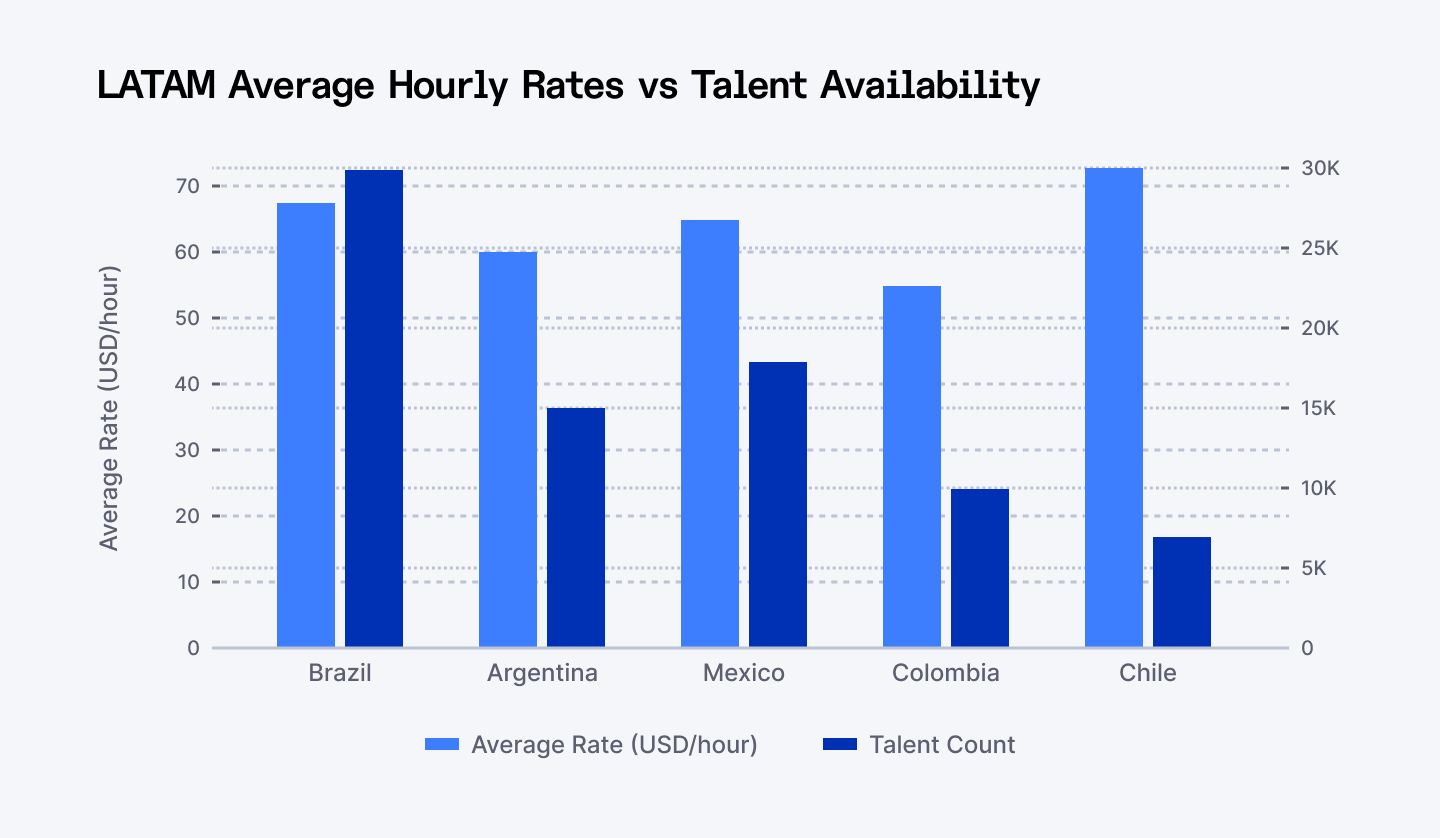
This chart compares the average hourly rates and talent availability in Brazil, Argentina, Mexico, Colombia, and Chile.
5. Asia
Asia dominates the global JavaScript talent market with both extensive cost advantages and high-end premium markets.
Average Hourly Rate
- India: $15-$50 per hour (largest talent pool)
- Vietnam: $20-$45 per hour
- Philippines: $20-$40 per hour
- Singapore: $75-$150 per hour (premium market)
- Malaysia: $30-$60 per hour
Seniority Level Rate Breakdown
- Junior (1-2 years): $15-$30/hour
- Mid-Level (3-4 years): $30-$45/hour
- Senior (5+ years): $45-$70/hour
- Tech Lead/Architect: $70-$150/hour
Talent Availability by Country
- India: Massive pool with ~150,000+ JavaScript developers
- Vietnam: Growing rapidly with ~25,000 developers
- Philippines: Established base with ~20,000 developers
- Singapore: Premium market with ~12,000 developers
Industry-Specific Expertise Rates
- FinTech: Typically 35-45% above base rates (especially in Singapore)
- Cloud Infrastructure: 30-40% premium
- E-commerce: 25-35% above base rates
- Blockchain: 30-40% premium
- AI/ML Integration: 25-35% premium
Tech Stack Expertise
- Modern Frameworks: Expertise in React, Angular, Vue.js
- Full-Stack Capabilities: Node.js and associated backend skills
- Microservices and Containerization: Critical for scalable architectures
Market-Specific Advantages
- Cost-Effectiveness: Lower base rates in India, Vietnam, and the Philippines
- High-Quality Training: Access to advanced technical education
- Large Talent Pool: Deep market with many experienced professionals
- Regional Tech Hubs: Singapore offers premium talent for strategic roles
Note: Data from reliable sources, industry reports on hiring in India and Singapore, and regional freelance studies provide these figures.
6. Other Regions
- Australia & New Zealand:
Rates in these regions are closer to North American standards, averaging $61-$100 per hour due to higher living expenses. - Africa:
Although data is more limited, several African countries tend to have lower hourly rates, generally ranging between $10-$20 per hour, reflecting both emerging tech ecosystems and lower living costs.
Detailed Cost Components Beyond Base Hourly Rates
When budgeting for a JavaScript developer, consider not only the hourly rate but additional cost components:
- Base Salary and Overtime:
- Junior developers typically start at around $30-$50/hour, while senior experts can command $100-$200/hour.
(Source: CloudDevs JavaScript Developer Rates)
- Junior developers typically start at around $30-$50/hour, while senior experts can command $100-$200/hour.
- Employee Benefits and Overheads:
- In developed markets, benefits such as health insurance, paid leave, and taxes can add 20-40% on top of the base hourly rate.
- Training and Continuous Education:
- Continuous upskilling in emerging frameworks and technologies (e.g., AI, TypeScript) increases long-term compensation costs.
- Recruitment and Onboarding:
- Costs associated with recruitment, interviews, and onboarding can lead to additional expenditures that should be factored into total cost-of-hire.
Market Dynamics Influencing Rates
Several evolving trends are shaping JavaScript developer hourly rates:
- Evolving Frameworks and Toolsets:
- While React.js, Angular, and Vue.js remain dominant, newer meta-frameworks like SvelteKit and Astro demand developers to continuously update their skills.
- AI and WebAssembly Integration:
- The adoption of AI-powered development tools and WebAssembly is prompting developers to acquire niche skills, often justifying premium billing.
- Remote Work and Global Talent Pooling:
- The ongoing shift to remote work allows companies to tap into lower-cost regions, though it introduces new challenges in cost negotiation and team management.
- Demand-Supply Gap:
- A sustained shortage of highly skilled JavaScript developers—particularly at the mid-to-senior levels—helps maintain or even increase rates.
Strategic Insights for Companies and Developers
For Companies
- Data-Informed Global Hiring:
- Leverage regional data to strategically source talent—consider outsourcing to Eastern Europe or South Asia for cost-effectiveness without compromising quality.
- Comprehensive Budgeting:
- Factor in hidden costs such as benefits, training, and recruitment overheads to develop a realistic hiring budget.
- Platform Selection:
- Utilize platforms like Index.dev to access pre-vetted talent and streamline the hiring process.
- Case in Point:
- Budgeting for a React or Node.js specialist may require negotiating premium rates, particularly if the project is complex. Larger companies often justify higher wages through structured career growth and robust project deliverables.
For Developers
- Skill Investment:
- Focus on continuous learning in modern frameworks (React.js, Angular, Vue.js), TypeScript, AI integration, and full-stack capabilities to command higher premiums.
- Portfolio and Networking:
- Build a robust project portfolio and engage in professional communities to enhance your market value and negotiation position.
- Market Awareness:
- Stay current with industry trends and regional demand-supply dynamics to position yourself competitively, especially in freelance or contract roles.
- Negotiation Tactics:
- Develop clear benchmarks based on regional data to negotiate fair rates that reflect both your technical expertise and market demand.
Conclusion
The JavaScript landscape moves fast and will continue to innovate endlessly. Framework popularity shifts constantly while talent migrates across regions. Smart companies blend remote teams across strategic locations, paying premiums only for genuinely scarce skills.
For developers, the message is clear: specialize strategically. The highest rates go to those who master emerging tech before market saturation.
Staying attuned to these detailed regional disparities, composite cost factors, and emerging trends—such as AI integration and evolving frameworks—will help both employers and developers secure a sustainable competitive advantage in an increasingly globalized market. These benchmarks matter, but they're snapshots of a moving target. The companies winning the talent war review compensation strategies quarterly, not annually.
…
For Clients: Hire the top 5% of vetted JavaScript developers in 48 hours—risk-free with a 30-day trial at Index.dev. Scale your tech team, faster.
For Developers: Ready to earn top global rates as a JavaScript developer? Join Index.dev and get matched with world-class companies for your next remote career move.