The Machine Learning Team Lead role has shifted dramatically over the past few years. Today, being a strong coder is only one part of what you need to bring to the table. You must also have a solid technical foundation, the ability to plan strategically, and the project management skills required to drive complex initiatives.
On top of that, understanding the ethical dimensions of AI is now a non-negotiable part of the job. In 2025, success means balancing hard technical expertise with a clear, forward-thinking vision for how technology can responsibly transform the business landscape.
Ready for more real-world challenges? Check out our Interview Questions!
Current Trends in Machine Learning Team Leadership
Demand for ML Expertise
We're seeing a big jump in Machine Learning job openings. LinkedIn and Gartner report that ML Engineer and Team Lead roles are set to grow rapidly in the coming years. Companies are prioritizing roles that drive innovation through data analytics and predictive modeling.
Integration of Generative AI
Generative AI represents a critical technological shift in project workflows. Advanced organizations are implementing technologies that streamline processes and foster innovative problem-solving approaches.
Focus on Ethical AI
Ethical AI is now a must-have, thanks to ML advancements and the need for unbiased models. Professional standards now require frameworks to spot and fix potential biases in machine learning models. The IEEE's Ethically Aligned Design offers useful guidelines for this new aspect of leadership.
Explore More: Data Scientists vs Machine Learning Engineers | Key Differences
Key Machine Learning Team Lead Interview Questions
Below are some questions that cover technical expertise, leadership, and, importantly, project management scenarios.
Technical Knowledge Assessment
1. Can you explain overfitting in Machine Learning models and outline strategies to prevent it?
Rationale: This question probes the candidate's understanding of machine learning model complexity and generalization strategies. A strong response demonstrates both theoretical knowledge and practical application.
Sample Answer: "When addressing model complexity, the real challenge is creating machine learning solutions that perform consistently across diverse scenarios. During a critical project for a manufacturing client, we discovered that simply minimizing training error wasn't enough and we needed a strategy that balanced model precision with generalization capability. By implementing targeted cross-validation and carefully applied L2 regularization, we developed a predictive model that maintained strong performance across multiple operational contexts. We created a robust framework that could adapt to nuanced, real-world data variations."
2. What do you think are the pros and cons of using TensorFlow versus PyTorch for model training?
Rationale: This question evaluates framework knowledge and technical decision-making.
Sample Answer: “Choosing between TensorFlow and PyTorch isn't straightforward. TensorFlow excels in large-scale production, while PyTorch offers great flexibility for research. The choice depends on project needs, team skills, and long-term goals. I choose based on the project’s needs and team expertise.”
Leadership and Collaboration
3. Describe a time when you had to mediate between data scientists and software engineers. How did you ensure alignment?
Rationale: Evaluating conflict resolution and collaborative leadership skills.
Sample Answer: "Bridging communication gaps between data science and engineering teams requires more than scheduled meetings. I've found success by creating shared understanding through structured workshops that map each team's objectives and constraints. By establishing a common language and collaborative framework, we transform potential conflicts into opportunities for innovative problem-solving."
4. How do you handle disagreements within your team regarding technical approaches to projects?
Rationale: Understanding the candidate's approach to constructive technical debate and how they’d promote a healthy debate while moving projects forward.
Sample Answer: “I see technical disagreements as opportunities to learn more. I create an environment where data drives decisions. We evaluate each approach against objective metrics, project goals, and technical feasibility. This turns potential conflicts into collaborative problem-solving sessions that improve our technical solutions.”
Project Management Scenarios
5. How would you prioritize tasks if a project has tight deadlines and the model isn't performing well?
Rationale: This tests resource management and adaptability under pressure.
Sample Answer: "In tight situations with performance issues, strategic prioritization is key. I focus on the most impactful tasks in the project's critical path, using rapid iteration cycles through focused agile sprints. This helps us tackle performance challenges while keeping the project moving forward."
6. What's your approach if a crucial dataset becomes unavailable mid-project?
Rationale: This is to assess crisis management and adaptability.
Sample Answer: "Data unavailability is a real issue in complex tech projects. I immediately assess alternative data sources and explore data augmentation techniques to keep the project on track. Clear communication with stakeholders is crucial, explaining potential impacts and proposed solutions."
7. How would you handle conflicting stakeholder priorities that risk derailing your project?
Rationale: Evaluating strategic negotiation and project leadership capabilities since stakeholder management is essential in project management.
Sample Answer: "I think it’s important for team leads to understand that conflicting stakeholder priorities are rarely about winning an argument—they're about finding aligned value. In my experience, the most effective approach combines data-driven insights with collaborative problem-solving. By facilitating a structured mediation session that maps each stakeholder's core objectives, we can uncover underlying shared goals. The key is creating a transparent framework where critical project deliverables remain protected while addressing individual stakeholder concerns through carefully designed iterative development phases."
8. How does your project management differ between Agile and Waterfall approaches?
Rationale: This assesses methodology flexibility and strategic project execution.
Sample Answer: "Project management methods aren't one-size-fits-all. Agile thrives on adaptation, with rapid iterations and real-time feedback. Waterfall needs careful upfront planning and sequential milestones. The main difference is how we handle uncertainty. In Agile, we use adaptive planning. In Waterfall, we create detailed roadmaps to minimize disruptions. Regardless of method, successful project leadership needs clear communication, stakeholder alignment, and the ability to navigate complex tech landscapes."
Unconventional Questions That Bring Depth
To truly elevate the conversation, here are a few unconventional questions that add a layer of depth to Machine Learning Team Lead Interview Questions:
9. How do you balance innovation and risk in deploying new ML models in highly regulated industries?
Rationale: This Machine Learning team lead interview question explores strategic innovation within compliance constraints.
Sample Answer: “Balancing innovation and regulations is tricky. My approach involves thorough risk assessment, strategic pilot testing, and working closely with regulators. By creating controlled test environments and maintaining open communication with compliance experts, we can push tech boundaries safely and within regulations.”
10. How would you redesign an existing model architecture while keeping the system running?
Rationale: This tests system transformation and operational continuity skills.
Sample Answer: “Redesigning existing model architectures needs a careful approach. I use a blue-green deployment strategy for smooth transitions, allowing parallel system testing and quick rollback options. The goal is to minimize disruptions while implementing major tech improvements.”
11. Describe a time you led a cross-departmental team through a major technical challenge. How did you keep team morale high?
Rationale: This Machine Learning team lead interview questions explores leadership and team cohesion strategies.
Sample Answer: “Leading cross-departmental teams needs more than tech skills—it requires creating a unified vision. I establish regular collaborative sessions, share progress openly, and recognize individual contributions. This turns potential interdepartmental friction into collective problem-solving momentum.”
Best Practices in Managing Machine Learning Projects
ML Lead Interview Structure
1. Structure Your Interview
Divide the process into technical, managerial, and scenario-based rounds. This not only helps in evaluating different skill sets but also allows each candidate to shine in their area of strength while addressing comprehensive machine learning team lead interview questions.
2. Prepare Follow-Up Questions
Have follow-up queries ready to dig deeper into candidates' experiences, especially for project management scenarios where real-life examples provide clarity.
3. Incorporate Unconventional Questions
As seen earlier, unconventional questions can reveal a candidate’s thought process and adaptability. Adding these to your roster of machine learning team lead interview questions can give you an edge in evaluating leadership potential.
4. Use Real-World Scenarios
Practical examples and case studies are essential. For instance, you may ask candidates to describe how they managed a project that involved both Machine Learning model deployment and cloud infrastructure challenges. This provides context-rich machine learning team lead interview questions that mirror the challenges faced in actual projects.
5. Partner with Index.dev
Global talent networks like Index.dev can help you hire and manage top machine learning talent remotely, offering unique insights into technical leadership best practices. Integrating such sources into your hiring process can significantly strengthen the quality of your machine learning team and help you stay ahead of your competitors.
Agile Methodologies
Effective ML project management needs a dynamic approach. Agile methods provide a solid framework for complex tech projects, focusing on continuous improvement and responsive development. Successful agile adoption goes beyond theoretical concepts. It requires creating a flexible ecosystem that:
- Supports rapid iterative development
- Enables quick pivots based on emerging insights
- Maintains consistent stakeholder engagement
The key is breaking complex projects into manageable sprints, addressing challenges systematically while maintaining overall momentum.
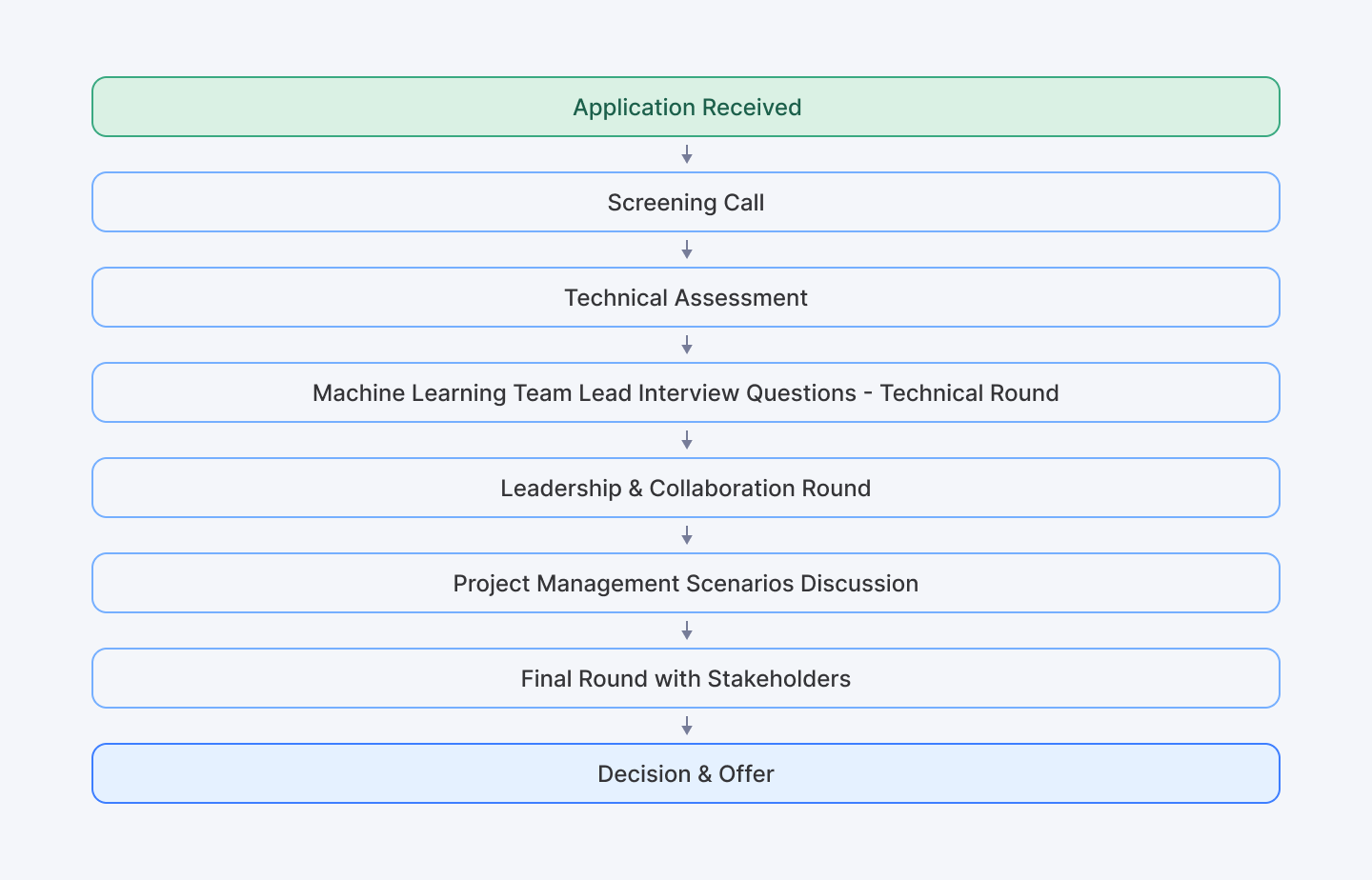
Interview Process Flowchart
Effective Communication
Technical excellence requires more than algorithmic precision. Bridging communication gaps between technical and non-technical stakeholders is fundamental to project success. This involves:
- Developing clear, accessible communication protocols
- Creating transparent reporting mechanisms
- Establishing regular collaborative touchpoints
Monitoring and Evaluation
Post-deployment model performance tracking is not optional—it's a critical operational requirement. Advanced monitoring approaches integrate:
- Automated performance detection systems
- Comprehensive feedback mechanisms
- Strategic visualization tools for rapid insight generation
Tools like Tableau and Power BI can be instrumental in visualizing performance data.
Additional Tips for Candidates and Interviewers
For Candidates:
- Be yourself. Share real examples of how you've solved problems.
- Keep learning. Tech moves fast, so stay on top of new ML and cloud trends.
- Practice explaining complex ideas simply. Interviewers love this skill.
For Interviewers:
- Tailor questions to your company's needs. Maybe include a case study.
- Mix technical questions with leadership scenarios.
- Give feedback, even to candidates you don't hire. It's good for your company's reputation.
Machine Learning Skills and Competencies Required in 2025
Technical Skills
Candidates must demonstrate proficiency in programming languages like Python, familiarity with Machine Learning frameworks (TensorFlow, PyTorch), and experience with data visualization tools like Tableau. Knowledge of cloud platforms such as AWS, Azure, and Google Cloud is also critical.
Soft Skills
Beyond technical capabilities, candidates need to excel in problem-solving, critical thinking, and adaptability. They must communicate complex ideas clearly and manage team dynamics effectively. While technical skills open doors, they must be complemented by soft skills that reveal leadership potential. You are looking for professionals who can creatively resolve complex challenges, adapt swiftly to changing environments, and motivate diverse teams, all while communicating with clarity and empathy.
Explore More: How to Cultivate Soft Skills in the Workplace
Business Acumen
ML isn't just about algorithms—it's about driving meaningful business change. ML Team Leads should know how to turn data insights into actionable strategies, aligning tech initiatives with broader organizational goals.
Conclusion
Remember, the best ML leaders don't just code well. They drive real change in their organizations. Look for candidates who can do both. Keep your hiring process sharp by partnering talent networks like Index.dev. The ML field moves fast, so continuous learning is key for effective leadership.
These Machine Learning team lead interview questions are designed to probe beyond algorithms, assessing a candidate’s overall professional capability and strategic vision. The strongest candidates understand that leadership in machine learning is ultimately about driving significant organizational change, not merely implementing technical solutions.
For Clients:
Hire elite ML talent today! Access the top 5% of vetted ML engineers & team leads through Index.dev’s senior talent network.
For ML Engineers:
Level up your ML career! Join Index.dev to land top remote Machine Learning Team Lead roles with global companies.