Think about it, when was the last time you appreciated a teammate just for their hard skills? Sure, expertise matters. But what really makes a difference in a team? It’s how well people communicate, solve problems, adapt to change, and work together. These are the “soft skills” that turn good employees into great ones. And companies are catching on fast.

According to Deloitte Insights, a whopping 92% of organizations now consider human capabilities—those essential soft skills—to be equally or more valuable than technical abilities.
The hiring landscape reflects this shift too, with LinkedIn Global Talent Trends reporting that 93% of employers view soft skills as important as or more important than hard skills when making hiring decisions.
And here's where it gets really interesting – the SHRM Report shows that 92% of hiring managers believe employees with strong soft skills are more likely to climb into leadership positions.
So the big question comes: How do you, as a leader, help your team develop these crucial interpersonal abilities? How can you create an environment where soft skills flourish naturally?
Unlike technical skills that can be taught through structured training, soft skills require cultivation. They're more like gardens than buildings – they need the right conditions to grow rather than a rigid construction plan. Forward-thinking companies recognize this distinction.
Instead of simply "training" for soft skills, they focus on nurturing and honing these inherently human capabilities. But what’s the most effective way to cultivate these skills in your workplace?
In this article, I'll share seven practical strategies you can implement to effectively cultivate soft skills across your entire organization. Let’s get into it.
Build stronger teams with Index.dev. Access the top 5% of developers with both technical expertise and essential soft skills. Start your 30-day free trial today!
Hard and Soft Skills: Key Differences Explained
Hard skills are the technical skills that are specific to a job. Think of them as the tools you use to get the job done. For example, if you're a software engineer, hard skills might include knowing programming languages like Python, Java, or C++. If you're a graphic designer, it might be expertise in design software like Figma or Adobe XD. These skills are concrete, measurable, and often acquired through education or training.
Now, soft skills are a little different. These are the “people skills” – things like communication, teamwork, leadership, and problem-solving. You can’t really measure them with a test or a certification. They’re about how you interact with others, how you manage conflict, or how you approach challenges.
In the past, many employers placed a heavier emphasis on hard skills. After all, a job is often about completing specific tasks. But without solid soft skills, even the most technically gifted person might struggle to thrive in a team or collaborate effectively. So, while technical expertise gets your foot in the door, it’s the ability to collaborate, solve problems, and communicate effectively that propels you forward.
Why Soft Skills Matter More Than You Think
At their core, soft skills are the interpersonal abilities that help us connect, communicate, and work well with others. Things like accountability, emotional intelligence, adaptability, and problem-solving are all examples of soft skills.
Imagine you’re giving a presentation to a room full of executives. Do you just blaze through your slides and hit the key points, or do you adjust your approach to their communication styles and objectives? Actively working to improve public speaking skills isn't just about mastering the content of your presentation, but also about how you read the room and connect with your audience.
Or you’re meeting a client who’s a bit more introverted. Do you jump in and dominate the conversation, or do you slow down and listen carefully to understand their needs? This isn’t something that comes naturally to everyone. It requires adaptability and a strong sense of empathy, both of which are highly valuable soft skills.
Now, think about it in the context of today’s world. AI can automate any technical task at lightning speed. But when it comes to understanding human emotions, reading the vibe of a room, or adjusting to a person’s unique communication style? AI can’t touch that.
That’s how soft skills become the true differentiators in the workplace. They help you connect with people, build relationships, and respond to challenges in ways that make a real impact.
Learn More: Case Study | How Index.dev Matched Top UX Designers with Fishbrain
The 7 Best Ways to Cultivate Soft Skills in Your Team
Soft skills don't develop in a vacuum. As a tech leader, you play a crucial role in creating an environment where these essential human capabilities can be built. Check out eight unconventional yet highly effective strategies for cultivating soft skills in the workplace. Ready to try something different?
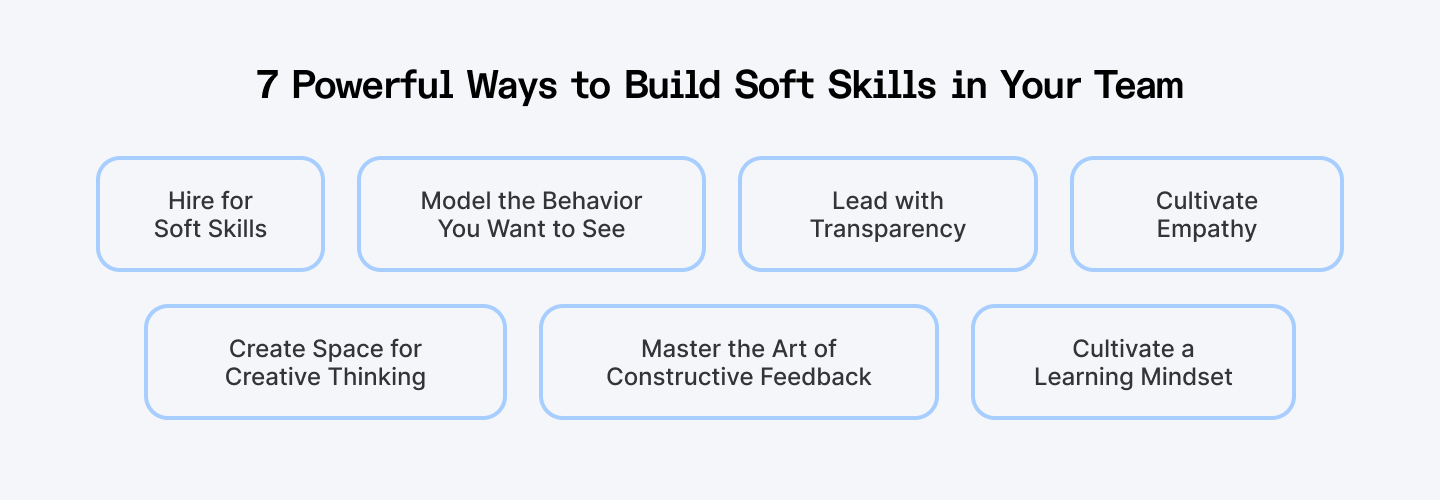
1. Hire for Soft Skills
When bringing new talent onboard, focus on finding people with a genuine willingness to learn and grow. What's their personality like? Are they adaptable? Do they actively listen to others' perspectives? Someone open to new ideas is far more likely to develop other soft skills along the way.
Have you noticed how Millennials and Gen Z are particularly motivated by growth opportunities? They often value skill development as much as compensation.
But how do you actually determine if a candidate possesses these qualities during the interview process? Combining behavioral with targeted questions works wonders. Try explaining to candidates that you'll be asking them to recall specific past situations, and you want them to describe:
- What happened
- Their thoughts and feelings at the time
- The actions they took
Let them know it’s okay to take a moment to think (this actually creates useful pressure that reveals how they respond). Then ask questions like:
“Describe a time when you received critical feedback. How did you handle it?”
“Tell me about a difficult conversation you had to initiate with a colleague or manager.”
“Share an example of when you experienced team conflict and how you addressed it.”
“When was the time a change was implemented that you disagreed with? What did you do?”
“Can you recall a situation where you needed to develop a creative solution under pressure?”
“Tell me about a significant mistake you made at work and how you handled it.”
Pay close attention to these revealing signals:
- Can they actually recall these situations? If not, they might avoid difficult conversations or struggle with accountability.
- How self-aware are they about their emotions and thoughts during these situations?
- Did their actions demonstrate ownership and courage, or did they become defensive or avoidant?
- Watch their body language – fidgeting, stuttering, breaking eye contact, or decreasing energy might indicate discomfort with pressure.
2. Model the Behavior You Want to See
Have you ever heard the saying, "actions speak louder than words"? In leadership, this couldn't be truer. Your team is constantly watching you:
- How you handle pressure.
- How you communicate during disagreements.
- How you respond to failures.
They're taking notes, whether you realize it or not. So think about it: What behaviors are you modeling in your everyday interactions? Do you practice active listening when an employee brings up a concern, or are you already formulating your response before they finish speaking? Do you acknowledge your mistakes openly? These moments teach your team more about soft skills than any training program ever could.
Instead of just talking about soft skills, create structures that physically demonstrate your commitment to them:
- If you value collaboration, have you set up spaces and times for cross-functional teamwork?
- If you believe in transparent communication, are you sharing both successes and challenges with your team?
- When was the last time you asked for feedback on your leadership style – have you actually implemented changes based on what you heard?
Try implementing a weekly demo day where teams can showcase their work in progress and invite input from colleagues across departments. This is a training ground for communication, constructive feedback, and collaborative thinking.
3. Lead with Transparency
Have you ever swept a project failure under the rug, hoping nobody would notice? We've all been tempted to hide our missteps, especially when we're in leadership positions. But what message does that send to your team? Transparency about failures builds trust in a way that a flawless façade never could. When you openly discuss what went wrong, you're creating a culture where people feel safe to take risks and learn from mistakes rather than hide them.
I remember working with a startup where the CEO called an all-hands meeting after losing a major client. Instead of spinning it positively or blaming external factors, he walked through exactly what happened, acknowledged his own misjudgments, and invited the team to help develop a better approach moving forward. The result? Team members started bringing problems to light earlier, before they became crises, because they knew transparency was valued.
Next time something doesn't go according to plan, resist that natural urge to minimize or gloss over it. Instead, try these approaches:
- Call a dedicated meeting where the only goal is to learn, not to assign blame.
- Start by acknowledging your own role in the outcome before asking for other perspectives.
- Create a safe space for everyone involved to share their observations without fear of blame.
- Document the lessons learned so they become part of your team's collective wisdom.
- Develop concrete action steps for handling similar situations differently in the future.
Your vulnerability won't diminish your authority. Quite the opposite. It shows that you value growth over ego, and that you trust your team. Authenticity stands out.
4. Cultivate Empathy
Have you ever worked for someone who treated you like a productivity widget instead of a human being? How did that make you feel? Did it inspire you to give your best, or did it make you count the minutes until you could clock out?
Empathy is the foundation for building a team that's willing to go the extra mile. It means developing the capacity to step into your team members' shoes and truly understand what they need to succeed, both professionally and personally. It's about seeing the whole person, not just the employee who shows up to work each day.
Here are some practical ways to cultivate empathy in your leadership:
- Take a genuine interest in your team members' lives outside work and remember the details they share.
- When someone seems off their game, check in privately instead of assuming it's a performance issue.
- Offer flexibility when personal matters arise—the work will still get done, and probably better.
- Recognize individual strengths and contributions regularly, showing you see what makes each person unique.
- Practice active listening—put down your phone, make eye contact, and really absorb what people are saying.
The irony is that by focusing less on productivity and more on people, you often end up with a more productive team. When people feel seen and understood, they're motivated to contribute their best work.
5. Create Space for Creative Thinking
When was the last time you had a truly breakthrough idea while sitting in your third consecutive meeting of the day? Probably never.
In our hyper-connected, always-on workplace culture, we've created an environment that feels productive but actually stifles the deep thinking necessary for innovation and creative problem-solving. Our brains need space and time to make unexpected connections, but we fill every moment with notifications, meetings, and urgent deadlines.
Try building dedicated "thinking time" into your team's regular schedule.
This might look like:
- Meeting-free Wednesdays where everyone can focus on deep work without interruptions.
- Two-hour blocks protected for focused creative thinking (with notifications turned off).
- Quarterly off-site days dedicated to deep thinking about your industry's future.
- ‘Innovation hours’ where people can work on projects outside their regular responsibilities.
Google's famous "20% time" policy – where employees could spend one day per week on projects outside their job descriptions – delivered tangible results. Gmail, Google News, and AdSense all emerged from this dedicated creative thinking time.
One of our client’s software team implemented "Thinking Thursdays" – afternoons with no meetings, no Slack, and no expectations of immediate responses. Initially, some managers worried about lost productivity. Six months later, they credited those afternoons with their most innovative product features.
So ask yourself honestly: Are you creating an environment where people have the mental space to think creatively? Or have you built a culture of reactive busywork, where being busy is mistaken for being productive?
Your team members might look active as they rapidly switch between tasks and meetings, but are they creating value or just creating motion? The difference could determine whether your team merely executes tasks or genuinely innovates.
6. Master the Art of Constructive Feedback
Think back to the last time you received feedback. Was it a vague "good job" that left you wondering what exactly you did well? Or was it specific, like "The way you handled that client's objection by acknowledging their concern before offering solutions showed excellent communication skills"? Which actually helped you more?
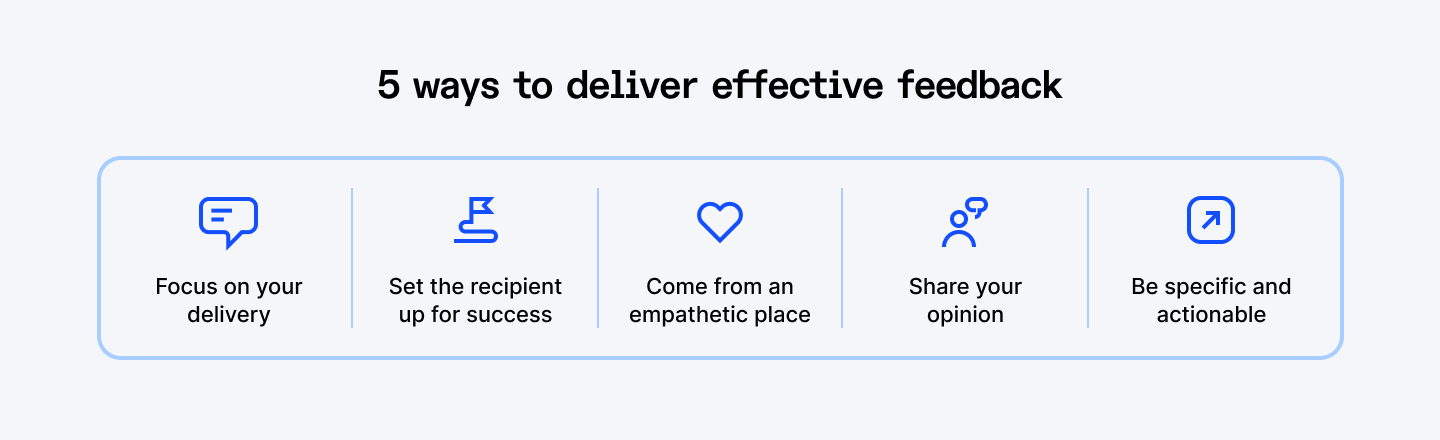
Giving effective feedback is perhaps the most underrated leadership soft skill in today's workplace. It's not about being nice or mean. It's about being clear and constructive in a way that actually helps people develop. Yet so many leaders either avoid giving feedback altogether or deliver it in ways that leave team members confused or defensive.
Try developing a simple feedback formula that you can use consistently:
specific observation + impact + question or suggestion.
For example:
- "I noticed you interrupted Maria three times during the meeting (observation). This might make team members hesitant to share their ideas (impact). How might you ensure everyone gets equal airtime in our next discussion? (question)"
- "When you included those client testimonials in your presentation (observation), it made our proposal much more compelling (impact). Consider adding this element to future presentations for similar clients (suggestion)."
This approach works for both constructive criticism and positive reinforcement. The key is being specific about what you observed and explaining why it matters. Timing matters too. Aim to deliver feedback close to when the behavior occurred, and always in an appropriate setting. Praise can often be public, but criticism should usually be private.
7. Cultivate a Learning Mindset
Is your team stuck in "that's how we've always done it" thinking? Creating a culture where continuous learning is valued might be simpler than you think. The behaviors you reward are the ones that will multiply. When team members complete training programs or develop new skills, do you acknowledge these achievements as thoughtfully as you do meeting sales targets or launching products?
If you want learning to be taken seriously, you need to lead by example. When was the last time you shared something new you learned with your team? Do you talk openly about books you're reading, courses you're taking, or mistakes that taught you valuable lessons?
More importantly, are you creating time and space for learning to happen during work hours? Many companies claim to value development but expect employees to pursue it entirely on their own time. This sends a clear message that learning is secondary to "real work."
Try these practical approaches to embed learning into your team's culture:
- Set up structured mentorship programs where team members can learn from more experienced colleagues.
- Implement cross-training initiatives that allow people to develop skills outside their primary role.
- Create learning circles where small groups explore a topic together and share insights.
- Establish a regular "learning showcase" where people can present new skills or knowledge they've acquired.
The advantage of team-based learning is that it builds skills while also strengthening workplace relationships.
Also Check Out: Top 10 Mistakes in Managing Remote Developers and How to Fix Them
The Hidden Benefits of Soft Skills in the Workplace
While hiring for soft skills is certainly important, there are compelling reasons to develop these qualities within your existing team. Here’s why cultivating soft skills internally can transform your workplace:
Employees Take Initiative
An employee who's confident in their communication abilities and emotional intelligence is more likely to pitch new ideas or volunteer for challenging projects. Instead of seeing change as a threat, they view it as an opportunity. This mindset shift creates a workforce that's bold and proactive rather than reactive. Wouldn't you prefer a team that solves problems before they escalate?
Managers Retain Their Best People
See the difference between a manager who says "Just get it done" versus one who asks "What obstacles are you facing, and how can I help?" We’ve all had those managers who seem out of touch with the team, right? When managers are trained in soft skills (like empathy and active listening) they’re much better equipped to understand what their employees need. The investment you make in developing your managers' soft skills pays dividends in reduced turnover costs and talent retention.
Teams Function as Teams
Teams that don’t get along don’t perform well. Often, the root cause isn't technical incompetence but underdeveloped soft skills.Instead of the hassle and cost of hiring a replacement, consider investing in soft skills. Suddenly, meetings will become productive, projects will finish on time, and people will enjoy working together.
Client Relationships Flourish
It’s not just the people on the frontlines who need soft skills. Sure, customer-facing roles demand strong interpersonal skills, but everyone in your organization represents your brand.
After all, your clients can interact with anyone on your team through professional networks like LinkedIn or at industry events – and their experience with any employee contributes to your company’s reputation.
The Bottom Line Improves
Soft skills directly impact your profitability. When employees at all levels can build rapport, understand customer needs, and establish trust that can have a major impact on sales.
Even if upselling isn’t the goal, happy customers are loyal customers, and loyal customers buy more often.
How Companies Foster Soft Skills: Real-World Cases
Looking at how leading companies have successfully implemented soft skills development can provide both inspiration and practical insights. Let's explore some notable examples:
Google's Project Oxygen
Google made a surprising discovery through their Project Oxygen research initiative. After analyzing mountains of performance data, they found that the most effective managers weren't necessarily the most technically skilled. Instead, the best managers were those who:
- Communicated clearly and listened attentively
- Showed genuine interest in team members' personal wellbeing
- Provided constructive feedback and coaching
This research fundamentally shifted Google's approach to leadership development, emphasizing that soft skills were as crucial as technical expertise in building high-performing teams.
IBM's Leadership Development Program
IBM recognized that leading in a complex, changing technology landscape required more than just industry knowledge. Their comprehensive Leadership Development Program places significant emphasis on:
- Emotional intelligence training
- Collaborative problem-solving
- Adaptive thinking in uncertain environments
By focusing on these human-centered capabilities, IBM prepares its leaders to build cohesive teams that can respond quickly to market changes.
Zappos' Customer Service Focus
Zappos built its reputation on extraordinary customer service, which starts with intentional soft skills development. The company's approach includes:
- Intensive communication training for all employees
- Problem-solving scenarios based on real customer interactions
- Cross-departmental training to foster company-wide collaboration
This investment has paid dividends not just in customer satisfaction, but also in employee engagement and retention.
These examples show the incredible value of soft skills training. These companies are investing in the human side of work, and it’s paying off. The benefits are clear: better communication, stronger leadership, improved problem-solving abilities, and more engaged, satisfied employees
Closing Thoughts: Soft Skills Are Worth the Investment
Have you ever considered that the most valuable investment you can make is in the uniquely human capabilities of your team? In a world where technical skills have increasingly short half-lives and technological disruption is constant, investing in soft skills is really investing in adaptability itself. The technical knowledge you acquired five years ago might already be outdated, but your ability to learn, adapt, and work effectively with others remains invaluable.
When you create an environment where soft skills flourish, you're essentially future-proofing your organization. You're building a team that can pivot when necessary, innovate when challenged, and maintain human connections in an increasingly digital world.
As the pace of technological change accelerates, these enduring human capabilities will only grow more valuable. Perhaps the most strategic move you can make is to democratize the cultivation of these human capabilities across your entire workforce. By making soft skills development accessible to everyone, you're protecting your company's access to competitive, adaptable talent for whatever the future holds.
For Tech Companies: Hire the best developers in 48 hours with Index.dev! Access the top 5% of vetted talent and get a 30-day free trial. Start your recruitment today!
For Tech Talent: Join Index.dev and get matched with global companies for remote work opportunities. Build your career with innovative projects and high pay!