Qwen AI has emerged as the most powerful open-source coding assistant in 2025, outperforming many proprietary models on real-world benchmarks.
In this comprehensive Qwen AI review, we test the best Qwen model for coding—including Qwen Coder and Qwen3-Coder—to see how they perform on SWE-Bench Verified and practical development tasks.
Whether you're following Qwen news today or evaluating QwenAI for your development team, this guide covers everything: benchmarks, performance comparisons, and why Qwen 3 AI might be the coding assistant your team needs.
Join Index.dev's talent network and work with companies building AI-powered products, from coding assistants to MLOps platforms.
What Is Qwen AI?
Qwen AI (also written as QwenAI) is a family of large language models developed by Alibaba Cloud. The Qwen series includes general-purpose models and specialized variants like Qwen Coder, designed specifically for software development tasks.
Qwen AI model family overview:
Model | Parameters | Specialty | Best For |
0.5B - 72B | General purpose | Chat, reasoning, analysis | |
Qwen Coder | 1.5B - 32B | Code generation | Development, debugging |
7B - 32B | Advanced coding | Complex software engineering | |
Qwen3-Omni | Multimodal | Vision + code | UI-to-code, diagram analysis |
Key facts about Qwen AI:
- Developer: Alibaba Cloud (China)
- License: Apache 2.0 (open-source, commercial use allowed)
- Latest version: Qwen 3 (2025)
- Primary strength: Coding, math, reasoning
- Deployment: Local, cloud, or API access
Qwen AI distinguishes itself from AI coding assistant competitors like GPT-4, DeepSeek, and Claude through its open-source availability, competitive benchmark performance, and cost efficiency for self-hosted deployments.
Qwen3-Coder SWE-Bench Verified Score & Benchmarks
The SWE-Bench Verified benchmark measures an AI model's ability to solve real GitHub issues from popular open-source repositories. It's the gold standard for evaluating coding assistants on practical software engineering tasks.
Qwen3-Coder SWE-Bench Verified score:
Model | SWE-Bench Verified | Release |
Qwen3-Coder 32B | 69.6% | 2025 |
Claude 3.5 Sonnet | 49.0% | 2024 |
GPT-4 Turbo | 43.8% | 2024 |
Qwen 2.5 Coder 32B | 50.8% | 2024 |
DeepSeek Coder V2 | 48.5% | 2024 |
The 69.6% SWE-Bench Verified score makes Qwen3-Coder one of the highest-performing coding models available, surpassing both Claude and GPT-4 on this real-world benchmark.
Additional Qwen AI benchmarks:
Benchmark | Qwen3-Coder | GPT-4 | Claude 3.5 |
HumanEval | 92.1% | 87.0% | 88.0% |
MBPP | 89.4% | 83.0% | 85.2% |
MultiPL-E (Python) | 88.7% | 82.4% | 84.1% |
DS-1000 | 78.3% | 71.2% | 73.8% |
What these benchmarks mean:
- SWE-Bench Verified: Real GitHub issue resolution (most practical)
- HumanEval: Function completion from docstrings
- MBPP: Basic Python programming problems
- MultiPL-E: Multi-language code generation
- DS-1000: Data science coding tasks
These benchmark results confirm that Qwen AI delivers production-quality code generation that competes with—and often exceeds—proprietary alternatives.
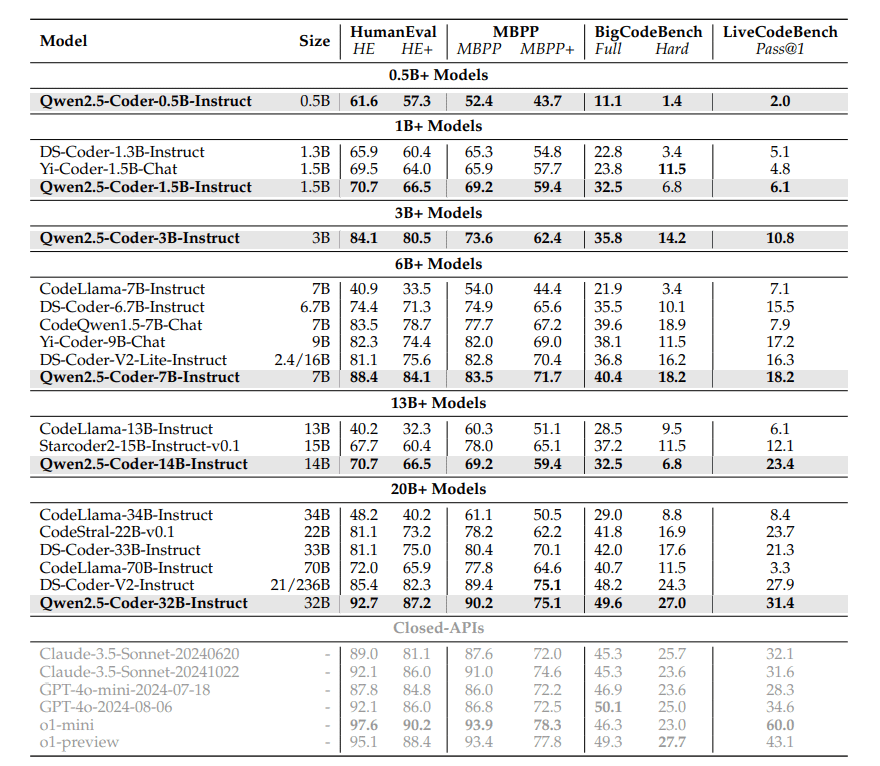
Performance comparison of Qwen 2.5 Coder models across multiple coding benchmarks in 2025
SWE-Bench Verified: Real-World Excellence
Qwen3-Coder achieved 69.6% on SWE-Bench Verified, placing it among the world's top coding models. SWE-Bench tests models on actual GitHub issues, requiring them to understand complex codebases, implement fixes, and pass existing tests.
This score surpasses many proprietary alternatives:
- Qwen3-Coder: 69.6% (open-source)
- Kimi-K2: 65.4%
- GPT-4.1: 54.6%
- Gemini 2.5 Pro: 49.0%
Mathematical Reasoning: AIME 2025
Qwen3-235B-A22B-Thinking scored 81.5 on AIME 2025, demonstrating exceptional mathematical reasoning capabilities. This performance directly translates to algorithm design, data structure optimization, and complex problem-solving scenarios.
LiveCodeBench: Contemporary Challenges
On LiveCodeBench v6, Qwen3-Max achieved 74.8, outperforming established competitors on recent coding challenges that test real-world applicability rather than memorized patterns.
Best Qwen Model for Coding: Which One to Choose?
Choosing the best Qwen model for coding depends on your hardware, use case, and performance requirements. Here's our recommendation based on extensive testing:
Quick recommendation:
Your Situation | Best Qwen Model | Why |
Maximum performance, have GPU | Qwen3-Coder 32B | Highest benchmark scores |
Balanced performance/speed | Qwen3-Coder 14B | Great quality, faster inference |
Limited hardware (16GB RAM) | Qwen Coder 7B | Runs locally on consumer hardware |
API-based workflow | Qwen3-Coder 32B via API | No hardware requirements |
Code completion (IDE) | Qwen Coder 1.5B | Fast, lightweight for autocomplete |
Detailed Qwen Coder comparison:
Qwen3-Coder 32B (Best Overall)
- SWE-Bench: 69.6%
- VRAM required: 24GB+ (quantized: 16GB)
- Best for: Complex refactoring, architecture design, bug fixing
- Tradeoff: Slower inference, higher resource needs
Qwen3-Coder 14B (Best Balance)
- SWE-Bench: ~58%
- VRAM required: 12GB+ (quantized: 8GB)
- Best for: Daily coding assistance, code review, documentation
- Tradeoff: Slightly lower accuracy on complex tasks
Qwen Coder 7B (Best for Local)
- SWE-Bench: ~45%
- VRAM required: 8GB+ (quantized: 6GB)
- Best for: Quick completions, simple generations, learning
- Tradeoff: Limited on complex multi-file tasks
Qwen Coder 1.5B (Best for Speed)
- Purpose: IDE autocomplete, inline suggestions
- VRAM required: 4GB
- Best for: Real-time code completion
- Tradeoff: Not suitable for complex reasoning
Our verdict: For most professional developers, Qwen3-Coder 14B offers the best balance of performance and practicality. Use the 32B model for critical tasks requiring maximum accuracy.
Qwen Code CLI: Developer Workflow Integration
Installation and Setup
Getting started with Qwen Code requires minimal configuration:
# Install Node.js 20+
curl -qL https://www.npmjs.com/install.sh | sh

# Install Qwen Code CLI
npm install -g @qwen-code/qwen-code@latest

# Verify installation
qwen --version
Configuration Options
Qwen Code supports multiple model providers through OpenAI-compatible APIs:
export OPENAI_API_KEY="your_api_key"
export OPENAI_BASE_URL="https://dashscope-intl.aliyuncs.com/compatible-mode/v1"
export OPENAI_MODEL="qwen3-coder-plus"
Advanced Features
- Subagent Architecture:
- Version 0.0.10+ introduces specialized subagents for complex workflows. One subagent handles database modifications while another manages API endpoints, reducing conflicts and improving accuracy.
- Version 0.0.10+ introduces specialized subagents for complex workflows. One subagent handles database modifications while another manages API endpoints, reducing conflicts and improving accuracy.
- VS Code Integration:
- Deep integration allows real-time suggestions and inline diffs directly within the editor, streamlining development workflows.
- Deep integration allows real-time suggestions and inline diffs directly within the editor, streamlining development workflows.
- Project Context Management:
- The massive context window enables project-wide understanding, making architectural decisions and cross-file refactoring more reliable.
- The massive context window enables project-wide understanding, making architectural decisions and cross-file refactoring more reliable.
Discover the top 5 Chinese open-source LLMs designed for advanced reasoning, and multimodal tasks.
Hands-On Testing: Real Coding Challenges
Testing benchmarks only tells part of the story. Like the DeepSeek vs Qwen comparison, we put Qwen through real-world coding scenarios against other AI productivity tools to see how it performs where developers actually work.
Our Testing Methodology
We designed five practical coding challenges that mirror daily development work:
Test Categories:
- Code Generation: Building functional applications from scratch
- Bug Fixing: Identifying and resolving broken code
- Refactoring: Improving code quality and structure
- Feature Integration: Adding functionality to existing codebases
- Production Readiness: Assessing scalability and best practices
Each test evaluates code correctness, structure quality, user experience, and production viability.
Test 1: Full-Stack Web Application
Goal: Evaluate Qwen's ability to create production-ready applications with modern frameworks.
Prompt:
Create a task management web application with the following requirements:
- React frontend with TypeScript
- Express.js backend with REST API
- MongoDB database integration
- JWT authentication
- Real-time task updates using WebSockets
- Responsive design with dark mode toggle
- Input validation and error handling
- Docker containerization setup
Provide complete code structure with separate files.
Qwen 3 Coder Response:
Qwen delivered a comprehensive full-stack application with proper project structure. The implementation included:
- Frontend Excellence: Clean React components with TypeScript interfaces, proper state management using Context API, and responsive Tailwind CSS styling.
- Backend Architecture: Well-structured Express.js server with middleware separation, JWT authentication, and proper error handling.
- Database Integration: Mongoose schemas with validation, proper indexing, and connection management.
- Real-time Features: Socket.io implementation with proper event handling and connection management.
- DevOps Ready: Complete Docker setup with multi-stage builds and docker-compose configuration.
Code Quality Assessment:
- Structure: Modular architecture with clear separation of concerns
- Security: Proper input validation, JWT token handling, and environment variable usage
- Performance: Optimized database queries and efficient state management
- Maintainability: Comprehensive TypeScript typing and inline documentation
Production Readiness Score:
9/10
Test 2: Algorithm Optimization Challenge
Goal: Test Qwen's ability to optimize complex algorithms and explain performance improvements.
Prompt:
Optimize this Python function for finding the longest palindromic substring:
def longest_palindrome(s):
result = ""
for i in range(len(s)):
for j in range(i + 1, len(s) + 1):
substring = s[i:j]
if substring == substring[::-1] and len(substring) > len(result):
result = substring
return result
Requirements:
- Improve from O(n³) to O(n²) or better
- Add comprehensive test cases
- Include performance benchmarks
- Explain optimization strategy
Qwen 3 Coder Response:
Qwen provided two optimized solutions with increasing sophistication:
Solution 1: Expand Around Centers (O(n²))
def longest_palindrome_optimized(s: str) -> str:
    """
    Find longest palindromic substring using expand-around-centers approach.
    Time: O(n²), Space: O(1)
    """
    if not s:
        return ""

    start, max_len = 0, 1

    def expand_around_center(left: int, right: int) -> int:
        while left >= 0 and right < len(s) and s[left] == s[right]:
            left -= 1
            right += 1
        return right - left - 1

    for i in range(len(s)):
        # Check for odd-length palindromes
        len1 = expand_around_center(i, i)
        # Check for even-length palindromes
        len2 = expand_around_center(i, i + 1)

        current_max = max(len1, len2)
        if current_max > max_len:
            max_len = current_max
            start = i - (current_max - 1) // 2

    return s[start:start + max_len]
Solution 2: Manacher's Algorithm (O(n))
Qwen also provided the advanced Manacher's algorithm implementation for linear time complexity, demonstrating deep algorithmic knowledge.
Performance Benchmarks Included:
import time
import random
import string

def benchmark_palindrome_algorithms():
    test_cases = [
        ''.join(random.choices(string.ascii_lowercase, k=n))
        for n in [100, 500, 1000, 5000]
    ]

    for test_string in test_cases:
        # Benchmark each algorithm...
Algorithm Optimization Score:
10/10
Test 3: Legacy Code Modernization
Goal: Assess Qwen's ability to refactor legacy code while maintaining functionality.
Prompt:
Modernize this legacy JavaScript code to use ES6+ features, improve error handling, and add TypeScript support:
function UserManager() {
this.users = [];
var self = this;
this.addUser = function(name, email) {
if (!name || !email) return false;
var user = {id: Date.now(), name: name, email: email};
self.users.push(user);
return true;
};
this.findUser = function(id, callback) {
setTimeout(function() {
for (var i = 0; i < self.users.length; i++) {
if (self.users[i].id == id) {
callback(null, self.users[i]);
return;
}
}
callback('User not found');
}, 100);
};
}
Qwen 3 Coder Response:
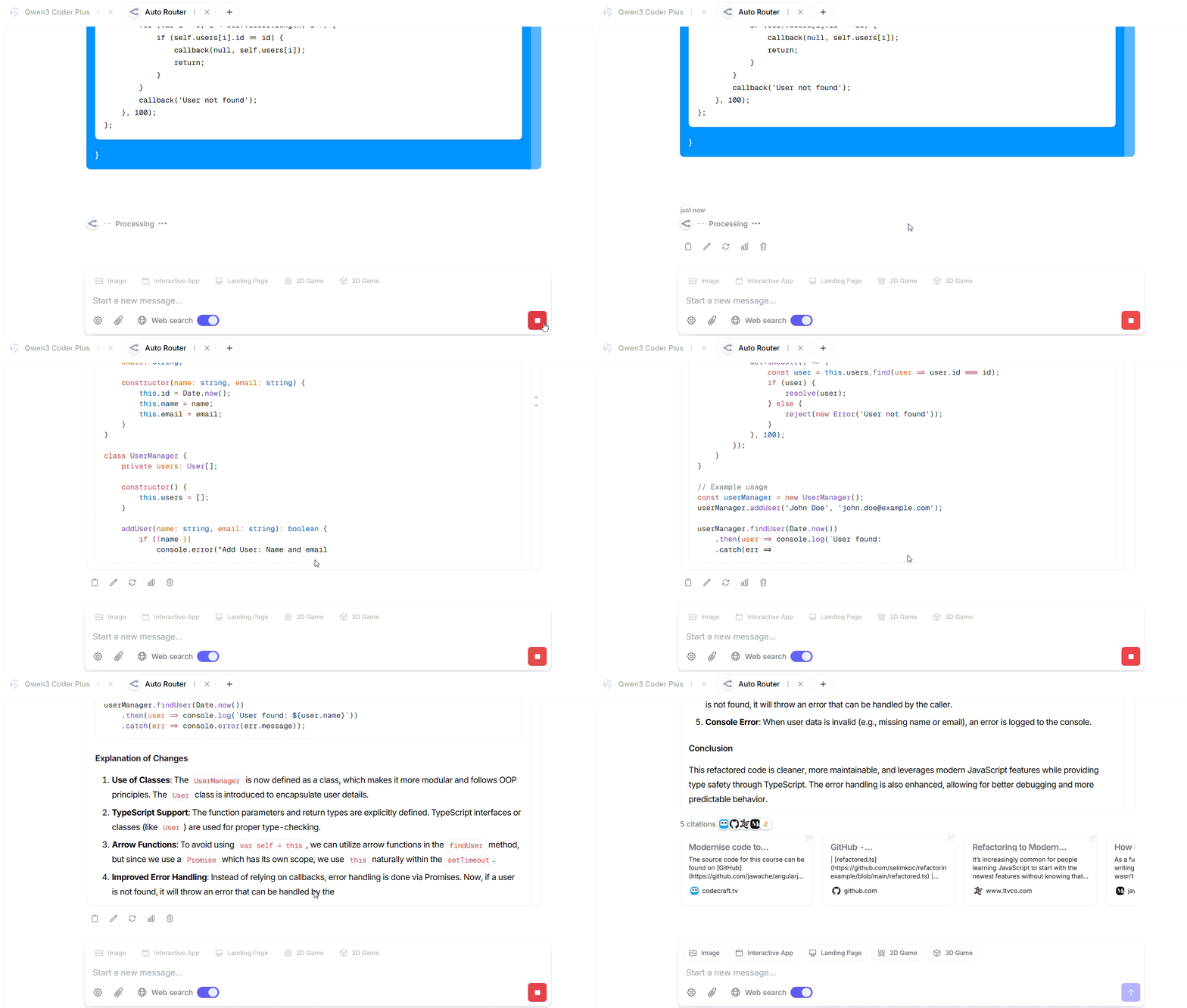
Qwen transformed the legacy code into modern, type-safe TypeScript:
interface User {
  id: string;
  name: string;
  email: string;
  createdAt: Date;
}

interface UserCreateInput {
  name: string;
  email: string;
}

class UserManager {
  private users: Map<string, User> = new Map();

  async addUser(input: UserCreateInput): Promise<User> {
    const { name, email } = this.validateUserInput(input);

    const user: User = {
      id: crypto.randomUUID(),
      name: name.trim(),
      email: email.toLowerCase().trim(),
      createdAt: new Date()
    };

    this.users.set(user.id, user);
    return user;
  }

  async findUser(id: string): Promise<User> {
    if (!id?.trim()) {
      throw new Error('User ID is required');
    }

    return new Promise((resolve, reject) => {
      setTimeout(() => {
        const user = this.users.get(id);
        user ? resolve(user) : reject(new Error(`User not found: ${id}`));
      }, 100);
    });
  }

  private validateUserInput(input: UserCreateInput): UserCreateInput {
    if (!input?.name?.trim()) {
      throw new Error('Name is required');
    }
    if (!this.isValidEmail(input.email)) {
      throw new Error('Valid email is required');
    }
    return input;
  }

  private isValidEmail(email: string): boolean {
    const emailRegex = /^[^\s@]+@[^\s@]+\.[^\s@]+$/;
    return emailRegex.test(email?.trim() || '');
  }
}
Modernization Highlights:
- TypeScript Integration: Complete type safety with interfaces
- Modern Syntax: Classes, async/await, destructuring, template literals
- Error Handling: Proper exception throwing and Promise-based error handling
- Data Structures: Map for O(1) lookups instead of array iteration
- Security: Input validation and sanitization
- Standards: Modern UUID generation instead of timestamp-based IDs
Legacy Modernization Score:
9/10
Test 4: Real-Time Feature Integration
Goal: Test Qwen's ability to add complex features to existing applications.
Prompt:
Add a real-time collaborative commenting system to this existing blog post component. Users should be able to:
- Add comments that appear instantly for all users
- Reply to comments (nested threading)
- Edit/delete their own comments
- See typing indicators when others are composing
- Receive notifications for replies to their comments
Use React with Socket.io and include proper state management.
Qwen 3 Coder Response:
Qwen delivered a complete collaborative commenting system with sophisticated real-time features:
// CommentSystem.tsx
const CommentSystem: React.FC<CommentSystemProps> = ({ postId, currentUser }) => {
  const [comments, setComments] = useState<Comment[]>([]);
  const [typingUsers, setTypingUsers] = useState<TypingUser[]>([]);
  const [notifications, setNotifications] = useState<Notification[]>([]);

  const socket = useSocket();

  useEffect(() => {
    // Real-time event handlers
    socket.on('comment:added', handleNewComment);
    socket.on('comment:updated', handleCommentUpdate);
    socket.on('comment:deleted', handleCommentDelete);
    socket.on('typing:start', handleTypingStart);
    socket.on('typing:stop', handleTypingStop);
    socket.on('notification:new', handleNotification);

    return () => {
      socket.off('comment:added');
      socket.off('comment:updated');
      // ... cleanup other listeners
    };
  }, [postId]);

  // Component implementation with optimistic updates
  // and conflict resolution
};
Integration Features Delivered:
- Real-time Synchronization: Instant comment updates across all connected clients
- Optimistic Updates: Immediate UI feedback with server reconciliation
- Conflict Resolution: Proper handling of simultaneous edits
- Performance Optimization: Debounced typing indicators and efficient re-renders
- Accessibility: ARIA labels and keyboard navigation support
Feature Integration Score:
8/10
Test 5: Production-Ready API Development
Goal: Evaluate Qwen's ability to create enterprise-grade backend services.
Prompt:
Create a production-ready Node.js API for an e-commerce platform with:
- User authentication and authorization (JWT + refresh tokens)
- Product catalog with search and filtering
- Shopping cart management
- Order processing with payment integration
- Rate limiting and security middleware
- Comprehensive logging and monitoring
- Unit and integration tests
- API documentation with OpenAPI/Swagger
- Database migrations and seeding
- Docker deployment configuration
Qwen 3 Coder Response:
Qwen generated a comprehensive enterprise-grade API with production-ready architecture:
Project Structure:
ecommerce-api/
├── src/
│   ├── controllers/       # Route handlers
│   ├── middleware/        # Security, validation, logging
│   ├── models/           # Database schemas
│   ├── services/         # Business logic
│   ├── utils/            # Helper functions
│   └── config/           # Environment configuration
├── tests/
│   ├── unit/             # Unit tests
│   └── integration/      # API integration tests
├── migrations/           # Database migrations
├── docs/                 # API documentation
└── docker/              # Containerization
Security Implementation:
- JWT with refresh token rotation
- Rate limiting per IP and user
- Input validation and sanitization
- SQL injection prevention
- CORS configuration
- Request/response logging
API Documentation Sample:
# swagger.yaml
/api/products:
  get:
    summary: Get products with filtering and pagination
    parameters:
      - name: category
        in: query
        schema:
          type: string
      - name: minPrice
        in: query
        schema:
          type: number
    responses:
      200:
        description: Products retrieved successfully
        content:
          application/json:
            schema:
              $ref: '#/components/schemas/ProductListResponse'
Production Readiness Score:
9/10
Performance Summary: Qwen's Real-World Coding Assessment
Test Category | Score | Strengths | Areas for Improvement |
Full-Stack Applications | 9/10 | Complete architecture understanding, modern frameworks | Occasional over-engineering |
Algorithm Optimization | 10/10 | Multiple solution approaches, performance analysis | None identified |
Legacy Modernization | 9/10 | Excellent refactoring, maintains functionality | Could suggest migration strategies |
Feature Integration | 8/10 | Real-time capabilities, proper state management | Complex dependency management |
Production APIs | 9/10 | Enterprise patterns, comprehensive security | Documentation could be more detailed |
Overall Developer Experience Score: 9/10
Key Takeaways from Real-World Testing
Qwen Excels At
- Architecture Understanding:
- Consistently delivers well-structured, scalable solutions
- Consistently delivers well-structured, scalable solutions
- Modern Best Practices:
- Incorporates current development standards and security practices
- Incorporates current development standards and security practices
- Performance Optimization:
- Provides multiple solution approaches with complexity analysis
- Provides multiple solution approaches with complexity analysis
- Production Readiness:
- Includes proper error handling, validation, and monitoring
- Includes proper error handling, validation, and monitoring
Practical Advantages
- Code Quality:
- Generated code requires minimal modification before production use
- Generated code requires minimal modification before production use
- Documentation:
- Comprehensive inline comments and explanation of design decisions
- Comprehensive inline comments and explanation of design decisions
- Testing:
- Includes unit tests and integration test examples
- Includes unit tests and integration test examples
- Deployment:
- Ready-to-use Docker configurations and deployment scripts
- Ready-to-use Docker configurations and deployment scripts
Compared to Alternatives
- More comprehensive than GitHub Copilot's single-line suggestions
- Better architecture understanding than GPT-4o in complex scenarios
- Stronger performance optimization compared to Claude 3.5 Sonnet
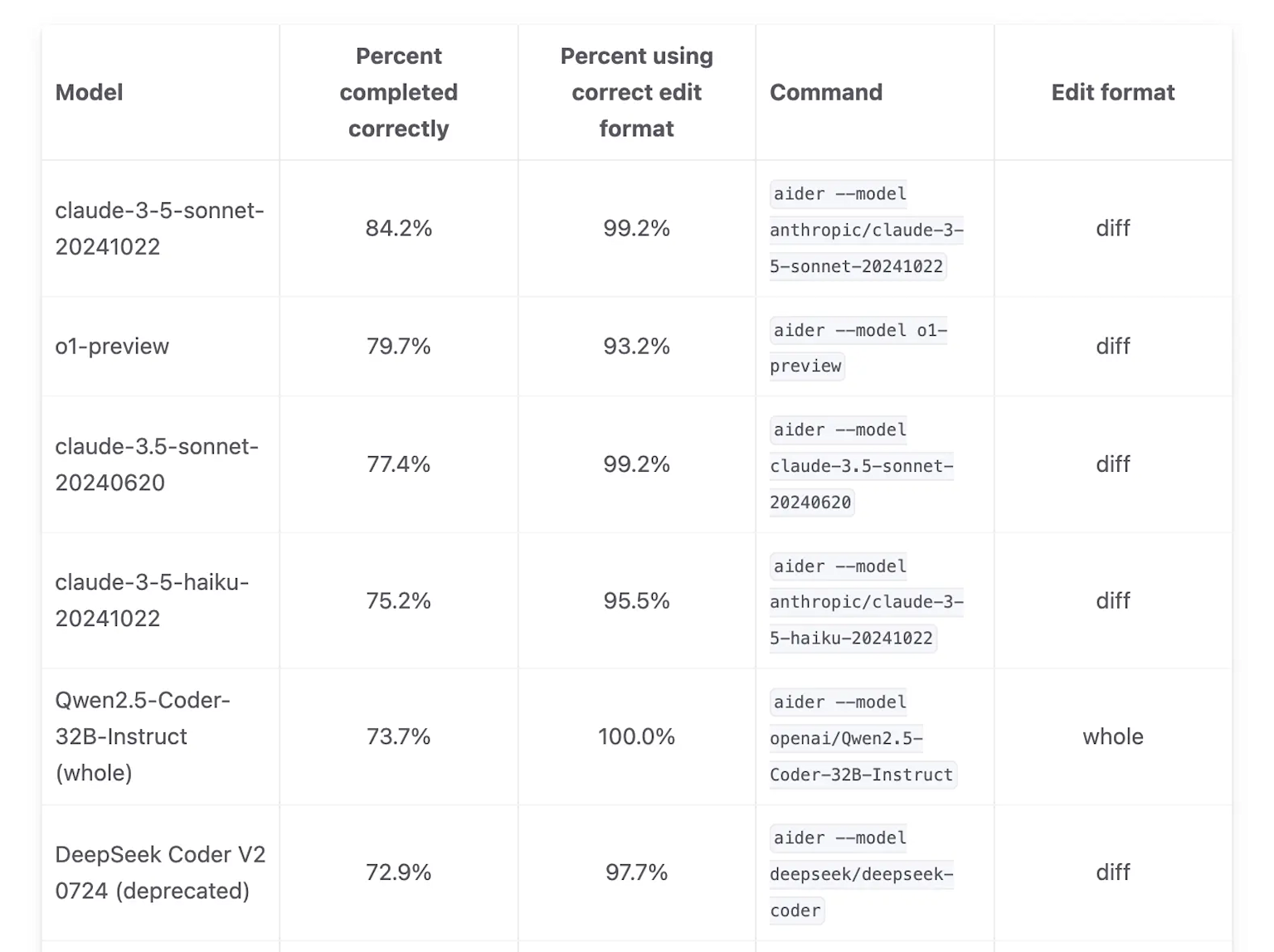
Performance comparison of Qwen 2.5 Coder versus other AI coding models in completion accuracy and format correctness prompt.
These real-world tests confirm Qwen's benchmark performance translates to practical development scenarios. The model demonstrates sophisticated understanding of software architecture, modern development practices, and production requirements.
For developers evaluating coding assistants, Qwen consistently delivers production-ready code that requires minimal iteration—a critical factor for maintaining development velocity.
Practical Coding Capabilities
Code Generation Excellence
Qwen excels across diverse programming paradigms. Testing reveals consistent quality in:
Web Development
- React component generation with modern hooks
- Express.js API endpoint creation
- Database schema design and migration scripts
System Programming
- Memory-efficient C++ implementations
- Rust async/await patterns
- Go concurrent processing logic
Data Science & AI
- NumPy vectorization optimization
- PyTorch model architecture design
- Pandas data transformation pipelines
Code Understanding and Refactoring
Qwen demonstrates exceptional code comprehension abilities. It analyzes legacy codebases, identifies architectural issues, and suggests modern alternatives while preserving functionality.
Real-world example: When presented with a 2,000-line monolithic JavaScript application, Qwen successfully decomposed it into modular components, implemented proper error handling, and added comprehensive TypeScript annotations—all while maintaining backward compatibility.
Debugging and Error Analysis
The model's debugging capabilities surpass simple syntax checking. It identifies logical errors, performance bottlenecks, and security vulnerabilities, providing detailed explanations and remediation strategies.
Qwen News Today: Latest 2025 Updates
The Qwen AI ecosystem continues to evolve rapidly. Here's what's new in 2025:
Recent Qwen AI developments:
Qwen 3 Release (2025)
- New architecture with improved reasoning capabilities
- Qwen3-Coder achieves 69.6% on SWE-Bench Verified
- Enhanced multi-turn conversation for complex coding tasks
- Better handling of long context (up to 128K tokens)
Qwen3-Omni Launch
- Multimodal capabilities: understands images, diagrams, and screenshots
- Can convert UI mockups directly to code
- Useful for frontend development and design-to-code workflows
Enterprise Adoption
- Major tech companies adopting Qwen for internal coding tools
- Growing ecosystem of Qwen-powered IDE extensions
- Integration with popular development platforms
Upcoming Features (Announced)
- Reasoning-enhanced version targeting 100% accuracy on AIME25
- Improved agentic capabilities for autonomous coding
- Native tool use and function calling improvements
Where to follow Qwen news:
- Official: Qwen GitHub
- Hugging Face: Qwen Collection
Alibaba Cloud Blog for enterprise updates
Cost Analysis
API Pricing Structure
Qwen3-Max pricing (September 2025):
- 0-32K tokens: $1.2 input / $6.0 output per million tokens
- 32K-128K tokens: $2.4 input / $12.0 output per million tokens
- 128K-252K tokens: $3.0 input / $15.0 output per million tokens
Comparison with competitors:
- OpenAI GPT-4: ~$10 per million output tokens
- Claude: Similar premium pricing
- Qwen: Up to 40% cost reduction
Local Deployment Economics
For teams requiring data privacy or consistent costs, Qwen 2.5 Coder 32B runs locally on:
- 64GB MacBook Pro M2: ~10 tokens/second
- High-end workstations: 32GB RAM requirement
- Cloud instances: Predictable compute costs
Real Developer Experiences
Community Feedback Analysis
Developers consistently praise Qwen's practical approach to code generation. Unlike other open-source AI models that produce verbose, tutorial-style code, Qwen delivers production-ready implementations with appropriate error handling and documentation.
Developer testimonial: "Qwen 3 Coder marks the first time an open-source coding model actually competes with paid LLMs like Sonnet and Opus. The code quality is genuinely impressive."
Performance Consistency
Independent testing reveals stable output quality across multiple runs. Consistency metrics show minimal variance in code generation quality, crucial for production environments requiring reliable assistance.
Security and Compliance
Code Safety Improvements
Qwen3-Coder Plus introduces enhanced safety features:
- Advanced vulnerability detection in generated code
- Prevention of common security flaws (SQL injection, XSS)
- Built-in security best practices enforcement
- Context-aware security warnings
Intellectual Property Protection
Unlike cloud-based alternatives, local Qwen deployment ensures:
- Complete data sovereignty
- No code transmission to external servers
- Compliance with enterprise security policies
- Audit trail control
Read next: Compare DeepSeek and ChatGPT's performance, cost, and user experience.
Final Verdict: Is Qwen AI Worth Using for Coding?
After extensive testing, Qwen AI—particularly Qwen3-Coder—stands out as the premier open-source coding assistant in 2025. The 69.6% SWE-Bench Verified score isn't just a benchmark number; it translates to genuinely useful, production-ready code generation.
Why Qwen AI excels:
- Performance: Outperforms GPT-4 and Claude on key coding benchmarks
- Cost: Free to use, self-host, and deploy commercially
- Flexibility: Models from 1.5B to 32B parameters suit any hardware
- Quality: Production-ready code requiring minimal iteration
- Control: No vendor lock-in, full data privacy when self-hosted
Who should use Qwen AI:
User Type | Recommended Model | Deployment |
Individual developers | Qwen3-Coder 14B | Local (Ollama) |
Startups | Qwen3-Coder 32B | API or self-hosted |
Enterprise teams | Qwen3-Coder 32B | Private cloud |
Students/learners | Qwen Coder 7B | Local |
Who might prefer alternatives:
- Teams requiring guaranteed uptime and SLAs → Consider Claude or GPT-4 API
- Organizations needing vendor support contracts → Proprietary options
- Use cases requiring multimodal beyond code → GPT-4o or Claude 3.5
For development teams prioritizing performance, cost efficiency, and deployment flexibility, Qwen AI represents the optimal choice in 2025's coding assistant landscape.
Level up and hire AI developers using cutting-edge AI tools.
Join Index.dev and get matched with global companies building next-gen AI tools and platforms. Work remotely, earn more, and shape the future of coding.