Establishing realistic rate expectations for tech talent is rarely straightforward. While many guides rely on broad estimates, real-world pricing depends heavily on localized demand, technical discipline, and market shifts.
In this guide, I bypass generic industry ranges to look at actual data from Index.dev's global platform. The goal is simple: offer an honest, data-backed perspective on current developer rates, making explicit distinctions between documented metrics and broader market projections.
At a Glance: What a Remote Developer Rate Means for Your Budget
Rate Band | What It Usually Means | What To Do |
| $12 to $35/hr | Junior, generalist, offshore (South/SE Asia mostly) | Fine for scoped, low risk tasks. Budget extra review time |
| $35 to $65/hr | Mid level or senior offshore, junior nearshore | Good default for steady feature work if you can manage async |
| $65 to $100/hr | Senior nearshore or offshore AI/ML | Where most scaling teams land for real ownership roles |
| $100 to $160/hr | Senior US/EU, or AI specialist anywhere | Pay this for architecture, security, or anything hard to unwind |
| $160 to $220+/hr | AI agent and applied ML specialists, top US talent | Reserve for the roadmap items you cannot afford to get wrong |
Why I Went Looking for Index.dev's Own Numbers Instead of Just Citing Everyone Else
I read through a stack of guides claiming to cover remote developer rates 2026 before writing a word of this, and the thing that annoyed me was how much they disagree. One puts senior developer rates at $30 to $45 an hour. Another says $40 to $70. A third has it as low as $15 to $22. Nobody shows where the number came from.
So I pulled the actual figures from Index.dev's own matching data, which covers a pool of over two and a half million applicants and roughly 30,000 vetted engineers, weighted toward Eastern Europe and Latin America, and I checked those against outside sources so this is not just us grading our own homework.
Rate Table by Skill and Region: Index.dev's 2026 Data
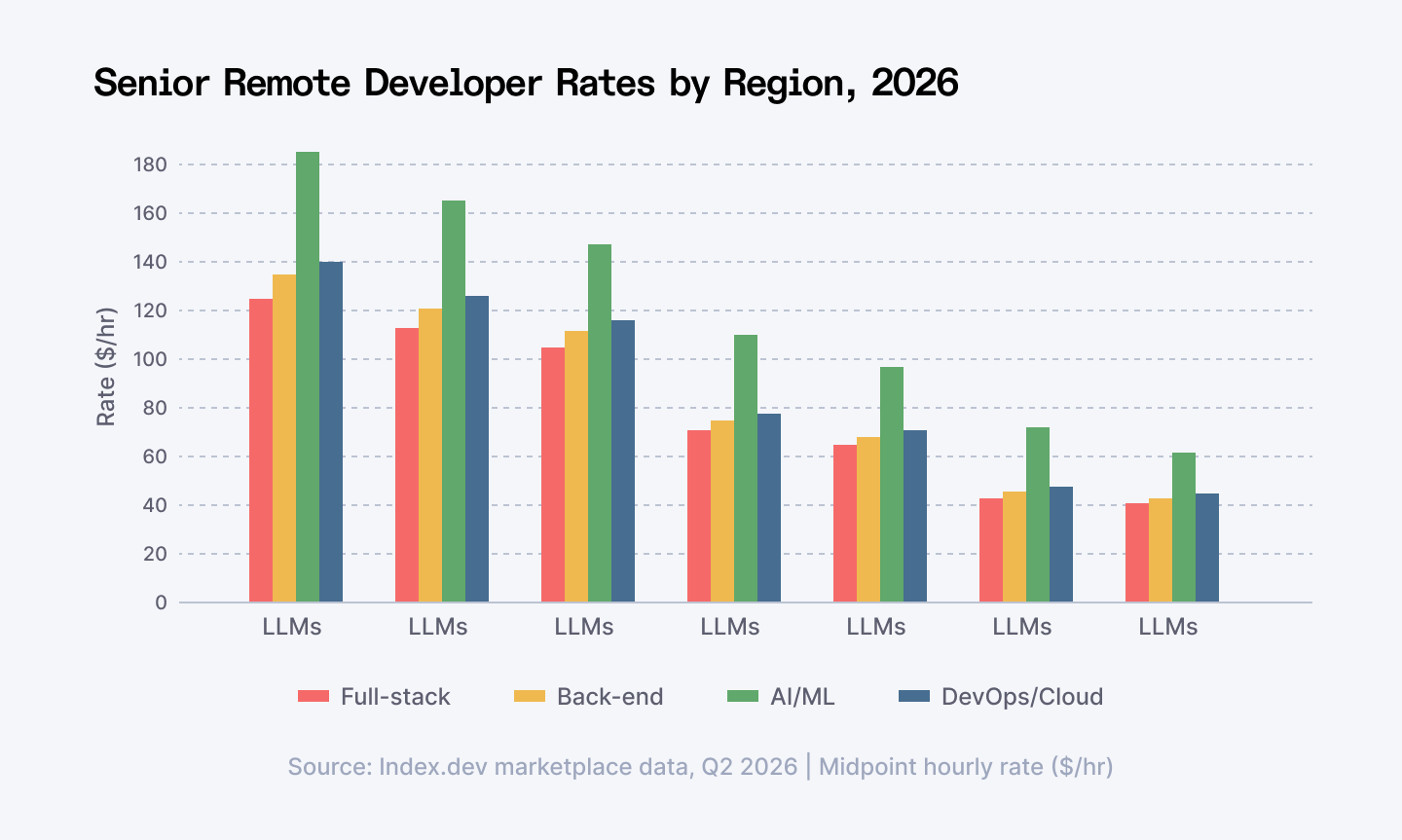
Below are the median senior hourly rates for four in demand stacks, pulled from Index.dev's marketplace as of Q2 2026, not scraped from job postings.
Region | Full-Stack | Backend | AI/ML | DevOps/Cloud |
United States | $100-150/hr | $110-160/hr | $150-220/hr | $115-165/hr |
Canada | $92-135/hr | $98-145/hr | $135-195/hr | $102-150/hr |
Western Europe | $85-125/hr | $90-135/hr | $120-175/hr | $92-140/hr |
Eastern Europe | $58-85/hr | $60-90/hr | $85-135/hr | $62-95/hr |
Latin America | $50-80/hr | $52-85/hr | $75-120/hr | $55-88/hr |
India | $34-52/hr | $36-56/hr | $55-90/hr | $38-58/hr |
Southeast Asia | $32-50/hr | $34-52/hr | $45-80/hr | $36-55/hr |
Source: Index.dev marketplace data, Q4 2026. Cross checked against Uvik's offshore rate index and A.Team's AI engagement data.
A few things stood out once I actually sat with these numbers instead of skimming them. Eastern Europe's senior AI/ML band now overlaps with the low end of a US full-stack senior's rate, which was not true even a year ago.
LATAM has also quietly caught up to Eastern Europe at the senior tier. The gap used to sit around 15-20%. Now it is closer to single digits, and I genuinely did not expect that.
How These Rates Are Calculated
Nobody sets a rate by pulling a number from thin air, even though it can feel that way when you get a quote.
Four things drive it. Seniority. Stack. Region. And the engagement model you pick, because a freelance marketplace hire and a staff augmentation contract for the "same" developer will not price the same.
Platform markup is the piece buyers miss most. Contra charges close to nothing on direct hourly work. Toptal can run a 30-100% markup baked quietly into the number you see. So a $150 an hour quote from two different platforms is not the same purchase.
What Affects the Rate: Specialization, Time Zones, and AI Tools
Specialization is now the biggest driver for remote developer rates 2026, easily outpacing developer location.
AI agent and applied ML specialists earn 60-100% more than a generalist at the same seniority, and inside that category there is another split. Traditional ML engineers doing training and feature work sit at $80-$180 an hour.
RAG and fine tuning specialists run higher, $130-$200. Agent developers building autonomous systems on frameworks like LangChain or Anthropic's MCP now clear $180-$300 at the senior end. That is a genuinely new tier that did not exist as a distinct pricing bracket two years ago.
You can read more on the criterias and details that determine these details here.
Time zone overlap is worth real money now, not just convenience.
Nearshore developers in LATAM or Eastern Europe who share several working hours with a US or EU client are pulling a 10-15% premium over pure offshore talent at the same skill level. Five years ago this would have been the opposite story, cheap and far away winning on price alone. That has flipped.
AI coding tools have not made hourly rates cheaper, they have made projects shorter.
Developers using Codex or Claude Code finish tasks 25-40% faster, but that shows up as fewer billed hours, not a lower rate per hour, except on routine maintenance work where rates have softened slightly.
The 2025 Stack Overflow survey backs this up in a roundabout way. 66% of developers still say AI output is "almost right, but not quite," and three quarters say they go find an actual human when something matters. Senior review time is not getting cheaper just because juniors ship faster.
How to Read a Rate Quote (If You Are Hiring)
Today: Pull your last three invoices from offshore or marketplace vendors and compare them to standard remote developer rates 2026 to check whether you are paying an "AI premium" for developers who are actually doing straightforward backend or product work.
This week: When you see a $150 an hour quote, ask for the markup split. If the platform keeps half of it, you are not buying a $150 senior engineer, you are buying a $75 mid-level engineer with an expensive middle layer in between.
This month: Test a nearshore hire if you are fully offshore right now. Even two or three overlapping hours per day with your core team can earn back the 10-15% rate premium through fewer async delays and less rework on misunderstood tickets.
How to Choose a Hiring Model Based on Your Rate Budget
If you want the absolute lowest sticker price and have time to screen yourself, an open marketplace like Upwork is the pick, accepting that quality control becomes your job.
If you need one senior specialist and cannot afford a bad hire, Toptal's heavier vetting is worth its markup, even if the pricing takes a call to actually understand.
If you are scaling a team of several senior engineers over six months or longer and cost per year matters more than speed, Turing's AI-assisted matching and lower typical bands make more sense than a boutique network.
If the work touches AI, backend, or data systems where a bad hire is genuinely expensive to unwind, Index.dev's more hands-on matching is worth the extra day or two it takes compared to instant marketplace intros.
Where I Tried Hiring Myself: Toptal, Upwork, Turing
I want to be straight about this part because it is the bit most rate guides fake. I ran one senior full-stack hire each through Toptal, Upwork, and Turing over about 6 weeks, tracking price transparency, vetting, and how long it actually took to get someone I would consider real. This was not a lab study. It was one buyer, real money, real calendar invites.
Toptal handed me four candidates in three days, and the vetting was clearly serious, live coding round, a real test project. What annoyed me was the pricing. I had to ask directly before I understood the markup, and it landed close to the 30-100% range that gets reported elsewhere. Fine for one hire you cannot get wrong. Painful if you are trying to build a team without the markup adding up fast.
Upwork flipped the experience entirely. Over 40 proposals landed within two days, and I could see exactly what the market was actually bidding, which felt refreshing after Toptal's opacity. The cost was my own time. I spent most of a week screening, and two of the four people I actually interviewed had portfolios that did not hold up under a few pointed questions.
Turing's assessment process was the most consistent of the three, and matching took about five days. Where it fell short for me, a React and Node role with some light AI work, was that I genuinely could not tell how much of the quoted rate the developer actually saw versus what Turing kept. That ambiguity made rate negotiation harder than it should have been.
None of these are wrong platforms. They are just built for different problems, and the pricing structure tells you which problem that is before the vetting quality does.
Comparison Table: Toptal vs Turing vs Upwork vs Index.dev
Option | Price/Markup | Time-to-shortlist | Vetting depth | Best for |
Toptal | 30-100% markup, undisclosed upfront | 3 days | High, live coding plus test project | One critical senior hire |
Turing | Salary plus markup, unclear split | 5 days | High, AI screen plus interviews | Scaling a remote team over months |
Upwork | 0-20% combined fees | Under 48 hrs | Low, buyer does the vetting | Small scoped work, price discovery |
Index.dev | Transparent, no upfront search fee | Under 48 hrs | High, multi-stage human vetting | AI, backend, or data hires that need to stick |
Limitations and What This Data Cannot Tell You
Currency swings, especially in Argentina, can move effective dollar rates for LATAM engineers within a single quarter. Contract length matters too. A one month sprint and a twelve month embedded role for the same senior engineer will often differ by 10-20% just because of commitment.
And none of this, not this report and not any platform's marketing page, guarantees a good hire. Vetting reduces risk. It does not remove it.
Frequently Asked Questions
What are the average remote developer rates 2026?
There is not one useful average. A blended global figure near $34 an hour mixes junior Asia-Pacific work with senior US work in the same bucket, which tells you almost nothing. Region and seniority together are what actually answer the question.
Why do AI/ML developers cost so much more than other developers?
Because production experience with agent frameworks and RAG pipelines is still barely 18 months old across the industry, and demand has outrun the supply of people who have actually shipped it, not just studied it.
Is a marketplace or a managed platform cheaper?
Depends how much of the screening you want to do yourself. Zero markup platforms push that work onto you. Managed platforms charge 15-100% for a shortlist you can mostly trust without redoing the legwork.
Has AI coding assistance actually lowered rates?
Not the hourly number. Total project cost, yes, because fewer hours get billed for the same scope, except in routine maintenance work where rates have softened a bit.
Are Latin American rates still cheaper than Eastern Europe?
Barely, at the senior tier. The old 15-20% gap has shrunk to single digits as LATAM repositioned from budget option to timezone-aligned option.
Do I need a subscription to use a platform like Index.dev?
No upfront search fee is typical for managed platforms like Index.dev. You pay for talent time itself, which is closer to try-before-you-commit than most premium networks offer.
Bottom Line
The truth about remote developer rates 2026 is that they are not really about the location anymore. They are entirely about what you are hiring for. Specialization now moves the number more than geography does, and Index.dev's own marketplace data shows that gap widening every quarter we check it.
If your hire touches AI, backend, or data work that would be expensive to redo, that is the lane Index.dev is built for. For everything else, this report should at least give you a real number to argue with instead of a guess.
Key Takeaways
- A remote developer rate in 2026 typically runs $30 to $220 an hour, driven mostly by specialization, then seniority, then region.
- Index.dev's own marketplace data shows senior AI/ML rates in Eastern Europe now overlapping the low end of US full-stack senior pay, a gap that barely existed in 2025.
- Nearshore time zone overlap is worth a real 10-15% premium now, not just a nice-to-have.
- Platform markup varies from near zero to 100%of the quoted rate, so comparing sticker prices across platforms without checking the fee structure is comparing the wrong thing.
- AI coding tools are shrinking total project budgets through speed, not through lower hourly rates.