The five best programming languages for AI in 2026 are Python, Java, C++, R, and Julia. Python wins on libraries and developer speed, used in roughly 70% of ML projects per Stack Overflow 2025. Java and C++ handle performance and enterprise scale. R owns statistics. Julia is the fastest-rising option for scientific AI.
Artificial Intelligence is rewriting how teams build software, ship products, and make decisions. From copilots and recommendation engines to autonomous driving and fraud detection, AI now sits inside almost every digital product. The language you build on still matters: it shapes how fast you ship, how well your model performs in production, and which talent pool you can hire from.
This guide compares the five languages that dominate AI engineering work in 2026: Python, Java, C++, R, and Julia. We pulled current adoption data from the Stack Overflow Developer Survey 2025, the JetBrains State of Developer Ecosystem 2025, and IEEE Spectrum's 2025 language rankings, then mapped each language to the AI workloads it actually wins. Use this to pick the right stack for your next AI project and, if you are hiring, to know which skill profiles to look for.
Read also: Designing Generative AI Applications: 5 Key Principles to Follow
5 Key Takeaways
- Python is the default AI language in 2026. About 70% of ML projects use it (Stack Overflow Developer Survey 2025), thanks to TensorFlow, PyTorch 2.x, JAX, and scikit-learn.
- Java leads enterprise AI integration. JVM portability plus mature libraries (Weka, H2O, Deeplearning4j, Tribuo) make it the safe choice for production-grade systems at banks, insurers, and telcos.
- C++ owns latency-critical AI. Self-driving stacks, robotics, and high-frequency trading still ship inference in C++ because it gives microsecond-level control and direct hardware access.
- R remains the analyst's language. Roughly one in four data scientists still use R for statistical modeling, per Kaggle's 2024 State of Data Science survey. R is strong for forecasting, biostatistics, and exploratory work.
- Julia is the fastest-growing scientific AI language. IEEE Spectrum's 2025 rankings put Julia in the top 20 for the first time, driven by Flux.jl, MLJ.jl, and SciML adoption in research labs.
AI Programming Languages at a Glance
Before the deep dive, here is a quick side-by-side of what each language is good at. We compared the languages on ecosystem depth, performance, learning curve, and the AI workloads they handle best.
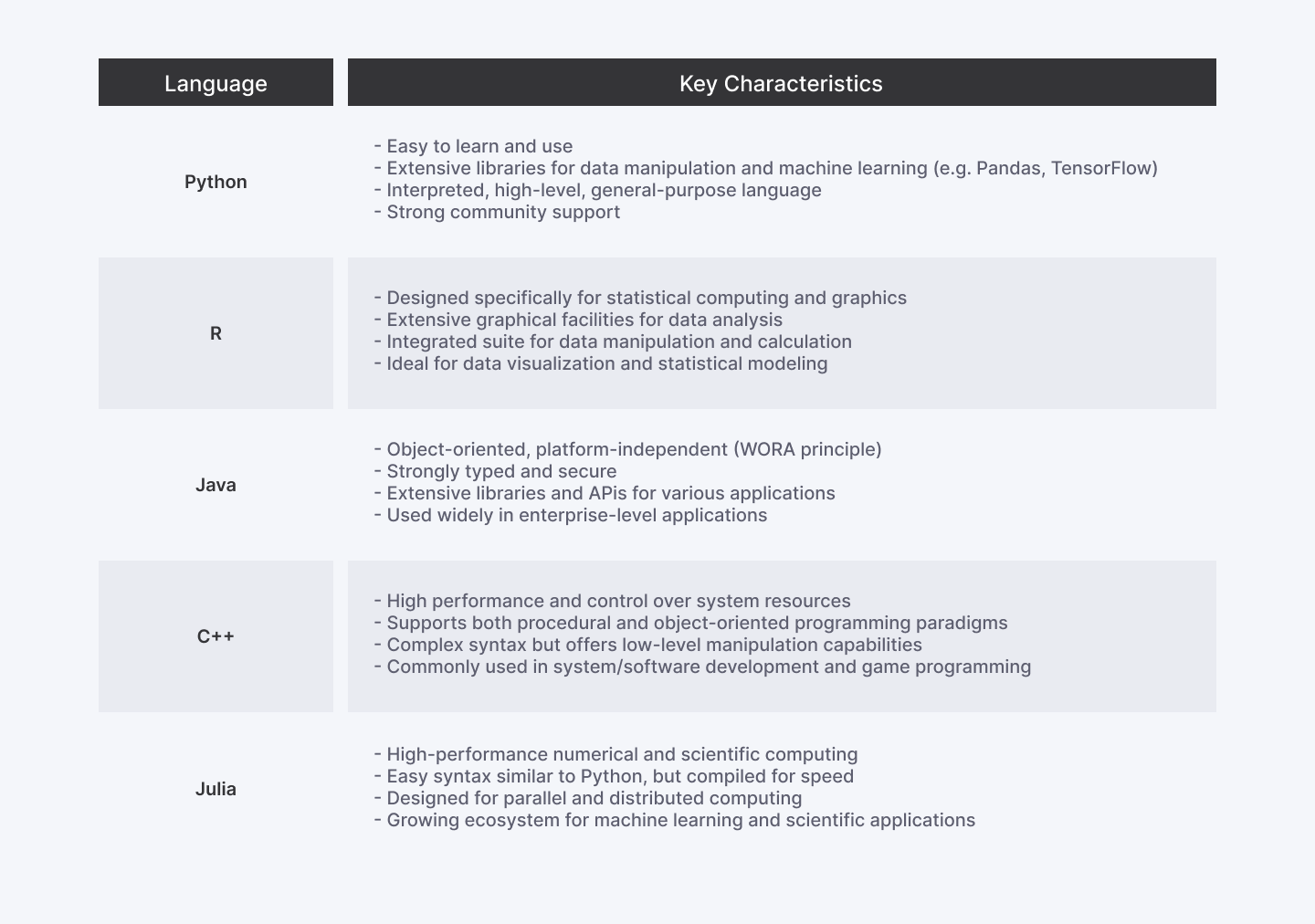
1. Python
Python is the most widely used language for AI and machine learning in 2026. Roughly 70% of AI/ML projects ship in Python, per the Stack Overflow Developer Survey 2025, and JetBrains' State of Developer Ecosystem 2025 lists it as the top language for data science and AI work for the seventh year running. It dominates because of its libraries, its readable syntax, and the depth of its talent pool.
Why Python Shines in AI
- Readability and ease of use. Python's clean, near-natural-language syntax keeps the focus on the model, not the boilerplate, and shortens the path from idea to working notebook.
- Rich ecosystem of AI libraries and frameworks. TensorFlow, PyTorch 2.x, JAX, scikit-learn, Hugging Face Transformers, and LangChain cover almost every modern AI workload, from classical ML to LLM agent orchestration.
- Rapid prototyping. Python lets teams test a model architecture, swap optimizers, or rewire a data pipeline in minutes, which matters when product requirements move every sprint.
Key Python Libraries and Frameworks for AI
- PyTorch 2.x: the de facto research framework in 2026, with native compile, dynamic graphs, and first-class support across Hugging Face, Meta, and OpenAI projects.
- TensorFlow / Keras 3: Google's production-grade stack, still the standard for large-scale training and TFLite deployment.
- JAX: Google DeepMind's framework for numerical computing and large-scale model research, used in Gemini and DeepMind's scientific work.
- scikit-learn: the workhorse for classical ML: classification, regression, clustering, and dimensionality reduction.
- Hugging Face Transformers: the default toolkit for fine-tuning, serving, and evaluating LLMs and vision-language models.
If you need fast iteration, a deep library ecosystem, and easy hiring, Python is hard to beat. The trade-off is raw execution speed. For tight inference loops, teams routinely drop into C++ or Rust at the bottleneck and keep Python at the orchestration layer.
Where Python Wins in Production
- LLM applications and agents. LangChain, LlamaIndex, and OpenAI Agents SDK are all Python-first, which makes it the default for building chatbots, RAG pipelines, and autonomous agents in 2026.
- Computer vision and multimodal AI. PyTorch plus Hugging Face plus OpenCV cover almost every image, video, and multimodal model in production.
- MLOps and model serving. MLflow, Ray, Kubeflow, and BentoML give Python teams end-to-end ML lifecycle tooling without leaving the language.
2. R
R is an open-source language built for statistical computing and data visualization. It remains the analyst's language of choice in 2026: roughly 24% of data scientists report using R as their primary language, per Kaggle's 2024 State of Data Science and ML survey, especially in research, biostatistics, and finance.
R's Strengths in AI Development
- Statistical modeling. R's base packages and CRAN ecosystem ship deep, peer-reviewed implementations of regression, time-series, Bayesian, and survival models, the foundations of many ML algorithms.
- Data exploration and visualization. ggplot2, plotly, and Shiny make it fast to explore patterns, share dashboards, and communicate model output to non-technical stakeholders.
- Large community and extensive packages. CRAN hosts more than 20,000 packages in 2026, with active maintenance from academic, government, and industry contributors.
R wins on statistical analysis, predictive modeling, and clear visual storytelling. The trade-off is scale: production-grade serving of large neural networks is still smoother in Python or Java.
3. Java
Java stays the enterprise AI workhorse in 2026. Its JVM portability, mature tooling, and a global developer pool of more than 9 million engineers (JetBrains 2025) make it the language of choice for AI systems that need to plug into existing core banking, ERP, telecom, or insurance backends.
Java's Advantages in AI Development
- Portability and scalability. Java's "write once, run anywhere" model and modern GraalVM/Project Loom releases keep it strong for large, long-running AI services that need predictable performance under load.
- Mature and extensive libraries. Weka, H2O, Deeplearning4j, Tribuo (Oracle), and Apache Spark's MLlib give Java teams everything from classical ML to deep learning on the JVM.
- Large developer pool and established best practices. Enterprise hiring is easier in Java than in almost any other language, and decades of coding standards make systems straightforward to maintain.
Read also: Implementation and Concept of the Binary Search Algorithm in Java
Java is the right choice for large-scale, portable AI in enterprise environments. The trade-off is verbosity and a steeper learning curve than Python or Julia, especially for teams new to type systems.
4. C++
C++ is the high-performance language behind the AI workloads where every microsecond counts. Most production deep-learning runtimes, including the cores of PyTorch, TensorFlow, ONNX Runtime, and NVIDIA TensorRT, are written in C++ underneath their Python APIs. Roughly 12% of AI projects use C++ directly, per the IEEE Spectrum 2025 language survey, mostly in robotics, automotive, gaming, and trading.
C++'s Performance Edge in AI Development
- Speed and efficiency. C++ compiles to native machine code, talks directly to CPU/GPU intrinsics, and runs inference loops faster than any garbage-collected language.
- Memory management. Fine-grained control over allocation and lifetime is critical for memory-hungry AI workloads on edge devices, drones, and embedded systems.
- Integration with existing systems. C++ slots into C-ABI environments such as game engines, OS kernels, and simulators, without rewrites, which keeps engineering cost low.
Examples of AI Applications Using C++
- Self-driving cars: real-time perception, sensor fusion, and path planning across stacks like NVIDIA DRIVE, Mobileye, and Tesla's in-house pipeline.
- High-frequency trading: latency-sensitive ML models for execution and signal scoring at the world's top quant firms.
- Computer vision and robotics: image processing in OpenCV, robotics in ROS 2, and on-device inference in TensorRT and CoreML compilers.
When raw speed and deterministic latency are non-negotiable, C++ is still the answer. The trade-off: it is harder to learn and slower to prototype in than Python.
5. Julia
Julia is the language designed from day one for high-performance numerical and scientific computing. IEEE Spectrum's 2025 rankings put Julia inside the top 20 most-popular programming languages for the first time, and its packaging count on JuliaHub has grown more than 25% year-over-year since 2023, the fastest among scientific-computing languages.
Why Julia Is an Emerging AI Leader
- Speed meets readability. Julia sits between C++ on performance and Python on syntax. It hits near-C execution speed through its LLVM-based JIT while reading like Python.
- Focus on scientific computing. Built for numerical work such as matrix operations, differential equations, and optimization, which is exactly the math at the core of modern AI.
- Growing AI-focused ecosystem. Flux.jl, MLJ.jl, Lux.jl, and the SciML stack now cover deep learning, classical ML, and differentiable physics. NASA, Pfizer, and Moderna use Julia in production research pipelines.
Trade-offs to Consider
- Smaller community. Julia's talent pool is a fraction of Python's, which can slow hiring and Stack Overflow lookup time.
- Younger ecosystem. Some niches such as agentic AI tooling, mobile inference, and LLM serving still lean on Python or C++ libraries.
Read also: 7 Best-Paying Tech Skills Companies Are Hiring for Now
Julia is the right call for teams that need Python-like productivity but C-like speed for scientific AI: physics-informed neural networks, differentiable simulation, computational biology. As its ecosystem matures, expect it to keep eating share from MATLAB and from Python in heavy numerical workloads.
Choosing the Right Language for AI Projects in 2026
There is no single best AI language. There is a best fit for your workload, team, and constraints. The factors that actually decide:
- Project requirements. Computer vision and robotics lean C++; LLMs and agents lean Python; statistical modeling leans R; numerical research leans Julia; large enterprise integration leans Java.
- Team expertise. The right language is the one your senior engineers can debug at 2 a.m. Hiring market depth matters as much as theoretical fit.
- Library and tooling depth. Library availability often beats raw language performance. Python wins more AI projects than it "should" because the ecosystem is unmatched.
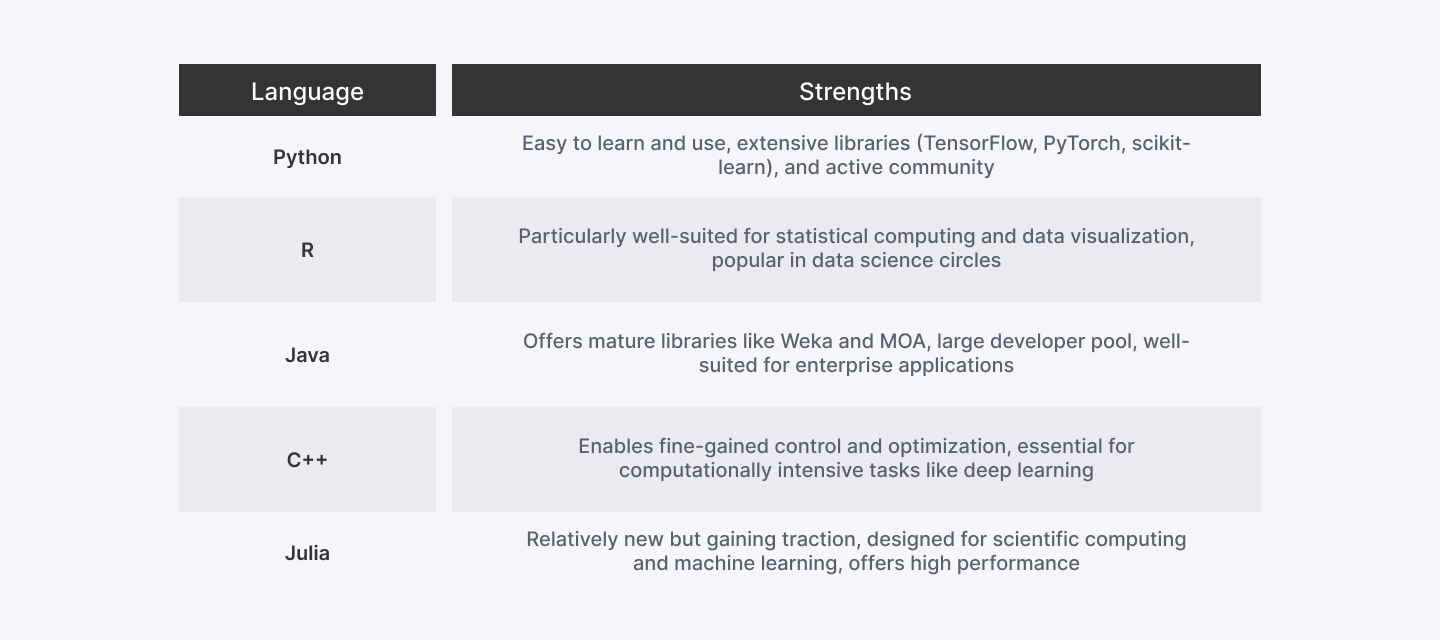
Hire Vetted AI Engineers, Fast
Need senior engineers in Python, Java, R, C++, or Julia for an AI build? Index.dev connects you with the top 1% of AI talent from a community of 27,000+ human-interviewed engineers, selected from more than 2.5 million candidates with a sub-3% acceptance rate. Companies hiring through Index.dev report a 95% successful placement rate and save up to 40% versus US in-house costs.
Read also: Java vs Python: Selecting the Right Programming Language (2026 Edition)
What the 2025 Benchmarks Say
If you want hard numbers to back the language choice, three 2025 references stand out:
- Stack Overflow Developer Survey 2025: Python remains the #1 language used by AI/ML developers (about 70% of respondents working on AI projects), with TypeScript second for AI-adjacent tooling and Rust climbing fast for inference runtimes.
- JetBrains State of Developer Ecosystem 2025: 71% of data scientists and ML engineers use Python as their primary language; Java is #1 for AI in enterprise (BFSI, telecom, manufacturing).
- IEEE Spectrum Top Programming Languages 2025: Python is overall #1, Julia broke into the top 20, and C++ remains in the top 5 thanks to AI runtimes and robotics.
Conclusion
The AI programming language landscape in 2026 is consolidating, not fragmenting. Python sits firmly at the top for general AI and ML work, Java owns enterprise integration, C++ runs the latency-critical inference layer, R holds statistical analysis, and Julia is steadily winning scientific computing. The right choice depends on three things:
- Project goals. Are you optimizing for prototyping speed, raw throughput, or hardware-level control?
- Team expertise. Which languages does your team already ship in production?
- Project scale. Does this need to run on a laptop, a Kubernetes fleet, or an edge device?
Get those three answers straight before you pick a language, and most of the comparison work is already done. In practice, most modern AI teams ship a polyglot stack: Python for research and orchestration, C++ or CUDA for the hot loop, and Java or Go for the surrounding production services. The five languages in this guide are the ones you are most likely to hire for, learn next, or audit a codebase in.
Next Steps
For Developers
Index.dev is a community of 27,000+ human-interviewed engineers, selected from 2.5 million+ candidates at a sub-3% acceptance rate, the top 1% of global tech talent. We match senior AI, Python, Java, C++, R, and Julia engineers with long-term remote roles at vetted US, UK, and EU companies. Join now and get matched to roles inside two weeks.
For Clients
Struggling to fill senior AI roles in Python, Java, R, C++, or Julia? Index.dev's network of 27,000+ pre-vetted engineers, the top 1% from 2.5 million candidates, ready ready to plug into your team. Customers report a 95% successful placement rate and save up to 40% versus US in-house hiring, with 3 to 5 matched candidates inside 48 hours.