
Hiring developers is a messy task in 2026 and the hard part is usually not finding options. There are plenty of hiring platforms to help you with that. The truly hard part is when you need to make a real decision with budget and time on the line.
Which is why, Toptal vs Turing is worth comparing because both are strong, but for different reasons. I am going to walk through the differences the way a buyer would actually read them.
Quick Picks: Who Wins for What
If you are skimming this with a shortlist open in another tab, this is the quick version.
- Best for premium, specialist freelancers: Toptal
- Best for fast, full time remote hires: Turing
- Best for long term AI and backend roles with more hand holding on matching: Index.dev
My bias is obvious, I work with Index.dev on hiring content, but the labels here follow what the platforms themselves and independent reviews are actually saying about pricing, vetting, and time to hire.
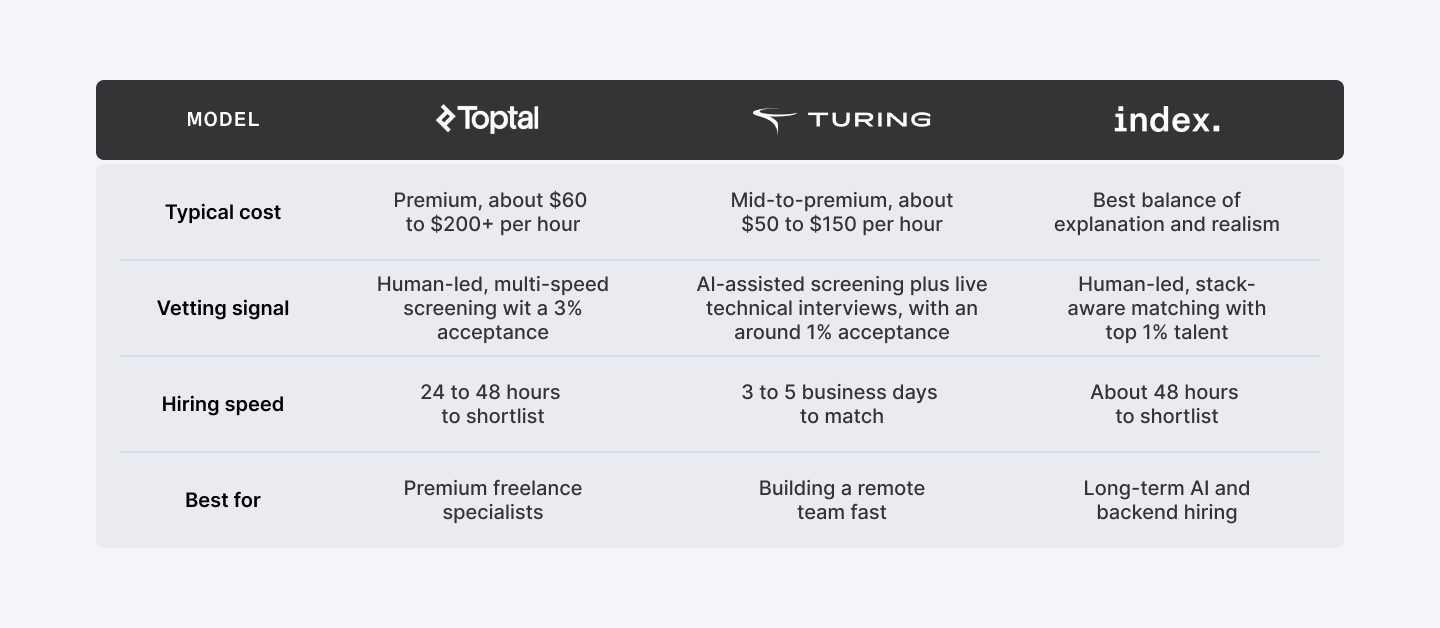
Comparison Table: Toptal vs Turing
How I Compared Toptal and Turing
I started where a buyer would probably start, on the platforms themselves, looking at Toptal’s developer and client pages, then Turing’s help center and hiring flow explanations.
From there I pulled recent 2026 comparisons that actually show numbers for a full Toptal vs Turing breakdown, rate comparisons, engineer focused view, and fee tables from other alternatives posts.
I have compared the platforms carefully, but this is not a full benchmark yet because the same brief has not been tested across all three in the same way.
Toptal: Best for Premium Specialist Freelancers

Toptal makes the most sense when you are hiring one very senior engineer, architect, or specialist freelancer and you want quality and hand holding more than you want speed or low rates.
Most reviews agree that fewer than 3% of developers get through Toptal’s vetting pipeline, which includes language checks, deep technical interviews, live coding, and a longer test project that feels closer to real work than many marketplaces offer.
The trade off is simple and not very subtle, you pay more and you probably wait longer than the slogan suggests, but you get a short curated list and an account manager who is paid to think about your requirements before throwing profiles at you.
Pros for buyers
- Very strong vetting depth and low acceptance rate for senior talent.
- White glove account management, especially on complex or multi role projects.
- Useful if you also need design, product, or finance roles from the same place.
Cons
- Rates tend to be 30-40% higher than Turing for similar seniority, and often higher than other vetted networks.
- The 500 USD deposit can feel heavy if you are only testing one shortlist, especially with additional subscription fees reported in some reviews.
- Matching often takes about two weeks from first call to someone starting, which can be slow if your roadmap is moving quickly.
Who should pick it
If your main problem is finding one excellent specialist that your team can plug into a messy legacy codebase, and budget is more of a concern than a constraint, starting with Toptal still makes sense.
Turing: Best for Fast Full Time Remote Hires

Turing is easier to justify when you are building a remote engineering team over months rather than hiring one consultant for a few weeks.
It leans heavily on AI assessments to process a very large global pool, then pairs that with live technical interviews, landing at an acceptance rate closer to 1% and a vetting window that usually finishes within 1 to 2 weeks.
The practical upside that shows up in reviews is faster matching and lower typical hourly rates, which matter if you are hiring three or four engineers with full time contracts that last half a year or longer.
Pros for buyers
- Matching promises of 3 to 5 business days are backed by their own help center and by real client examples.
- Pricing bands around 50 to 100 USD per hour feel more realistic for long term senior remote work than Toptal’s top premium bracket.
- Platform tooling around dashboards and performance tracking makes sense if you like data about your team.
Cons
- There is less concierge style help than Toptal, so you will feel the platform more than you feel a talent manager.
- Full time, ongoing engagements are clearly the focus, so it is not a great fit for tiny ad hoc tasks.
- Public rate clarity can be uneven because of the salary plus markup approach, and you sometimes need to get a quote before comparing clean numbers.
Who should pick it
If your pain is that you need a small remote team that hangs together for a year or more, and your budget has to cover that reality, Turing is usually the practical choice to pit against your internal hiring process.
Index.dev Is the One I’d Try When the Role Is More About Fit

If you need a long-term AI or backend hire and want help narrowing the field fast, start with Index.dev and see how the shortlist compares.
Index.dev belongs in this conversation even though it does not try to be a massive marketplace, because it helps buyers who want long term AI, backend, or data roles with more guidance on matching.
If you want three strong candidates who match your stack and roadmap instead of a flood of generic remote profiles, and you are fine with a partner that is more about long term engineering fit than instant gig volume, Index.dev is worth putting next to Toptal and Turing on your shortlist.
If you are still weighing Toptal vs Turing, it may be worth seeing what a more hands-on search looks like first. Start with Index.dev.
How to Choose Between Toptal and Turing
The cleanest way I found to make sense of these options was to stop asking which platform is best overall, and to start asking which hiring headache you are actually trying to fix this quarter.
If your headache is one very specialised problem that needs a short sharp fix, Toptal and similar premium networks are more defensible because you are paying for extreme vetting and account management.
If your headache is that you need three or more remote engineers who stick around for six months without blowing your budget, Turing and Index.dev are simply closer to the problem you have.
A rough guide
- If you want one top tier specialist and clients will judge you on pedigree, start with Toptal.
- If you want a remote team quickly and cost over a year matters, start with Turing.
- If you want a long term AI or backend engineer and prefer a partner who actively helps with matching, start with Index.dev.
Limitations and Precautions When Using Platform Claims
Every timeline and rate in the table earlier comes from platform pages and external reviews, not from a multi-platform test we ran with identical briefs and controlled conditions.
Different platforms also use words like match, shortlist, hire, and start in slightly different ways, which means a 48 hour match on one site can still leave you doing most of the work around interviews and onboarding yourself.
Before you commit, I would ask the same five questions on every sales call: What counts as a match? What happens if the hire drops out? Who owns contracts and compliance? When can the person actually start on your repo? What will the all in cost be beyond the headline hourly rate?
FAQs
Is Toptal or Turing cheaper in practice?
Most 2026 comparisons put Toptal’s typical senior rates around 60 to 200+ USD per hour, with averages near 120 USD, and Turing around 50 to 150 USD per hour with averages nearer 85 USD, so Turing tends to be cheaper at similar seniority.
Over a full year with several engineers, that 30-40% rate gap usually matters more than a one time deposit or trial, especially for startups.
Who has stricter vetting, Toptal or Turing?
Toptal reports accepting about 3% of applicants after multi week human vetting with interviews and test projects, while Turing accepts roughly 1% through a mix of AI assessments and live technical interviews, so both are strict in different ways.
The real difference is that Toptal leans on human review and test projects, while Turing leans on AI to process a much larger pool before humans step in.
How fast can I realistically hire on Toptal and Turing?
Turing’s own help center describes typical matching in 3-5 business days, while detailed Toptal walkthroughs and video reviews point to about 24-48 hours for a shortlist and around 2 weeks before a developer starts work.
Your internal interview speed still matters, so those numbers only hold if you respond to intros, schedule calls, and approve hires quickly.
Can I use both and then decide?
Both platforms offer trial periods, Toptal with a two week risk free trial and Turing with similar offer for early engagements, so you can absolutely run one small role through each and then commit to the one that fits your workflow better.
That is usually safer than betting your whole roadmap on claims from one comparison post.
Where does Index.dev fit next to Toptal and Turing?
Index.dev is a good third option to consider if you are hiring for long-term engineering roles. It is not trying to be everything for everyone, but for the right brief, it can be a very practical third option.
If you care about quality and fit on those roles more than glossy brand names, it is worth putting one brief through Index.dev as an option.
Bottom Line: Where Index.dev Fits
If your budget is large and your main worry is finding one elite specialist who can dig into a gnarly system, Toptal still earns its premium reputation.
If you are trying to staff a remote team quickly on a finite budget, Turing’s mix of AI vetting and lower typical rates will probably feel more practical.
If you are in the middle, with AI, backend, or data work that needs long term engineers and a more human matching process, Index.dev is the third option that makes sense to test, especially if you like having someone think through the brief with you instead of just sending profiles.
Key Takeaways for Buyers Comparing Toptal and Turing
- Toptal is the premium specialist choice, with deep human vetting and higher rates that fit short or high impact projects.
- Turing is built for fast full time remote hiring, with AI assisted matching and more budget friendly bands for long term teams.
- Index.dev is a useful third option when your work leans on AI and backend roles and you want hands on help with matching, not just a marketplace.
- All published timelines are direction, not hard guarantees, so a small real test with your own brief is the safest way to pick a platform.

