
AI agents are rapidly reshaping how work gets done. But many teams still lack clarity on how they're used and where they add value.
This listicle rounds up 50+ AI agent statistics from 2026, covering adoption trends, use cases, enterprise workflows, user behavior, tool stacks, and market growth.
Hire developers ready for the agentic future. Get matched in 48 hours with vetted talent from Index.dev!
Key AI Agents Statistics at a Glance
- Adoption is real and growing fast: 78% of organizations are already using AI in some form, and 85% have adopted agents in at least one workflow.
- The agent stack is layered and modular: It includes LLMs, frameworks, orchestration tools, developer platforms, and control systems.
- Usage is widespread across functions: From coding to content generation, scheduling to support, agents are enhancing productivity and efficiency.
- Human trust and oversight matter: Most users prefer a human-in-the-loop setup, especially when agents take high-stakes actions.
- The market is expanding rapidly: From $3.7B in 2023 to $7.38B in 2025 and over $100B by 2032, the economic potential is massive.
- Agent autonomy is increasing: Systems are moving from task execution to goal-driven behaviour with memory, reasoning, and retry capabilities.
- The future is stackable, composable, and agentic: Companies will increasingly build their own workflows using agents as core units.
What Is the AI Agent Stack?
The AI Agent Stack is a structured system of tools, platforms, and governance layers that work together to help teams complete tasks faster using autonomous or semi-autonomous software agents. These agents can write code, summarize content, build workflows, and interact with software or people, often with minimal human input.
This stack is not one product. It is made up of four main layers:
- Developer Layer: Tools that assist in coding, debugging, and deployment.
- Knowledge Worker Layer: Agents that help with writing, research, summarization, and reporting.
- Workflow Layer: Platforms that allow automation across apps and departments using agent-based actions.
- Control Layer: Systems that apply guardrails, human oversight, and access controls to ensure safe use.
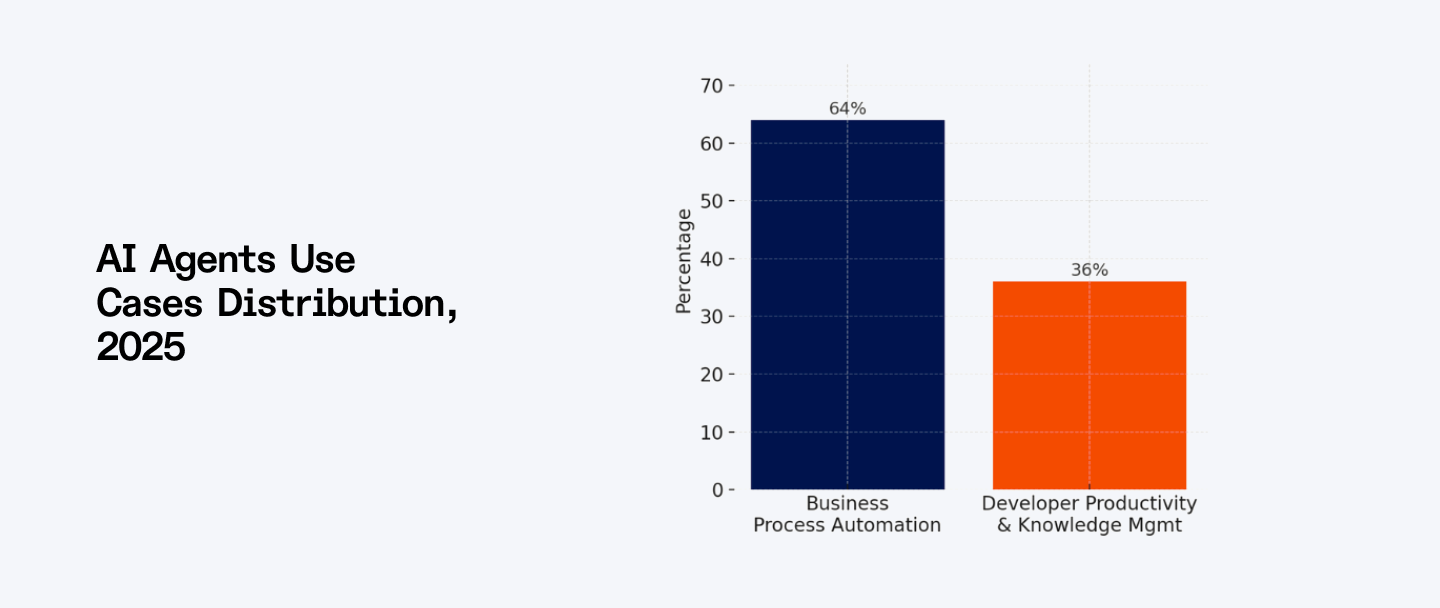
Each layer plays a specific role. For example, 64% of current AI agent use cases involve business process automation, while another large segment focuses on developer productivity and knowledge management.
These tools work together in real time. One agent may write code, another may run a test, and a third may log the result into a report. This is what makes the AI Agent Stack powerful — it enables connected work with minimal friction.
Organizations that adopt agent stacks do not rely on a single vendor. They use a combination of tools for different tasks. This approach is why 51% of companies use two or more methods to manage AI agents, including human approval, access controls, and monitoring.
In short, the AI Agent Stack is a practical way to integrate AI across teams, tools, and tasks, making work faster, more accurate, and more scalable.
The Developer Layer: Boosting Productivity and Code Quality
The developer layer of the AI Agent Stack includes tools that help engineers write, debug, test, and deploy code faster. These agents reduce manual tasks and improve accuracy, especially in repetitive or time-consuming areas like documentation, boilerplate generation, and bug detection.
This layer is widely adopted in engineering teams. For example:
- GitHub Copilot has over 15 million users worldwide, making it one of the most used AI coding tools.
- 230,000 organizations use Copilot for Business, which includes features like code suggestions, security scanning, and team policies.
- Coding speed can increase by 126% when using AI-powered developer tools, based on benchmark testing.
- A Cornell study found a 15% productivity gain among engineers using AI pair programming assistants.
- More than 55% of developers report efficiency improvements when using AI agents during build and test phases.
- 41% of engineers now use AI tools for documentation generation, reducing time spent on non-coding tasks.
These agents are typically integrated into the IDE or development environment. Some tools offer natural language interfaces, allowing developers to give instructions like “write a unit test for this function” or “refactor this block using async methods.”
Beyond writing code, AI agents are also being used for:
- Code reviews and bug detection during pull request cycles
- Testing automation using smart scripts or generated test cases
- Deployment optimization, especially in CI/CD pipelines
As AI tools become standard in engineering workflows, companies are also adjusting hiring requirements. Recruiters are now looking for developers who are comfortable working alongside AI tools and know how to prompt agents for better outputs.
This layer sets the foundation of the AI Agent Stack by improving build velocity, team output, and software quality, all critical to modern product development.
Explore 6 top AI tools for coding documentation.
The Knowledge Worker Layer: Enhancing Everyday Tasks
The knowledge worker layer includes AI agents that support non-technical users in performing common business tasks, like writing, summarizing, planning, reporting, and communication. These agents are often used in tools like word processors, email clients, spreadsheets, and CRMs.
This layer has seen strong adoption across roles such as marketing, HR, operations, and finance.
- 58% of organizations use AI agents for summarizing emails, documents, and meetings.
- 64% apply AI agents for automating repetitive business workflows, such as follow-ups, updates, and internal reports.
- 44% of consumers say they would prefer interacting with AI for simple service tasks, like bookings or tracking.
- 70% of airline bookings through digital channels are now influenced or executed by AI assistants, especially chat-based agents.
- 32% of Gen Z users are comfortable using AI to make online purchases or decisions.
- 27% of users review AI-generated output before taking action, showing a shift toward agent-assisted, not agent-led, decision-making.
Popular tools in this layer include:
- AI writing assistants that generate or rewrite emails
- Spreadsheet agents that help with data formulas and summaries
- CRM assistants that follow up with leads or schedule meetings
This layer makes AI available to wider business teams, even if they have no technical background. With simple prompts or clicks, users can offload time-consuming tasks to an agent, allowing them to focus on higher-priority work.
AI agents in this layer are now considered productivity defaults in many enterprise software platforms. Adoption is expected to grow as companies expand usage across departments.
The Workflow Layer: Automating Multi-Step Business Processes
The workflow layer of the AI Agent Stack connects tools and tasks across different departments. These agents can complete multi-step actions across platforms like updating CRMs, managing email lists, sending emails, generating reports, and scheduling events based on goals, triggers, or user inputs.
This layer is especially useful in operations, support, and admin-heavy functions where repeatable processes exist.
Key adoption insights:
- Workflow automation is the top use case in 64% of agent deployments, especially in customer support, HR, and sales ops.
- 35% of organizations using AI agents have reported cost savings through automation.
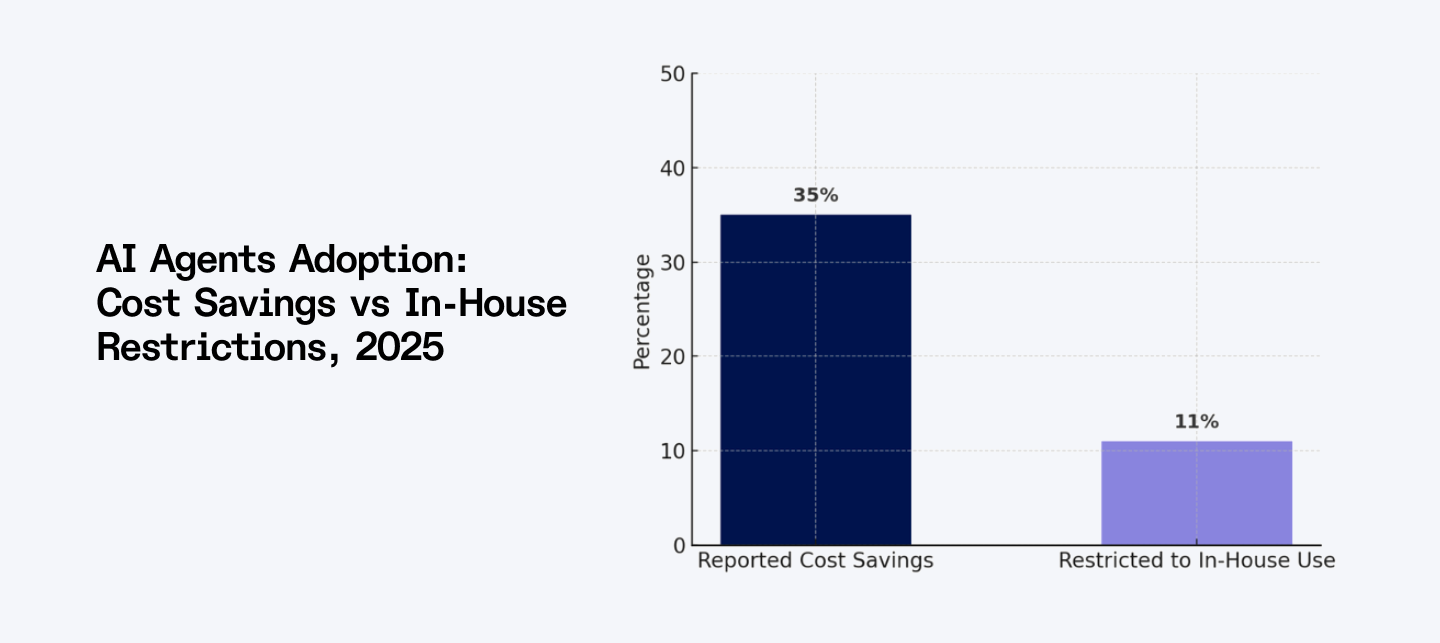
- 11% of companies restrict agent use to in-house systems only, due to data sensitivity concerns.
- 88% of executives said they are either exploring or scaling agent-led workflows inside their operations.
- 51% of companies use more than one method to control agent workflows, including role-based access, human review, and input/output validation.
- 29% of organizations require oversight or audit logs before agents can perform key actions in workflows.
Agents in this layer are often connected to platforms like:
- Zapier or Make (for logic-based task chains)
- Slack, MS Teams, or email (for agent-user interactions)
- HubSpot, Salesforce, or Monday.com (for CRM and workflow automation)
- AI SDRs like AgentFrank, Artisan, or Ai SDR (for automated outreach, lead qualification, and pipeline engagement)
They work by chaining tasks. For example, an agent could read a support ticket, summarize it, update the helpdesk status, notify a manager, and close the loop with a response, without human intervention.
This layer is driving efficiency and consistency in business operations. As more systems offer APIs and AI integrations, the workflow layer is becoming a core part of how companies scale without increasing headcount.
The Control Layer: Keeping AI Agents Use Safe and Accountable
The control layer is what makes the AI Agent Stack reliable at scale. It includes tools and policies that monitor, restrict, and validate agent behaviour. This layer ensures that agents work within set boundaries, especially when they handle sensitive data, perform critical tasks, or interact with customers.
As AI agents become more autonomous, companies are increasing their focus on safety, transparency, and compliance.
Key data from enterprise adoption trends:
- 31% of organizations do not allow AI agents to access sensitive or confidential data.
- 29% of companies require oversight mechanisms, such as human validation, logs, or approval workflows.
- 11% operate their agents in closed systems, only avoiding public APIs or third-party integrations.
- 71% of employees say they prefer that AI-generated content be reviewed by a human before use.
- 27% of all AI agent outputs are subject to manual review or sign-off before action.
The control layer often includes:
- Role-based access: Only certain users or teams can launch or edit agent workflows.
- Input/output filtering: Ensures agents don’t process or return unsafe or restricted content.
- Audit logs: Track what the agent did, when, and what data was involved.
- Trust levels: Different agents may have different permissions based on their reliability.
As AI tools integrate deeper into critical systems, this layer becomes essential, not just for safety, but also for meeting compliance standards across regions and industries.
The control layer doesn’t slow down automation; it makes it sustainable and trustworthy.
Enterprise Adoption Trends: How Companies Are Using AI Agents Today
AI agents are being adopted at scale across companies of all sizes. From automating basic workflows to assisting in core development tasks, these agents are becoming integral to how teams operate.
Here are the current enterprise-level adoption insights:
- 78% of global organizations already use some form of AI tools in daily operations.
- 85% of those organizations say they’ve started integrating AI agents, not just passive AI features, into their workflows.
- 88% of executives say they’re either piloting or scaling the use of autonomous agents.
- 46% of leaders say they fear falling behind if they don’t adopt AI agent technologies quickly.

- 48% of companies plan to increase hiring to support AI-led transformation, especially roles like AI operations managers and AI workflow analysts.
- 67% of decision-makers believe agent-led tools will change existing job roles significantly within the next 2–3 years.
- 87% agree that AI agents augment existing roles rather than replace them.
Adoption is not limited to large enterprises. Mid-sized firms and startups are also deploying AI agents to remain competitive.
- SMBs are increasingly early adopters, using lightweight agents to save time and reduce overhead.
- Agent-led tools are now embedded AI agents in customer support, HR tech, project management, and software engineering platforms.
The adoption trend shows that what was once experimental is now enterprise-ready. Agent systems are tracked, governed, and scaled like any core tool.
Companies that invest in agent systems today are doing so with long-term goals: faster execution, better output, and workforce support.
User Behaviour and Agent Interactions: How People Use and Respond to AI Agents
As agents become more autonomous, user trust, interaction patterns, and expectations are evolving, especially in consumer and workplace settings.
Understanding how users interact with AI agents helps companies design better tools and experiences. In both consumer and workplace settings, behaviours are shifting from passive use to active collaboration with agents.
Key behaviour patterns and preferences:
- 97% of users have interacted with AI voice assistants at least once.
- 75% of users say they rely on voice-based AI agents for daily tasks like setting reminders or checking schedules.
- 39% regularly use tools like Google Assistant, Siri, or Alexa for information lookup or home control.
- 44% of global users are open to using an AI assistant to manage their services, such as booking, support, or payment reminders.
- 32% of Gen Z users are comfortable letting AI agents make certain decisions, including recommendations and purchases.
- 71% of users prefer that AI agent responses be reviewed or approved by a human, especially in critical tasks.
- 27% of AI agent outputs are manually checked by users before final action.
When it comes to how users interact with agents:
- Many use simple natural language commands (e.g., “summarize this report” or “book a meeting next week”).
- In enterprise tools, agent prompts are built into UI elements, such as chat interfaces, sidebars, or action buttons.
- Voice and text-based interfaces are both common, with some users preferring multimodal interactions depending on context.
This shift reflects a growing comfort with agent-led workflows, but it also reinforces the need for transparency, feedback loops, and optional control, especially when agents make decisions or take actions.
Companies building AI-powered platforms should prioritize clarity and user oversight to improve agent adoption and trust.
Tools, Platforms, and Ecosystems: What Powers the AI Agent Stack
A wide range of tools, platforms, and ecosystems supports the AI Agent Stack. These are the systems developers and companies rely on to build, deploy, and manage AI agents at scale.
This layer includes IDE plugins, workflow platforms, LLMs, agent frameworks, orchestration layers, and security controls.
Key usage statistics and ecosystem data:
- GitHub Copilot has over 15 million users globally, with usage across individual developers and enterprise teams.
- Copilot Studio is now used by more than 230,000 organizations, showing rapid growth in enterprise-grade AI dev tools.
- 51% of enterprises use two or more methods to control or manage their AI agent tools, including APIs, dashboards, and human reviews.
- Zapier and Make are two of the most widely used no-code platforms for automating agent workflows.
- Leading orchestration frameworks like LangChain and AutoGen are being used to connect LLMs, APIs, tools, and memory.
- Open-source agent stacks are gaining traction, especially in developer-focused environments and startups.
- Big cloud providers like Microsoft, Google, and Amazon have integrated agent toolkits into their developer ecosystems.
Common layers in the AI Agent ecosystem:
- LLM & Model Providers: GPT-4o, Claude 3, Gemini 1.5, Mistral, etc.
- Agent Frameworks: LangChain, AutoGen, CrewAI, MetaGPT
- Developer Tools: GitHub Copilot, Cursor, Replit, Visual Studio with agent plugins
- Workflow Builders: Zapier, Make, n8n, Airtable with automation
- Monitoring & Security: Humanloop, Guardrails AI, PromptLayer
Together, these tools allow developers and enterprises to:
- Spin up task-specific agents quickly
- Integrate them into existing workflows
- Monitor outputs and control behaviour
- Scale usage across teams and departments
This ecosystem continues to evolve rapidly. New tools are focusing on multimodal inputs, long-term memory, real-time reasoning, and tighter enterprise controls, making the agent stack more powerful and safer to deploy.
Discover the top 5 AI coding agents of 2025.
Autonomy and Agentic Trends: Moving Toward Self-Directed Systems
AI agents are becoming more than task followers; they are turning into self-directed workers. This shift toward agentic systems means agents can take initiative, make decisions, and complete multi-step tasks without constant human input.
The trend is clear across both product design and enterprise strategies.
Key data points on autonomy:
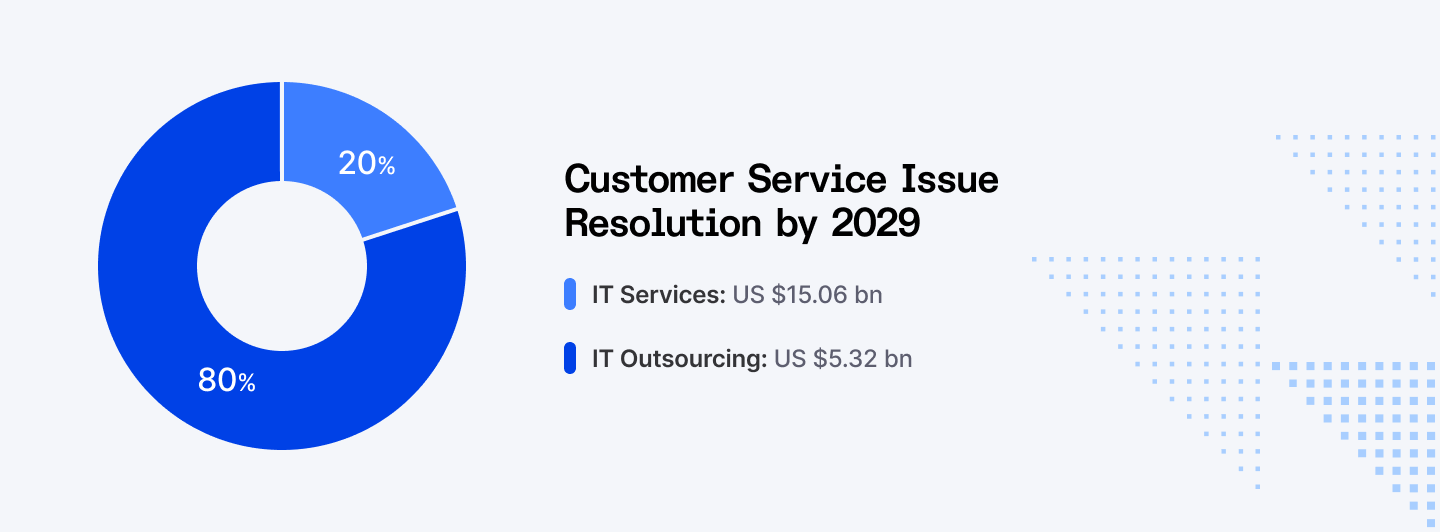
- By 2029, 80% of customer service issues are expected to be resolved entirely by autonomous agents without human intervention.
- One-third of enterprise software tools will include agentic capabilities by 2028, enabling systems to act based on goals, not just commands.
- Leading vendors are building agents that can handle long-term objectives, adjust to feedback, and replan when they fail.
- Autonomous agents are being used for tasks like outbound sales, code refactoring, product research, and workflow management.
Current capabilities include:
- Multi-step reasoning: Agents can break down a user request into smaller goals.
- Self-correction: If they fail a task, they try again or ask for help.
- Memory: They remember previous instructions or decisions to improve outcomes.
- Tool use: Agents know when and how to call APIs, databases, or functions to complete goals.
This shift to agentic behaviour demands:
- Better safety and control layers
- More transparent agent logs and reasoning trails
- Human override mechanisms when stakes are high
Agent autonomy will not replace humans, but it will extend their capacity for more strategic, high-value tasks.. The role of human workers will shift toward monitoring, strategy, and feedback, while agents take on execution.
Market Size and Future Forecast
The market for AI agents is growing fast. As adoption expands across industries and use cases, both global and segment-specific growth rates are rising.
This growth is not just about hype — it reflects real investment, enterprise usage, and product development across AI agent platforms.
Key market figures:
- The global AI agent market was valued at $3.7 billion in 2023.
- By the end of 2025, it is projected to reach $7.38 billion, nearly doubling in just two years.
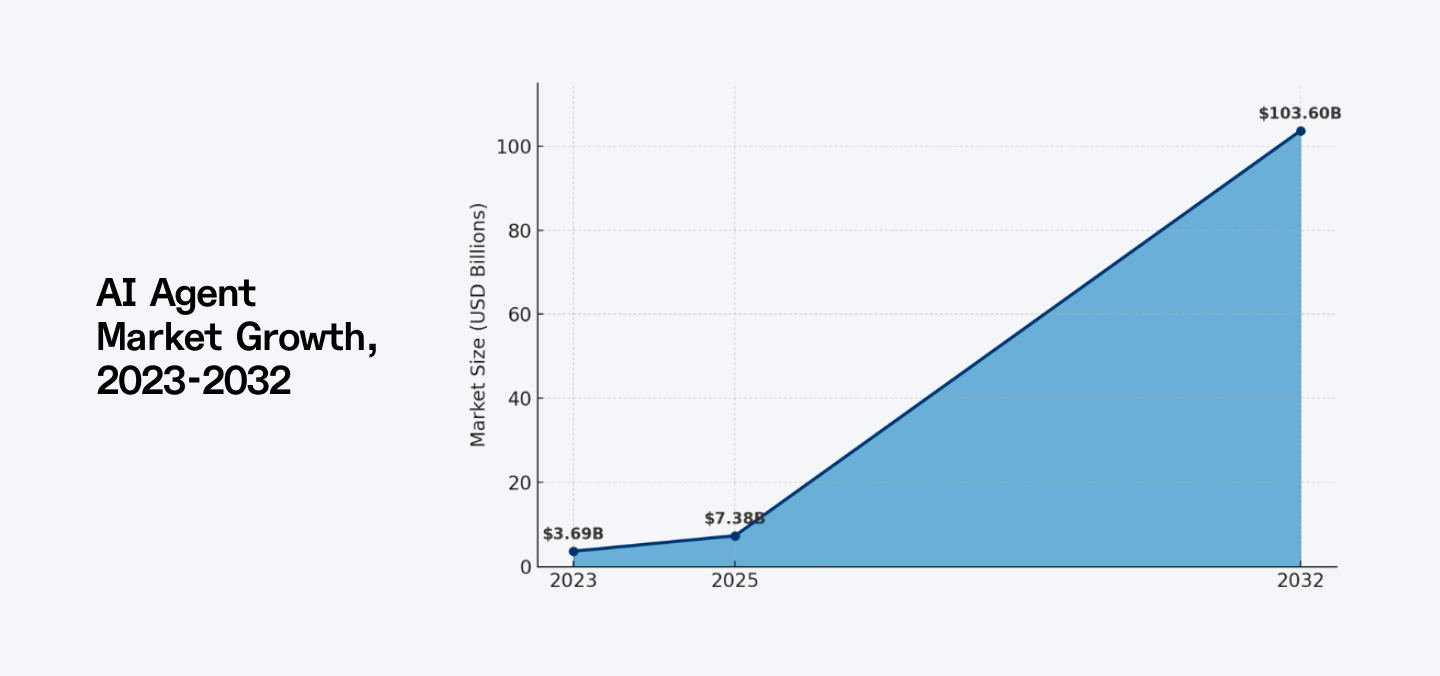
- Long-term projections show the market hitting $103.6 billion by 2032, driven by rapid enterprise adoption and new SaaS products.
- The compound annual growth rate (CAGR) from 2023 to 2032 is estimated at 45.3%.
What’s driving this AI Agent growth?
- Increased enterprise demand for AI-led automation, especially in development, customer service, and operations.
- The rise of AI-native startups, building platforms where agents are core features, not add-ons.
- New agent marketplaces offering plug-and-play solutions for specific domains — like finance, HR, legal, and marketing.
- Investment in agent infrastructure, including model training, orchestration layers, and control systems.
What to expect in the next 3–5 years
- More pre-trained agents embedded into SaaS tools.
- A shift toward agent marketplaces and APIs, letting companies compose their own workflows.
- Increased funding and M&A activity in the agent tooling ecosystem.
- Strong demand for talent with prompt engineering, agent design, and LLM integration skills.
As AI agents move from experimental tools to critical business infrastructure, the companies building, integrating, or hiring around this stack will define the next wave of digital transformation.
Final Words
AI agents play a central role in how businesses operate in 2025. They help teams generate code, automate content, and manage enterprise workflows with greater speed and accuracy.
Companies that adopt agent stacks with proper oversight and orchestration will stay ahead of the competition. Understanding how to build, use, and manage AI agents is now a key skill for teams across functions. As these systems become more advanced, they will continue to change how companies operate and grow.
Data sources
- plivo.com
- litslink.com
- masterofcode.com
- ventionteams.com
- reuters.com
- deloitte.com
- pragmaticcoders.com
- sybill.ai
- survey.stackoverflow.co
- blogs.microsoft.com
- gartner.com
- bcg.com
- mckinsey.com
- pwc.com
- langchain.com
- lyzr.ai
- snsinsider.com
- salesforce.com
- ibm.com
- engagedly.com
- prnewswire.com
- kpmg.com
- statista.com
- sellerscommerce.com
- bnnbloomberg.ca
- aiprm.com
- jll-mena.com
- cmswire.com
- zendesk.com
- arxiv.org
- amplyfi.com
FAQs
1. What is the current adoption rate of AI agents in 2025?
As of 2025, 85% of organizations have integrated AI agents in at least one workflow, showing rapid enterprise-level adoption beyond passive AI tools.
2. How big is the AI agent market in 2025?
The global AI agent market is valued at $7.38 billion in 2025, nearly doubling from $3.7 billion in 2023. It’s projected to grow to $103.6 billion by 2032.
3. Which is the most common use case for AI agents?
Business process automation leads adoption, with 64% of AI agent deployments focused on automating workflows across support, HR, sales ops, and admin tasks.
4. What’s the impact of AI agents on developer productivity?
AI coding tools like GitHub Copilot have led to productivity boosts of 15–126%, especially in coding, documentation, and testing.
5. How many users prefer human oversight in AI agent outputs?
About 71% of users prefer a human-in-the-loop setup, especially for high-stakes decisions, ensuring safety and accountability in AI-driven tasks.
6. What percentage of companies use multiple tools to manage AI agents?
51% of enterprises use two or more control methods, like access roles, monitoring, or human validation, to manage AI agent performance and safety.


