Every recruiter knows the drill: endless CVs, ticking clocks, and the nagging question—are we missing the perfect hire? Candidate shortlisting with AI ends that grind and puts smart automation at your side, surfacing the best matches in minutes, not weeks.
In this guide, you’ll learn exactly how candidate shortlisting with AI works, why it pays off, how you can start today and plug it into your process by tomorrow.
Skip lengthy CV screening with Index.dev's AI-powered candidate shortlisting that delivers pre-vetted talent in 48 hours.
Why You Can’t Afford Manual Screening Anymore
The pain points of traditional hiring run deeper than most leaders realise. You need speed, accuracy, fairness. And you need cost control.
Manual screening drags you down with:
- Time drain:
You spend 20-30 minutes per CV. At 200 CVs, that’s 80 hours gone.
- Hidden costs:
A bad hire costs you ~30% of their first-year salary.
- Bias risk:
Top talent lost to keyword filters since traditional filters weed out non-traditional talent.
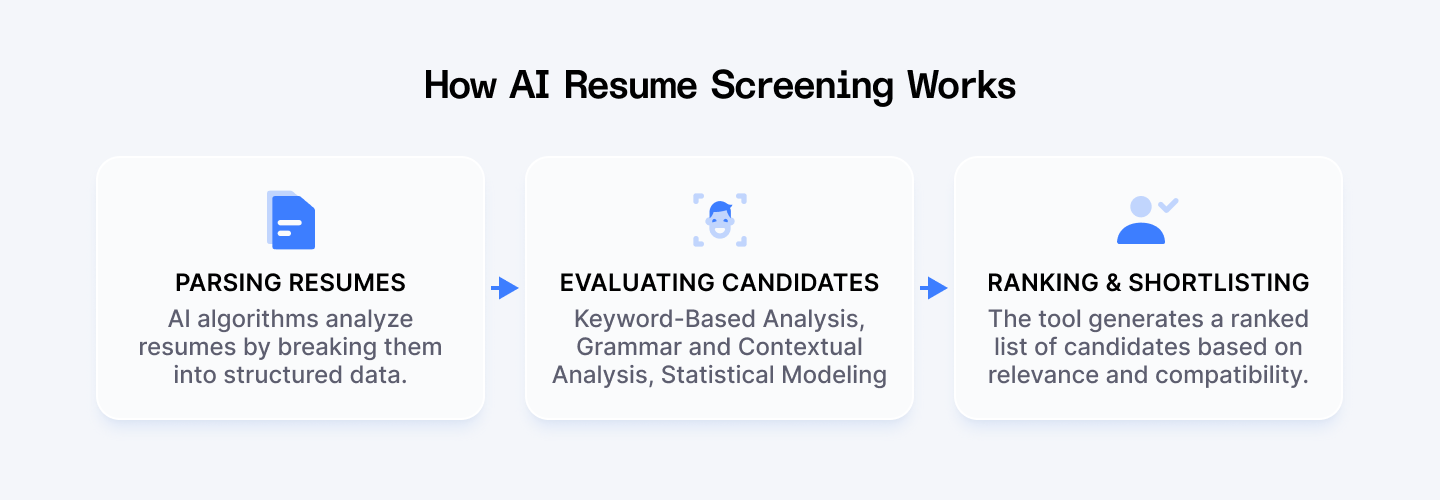
By contrast, candidate shortlisting with AI empowers you to:
- Screen 1000 CVs in minutes (vs. weeks)
- Boost match accuracy from ~65% → 97%
- Reduce time-to-hire by 75%
- Cut recruitment spend by 40%
- Improve diversity by 16%
We’ve watched teams burn out on screening. We’ve watched them slowly dissolve into resume chaos and impending hiring deadlines. Candidate shortlisting with AI fixes this by replacing grunt work with data-driven precision, so you focus on interviewing and culture fit.
That’s why more teams in tech, finance, and healthcare are turning to candidate shortlisting with AI: it’s fast, fair, and focused on results.
Platforms like Index.dev have pioneered a hybrid approach that combines AI precision with human expertise. Our process achieves an astonishing 97% candidate-match rate by applying machine-learning algorithms tuned to successful staffing trends, supplemented by human judgment for ultimate decision-making.
How Candidate Shortlisting with AI Works
To understand how AI shortlisting works, one needs to deconstruct the process into four key components that work together harmoniously.
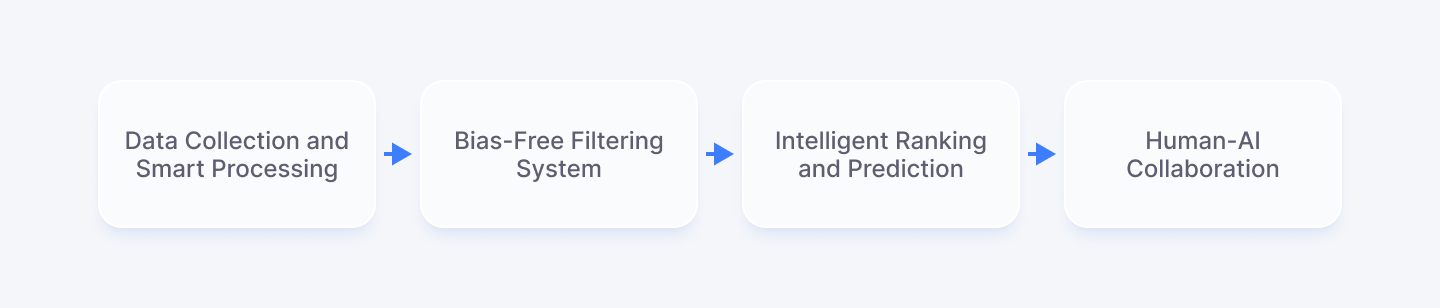
1. Smart Data Collection and Parsing
The AI software connects to your ATS, LinkedIn, GitHub, portfolios—whatever sources you use. Natural Language Processing tags skills, education, projects, code contributions; creating a digital fingerprint for each person that shows not just what they’ve done, but how they did it.
2. Bias-Free Screening
We anonymize names, gender markers, age, etc. thereby removing any unconscious bias. Then the audited algorithms rank purely on skills and success patterns, championing 16% uptick in diversity without manual effort. That's a candidate shortlisting with AI at its fairest.
3. Predictive Scoring & Ranking
Beyond keywords, AI screening systems add live coding tests and problem-solving challenges. This proves real ability instead of simple buzzwords while training the model on histrionic data based on top candidate profiles, technical skills, and cultural fit indicators.
4. Human-In-The-Loop
Your recruiters review AI’s top picks, armed with data-backed rationales. You receive a shortlist of 3-5 top matches, each with a “why they ranked here” snapshot. Your team interviews, not sifts.
This means:
- No more sifting through low-potential resumes
- More time for interviews & strategic tasks
What you get:
- 48-hour delivery of vetted candidates
- 97% match accuracy versus ~65% manually
- 16% boost in team diversity
- 75% cut in screening hours
Understanding the mechanics is one thing, seeing the true cost impact is another. Let’s quantify what manual vs. AI screening really means for your bottom line.
Discover 7 proven strategies to build a talent pipeline that helps you hire faster, cut hiring costs, and secure top talent.
Real Costs and Savings of Hiring Methods
Before you commit to another round of manual CV reviews, let’s look at the full financial and productivity impact, then see how AI flips the script.
The Hidden Costs of Manual Screening
When you screen manually, you trigger the ‘screening paradox’. The more applications you receive, the less time you will have to go through each one thoroughly. This rushed evaluation process leads to judgy, keyword-based decisions rather than genuine capability evaluation.
When you screen by hand:
- You speed-read your way to bias. Fewer minutes per CV means you lean on keywords, not real talent.
- You lose non-traditional talent. Self-taught developers, career-changers and unconventional profiles get cut early.
- You pay for every mistake. A single bad hire can cost up to 30% of that person’s first-year salary in training, lost productivity, and replacement.
Conversely, top-performing candidates with non-traditional backgrounds or non-linear career histories are weeded out as their resumes fail the traditional templated approach. Organisations are left with homogeneous groups while losing out on diverse talent that can spur innovation and growth.
The cost implications are staggering: churn, re-advertising roles, extra training, and management hours spent fixing avoidable issues. That’s why, even if your P&L looks tight today, you’re actually losing time, and money, with every manual review. Index.dev's data reveal that businesses employing conventional methods are estimated to waste about 60% more resources than they do with AI-aided methods.
Quantifying AI-Driven Savings
When you compare your old process with candidate shortlisting with AI, the benefits become impossible to ignore. Human screening processes are a time-consuming process and take weeks to sort through large volumes of applications while AI systems screen 1,000 applications within minutes.
Let’s put numbers to the pain. When you switch to candidate shortlisting with AI, here’s what happens:
Metric | Traditional Hiring | AI Shortlisting | Improvement |
| Time per CV | 20-30 minutes | 30 seconds | 95% faster |
| Weekly screening hours | 150 hours | 30 hours | 75% reduction |
| Time-to-hire | 3-6 weeks | 48 hours | 80% quicker |
| Candidate accuracy | 65% | 97% | 32% better |
| Retention rate | 65% | 95% | 30% higher |
| Cost per hire | $3.2K-$5.3K | $1.9K-$3.2K | Est. 40% saving |
By blending candidate shortlisting with AI into your workflow, you avoid the downstream expenses of bad hires: training loss, productivity dips, replacements. This cost savings is due to the elimination of labor-intensive manual checking and fewer unqualified applicants making it too costly interview rounds.
Maximizing Your ROI with Candidate Shortlisting with AI
You’ve seen the cost and time savings. Now let’s look at the strategic upside, how you actually roll this out, and how you prove it’s working.
Key Strategic Benefits
Advantages | How it Helps |
| Cut Bias, Boost Fairness |
|
| Breaks Pattern Matching |
|
| Unleashes Hidden Potential |
|
| Supports Career Switchers |
|
Those strategic gains look great on paper, but you need a clear playbook to turn them into reality.
Here’s how to plug candidate shortlisting with AI into your workflow.
Implementation Strategy for Success
Getting AI-powered shortlisting working in your team is simpler than you think. Here’s our five-step playbook:
- Start with Process Audit:
Map every step of your current hiring flow. Pinpoint high-volume or high-impact roles where AI can add the most value.
- Pick Your First Targets:
Start with roles that have clear benchmarks: software engineers, data scientists, and product managers. Defined skill sets mean smoother AI training considering their well-defined metrics and ample candidate pools.
- Select Compatible Tools:
Pick AI tools that coexist harmoniously with your current Applicant Tracking Systems and induce the least amount of workflow disruption.
- Ensure Bias Reduction:
Give highest priority to tools with an inbuilt bias audit feature. You’re not just automating—you’re elevating your diversity goals.
- Use Expert Partnering:
Bring in experienced teams (like Index.dev) who’ve done this dozens of times. We’ll shortcut your learning curve, accelerate deployment, reduce over 60 hours per hire and leverage proven methods and assistance.
Measuring Success and ROI
You’ll know candidate shortlisting with AI is winning when you see improvements, both in hard metrics and in how your team feels about hiring.
Keep an eye out for these numbers:
- Cost-per-Hire
- Time-to-Hire
- Match Accuracy & Retention
- Recruiter Satisfaction Scores
- Candidate Experience Feedback
- Diversity & Inclusion Metrics
Why Index.dev?
Seeing is believing. Here’s why we’re the partner you need:
- 12,000+ candidates screened monthly with 97% match accuracy.
- Up to 60% lower development costs and higher retention reported by clients.
- Start a risk-free, 30-day trial—get your first shortlist in 48 hours.
Set your baselines before you flip the switch on AI. Then check in at 30, 60, and 90 days. Tracking over time will enable the AI system to remain useful and identify areas for improvement.
At scale, AI-driven hiring could unlock $4.4 trillion in long-term productivity growth globally. As the AI “learns,” you’ll see those numbers climb and your team freed up to do the work they actually love: interviewing, engaging, and building culture.
Get an in-depth look at how Index.dev vets its high-performing tech talent.
Conclusion
Candidate shortlisting with AI is not a promise of the future, it's a benefit today.
You’ve seen how AI shortlisting moves hiring from grunt work to growth work. Now it’s your turn: start a 30-day risk-free trial with Index.dev, get your first shortlist in 48 hours.
Experience how AI transforms your hiring process from chaos into clarity. Don’t let another great candidate slip through the cracks.
Try it today and make every hire your best hire.